
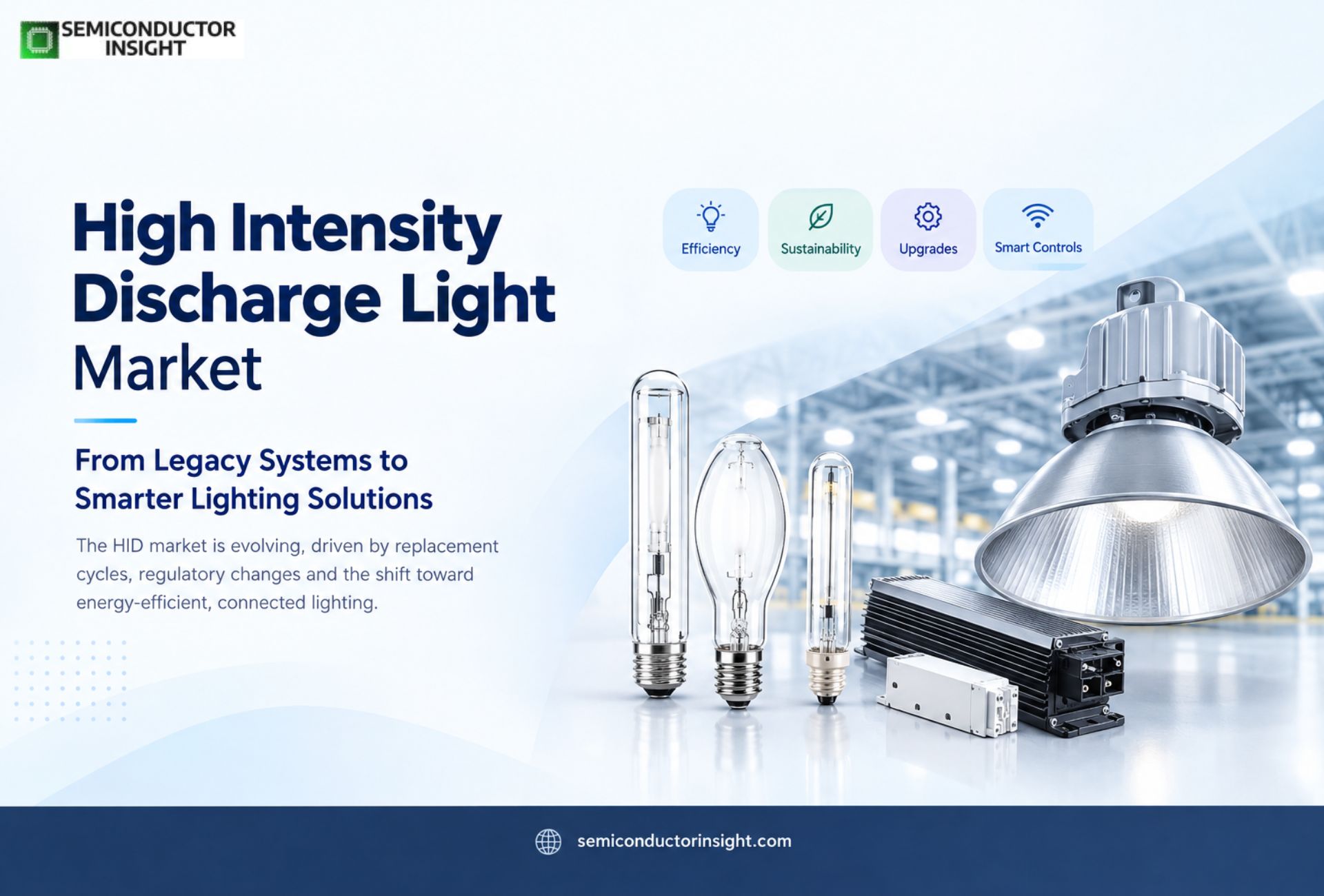
Why High Intensity Discharge Light Market Demand Still Matters in 2026?
High-intensity discharge lighting occupies an unusual position in today’s lighting industry. Metal halide, high-pressure sodium and mercury-vapor systems helped illuminate warehouses, stadiums, roadways, parking facilities and industrial sites for decades, yet LED technology has fundamentally changed the economics of commercial illumination.
– In 2026, High Intensity Discharge Light Market is therefore less about straightforward volume expansion and more about replacement cycles, specialized applications, retrofit compatibility and regulatory transition.
Why HID Technology Still Has a Place?
The U.S. Department of Energy defines an HID lamp as an electric-discharge lamp in which the light-producing arc is stabilized by the temperature of the arc-tube wall, with arc-tube loading above 3 W/cm². The category includes mercury-vapor, metal-halide and high-pressure-sodium lamps.
These technologies produce light through an electrical arc rather than the semiconductor-based light generation used by LEDs. That distinction matters because HID installations generally involve more than the lamp itself. Ballasts, igniters, reflectors, sockets and luminaires can all affect system performance and replacement decisions.
The Three Technologies Tell Three Different Stories
o Metal halide remains associated with applications where strong illumination and color rendering have historically been important.
o High-pressure sodium became widely established for roadway, security and outdoor lighting, while mercury-vapor systems represent an older generation of HID technology.
o The U.S. Environmental Protection Agency identifies metal halide, ceramic metal halide, high-pressure sodium and mercury vapor among HID lamp types that can contain mercury.
o This creates a distinctive market structure in which the installed base can remain relevant even as new lighting specifications increasingly favor alternative technologies.
A Technical Shift Is Happening Inside the Fixture
The transition can be understood through a simple equipment pathway:
Legacy HID luminaire → Lamp and ballast replacement → LED retrofit evaluation → Complete LED luminaire conversion → Controls and sensors → Connected lighting management
This shift is particularly significant in high-bay, warehouse, parking and outdoor applications where lighting operates for long periods. DOE federal purchasing guidance, for example, establishes minimum luminaire efficacy requirements for several exterior applications, including 136 lumens per watt for outdoor pole- or arm-mounted area and roadway luminaires.
Warm-Up Time Changes the Economics
· HID systems have an operational characteristic that differentiates them from many modern solid-state alternatives: starting and restriking take time.
· Historical EPA technical guidance documented typical HID warm-up periods of approximately 2–6 minutes and restrike periods of roughly 5–15 minutes, depending on the technology and operating condition.
· For facilities where lights are frequently switched because of occupancy controls or automation, this characteristic can influence retrofit decisions. In contrast, applications requiring continuous high-output illumination may evaluate HID systems differently.
Our most recent updated related study is available for free at this link: https://semiconductorinsight.com/report/high-intensity-discharge-hid-light-market/
Europe Is Tightening the Mercury Equation
Regulation is becoming one of the most visible forces shaping the HID landscape. The European Commission states that additional mercury-containing lamps are being prohibited from manufacture and export beginning in 2025 or 2026 depending on lamp type.
The EU RoHS framework also lists specific exemptions for mercury in metal-halide lamps and certain high-pressure sodium lamps, with several relevant exemptions scheduled to expire on 24 February 2027.
For manufacturers and distributors, these dates make product compliance, inventory planning and alternative-lamp development increasingly important.
Where HID Continues to Intersect With Industry
HID technology remains associated with environments requiring concentrated, high-output illumination. Metal halide systems have historically been used in warehouses, stadiums and industrial environments, while high-pressure sodium has been widely deployed for outdoor and roadway illumination. EPA documentation specifically identifies these applications and emphasizes factors such as efficacy, lamp life, lumen maintenance and light distribution when evaluating HID systems.
The modern purchasing decision is consequently becoming more technical. A facility may compare not simply lamp wattage, but total luminaire performance, controls compatibility, maintenance intervals, color quality, startup behavior and disposal requirements.
The Retrofit Market Is Becoming the Real Story
Rather than treating HID and LED as completely separate lighting categories, today’s market increasingly connects them through retrofit activity. Existing HID fixtures create an installed base that requires maintenance, replacement lamps and eventual modernization.
That produces a second lifecycle:
Installed HID base → Replacement demand → Efficiency assessment → Retrofit opportunity → LED conversion → Smart controls → Lower-maintenance lighting system
High Intensity Discharge Light Market in 2026 is therefore being shaped by both persistence and substitution. HID continues to serve established applications, while efficiency expectations, mercury-related regulation and digital lighting controls are steadily changing what facility owners expect from illumination systems.
For manufacturers and lighting-system suppliers, the opportunity increasingly lies in understanding where HID remains technically suitable, where retrofit products can extend existing infrastructure, and where complete conversion to solid-state lighting provides a more appropriate long-term solution.

Comments (0)