High Intensity Discharge (HID) Light Market, Global Business Strategies 2025-2032

High Intensity Discharge (HID) Light Market size was valued at USD 6008 million in 2024 to USD 7211 million by 2032, exhibiting a CAGR of 2.7% during the forecast period

PDF Icon Download Sample Report PDF
  • Quick Dispatch

    All Orders

  • Secure Payment

    100% Secure Payment

Price range: $1,500.00 through $4,250.00

Clear

MARKET INSIGHTS

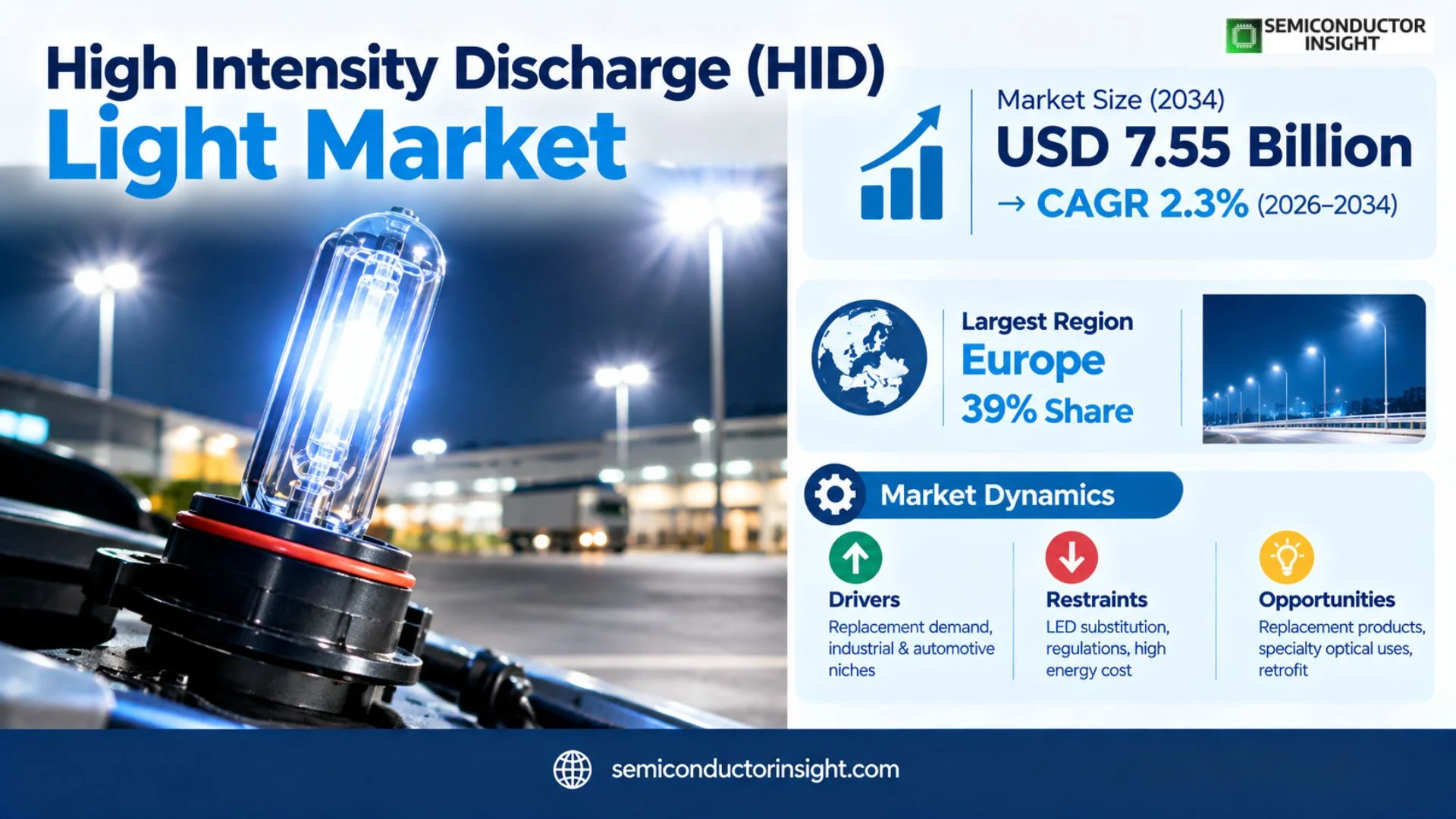
Global High Intensity Discharge (HID) Light Market size was valued at USD 6008 million in 2024 to USD 7211 million by 2032, exhibiting a CAGR of 2.7% during the forecast period.

High Intensity Discharge (HID) lights are a category of electrical gas-discharge lamps that produce light by creating an electric arc between two tungsten electrodes housed inside a translucent or transparent fused quartz or fused alumina arc tube. This tube is filled with both gas and metal salts, which facilitates the arc and generates an intensely bright light. Key types of HID lighting include Metal Halide, High-Pressure Sodium, and Xenon Arc lights.

The market is experiencing steady growth despite increasing competition from LED technology. This persistence is driven by factors such as the established infrastructure for HID systems, their high lumen output, and cost-effectiveness for large-scale applications like street lighting and industrial high-bay lighting. However, the market faces challenges from the superior energy efficiency and longer lifespan of LEDs. Europe currently represents the largest regional market with about 39% share, followed by the United States with approximately 28%. The key players operating in this market include Philips, Osram, and GE, with the top three companies occupying about 46% of the total market share.

High Intensity Discharge (HID) Light Market Trends- semiconductorinsight

MARKET DRIVERS

Superior Lighting Performance for Demanding Applications

High Intensity Discharge (HID) light market continues to be driven by the technology’s unparalleled performance in high-ceiling and industrial environments. HID lamps, including metal halide and high-pressure sodium variants, deliver exceptionally high luminous efficacy and superior color rendering compared to many alternatives. This makes them the preferred choice for applications requiring intense, wide-area illumination, such as stadiums, warehouses, and manufacturing facilities, where consistent and reliable light output is critical for safety and operational efficiency.

Established Infrastructure and Cost-Effectiveness

The extensive, long-standing global infrastructure for HID lighting systems represents a significant market driver. Many industrial and commercial facilities are already equipped with HID fixtures, creating a powerful installed base effect. The relatively low initial cost of HID lamps compared to installing entirely new LED-based systems provides a strong economic incentive for continued use and replacement in existing setups, particularly in cost-sensitive markets and for applications with long, unattended operating hours.

The ability of HID lights to operate effectively in extreme temperature conditions ensures their sustained demand in specialized sectors like outdoor lighting in harsh climates and heavy industrial settings.

Furthermore, ongoing technological refinements have led to improvements in lamp life and energy efficiency for certain HID types, helping to maintain their competitiveness in specific niches where their unique spectral properties and high-intensity output are difficult to replicate with other technologies at a comparable total cost of ownership.

MARKET CHALLENGES

Intense Competition from LED Technology

The most significant challenge facing the HID light market is the rapid and widespread adoption of Light Emitting Diode (LED) technology. LEDs offer superior energy efficiency, longer lifespans exceeding 50,000 hours, instant-on capability, and greater durability. This has led to a accelerated phase-out of HID lighting in many general lighting applications, as end-users prioritize long-term operational savings and lower maintenance costs. The performance gap continues to widen as LED technology advances.

Other Challenges

Environmental Regulations and Phase-Outs
Stringent global regulations, such as the RoHS (Restriction of Hazardous Substances) directive, impact certain HID lamp types due to their mercury content. This has led to bans or restrictions on the sale of some HID products in key regions, shrinking the addressable market and increasing compliance costs for manufacturers.

Inherent Technological Limitations
HID lamps suffer from well-known drawbacks including a slow warm-up and restrike time, sensitivity to power fluctuations, and lumen depreciation over time. These limitations make them unsuitable for applications requiring instant, frequent switching or consistent light output over the lamp’s life, further eroding their market position against more flexible solid-state lighting.

MARKET RESTRAINTS

Declining Demand in Traditional Strongholds

The market for HID lighting is experiencing a structural decline in its traditional core segments. The automotive industry, once a major consumer of HID xenon headlights, has largely transitioned to LED and laser-based systems for new vehicles. Similarly, the general retail and office lighting markets have almost completely abandoned HID in favor of LEDs due to the latter’s superior color quality and controllability. This erosion of key application areas acts as a primary restraint on market growth.

High Total Cost of Ownership in the Long Run

While HID lamps may have a lower initial purchase price, their higher energy consumption and shorter lifespan compared to LEDs result in a significantly higher total cost of ownership over time. As energy prices remain volatile and businesses increasingly focus on sustainability and operational expenditure reduction, the economic argument for investing in new HID installations has become increasingly difficult to justify, restraining new market growth.

MARKET OPPORTUNITIES

Niche Industrial and Horticultural Applications

Significant opportunities exist for HID lighting in specialized industrial processes and commercial horticulture. Certain industrial curing, drying, and material processing applications rely on the specific spectral output and high intensity of HID lamps. In horticulture, particularly for high-value crops, specific HID lamp types like High-Pressure Sodium are valued in controlled environment agriculture for their effectiveness in promoting plant growth during specific phases, creating a stable, high-value niche market.

Aftermarket and Replacement Segment

The vast installed base of HID lighting systems worldwide presents a substantial aftermarket opportunity. As existing lamps in stadiums, factory high bays, and street lights reach end-of-life, there remains a consistent demand for direct replacement HID lamps. This replacement cycle provides a steady revenue stream for manufacturers and distributors, especially in regions where the capital for a full system upgrade to LED is not readily available or justified.

Hybrid and Retrofit Solutions

Innovation in hybrid lighting systems and HID-to-LED retrofit kits offers a growth avenue. Some manufacturers are developing solutions that allow existing HID fixtures to be upgraded with LED engines while utilizing the original housing and electrical infrastructure. This approach can extend the market life of HID-related products by providing a cost-effective transition path for end-users, blending the established infrastructure with modern efficiency.
High Intensity Discharge (HID) Light Market Trends

Steady Market Growth Fueled by Automotive and Infrastructure Demand

Global High Intensity Discharge (HID) Light Market is on a trajectory of steady expansion, with its value projected to grow from USD 6008 million in 2024 to USD 7211 million by 2032, representing a compound annual growth rate (CAGR) of 2.7%. This growth is underpinned by HID lighting’s key advantages, which include the second highest efficacy and longest service life of any lighting technology. The market continues to benefit from sustained demand in its core applications, particularly in the automotive industry and for road and highway lighting, where intense, durable illumination is a critical requirement.

Other Trends

Market Leadership and Consolidation

The market is characterized by a consolidated competitive landscape, with the top three players—Philips, Osram, and GE—collectively accounting for approximately 46% of the global market share. This dominance by established industrial giants creates high barriers to entry and emphasizes the importance of technological innovation and global supply chain management. Other significant participants include Hella, Valeo, and Koito, which hold strong positions, particularly within the automotive lighting segment. This concentration suggests a mature market where scale and brand recognition are key competitive factors.

Type and Application Segmentation

Metal Halide, High-pressure Sodium, and Xenon Arc lights constitute the primary product segments. The application landscape is dominated by the automotive industry and road lighting. The consistent demand from these sectors is a primary driver of the market’s stability. While newer lighting technologies like LED present competition, HID lights maintain a significant market position due to their performance characteristics and established infrastructure, especially in large-scale outdoor and industrial lighting applications.

Distinct Regional Dynamics

Regionally, Europe stands as the largest market for HID lights, holding about 39% of the global share, closely followed by the United States with approximately 28%. This distribution reflects the advanced state of infrastructure and automotive manufacturing in these developed economies. The regional analysis indicates that future growth opportunities may increasingly be found in the developing economies of Asia and other regions, where infrastructure development is accelerating, potentially opening new avenues for market expansion beyond the traditional strongholds.

COMPETITIVE LANDSCAPE

Key Industry Players

A Market Characterized by the Dominance of Major Lighting Giants

Global High Intensity Discharge (HID) Light Market exhibits a semi-consolidated structure, with the top three players—Philips, Osram, and GE—collectively accounting for approximately 46% of the market share. This dominance underscores their extensive product portfolios, strong global distribution networks, and significant investment in research and development. These established leaders have a firm grip on key application segments such as automotive lighting, industrial lighting, and public road lighting. Their brand recognition and ability to deliver reliable, high-performance HID lighting solutions for demanding environments create a high barrier to entry for new competitors, reinforcing their market positions.

Beyond the leading triumvirate, the market landscape includes a number of significant niche and regional players that contribute to its dynamism. Companies like Hella and Valeo are particularly influential in the automotive HID lighting sector, while Koito is a major force in automotive OEM lighting. Other important participants, such as Acuity Brands and Hubbell, command strong positions in the North American commercial and industrial lighting markets. The Asia-Pacific region is served by prominent manufacturers like NVC Lighting, Opple, and FSL, which leverage cost-effective production and strong local distribution to compete effectively. These players often focus on specific geographic regions or specialized applications, carving out sustainable market segments.

List of Key High Intensity Discharge (HID) Light Companies Profiled

Segment Analysis:

Segment Category Sub-Segments Key Insights
By Type
  • Metal Halide Light
  • High-pressure Sodium Light
  • Xenon Arc Light
  • Others
Metal Halide Light is the dominant segment, prized for its superior color rendering index which delivers bright, white light ideal for applications requiring high visibility and accurate color perception, such as sports arenas, industrial facilities, and large retail spaces. While facing competition from LEDs, this segment maintains a strong position in specialized high-bay lighting environments. In contrast, High-pressure Sodium Lights offer excellent energy efficiency for their luminous output but are relegated to applications where color quality is less critical, such as street and roadway lighting. Xenon Arc Lights are distinguished by their extremely intense, focused beams, making them indispensable for specialized uses like high-end automotive headlamps and cinematic projection.
By Application
  • Automotive Industry
  • Road
  • Others
Road lighting constitutes the most significant application segment for HID technology, primarily due to the widespread global deployment of high-pressure sodium lamps for public street and highway illumination. This segment is driven by the need for reliable, long-lasting, and efficient lighting solutions for extensive public infrastructure. The growth in this area is sustained by replacement demand and infrastructure development in emerging economies. The Automotive Industry application, while still relevant for high-performance and luxury vehicle headlights, is undergoing a significant transition towards LED and laser technologies. The Others category, encompassing areas like industrial lighting, sports complexes, and horticulture, shows niche but steady demand, particularly for large-area illumination where HID’s high efficacy is a key advantage.
By End User
  • Government & Municipalities
  • Industrial & Commercial
  • Automotive OEMs & Aftermarket
Government & Municipalities represent the leading end-user segment, serving as the primary procurers for public infrastructure projects such as street and highway lighting systems. Their purchasing decisions are heavily influenced by long-term operational cost, durability, and lifecycle value, factors where HID lamps have historically performed well. Industrial & Commercial end users, including factories, warehouses, and large retail outlets, value the powerful illumination provided by HID systems for operational safety and productivity. While encroached upon by LEDs, HIDs remain competitive in certain high-ceiling applications. Automotive OEMs & Aftermarket users form a more specialized segment, with demand concentrated in specific vehicle models and replacement parts, though this segment is progressively being transformed by newer lighting technologies.
By Technology Maturity
  • Mature/Established
  • Niche/Specialized
  • Declining/Replacement
Mature/Established technology represents the largest portion of the HID market, characterized by widespread adoption, standardized manufacturing processes, and well-understood performance characteristics. This segment includes common applications like street lighting where the technology is proven and cost-effective. The Niche/Specialized segment focuses on applications requiring the unique properties of HID lights, such as high-intensity beams for film production or specialized UV lighting, where alternatives cannot easily match performance. The Declining/Replacement segment is defined by markets where HID is being actively phased out in favor of LED technology; however, it continues to generate significant revenue from the replacement of existing installed bases, particularly in public infrastructure where upgrading entire systems is a prolonged process.
By Sales Channel
  • Direct Sales/OEM
  • Distributors & Wholesalers
  • Retail/Aftermarket
Distributors & Wholesalers serve as the primary conduit for HID light sales, acting as critical intermediaries between large manufacturers and a fragmented base of end-users, including electrical contractors and municipal procurement offices. Their extensive networks and logistical capabilities are vital for reaching diverse geographical markets and managing inventory for replacement parts. The Direct Sales/OEM channel is crucial for high-volume contracts, such as supplying lighting systems directly to automotive manufacturers or securing large municipal tenders for street lighting projects. The Retail/Aftermarket channel, while smaller, is essential for servicing the replacement needs of individual consumers and small businesses, particularly for automotive HID bulbs and fixtures, ensuring continued revenue from the existing installed base of products.

Regional Analysis: High Intensity Discharge (HID) Light Market

Asia-Pacific

The Asia-Pacific region stands as the undisputed leader in the High Intensity Discharge (HID) Light Market, driven by a confluence of powerful economic and industrial forces. The core of this dominance lies in rapid industrialization across major economies like China and India, fueling immense demand for high-performance lighting solutions in manufacturing plants, warehouses, and large-scale commercial facilities. The widespread expansion and modernization of public infrastructure projects, including highways, airports, and urban transit systems, create a continuous demand for robust and efficient outdoor HID lighting. This is complemented by the region’s strong manufacturing base, which ensures competitive production costs and widespread availability of HID lamps and fixtures. While the shift towards LED technology is a global trend, the sheer scale of current industrial and infrastructural development in the Asia-Pacific region sustains a substantial and resilient market for HID technologies, particularly in applications requiring high lumen output and proven reliability in demanding environments.

Industrial Expansion
The ongoing massive industrial growth is the primary driver for HID lights. Factories, processing plants, and construction sites require powerful, durable lighting for high-ceiling applications and 24/7 operations, making metal halide and high-pressure sodium lamps a preferred, cost-effective choice in the region’s developing economies.
Infrastructure Development
Unprecedented investments in infrastructure, from new smart cities to extensive highway networks, sustain a strong market for HID lighting used in streetlights, stadiums, and airport runways. The technology’s ability to provide broad, high-intensity illumination makes it suitable for large-area lighting projects that are ubiquitous across the region.
Manufacturing and Supply Chain
The region’s dominance in manufacturing extends to the HID lighting components themselves. A well-established supply chain for materials like ceramics and metals used in arc tubes, coupled with lower production costs, ensures a steady and affordable supply of HID products for both domestic use and global export.
Market Dynamics
The market dynamics are characterized by high volume demand from price-sensitive segments. While LED adoption grows, the initial cost advantage and familiarity with HID technology in many industrial and municipal procurement processes continue to secure its position, particularly in cost-conscious markets within the region.

North America
The North American market for HID lighting is mature but remains significant, characterized by a focus on replacement and retrofit activities rather than new installations. The primary demand stems from the industrial and commercial sectors, where existing HID fixtures in warehouses, manufacturing facilities, and large retail spaces require ongoing maintenance and lamp replacements. There is a strong trend towards upgrading older HID systems to more efficient LED solutions, driven by energy-saving incentives and long-term cost considerations. However, niche applications where HID’s specific performance characteristics—such as very high light output and excellent color rendering in certain metal halide lamps for sports lighting or film production—are still vital. The market is therefore evolving, with a gradual decline in some segments balanced by sustained use in specialized, performance-critical applications.

Europe
Europe’s HID light market is heavily influenced by stringent energy efficiency regulations and environmental directives, which are accelerating the phase-out of less efficient lighting technologies. The market is primarily sustained by the industrial sector and specialized applications like horticultural lighting, where specific light spectra from HID lamps are valued for plant growth. There is a strong emphasis on retrofitting existing HID installations in factories and sports complexes with more modern controls and, where feasible, LED alternatives. The automotive sector also contributes to a niche market for HID xenon headlights, although this segment is also facing competition from advanced LED systems. Overall, the European market is characterized by a decline in traditional applications but maintains stability in specialized, high-performance niches that have not yet been fully supplanted by newer technologies.

South America
The HID lighting market in South America is driven by ongoing industrial development and urban infrastructure projects, though at a slower pace compared to Asia-Pacific. Countries like Brazil and Argentina see demand from mining operations, agricultural processing facilities, and public street lighting projects. The market is cost-sensitive, and the relatively lower upfront cost of HID systems compared to full LED retrofits makes them an attractive option for many projects. However, the market growth is tempered by economic volatility in some countries and an increasing awareness of energy efficiency. The region presents a mixed landscape, with new HID installations in developing areas coexisting with a gradual shift towards more efficient technologies in modernized urban centers.

Middle East & Africa
The HID light market in the Middle East & Africa region is bifurcated. In the oil-rich Gulf states, HID lighting is widely used in large-scale infrastructure, including ports, oil refineries, and sprawling commercial complexes, where its high output is necessary. In Africa, the market is driven by gradual infrastructure development and mining activities. The technology’s robustness and ability to operate in harsh environments are key advantages. However, the lack of widespread reliable electricity in many parts of Sub-Saharan Africa limits market penetration. Across the region, the high maintenance costs associated with HID lamps and the global trend towards LEDs are influencing new project decisions, but HID remains relevant in heavy industrial and outdoor applications where its performance characteristics are critical.

Report Scope

This market research report provides a comprehensive analysis of the High Intensity Discharge (HID) Light Market , covering the forecast period 2025–2032. It offers detailed insights into market dynamics, technological advancements, competitive landscape, and key trends shaping the industry.

Key focus areas of the report include:

  • Market Overview: The report begins with an overview outlining its current market scenario, key growth indicators, and industry transformation drivers. It discusses macroeconomic factors, demand–supply balance, regulatory landscape, and the strategic role of semiconductors in powering advancements across industries such as automotive, telecommunications, consumer electronics, and industrial automation.
  • Market Size & Forecast: Historical data and future projections for revenue, unit shipments, and market value across major regions and segments.
  • Segmentation Analysis: Detailed breakdown by product type, technology, application, and end-user industry to identify high-growth segments and investment opportunities.
  • Regional Insights: Insights into market performance across North America, Europe, Asia-Pacific, Latin America, and the Middle East & Africa, including country-level analysis where relevant.
  • Competitive Landscape: Profiles of leading market participants, including their product offerings, R&D focus, manufacturing capacity, pricing strategies, and recent developments such as mergers, acquisitions, and partnerships.
  • Technology Trends & Innovation: Assessment of emerging technologies, integration of AI/IoT, semiconductor design trends, fabrication techniques, and evolving industry standards.
  • Market Drivers & Restraints: Evaluation of factors driving market growth along with challenges, supply chain constraints, regulatory issues, and market-entry barriers.
  • Stakeholder Insights: Insights for component suppliers, OEMs, system integrators, investors, and policymakers regarding the evolving ecosystem and strategic opportunities.

Primary and secondary research methods are employed, including interviews with industry experts, data from verified sources, and real-time market intelligence to ensure the accuracy and reliability of the insights presented.

FREQUENTLY ASKED QUESTIONS:

What is the current market size of High Intensity Discharge (HID) Light Market?

-> High Intensity Discharge (HID) Light Market size was valued at USD 6008 million in 2024 to USD 7211 million by 2032, exhibiting a CAGR of 2.7% during the forecast period.

Which key companies operate in High Intensity Discharge (HID) Light Market?

-> Key players include Philips, Osram, GE, Hella, Valeo, Koito, Panasonic, Robertson, Hubbell, Acuity Brands, Eaton, NVC, FSL, PAK, Yankon, Cnlight, and Opple, among others. The top 3 companies occupied about 46% market share.

What are the key growth drivers?

-> Key growth drivers include the high efficacy and long service life of HID lighting, making it a preferred choice for applications demanding intense, reliable illumination.

Which region dominates the market?

-> Europe is the largest High Intensity Discharge (HID) Light Market with about 39% market share, followed by the US, which accounts for about 28%.

What are the emerging trends?

-> Emerging trends involve the application of HID lights across various sectors, primarily in the automotive industry and road lighting, as detailed in the market segmentation analysis by application.


High Intensity Discharge (HID) Light Market, Global Business Strategies 2025-2032

Get Sample Report PDF for Exclusive Insights

Report Sample Includes

  • Table of Contents
  • List of Tables & Figures
  • Charts, Research Methodology, and more...

PDF Icon Download Sample Report PDF

Download Sample Report

Table of Content

1 Introduction to Research & Analysis Reports
1.1 High Intensity Discharge (HID) Light Market Definition
1.2 Market Segments
1.2.1 Segment by Type
1.2.2 Segment by Application
1.3 Global High Intensity Discharge (HID) Light Market Overview
1.4 Features & Benefits of This Report
1.5 Methodology & Sources of Information
1.5.1 Research Methodology
1.5.2 Research Process
1.5.3 Base Year
1.5.4 Report Assumptions & Caveats
2 Global High Intensity Discharge (HID) Light Overall Market Size
2.1 Global High Intensity Discharge (HID) Light Market Size: 2024 VS 2032
2.2 Global High Intensity Discharge (HID) Light Market Size, Prospects & Forecasts: 2020-2032
2.3 Global High Intensity Discharge (HID) Light Sales: 2020-2032
3 Company Landscape
3.1 Top High Intensity Discharge (HID) Light Players in Global Market
3.2 Top Global High Intensity Discharge (HID) Light Companies Ranked by Revenue
3.3 Global High Intensity Discharge (HID) Light Revenue by Companies
3.4 Global High Intensity Discharge (HID) Light Sales by Companies
3.5 Global High Intensity Discharge (HID) Light Price by Manufacturer (2020-2025)
3.6 Top 3 and Top 5 High Intensity Discharge (HID) Light Companies in Global Market, by Revenue in 2024
3.7 Global Manufacturers High Intensity Discharge (HID) Light Product Type
3.8 Tier 1, Tier 2, and Tier 3 High Intensity Discharge (HID) Light Players in Global Market
3.8.1 List of Global Tier 1 High Intensity Discharge (HID) Light Companies
3.8.2 List of Global Tier 2 and Tier 3 High Intensity Discharge (HID) Light Companies
4 Sights by Product
4.1 Overview
4.1.1 Segment by Type – Global High Intensity Discharge (HID) Light Market Size Markets, 2024 & 2032
4.1.2 Metal Halide Light
4.1.3 High-pressure Sodium Light
4.1.4 Xenon Arc Light
4.1.5 Others
4.2 Segment by Type – Global High Intensity Discharge (HID) Light Revenue & Forecasts
4.2.1 Segment by Type – Global High Intensity Discharge (HID) Light Revenue, 2020-2025
4.2.2 Segment by Type – Global High Intensity Discharge (HID) Light Revenue, 2026-2032
4.2.3 Segment by Type – Global High Intensity Discharge (HID) Light Revenue Market Share, 2020-2032
4.3 Segment by Type – Global High Intensity Discharge (HID) Light Sales & Forecasts
4.3.1 Segment by Type – Global High Intensity Discharge (HID) Light Sales, 2020-2025
4.3.2 Segment by Type – Global High Intensity Discharge (HID) Light Sales, 2026-2032
4.3.3 Segment by Type – Global High Intensity Discharge (HID) Light Sales Market Share, 2020-2032
4.4 Segment by Type – Global High Intensity Discharge (HID) Light Price (Manufacturers Selling Prices), 2020-2032
5 Sights by Application
5.1 Overview
5.1.1 Segment by Application – Global High Intensity Discharge (HID) Light Market Size, 2024 & 2032
5.1.2 Automotive Industry
5.1.3 Road
5.1.4 Others
5.2 Segment by Application – Global High Intensity Discharge (HID) Light Revenue & Forecasts
5.2.1 Segment by Application – Global High Intensity Discharge (HID) Light Revenue, 2020-2025
5.2.2 Segment by Application – Global High Intensity Discharge (HID) Light Revenue, 2026-2032
5.2.3 Segment by Application – Global High Intensity Discharge (HID) Light Revenue Market Share, 2020-2032
5.3 Segment by Application – Global High Intensity Discharge (HID) Light Sales & Forecasts
5.3.1 Segment by Application – Global High Intensity Discharge (HID) Light Sales, 2020-2025
5.3.2 Segment by Application – Global High Intensity Discharge (HID) Light Sales, 2026-2032
5.3.3 Segment by Application – Global High Intensity Discharge (HID) Light Sales Market Share, 2020-2032
5.4 Segment by Application – Global High Intensity Discharge (HID) Light Price (Manufacturers Selling Prices), 2020-2032
6 Sights by Region
6.1 By Region – Global High Intensity Discharge (HID) Light Market Size, 2024 & 2032
6.2 By Region – Global High Intensity Discharge (HID) Light Revenue & Forecasts
6.2.1 By Region – Global High Intensity Discharge (HID) Light Revenue, 2020-2025
6.2.2 By Region – Global High Intensity Discharge (HID) Light Revenue, 2026-2032
6.2.3 By Region – Global High Intensity Discharge (HID) Light Revenue Market Share, 2020-2032
6.3 By Region – Global High Intensity Discharge (HID) Light Sales & Forecasts
6.3.1 By Region – Global High Intensity Discharge (HID) Light Sales, 2020-2025
6.3.2 By Region – Global High Intensity Discharge (HID) Light Sales, 2026-2032
6.3.3 By Region – Global High Intensity Discharge (HID) Light Sales Market Share, 2020-2032
6.4 North America
6.4.1 By Country – North America High Intensity Discharge (HID) Light Revenue, 2020-2032
6.4.2 By Country – North America High Intensity Discharge (HID) Light Sales, 2020-2032
6.4.3 United States High Intensity Discharge (HID) Light Market Size, 2020-2032
6.4.4 Canada High Intensity Discharge (HID) Light Market Size, 2020-2032
6.4.5 Mexico High Intensity Discharge (HID) Light Market Size, 2020-2032
6.5 Europe
6.5.1 By Country – Europe High Intensity Discharge (HID) Light Revenue, 2020-2032
6.5.2 By Country – Europe High Intensity Discharge (HID) Light Sales, 2020-2032
6.5.3 Germany High Intensity Discharge (HID) Light Market Size, 2020-2032
6.5.4 France High Intensity Discharge (HID) Light Market Size, 2020-2032
6.5.5 U.K. High Intensity Discharge (HID) Light Market Size, 2020-2032
6.5.6 Italy High Intensity Discharge (HID) Light Market Size, 2020-2032
6.5.7 Russia High Intensity Discharge (HID) Light Market Size, 2020-2032
6.5.8 Nordic Countries High Intensity Discharge (HID) Light Market Size, 2020-2032
6.5.9 Benelux High Intensity Discharge (HID) Light Market Size, 2020-2032
6.6 Asia
6.6.1 By Region – Asia High Intensity Discharge (HID) Light Revenue, 2020-2032
6.6.2 By Region – Asia High Intensity Discharge (HID) Light Sales, 2020-2032
6.6.3 China High Intensity Discharge (HID) Light Market Size, 2020-2032
6.6.4 Japan High Intensity Discharge (HID) Light Market Size, 2020-2032
6.6.5 South Korea High Intensity Discharge (HID) Light Market Size, 2020-2032
6.6.6 Southeast Asia High Intensity Discharge (HID) Light Market Size, 2020-2032
6.6.7 India High Intensity Discharge (HID) Light Market Size, 2020-2032
6.7 South America
6.7.1 By Country – South America High Intensity Discharge (HID) Light Revenue, 2020-2032
6.7.2 By Country – South America High Intensity Discharge (HID) Light Sales, 2020-2032
6.7.3 Brazil High Intensity Discharge (HID) Light Market Size, 2020-2032
6.7.4 Argentina High Intensity Discharge (HID) Light Market Size, 2020-2032
6.8 Middle East & Africa
6.8.1 By Country – Middle East & Africa High Intensity Discharge (HID) Light Revenue, 2020-2032
6.8.2 By Country – Middle East & Africa High Intensity Discharge (HID) Light Sales, 2020-2032
6.8.3 Turkey High Intensity Discharge (HID) Light Market Size, 2020-2032
6.8.4 Israel High Intensity Discharge (HID) Light Market Size, 2020-2032
6.8.5 Saudi Arabia High Intensity Discharge (HID) Light Market Size, 2020-2032
6.8.6 UAE High Intensity Discharge (HID) Light Market Size, 2020-2032
7 Manufacturers & Brands Profiles
7.1 Philips
7.1.1 Philips Company Summary
7.1.2 Philips Business Overview
7.1.3 Philips High Intensity Discharge (HID) Light Major Product Offerings
7.1.4 Philips High Intensity Discharge (HID) Light Sales and Revenue in Global (2020-2025)
7.1.5 Philips Key News & Latest Developments
7.2 Osram
7.2.1 Osram Company Summary
7.2.2 Osram Business Overview
7.2.3 Osram High Intensity Discharge (HID) Light Major Product Offerings
7.2.4 Osram High Intensity Discharge (HID) Light Sales and Revenue in Global (2020-2025)
7.2.5 Osram Key News & Latest Developments
7.3 GE
7.3.1 GE Company Summary
7.3.2 GE Business Overview
7.3.3 GE High Intensity Discharge (HID) Light Major Product Offerings
7.3.4 GE High Intensity Discharge (HID) Light Sales and Revenue in Global (2020-2025)
7.3.5 GE Key News & Latest Developments
7.4 Hella
7.4.1 Hella Company Summary
7.4.2 Hella Business Overview
7.4.3 Hella High Intensity Discharge (HID) Light Major Product Offerings
7.4.4 Hella High Intensity Discharge (HID) Light Sales and Revenue in Global (2020-2025)
7.4.5 Hella Key News & Latest Developments
7.5 Valeo
7.5.1 Valeo Company Summary
7.5.2 Valeo Business Overview
7.5.3 Valeo High Intensity Discharge (HID) Light Major Product Offerings
7.5.4 Valeo High Intensity Discharge (HID) Light Sales and Revenue in Global (2020-2025)
7.5.5 Valeo Key News & Latest Developments
7.6 Koito
7.6.1 Koito Company Summary
7.6.2 Koito Business Overview
7.6.3 Koito High Intensity Discharge (HID) Light Major Product Offerings
7.6.4 Koito High Intensity Discharge (HID) Light Sales and Revenue in Global (2020-2025)
7.6.5 Koito Key News & Latest Developments
7.7 Panasonic
7.7.1 Panasonic Company Summary
7.7.2 Panasonic Business Overview
7.7.3 Panasonic High Intensity Discharge (HID) Light Major Product Offerings
7.7.4 Panasonic High Intensity Discharge (HID) Light Sales and Revenue in Global (2020-2025)
7.7.5 Panasonic Key News & Latest Developments
7.8 Robertson
7.8.1 Robertson Company Summary
7.8.2 Robertson Business Overview
7.8.3 Robertson High Intensity Discharge (HID) Light Major Product Offerings
7.8.4 Robertson High Intensity Discharge (HID) Light Sales and Revenue in Global (2020-2025)
7.8.5 Robertson Key News & Latest Developments
7.9 Hubbell
7.9.1 Hubbell Company Summary
7.9.2 Hubbell Business Overview
7.9.3 Hubbell High Intensity Discharge (HID) Light Major Product Offerings
7.9.4 Hubbell High Intensity Discharge (HID) Light Sales and Revenue in Global (2020-2025)
7.9.5 Hubbell Key News & Latest Developments
7.10 Acuity Brands
7.10.1 Acuity Brands Company Summary
7.10.2 Acuity Brands Business Overview
7.10.3 Acuity Brands High Intensity Discharge (HID) Light Major Product Offerings
7.10.4 Acuity Brands High Intensity Discharge (HID) Light Sales and Revenue in Global (2020-2025)
7.10.5 Acuity Brands Key News & Latest Developments
7.11 Eaton
7.11.1 Eaton Company Summary
7.11.2 Eaton Business Overview
7.11.3 Eaton High Intensity Discharge (HID) Light Major Product Offerings
7.11.4 Eaton High Intensity Discharge (HID) Light Sales and Revenue in Global (2020-2025)
7.11.5 Eaton Key News & Latest Developments
7.12 NVC
7.12.1 NVC Company Summary
7.12.2 NVC Business Overview
7.12.3 NVC High Intensity Discharge (HID) Light Major Product Offerings
7.12.4 NVC High Intensity Discharge (HID) Light Sales and Revenue in Global (2020-2025)
7.12.5 NVC Key News & Latest Developments
7.13 FSL
7.13.1 FSL Company Summary
7.13.2 FSL Business Overview
7.13.3 FSL High Intensity Discharge (HID) Light Major Product Offerings
7.13.4 FSL High Intensity Discharge (HID) Light Sales and Revenue in Global (2020-2025)
7.13.5 FSL Key News & Latest Developments
7.14 PAK
7.14.1 PAK Company Summary
7.14.2 PAK Business Overview
7.14.3 PAK High Intensity Discharge (HID) Light Major Product Offerings
7.14.4 PAK High Intensity Discharge (HID) Light Sales and Revenue in Global (2020-2025)
7.14.5 PAK Key News & Latest Developments
7.15 Yankon
7.15.1 Yankon Company Summary
7.15.2 Yankon Business Overview
7.15.3 Yankon High Intensity Discharge (HID) Light Major Product Offerings
7.15.4 Yankon High Intensity Discharge (HID) Light Sales and Revenue in Global (2020-2025)
7.15.5 Yankon Key News & Latest Developments
7.16 Cnlight
7.16.1 Cnlight Company Summary
7.16.2 Cnlight Business Overview
7.16.3 Cnlight High Intensity Discharge (HID) Light Major Product Offerings
7.16.4 Cnlight High Intensity Discharge (HID) Light Sales and Revenue in Global (2020-2025)
7.16.5 Cnlight Key News & Latest Developments
7.17 Opple
7.17.1 Opple Company Summary
7.17.2 Opple Business Overview
7.17.3 Opple High Intensity Discharge (HID) Light Major Product Offerings
7.17.4 Opple High Intensity Discharge (HID) Light Sales and Revenue in Global (2020-2025)
7.17.5 Opple Key News & Latest Developments
8 Global High Intensity Discharge (HID) Light Production Capacity, Analysis
8.1 Global High Intensity Discharge (HID) Light Production Capacity, 2020-2032
8.2 High Intensity Discharge (HID) Light Production Capacity of Key Manufacturers in Global Market
8.3 Global High Intensity Discharge (HID) Light Production by Region
9 Key Market Trends, Opportunity, Drivers and Restraints
9.1 Market Opportunities & Trends
9.2 Market Drivers
9.3 Market Restraints
10 High Intensity Discharge (HID) Light Supply Chain Analysis
10.1 High Intensity Discharge (HID) Light Industry Value Chain
10.2 High Intensity Discharge (HID) Light Upstream Market
10.3 High Intensity Discharge (HID) Light Downstream and Clients
10.4 Marketing Channels Analysis
10.4.1 Marketing Channels
10.4.2 High Intensity Discharge (HID) Light Distributors and Sales Agents in Global
11 Conclusion
12 Appendix
12.1 Note
12.2 Examples of Clients
12.3 DisclaimerList of Tables
Table 1. Key Players of High Intensity Discharge (HID) Light in Global Market
Table 2. Top High Intensity Discharge (HID) Light Players in Global Market, Ranking by Revenue (2024)
Table 3. Global High Intensity Discharge (HID) Light Revenue by Companies, (US$, Mn), 2020-2025
Table 4. Global High Intensity Discharge (HID) Light Revenue Share by Companies, 2020-2025
Table 5. Global High Intensity Discharge (HID) Light Sales by Companies, (K Units), 2020-2025
Table 6. Global High Intensity Discharge (HID) Light Sales Share by Companies, 2020-2025
Table 7. Key Manufacturers High Intensity Discharge (HID) Light Price (2020-2025) & (USD/Unit)
Table 8. Global Manufacturers High Intensity Discharge (HID) Light Product Type
Table 9. List of Global Tier 1 High Intensity Discharge (HID) Light Companies, Revenue (US$, Mn) in 2024 and Market Share
Table 10. List of Global Tier 2 and Tier 3 High Intensity Discharge (HID) Light Companies, Revenue (US$, Mn) in 2024 and Market Share
Table 11. Segment by Type – Global High Intensity Discharge (HID) Light Revenue, (US$, Mn), 2024 & 2032
Table 12. Segment by Type – Global High Intensity Discharge (HID) Light Revenue (US$, Mn), 2020-2025
Table 13. Segment by Type – Global High Intensity Discharge (HID) Light Revenue (US$, Mn), 2026-2032
Table 14. Segment by Type – Global High Intensity Discharge (HID) Light Sales (K Units), 2020-2025
Table 15. Segment by Type – Global High Intensity Discharge (HID) Light Sales (K Units), 2026-2032
Table 16. Segment by Application – Global High Intensity Discharge (HID) Light Revenue, (US$, Mn), 2024 & 2032
Table 17. Segment by Application – Global High Intensity Discharge (HID) Light Revenue, (US$, Mn), 2020-2025
Table 18. Segment by Application – Global High Intensity Discharge (HID) Light Revenue, (US$, Mn), 2026-2032
Table 19. Segment by Application – Global High Intensity Discharge (HID) Light Sales, (K Units), 2020-2025
Table 20. Segment by Application – Global High Intensity Discharge (HID) Light Sales, (K Units), 2026-2032
Table 21. By Region – Global High Intensity Discharge (HID) Light Revenue, (US$, Mn), 2025-2032
Table 22. By Region – Global High Intensity Discharge (HID) Light Revenue, (US$, Mn), 2020-2025
Table 23. By Region – Global High Intensity Discharge (HID) Light Revenue, (US$, Mn), 2026-2032
Table 24. By Region – Global High Intensity Discharge (HID) Light Sales, (K Units), 2020-2025
Table 25. By Region – Global High Intensity Discharge (HID) Light Sales, (K Units), 2026-2032
Table 26. By Country – North America High Intensity Discharge (HID) Light Revenue, (US$, Mn), 2020-2025
Table 27. By Country – North America High Intensity Discharge (HID) Light Revenue, (US$, Mn), 2026-2032
Table 28. By Country – North America High Intensity Discharge (HID) Light Sales, (K Units), 2020-2025
Table 29. By Country – North America High Intensity Discharge (HID) Light Sales, (K Units), 2026-2032
Table 30. By Country – Europe High Intensity Discharge (HID) Light Revenue, (US$, Mn), 2020-2025
Table 31. By Country – Europe High Intensity Discharge (HID) Light Revenue, (US$, Mn), 2026-2032
Table 32. By Country – Europe High Intensity Discharge (HID) Light Sales, (K Units), 2020-2025
Table 33. By Country – Europe High Intensity Discharge (HID) Light Sales, (K Units), 2026-2032
Table 34. By Region – Asia High Intensity Discharge (HID) Light Revenue, (US$, Mn), 2020-2025
Table 35. By Region – Asia High Intensity Discharge (HID) Light Revenue, (US$, Mn), 2026-2032
Table 36. By Region – Asia High Intensity Discharge (HID) Light Sales, (K Units), 2020-2025
Table 37. By Region – Asia High Intensity Discharge (HID) Light Sales, (K Units), 2026-2032
Table 38. By Country – South America High Intensity Discharge (HID) Light Revenue, (US$, Mn), 2020-2025
Table 39. By Country – South America High Intensity Discharge (HID) Light Revenue, (US$, Mn), 2026-2032
Table 40. By Country – South America High Intensity Discharge (HID) Light Sales, (K Units), 2020-2025
Table 41. By Country – South America High Intensity Discharge (HID) Light Sales, (K Units), 2026-2032
Table 42. By Country – Middle East & Africa High Intensity Discharge (HID) Light Revenue, (US$, Mn), 2020-2025
Table 43. By Country – Middle East & Africa High Intensity Discharge (HID) Light Revenue, (US$, Mn), 2026-2032
Table 44. By Country – Middle East & Africa High Intensity Discharge (HID) Light Sales, (K Units), 2020-2025
Table 45. By Country – Middle East & Africa High Intensity Discharge (HID) Light Sales, (K Units), 2026-2032
Table 46. Philips Company Summary
Table 47. Philips High Intensity Discharge (HID) Light Product Offerings
Table 48. Philips High Intensity Discharge (HID) Light Sales (K Units), Revenue (US$, Mn) and Average Price (USD/Unit) & (2020-2025)
Table 49. Philips Key News & Latest Developments
Table 50. Osram Company Summary
Table 51. Osram High Intensity Discharge (HID) Light Product Offerings
Table 52. Osram High Intensity Discharge (HID) Light Sales (K Units), Revenue (US$, Mn) and Average Price (USD/Unit) & (2020-2025)
Table 53. Osram Key News & Latest Developments
Table 54. GE Company Summary
Table 55. GE High Intensity Discharge (HID) Light Product Offerings
Table 56. GE High Intensity Discharge (HID) Light Sales (K Units), Revenue (US$, Mn) and Average Price (USD/Unit) & (2020-2025)
Table 57. GE Key News & Latest Developments
Table 58. Hella Company Summary
Table 59. Hella High Intensity Discharge (HID) Light Product Offerings
Table 60. Hella High Intensity Discharge (HID) Light Sales (K Units), Revenue (US$, Mn) and Average Price (USD/Unit) & (2020-2025)
Table 61. Hella Key News & Latest Developments
Table 62. Valeo Company Summary
Table 63. Valeo High Intensity Discharge (HID) Light Product Offerings
Table 64. Valeo High Intensity Discharge (HID) Light Sales (K Units), Revenue (US$, Mn) and Average Price (USD/Unit) & (2020-2025)
Table 65. Valeo Key News & Latest Developments
Table 66. Koito Company Summary
Table 67. Koito High Intensity Discharge (HID) Light Product Offerings
Table 68. Koito High Intensity Discharge (HID) Light Sales (K Units), Revenue (US$, Mn) and Average Price (USD/Unit) & (2020-2025)
Table 69. Koito Key News & Latest Developments
Table 70. Panasonic Company Summary
Table 71. Panasonic High Intensity Discharge (HID) Light Product Offerings
Table 72. Panasonic High Intensity Discharge (HID) Light Sales (K Units), Revenue (US$, Mn) and Average Price (USD/Unit) & (2020-2025)
Table 73. Panasonic Key News & Latest Developments
Table 74. Robertson Company Summary
Table 75. Robertson High Intensity Discharge (HID) Light Product Offerings
Table 76. Robertson High Intensity Discharge (HID) Light Sales (K Units), Revenue (US$, Mn) and Average Price (USD/Unit) & (2020-2025)
Table 77. Robertson Key News & Latest Developments
Table 78. Hubbell Company Summary
Table 79. Hubbell High Intensity Discharge (HID) Light Product Offerings
Table 80. Hubbell High Intensity Discharge (HID) Light Sales (K Units), Revenue (US$, Mn) and Average Price (USD/Unit) & (2020-2025)
Table 81. Hubbell Key News & Latest Developments
Table 82. Acuity Brands Company Summary
Table 83. Acuity Brands High Intensity Discharge (HID) Light Product Offerings
Table 84. Acuity Brands High Intensity Discharge (HID) Light Sales (K Units), Revenue (US$, Mn) and Average Price (USD/Unit) & (2020-2025)
Table 85. Acuity Brands Key News & Latest Developments
Table 86. Eaton Company Summary
Table 87. Eaton High Intensity Discharge (HID) Light Product Offerings
Table 88. Eaton High Intensity Discharge (HID) Light Sales (K Units), Revenue (US$, Mn) and Average Price (USD/Unit) & (2020-2025)
Table 89. Eaton Key News & Latest Developments
Table 90. NVC Company Summary
Table 91. NVC High Intensity Discharge (HID) Light Product Offerings
Table 92. NVC High Intensity Discharge (HID) Light Sales (K Units), Revenue (US$, Mn) and Average Price (USD/Unit) & (2020-2025)
Table 93. NVC Key News & Latest Developments
Table 94. FSL Company Summary
Table 95. FSL High Intensity Discharge (HID) Light Product Offerings
Table 96. FSL High Intensity Discharge (HID) Light Sales (K Units), Revenue (US$, Mn) and Average Price (USD/Unit) & (2020-2025)
Table 97. FSL Key News & Latest Developments
Table 98. PAK Company Summary
Table 99. PAK High Intensity Discharge (HID) Light Product Offerings
Table 100. PAK High Intensity Discharge (HID) Light Sales (K Units), Revenue (US$, Mn) and Average Price (USD/Unit) & (2020-2025)
Table 101. PAK Key News & Latest Developments
Table 102. Yankon Company Summary
Table 103. Yankon High Intensity Discharge (HID) Light Product Offerings
Table 104. Yankon High Intensity Discharge (HID) Light Sales (K Units), Revenue (US$, Mn) and Average Price (USD/Unit) & (2020-2025)
Table 105. Yankon Key News & Latest Developments
Table 106. Cnlight Company Summary
Table 107. Cnlight High Intensity Discharge (HID) Light Product Offerings
Table 108. Cnlight High Intensity Discharge (HID) Light Sales (K Units), Revenue (US$, Mn) and Average Price (USD/Unit) & (2020-2025)
Table 109. Cnlight Key News & Latest Developments
Table 110. Opple Company Summary
Table 111. Opple High Intensity Discharge (HID) Light Product Offerings
Table 112. Opple High Intensity Discharge (HID) Light Sales (K Units), Revenue (US$, Mn) and Average Price (USD/Unit) & (2020-2025)
Table 113. Opple Key News & Latest Developments
Table 114. High Intensity Discharge (HID) Light Capacity of Key Manufacturers in Global Market, 2023-2025 (K Units)
Table 115. Global High Intensity Discharge (HID) Light Capacity Market Share of Key Manufacturers, 2023-2025
Table 116. Global High Intensity Discharge (HID) Light Production by Region, 2020-2025 (K Units)
Table 117. Global High Intensity Discharge (HID) Light Production by Region, 2026-2032 (K Units)
Table 118. High Intensity Discharge (HID) Light Market Opportunities & Trends in Global Market
Table 119. High Intensity Discharge (HID) Light Market Drivers in Global Market
Table 120. High Intensity Discharge (HID) Light Market Restraints in Global Market
Table 121. High Intensity Discharge (HID) Light Raw Materials
Table 122. High Intensity Discharge (HID) Light Raw Materials Suppliers in Global Market
Table 123. Typical High Intensity Discharge (HID) Light Downstream
Table 124. High Intensity Discharge (HID) Light Downstream Clients in Global Market
Table 125. High Intensity Discharge (HID) Light Distributors and Sales Agents in Global Market

List of Figures
Figure 1. High Intensity Discharge (HID) Light Product Picture
Figure 2. High Intensity Discharge (HID) Light Segment by Type in 2024
Figure 3. High Intensity Discharge (HID) Light Segment by Application in 2024
Figure 4. Global High Intensity Discharge (HID) Light Market Overview: 2024
Figure 5. Key Caveats
Figure 6. Global High Intensity Discharge (HID) Light Market Size: 2024 VS 2032 (US$, Mn)
Figure 7. Global High Intensity Discharge (HID) Light Revenue: 2020-2032 (US$, Mn)
Figure 8. High Intensity Discharge (HID) Light Sales in Global Market: 2020-2032 (K Units)
Figure 9. The Top 3 and 5 Players Market Share by High Intensity Discharge (HID) Light Revenue in 2024
Figure 10. Segment by Type – Global High Intensity Discharge (HID) Light Revenue, (US$, Mn), 2024 & 2032
Figure 11. Segment by Type – Global High Intensity Discharge (HID) Light Revenue Market Share, 2020-2032
Figure 12. Segment by Type – Global High Intensity Discharge (HID) Light Sales Market Share, 2020-2032
Figure 13. Segment by Type – Global High Intensity Discharge (HID) Light Price (USD/Unit), 2020-2032
Figure 14. Segment by Application – Global High Intensity Discharge (HID) Light Revenue, (US$, Mn), 2024 & 2032
Figure 15. Segment by Application – Global High Intensity Discharge (HID) Light Revenue Market Share, 2020-2032
Figure 16. Segment by Application – Global High Intensity Discharge (HID) Light Sales Market Share, 2020-2032
Figure 17. Segment by Application -Global High Intensity Discharge (HID) Light Price (USD/Unit), 2020-2032
Figure 18. By Region – Global High Intensity Discharge (HID) Light Revenue, (US$, Mn), 2025 & 2032
Figure 19. By Region – Global High Intensity Discharge (HID) Light Revenue Market Share, 2020 VS 2024 VS 2032
Figure 20. By Region – Global High Intensity Discharge (HID) Light Revenue Market Share, 2020-2032
Figure 21. By Region – Global High Intensity Discharge (HID) Light Sales Market Share, 2020-2032
Figure 22. By Country – North America High Intensity Discharge (HID) Light Revenue Market Share, 2020-2032
Figure 23. By Country – North America High Intensity Discharge (HID) Light Sales Market Share, 2020-2032
Figure 24. United States High Intensity Discharge (HID) Light Revenue, (US$, Mn), 2020-2032
Figure 25. Canada High Intensity Discharge (HID) Light Revenue, (US$, Mn), 2020-2032
Figure 26. Mexico High Intensity Discharge (HID) Light Revenue, (US$, Mn), 2020-2032
Figure 27. By Country – Europe High Intensity Discharge (HID) Light Revenue Market Share, 2020-2032
Figure 28. By Country – Europe High Intensity Discharge (HID) Light Sales Market Share, 2020-2032
Figure 29. Germany High Intensity Discharge (HID) Light Revenue, (US$, Mn), 2020-2032
Figure 30. France High Intensity Discharge (HID) Light Revenue, (US$, Mn), 2020-2032
Figure 31. U.K. High Intensity Discharge (HID) Light Revenue, (US$, Mn), 2020-2032
Figure 32. Italy High Intensity Discharge (HID) Light Revenue, (US$, Mn), 2020-2032
Figure 33. Russia High Intensity Discharge (HID) Light Revenue, (US$, Mn), 2020-2032
Figure 34. Nordic Countries High Intensity Discharge (HID) Light Revenue, (US$, Mn), 2020-2032
Figure 35. Benelux High Intensity Discharge (HID) Light Revenue, (US$, Mn), 2020-2032
Figure 36. By Region – Asia High Intensity Discharge (HID) Light Revenue Market Share, 2020-2032
Figure 37. By Region – Asia High Intensity Discharge (HID) Light Sales Market Share, 2020-2032
Figure 38. China High Intensity Discharge (HID) Light Revenue, (US$, Mn), 2020-2032
Figure 39. Japan High Intensity Discharge (HID) Light Revenue, (US$, Mn), 2020-2032
Figure 40. South Korea High Intensity Discharge (HID) Light Revenue, (US$, Mn), 2020-2032
Figure 41. Southeast Asia High Intensity Discharge (HID) Light Revenue, (US$, Mn), 2020-2032
Figure 42. India High Intensity Discharge (HID) Light Revenue, (US$, Mn), 2020-2032
Figure 43. By Country – South America High Intensity Discharge (HID) Light Revenue Market Share, 2020-2032
Figure 44. By Country – South America High Intensity Discharge (HID) Light Sales, Market Share, 2020-2032
Figure 45. Brazil High Intensity Discharge (HID) Light Revenue, (US$, Mn), 2020-2032
Figure 46. Argentina High Intensity Discharge (HID) Light Revenue, (US$, Mn), 2020-2032
Figure 47. By Country – Middle East & Africa High Intensity Discharge (HID) Light Revenue, Market Share, 2020-2032
Figure 48. By Country – Middle East & Africa High Intensity Discharge (HID) Light Sales, Market Share, 2020-2032
Figure 49. Turkey High Intensity Discharge (HID) Light Revenue, (US$, Mn), 2020-2032
Figure 50. Israel High Intensity Discharge (HID) Light Revenue, (US$, Mn), 2020-2032
Figure 51. Saudi Arabia High Intensity Discharge (HID) Light Revenue, (US$, Mn), 2020-2032
Figure 52. UAE High Intensity Discharge (HID) Light Revenue, (US$, Mn), 2020-2032
Figure 53. Global High Intensity Discharge (HID) Light Production Capacity (K Units), 2020-2032
Figure 54. The Percentage of Production High Intensity Discharge (HID) Light by Region, 2024 VS 2032
Figure 55. High Intensity Discharge (HID) Light Industry Value Chain
Figure 56. Marketing Channels