

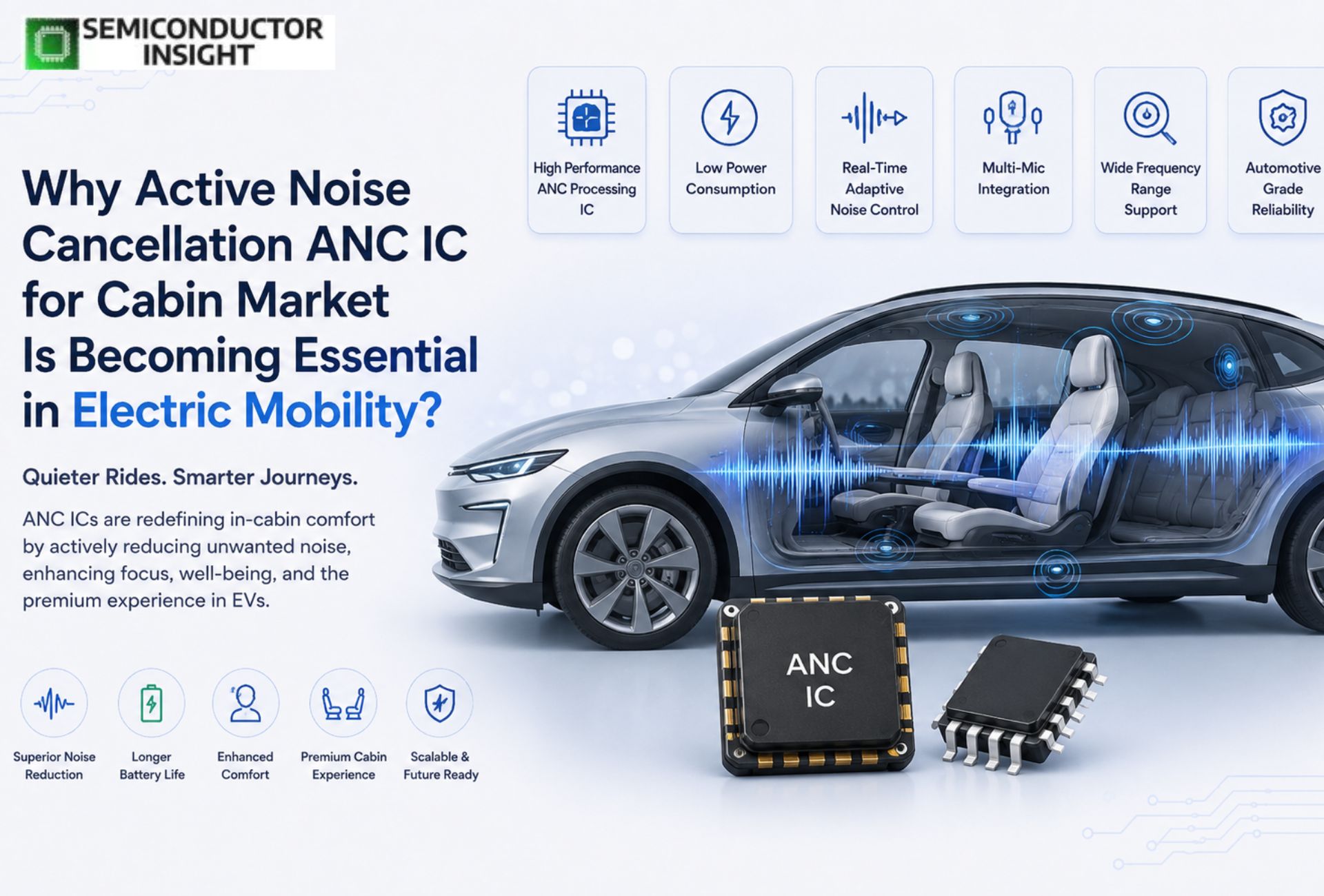
Why Active Noise Cancellation ANC IC for Cabin Market Is Becoming Essential in Electric Mobility?
Modern vehicle cabin is no longer judged only by horsepower, battery range, or touchscreen size. Cabin acoustics have quietly become one of the defining factors of premium mobility. As electric vehicles, autonomous driving systems, and software-defined architectures continue to evolve, automotive manufacturers are investing heavily in technologies that improve passenger comfort inside increasingly silent vehicles. This shift is placing Active Noise Cancellation ANC IC for Cabin Market directly at the centre of next-generation semiconductor innovation.
Active Noise Cancellation integrated circuits remove the need for traditional sound insulation techniques that rely on heavier materials and physical damping, instead relying on microphones, digital signal processors and audio algorithms to create inverse sound waves to negate undesirable cabin noise in real time. This is especially important for electric vehicles since the lack of combustion engines means road, tyre and wind noise may be heard more clearly than before.
Automotive engineers now view cabin acoustics as part of the broader intelligent cockpit experience. Semiconductor companies developing ANC ICs are increasingly collaborating with automakers, infotainment suppliers, and AI audio firms to create adaptive sound environments that respond dynamically to driving conditions.
Electric Vehicles Are Changing the Cabin Noise Equation
- The rapid growth of electric mobility is one of the biggest reasons behind rising attention toward ANC semiconductor solutions.
- Traditional internal combustion vehicles naturally masked certain environmental sounds through engine vibration and exhaust frequencies.
- EVs operate much more quietly, making aerodynamic turbulence, rolling resistance, and external traffic sounds far more noticeable to passengers.
- According to the International Energy Agency IEA, global electric car sales surpassed 17 million units in 2024, with China, Europe, and the United States accounting for the majority of demand.
- As EV adoption accelerates, automakers are redesigning cabin engineering strategies to maintain comfort expectations in quieter drivetrains.
- Luxury EV manufacturers, including Tesla, Mercedes-Benz, and BMW Group, have increasingly integrated sophisticated acoustic management systems into premium models.
- In several flagship vehicles, ANC processors work continuously alongside digital audio systems to suppress low-frequency disturbances generated by tyres and road surfaces.
Stay connected for additional in-depth information right here: https://semiconductorinsight.com/report/active-noise-cancellation-anc-ic-for-cabin-market/
Semiconductor Miniaturisation Is Reshaping Acoustic Intelligence
Modern ANC ICs are no longer simple audio chips. They now integrate advanced DSP cores, machine learning optimisation, multi-channel processing, and low-latency response systems within compact semiconductor architectures.
Several semiconductor manufacturers are focusing on automotive-grade chips capable of handling dozens of cabin audio inputs simultaneously. This includes microphones positioned near headrests, roof panels, and door structures that continuously capture sound patterns for real-time correction.
The rise of smaller and more power-efficient semiconductor nodes has also enabled ANC modules to fit seamlessly within centralised vehicle computing platforms. Automotive electronics suppliers are gradually shifting from isolated hardware modules toward domain-based architectures where infotainment, voice recognition, driver assistance, and acoustic management systems operate together through unified processors.
This evolution is particularly important in software-defined vehicles, where many cabin functions can now be updated remotely through over-the-air software upgrades.
Airlines and Premium Mobility Platforms Are Influencing Automotive Design
The idea of active noise cancellation originally gained popularity through aviation headsets and premium consumer electronics. Today, that same passenger comfort philosophy is influencing automotive cabin development.
- Airline-grade acoustic concepts are increasingly appearing in luxury SUVs, executive sedans, and premium electric crossovers. Some manufacturers are exploring personalised sound zones where ANC algorithms reduce noise differently for each seating position.
- In 2025, several automotive technology showcases demonstrated adaptive cabin soundscapes capable of automatically adjusting based on vehicle speed, road texture, and passenger occupancy. These systems combine semiconductor audio processing with AI-driven environmental sensing to deliver highly customised acoustic environments.
The convergence between consumer electronics and automotive semiconductor engineering is becoming more visible as infotainment systems evolve into immersive digital experiences rather than basic entertainment interfaces.
Cabin Electronics Are Becoming a Semiconductor Battleground
Vehicle cabins are rapidly turning into one of the most competitive areas for semiconductor innovation. Displays, AI voice assistants, biometric sensors, ambient lighting controllers, and spatial audio systems are now integrated into a unified digital cockpit ecosystem.
ANC ICs are emerging as a critical component of this ecosystem because sound quality directly affects communication clarity, navigation prompts, hands-free calling, and immersive infotainment performance.
According to technical papers published by the Society of Automotive Engineers SAE International, active acoustic management systems can significantly reduce low-frequency cabin noise without adding excessive vehicle weight. This is especially valuable for EV manufacturers attempting to maximise battery efficiency because lighter vehicles generally improve driving range.
In some premium vehicle platforms, engineers are replacing several kilograms of traditional soundproofing material with lightweight digital acoustic systems powered by semiconductor-based ANC processors.
AI Audio Processing Is Entering the Automotive Mainstream
- Artificial intelligence is beginning to play a larger role in automotive acoustic management. Instead of relying only on predefined sound cancellation profiles, emerging ANC IC platforms can learn driver habits, recognise road conditions, and predict noise variations before passengers notice them.
- Semiconductor firms are increasingly integrating neural processing capabilities into automotive audio chips to support predictive noise reduction and adaptive cabin personalisation. This transition aligns closely with the broader movement toward AI-powered mobility platforms.
- At recent automotive electronics exhibitions in Germany, Japan, and the United States, next-generation ANC demonstrations showed systems capable of reducing cabin disturbances during acceleration, regenerative braking, and uneven terrain transitions in real time.
These developments indicate that ANC semiconductor technology is evolving far beyond traditional noise suppression. It is becoming part of a larger intelligent mobility architecture where comfort, digital interaction, and sensory optimisation are deeply interconnected.

Comments (0)