Market Insights
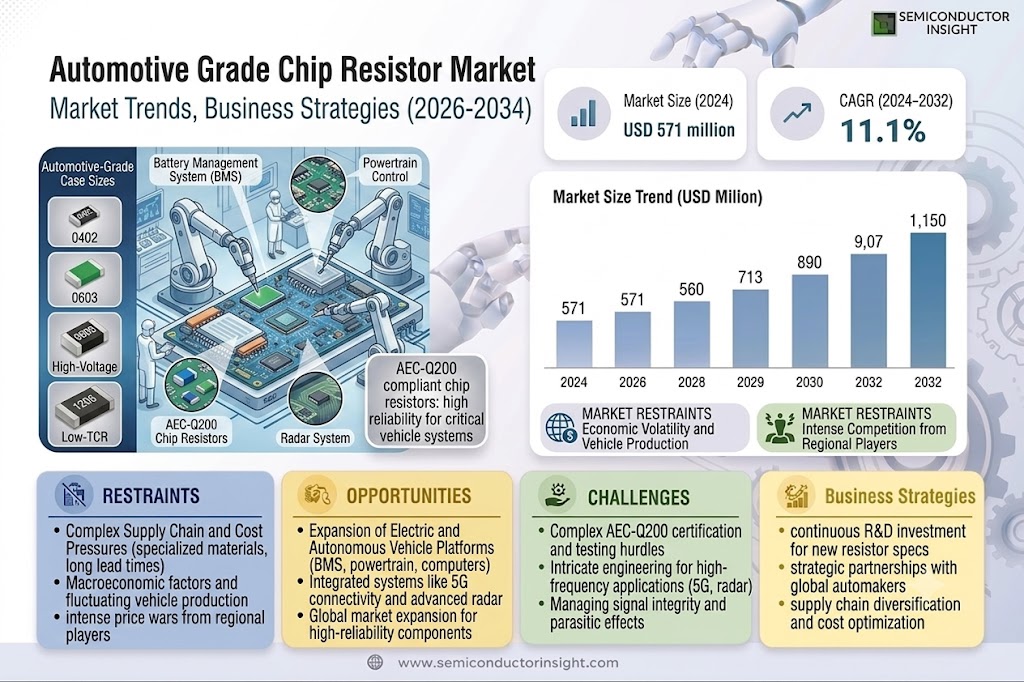
Global Automotive Grade Chip Resistor Market was valued at USD 571 million in 2024 and is projected to reach USD 1,150 million by 2032, exhibiting a CAGR of 11.1% during the forecast period.
Automotive grade chip resistors are surface mount resistors designed for automotive electronic systems, meeting stringent environmental requirements such as high temperature resistance, vibration resistance, shock resistance, and long-term reliability. These components are AEC-Q200 certified and utilize specialized materials and processes to withstand extreme conditions, ensuring stable operation in critical applications like power control, ADAS (Advanced Driver Assistance Systems), and battery management systems (BMS).
The market growth is driven by increasing vehicle electrification and the rising adoption of advanced automotive electronics. According to industry data, Asia dominates global automobile production with a 56% share, followed by Europe (20%) and North America (16%). Leading manufacturers such as Vishay, Rohm, and Panasonic hold significant market share in high-end applications, while regional players like Yageo and Fenghua Advanced Technology focus on cost-competitive solutions for mid-range segments.
MARKET DRIVERS
Accelerated Automotive Electrification and Digitalization
Global surge in vehicle electrification and the increasing integration of sophisticated electronic control units (ECUs) are major drivers for the Automotive Grade Chip Resistor Market. Modern vehicles, including electric vehicles (EVs) and hybrids, require thousands of these passive components to manage power distribution, sensor interfaces, and signal conditioning. The demand for reliable, high-precision resistors that can withstand harsh automotive environments is directly correlated with the production volumes of advanced vehicles, which are projected to grow steadily.
Stringent Standards for Safety and Reliability
Automotive safety systems like advanced driver-assistance systems (ADAS), anti-lock braking systems (ABS), and airbag control modules require components that meet rigorous AEC-Q200 qualification. Automotive grade chip resistors are essential for these applications, as they offer superior performance in terms of temperature stability, moisture resistance, and long-term reliability compared to commercial-grade components. This adherence to high-quality standards is a fundamental driver of market growth.
Furthermore, the trend towards miniaturization and higher component density on printed circuit boards (PCBs) necessitates the use of smaller form-factor resistors, such as 0201 and 01005 sizes, which are seeing increased adoption in the Automotive Grade Chip Resistor Market.
MARKET CHALLENGES
Complex Supply Chain and Cost Pressures
Despite strong demand, the Automotive Grade Chip Resistor Market faces significant challenges from global supply chain disruptions and intense cost pressure from automotive manufacturers. The specialized materials and manufacturing processes required for AEC-Q200 compliance can lead to longer lead times and higher production costs. Automakers consistently demand lower prices, squeezing profit margins for component suppliers while requiring unwavering quality.
Other Challenges
Technical Complexity of High-Frequency Applications
As vehicle systems evolve to include 5G connectivity and advanced radar, chip resistors must perform reliably at high frequencies. Managing parasitic effects and ensuring signal integrity in these applications presents a substantial technical hurdle for manufacturers in the Automotive Grade Chip Resistor Market.
Rapid Technological Obsolescence
The fast pace of innovation in automotive electronics means resistor specifications can change quickly. Manufacturers must continuously invest in research and development to keep pace with new requirements for power ratings, tolerance, and temperature coefficients, adding to operational complexity.
MARKET RESTRAINTS
Economic Volatility and Fluctuating Vehicle Production
Macroeconomic factors such as inflation, rising interest rates, and potential recessions can significantly impact automotive production volumes. A downturn in car sales directly reduces the demand for all electronic components, including those in the Automotive Grade Chip Resistor Market. This cyclical nature of the automotive industry poses a persistent restraint on stable, predictable growth for component suppliers.
Intense Competition from Regional Players
The market is characterized by the presence of numerous global and regional manufacturers. This high level of competition often leads to price wars, which can deter investment in advanced technologies and constrain the overall market profitability. New entrants offering lower-cost alternatives can also capture market share, particularly in price-sensitive segments.
MARKET OPPORTUNITIES
Expansion of Electric and Autonomous Vehicle Platforms
The rapid development of fully electric and autonomous vehicles represents the most significant growth frontier for the Automotive Grade Chip Resistor Market. These platforms require a substantially higher number of electronic components per vehicle compared to traditional internal combustion engine vehicles. This creates a massive, long-term opportunity for suppliers of high-reliability resistors used in battery management systems, powertrain controls, and autonomous driving computers.
Innovation in High-Power and High-Temperature Resistors
There is growing demand for chip resistors capable of handling higher power densities and operating at extreme temperatures exceeding 150°C, particularly in under-hood applications. Investing in the development of advanced thick-film and metal strip technologies to meet these demands presents a key opportunity for differentiation and value creation within the Automotive Grade Chip Resistor Market.
Adoption in Emerging Economies
As automotive manufacturing continues to grow in emerging economies across Asia Pacific and Latin America, local demand for compliant electronic components will rise. Establishing strong distribution networks and manufacturing partnerships in these regions offers a substantial opportunity for market expansion for vendors in the Automotive Grade Chip Resistor Market.
Automotive Grade Chip Resistor Market Trends
Robust Market Expansion Fueled by Automotive Electronics
Global Automotive Grade Chip Resistor Market is on a significant growth trajectory, with its valuation projected to surge from USD 571 million in 2024 to approximately USD 1150 million by 2032. This robust expansion, reflecting a compound annual growth rate (CAGR) of 11.1%, is primarily driven by the relentless growth and increasing electronic content within the global automotive industry. These components are critical for ensuring the high reliability required in modern vehicles, as they are designed to withstand extreme operating conditions, including high temperatures, vibration, and shock, while meeting the stringent AEC-Q200 certification standards. The proliferation of electronic control units (ECUs), advanced driver-assistance systems (ADAS), and sophisticated battery management systems (BMS) in both conventional and new energy vehicles is a central demand driver for these specialized resistors.
Other Trends
The Ascendancy of New Energy Vehicles and High-Voltage Platforms
A key trend accelerating the Automotive Grade Chip Resistor Market is the exponential growth of electric and hybrid vehicles. The shift to 800V high-voltage platforms in many new EV models creates a surging requirement for chip resistors with higher power ratings and superior temperature resistance. Simultaneously, the advancement towards Level 3 and higher autonomous driving systems places unprecedented demands on component precision, necessitating thin-film resistors with tolerances as tight as ±0.1% to ensure sensor accuracy and system reliability.
Geographical Concentration and Competitive Landscape Dynamics
The market is heavily influenced by geographical production patterns, with over 90% of global automobile manufacturing concentrated in Asia, Europe, and North America. Asia, led by China which accounts for approximately 32% of worldwide production, is a dominant force. This geographical concentration shapes the competitive dynamics. International leaders like Vishay, Rohm, and Panasonic maintain a stronghold on the high-end market segments, leveraging their technological expertise and established AEC-Q200 certification. Concurrently, companies such as Yageo and Fenghua Advanced Technology are aggressively increasing their market share in mid- to low-end applications through competitive pricing and domestic substitution strategies, particularly within the vast Asian market.
Future Outlook: Technological Evolution and Supply Chain Resilience
Looking ahead, the market is evolving towards higher integration with the adoption of resistor arrays to save space on increasingly dense PCBs. Material science innovations focused on enhancing anti-sulfurization and anti-humidity properties are emerging to improve longevity in harsh environments. The rise of wide-bandgap semiconductors like Silicon Carbide (SiC) and Gallium Nitride (GaN) in power electronics also necessitates compatible resistor technologies. Key challenges include managing volatility in raw material costs and navigating the lengthy automotive qualification cycles, which can span two to three years. The future will likely see intensified focus on supply chain localization and technological innovation as critical factors for market resilience and growth.
COMPETITIVE LANDSCAPE
Key Industry Players
Strategic Positioning in a Rapidly Evolving Automotive Electronics Market
Global Automotive Grade Chip Resistor Market is characterized by a competitive landscape where established international manufacturers dominate the high-reliability segments, while regional players aggressively compete in the mid-to-low end. Leading companies such as Vishay, Rohm, and Panasonic leverage their extensive R&D capabilities and first-mover advantage in AEC-Q200 certification to secure strong positions in high-performance applications like Advanced Driver-Assistance Systems (ADAS) and Battery Management Systems (BMS) for electric vehicles. These players command premium pricing due to their proven track record in meeting stringent automotive requirements for temperature resistance, vibration, and long-term reliability. The market structure is moderately consolidated, with the top five companies accounting for a significant revenue share, reflecting the high technical and certification barriers to entry.
Beyond the dominant global players, a tier of significant niche and regional competitors is expanding its footprint. Chinese manufacturers, including Yageo and Fenghua Advanced Technology, are rapidly gaining market share by focusing on cost-optimized solutions for applications like body control modules and lighting, capitalizing on domestic substitution trends and strong local supply chains. Other key participants such as KOA, Samsung Electro-Mechanics, and Bourns offer specialized product portfolios that cater to specific automotive needs, including high-power resistors for 800V platforms and precision thin-film resistors for autonomous driving systems. These companies compete on factors like product customization, regional support, and the ability to navigate complex global supply chains and tariff landscapes.
List of Key Automotive Grade Chip Resistor Companies Profiled
- Yageo
- Vishay Intertechnology, Inc.
- KOA Speer Electronics, Inc.
- Panasonic Corporation
- Fenghua Advanced Technology
- Walsin Technology Corporation
- Samsung Electro-Mechanics
- Ta-I Technology Co., Ltd.
- Uniroyal (Uniohm)
- ROHM Semiconductor
- Susumu Co., Ltd.
- Viking Tech Corporation
- ABCO Electronics
- TE Connectivity
- Bourns, Inc.
- Ever Ohms Technology Co., Ltd.
Segment Analysis:
| Segment Category | Sub-Segments | Key Insights |
| By Type |
|
Thick Film Chip Resistor holds a dominant position due to its suitability for general-purpose automotive applications. High-volume manufacturing advantages and cost-effectiveness make it ideal for standard electronic control units and body electronics, while innovations in materials improve temperature stability and power handling for basic automotive circuits. |
| By Application |
|
Advanced Driver-Assistance Systems (ADAS) are experiencing the most significant growth, driven by the push towards autonomous driving. These systems demand exceptional reliability and precision from chip resistors to ensure functions like automatic braking and lane-keeping perform flawlessly under extreme conditions, creating a high-value application segment. |
| By End User |
|
Electric Vehicle (EV/HEV) Manufacturers constitute the most dynamic and demanding end-user segment. The transition to electrification requires specialized high-power and high-temperature resistant resistors capable of managing the high-voltage battery systems and power electronics unique to electric powertrains, spurring continuous technological advancements. |
| By Certification Level |
|
AEC-Q200 Certified resistors are unequivocally the leading segment, as this qualification is mandatory for all safety-critical automotive electronics. This certification signifies compliance with rigorous standards for reliability, temperature endurance, and vibration resistance, forming a critical market barrier and establishing product credibility with automotive OEMs and suppliers for use in vehicles. |
| By Power Rating |
|
High Power chip resistors are witnessing surging demand, primarily fueled by the adoption of 800V high-voltage platforms in electric vehicles. These platforms require components that can dissipate significant amounts of heat and manage high current flows reliably, pushing innovation in resistor materials and thermal management designs to ensure long-term system integrity and performance. |
Regional Analysis: Automotive Grade Chip Resistor Market
Asia-Pacific
The region’s unparalleled electronics manufacturing infrastructure provides a significant competitive edge for the Automotive Grade Chip Resistor Market. Established semiconductor fabrication plants and a dense network of component suppliers ensure a reliable, scalable, and cost-effective supply chain. This ecosystem minimizes logistical challenges and production lead times, making it the preferred sourcing destination for global automakers.
The rapid electrification of vehicles and the integration of sophisticated ADAS features are primary growth drivers. The Asia-Pacific Automotive Grade Chip Resistor Market benefits directly from these trends, as chip resistors are critical for battery management systems, power electronics, and sensor modules. Local automakers are at the forefront of these technologies, creating immense, sustained demand for high-reliability components.
Supportive government initiatives aimed at strengthening the domestic automotive and semiconductor industries significantly boost the market. Policies promoting EV adoption, local manufacturing, and technological self-sufficiency incentivize investment in component production, including the development of advanced Automotive Grade Chip Resistors that meet stringent international quality standards.
Leading electronics firms in the region invest heavily in research and development to create chip resistors with higher power ratings, improved temperature stability, and greater miniaturization. This focus on innovation ensures that the Asia-Pacific Automotive Grade Chip Resistor Market remains aligned with the evolving requirements of next-generation vehicle architectures and maintains its technological leadership.
North America
The North American Automotive Grade Chip Resistor Market is characterized by its strong demand for premium and high-performance vehicles, particularly in the United States and Canada. The region’s automotive sector has a significant emphasis on integrating advanced safety features and connectivity solutions, which fuels the need for reliable electronic components. The presence of major automotive OEMs and a well-developed technological ecosystem drives the adoption of high-specification Automotive Grade Chip Resistors. Furthermore, the gradual but steady shift towards electric vehicles, supported by federal and state-level incentives, is creating new growth avenues for suppliers in this market. The stringent quality and reliability standards demanded by North American automakers ensure that only components meeting the highest performance criteria are incorporated, influencing global supply chain dynamics.
Europe
Europe represents a highly sophisticated and mature Automotive Grade Chip Resistor Market, driven by its legacy of automotive excellence and stringent regulatory environment. The region is a global leader in the production of luxury and performance vehicles, which extensively utilize complex electronic control units requiring robust chip resistors. The European Union’s rigorous emissions standards and safety regulations accelerate the adoption of electronic systems, thereby increasing component demand. The strong push towards electrification, led by European automakers, is a significant factor shaping the market. The presence of leading automotive electronics suppliers and a strong culture of engineering precision ensures a continuous focus on quality and innovation within the European Automotive Grade Chip Resistor Market, particularly for applications in powertrain and safety-critical systems.
South America
The South American Automotive Grade Chip Resistor Market is an emerging region with growth potential largely tied to the recovery and modernization of its automotive industry, primarily in Brazil and Argentina. The market demand is influenced by the gradual introduction of vehicles with more advanced electronic features, though at a slower pace compared to other regions. Economic volatility can impact automotive production volumes and, consequently, the demand for components. However, as global OEMs establish manufacturing bases and regional safety standards evolve, there is a growing need for compliant electronic parts. The market is characterized by a focus on cost-effectiveness and durability, with potential for growth as the regional automotive fleet modernizes and adopts more electronic content over the long term.
Middle East & Africa
The Automotive Grade Chip Resistor Market in the Middle East & Africa is nascent but shows potential, driven by economic diversification efforts in Gulf Cooperation Council countries and the gradual growth of automotive assembly operations in certain African nations. Demand is primarily fueled by the import of modern vehicles equipped with contemporary electronics, as there is limited local automotive manufacturing. The luxury vehicle segment in the Middle East provides a niche market for high-performance components. In Africa, market development is linked to infrastructure growth and the increasing availability of vehicles featuring basic electronic systems. The region’s harsh climatic conditions also create a specific demand for Automotive Grade Chip Resistors with enhanced reliability and tolerance to extreme temperatures and humidity.
Report Scope
This market research report provides a comprehensive analysis of the Automotive Grade Chip Resistor, covering the forecast period 2024–2032. It offers detailed insights into market dynamics, technological advancements, competitive landscape, and key trends shaping the industry.
Key focus areas of the report include:
- Market Overview: The report begins with an overview outlining its current market scenario, key growth indicators, and industry transformation drivers. It discusses macroeconomic factors, demand–supply balance, regulatory landscape, and the strategic role of automotive-grade chip resistors in powering advancements across automotive electronic systems such as power control, ADAS, and battery management.
- Market Size & Forecast: Historical data and future projections for revenue, unit shipments, and market value across major regions and segments.
- Segmentation Analysis: Detailed breakdown by product type, technology, application, and end-user industry to identify high-growth segments and investment opportunities.
- Regional Insights: Insights into market performance across North America, Europe, Asia-Pacific, Latin America, and the Middle East & Africa, including country-level analysis where relevant.
- Competitive Landscape: Profiles of leading market participants, including their product offerings, R&D focus, manufacturing capacity, pricing strategies, and recent developments such as mergers, acquisitions, and partnerships.
- Technology Trends & Innovation: Assessment of emerging technologies, integration of semiconductor adaptation (SiC/GaN), fabrication techniques, and evolving industry standards.
- Market Drivers & Restraints: Evaluation of factors driving market growth along with challenges, supply chain constraints, regulatory issues, and market-entry barriers.
- Stakeholder Insights: Insights for component suppliers, OEMs, system integrators, investors, and policymakers regarding the evolving ecosystem and strategic opportunities.
Primary and secondary research methods are employed, including interviews with industry experts, data from verified sources, and real-time market intelligence to ensure the accuracy and reliability of the insights presented.
FREQUENTLY ASKED QUESTIONS:
What is the current market size of Automotive Grade Chip Resistor?
-> Automotive Grade Chip Resistor Market was valued at USD 571 million in 2024 and is projected to reach USD 1,150 million by 2032, exhibiting a CAGR of 11.1% during the forecast period.
Which key companies operate in Automotive Grade Chip Resistor Market?
-> Key players include Vishay, Rohm, Panasonic, Yageo, Fenghua Advanced Technology, Walsin Technology, Samsung Electro-Mechanics, TE Connectivity, among others.
What are the key growth drivers?
-> Key growth drivers include explosive growth of new energy vehicles (EV/HEV), popularization of 800V high-voltage platforms, and increasing demand for high-power and high-temperature resistant resistors.
Which region dominates the market?
-> Asia is the dominant region, accounting for 56% of global automotive production, with China being the largest producer (32% share).
What are the emerging trends?
-> Emerging trends include high integration (resistor arrays), anti-sulfurization/anti-humidity upgrades, and third-generation semiconductor adaptation (SiC/GaN).

Get Sample Report PDF for Exclusive Insights
Report Sample Includes
- Table of Contents
- List of Tables & Figures
- Charts, Research Methodology, and more...
 Download Sample Report PDF