
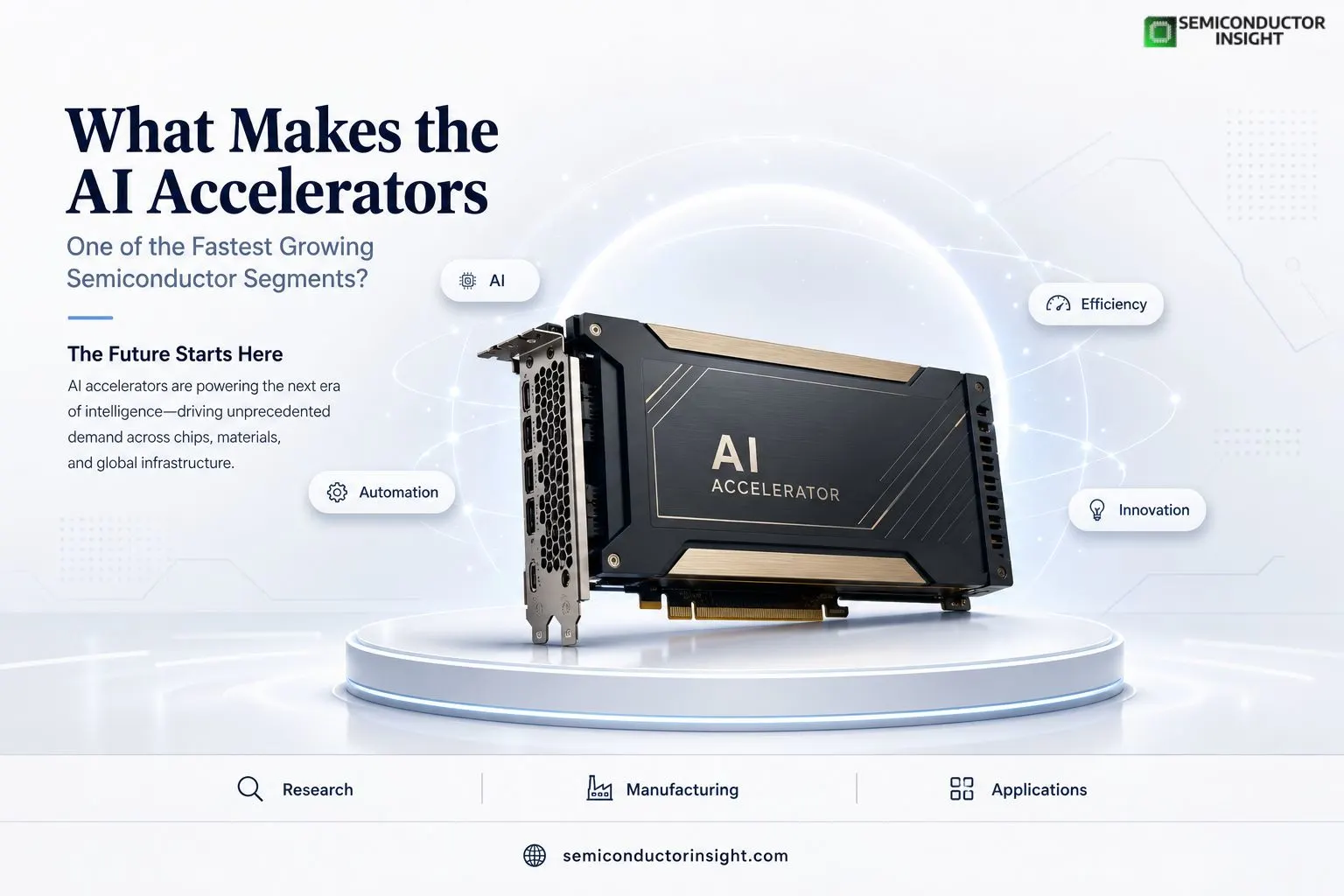
What Makes the AI Accelerators Market One of the Fastest Growing Semiconductor Segments?
The rapid rise of generative artificial intelligence has transformed AI accelerators from a specialized semiconductor category into one of the most strategically important technologies in the global digital economy. Whether training large language models, powering recommendation engines, or enabling autonomous decision-making systems, AI accelerators now sit at the center of modern computing infrastructure.
– According to publicly available reports from major cloud providers and industry organizations, data center investments linked to AI surpassed hundreds of billions of dollars globally during 2025 and 2026.
– The growing demand for computational performance has placed the AI Accelerators Market at the forefront of semiconductor innovation.
The Compute Race behind Every AI Model
Every breakthrough AI application relies on enormous computing power. Training advanced foundation models requires thousands of accelerator chips operating simultaneously across interconnected data centers.
Recent deployments by leading cloud companies demonstrate the scale of this demand. Some AI training clusters now contain more than 100,000 accelerator units connected through ultra-high-speed networking systems. As model sizes continue to expand into trillions of parameters, accelerator demand continues to outpace traditional server processor growth.
This shift has made accelerators a strategic resource comparable to energy infrastructure in the digital era.
Where the Silicon Spending Is Flowing
Ø The semiconductor industry is witnessing unprecedented capital expenditure directed toward AI-focused manufacturing.
Ø The Semiconductor Industry Association reported that global semiconductor sales exceeded USD 600 billion in recent years, with AI-related devices becoming one of the fastest-growing categories. At the same time, advanced packaging facilities, wafer fabrication plants, and memory production lines are expanding to support accelerator deployment.
Ø Taiwan, South Korea, the United States, and Japan have announced multi-billion-dollar semiconductor investment programs aimed at strengthening AI hardware supply chains.
Memory Has Become the New Performance Battleground
Raw processing power alone is no longer sufficient. AI workloads increasingly depend on rapid movement of massive datasets between processors and memory.
High Bandwidth Memory (HBM) has therefore become a critical technology layer for accelerator performance. Modern AI accelerators integrate several stacks of HBM capable of delivering bandwidth measured in terabytes per second.
Industry reports from memory manufacturers indicate that demand for HBM products has reached record levels as cloud operators expand AI infrastructure. This has created new opportunities for advanced packaging specialists and semiconductor material suppliers.
The Material Ecosystem Powering Atomic Scale Computing
ü As AI accelerators move toward sub-3 nanometer manufacturing nodes, the spotlight is shifting from chip designers to the materials ecosystem that makes advanced fabrication possible.
ü Key contributors include silicon wafer suppliers, photoresist developers, specialty gas manufacturers, deposition material providers, and advanced packaging material companies. Organizations such as Shin-Etsu Chemical, SUMCO, JSR Corporation, Tokyo Ohka Kogyo, and Entegris supply critical materials required for extreme ultraviolet lithography and advanced transistor architectures.
ü Without improvements in ultra-pure chemicals, deposition precursors, advanced substrates, and packaging materials, the progression toward sub-3 nm AI accelerators would face significant bottlenecks.
Data Centers Are Being Redesigned Around AI
Traditional data centers were built around general-purpose CPUs. AI infrastructure requires a completely different approach.
Modern AI facilities demand liquid cooling systems, high-density power delivery, advanced networking fabrics, and accelerator-optimized server racks. The International Energy Agency estimates that electricity demand from data centers will continue to increase as AI deployment expands globally.
Several newly announced hyperscale campuses are being designed specifically for AI workloads rather than conventional cloud computing applications. This architectural transformation is creating demand across multiple semiconductor segments.
To find out more, feel free to browse our latest updated relevant report: https://semiconductorinsight.com/report/ai-accelerator-advanced-packaging-market-trends-business-strategies-2026-2034/
Smart Home Ecosystems Create Unexpected Edge AI Opportunities
While large data centers dominate headlines, AI acceleration is increasingly moving closer to consumers through edge devices and connected environments.
Companies such as Signify, Legrand, Lutron Electronics, Aqara, and Nanoleaf have integrated lighting systems with major smart home platforms including voice assistants, automation hubs, and AI-enabled control systems.
As edge AI capabilities improve, future smart homes may increasingly utilize dedicated AI accelerators for real-time energy management, occupancy sensing, security analytics, and adaptive lighting optimization without relying entirely on cloud processing.
The Emerging Metric That Matters More Than Speed
– The next phase of competition is not solely about computational throughput. Energy efficiency has become a defining metric for AI accelerator success.
– A single advanced AI training cluster can consume tens of megawatts of power. Semiconductor designers are therefore prioritizing performance per watt alongside raw processing capability.
– From advanced transistor structures to innovative packaging and cooling technologies, the industry is pursuing every possible efficiency gain. The companies that successfully balance performance, scalability, and energy consumption will shape the next generation of AI infrastructure.
As artificial intelligence expands across cloud computing, autonomous systems, healthcare, industrial automation, and consumer electronics, AI accelerators are evolving from specialized processors into the foundational engines of the global digital economy.

Comments (0)