High Computing Power AI Module Market Insights
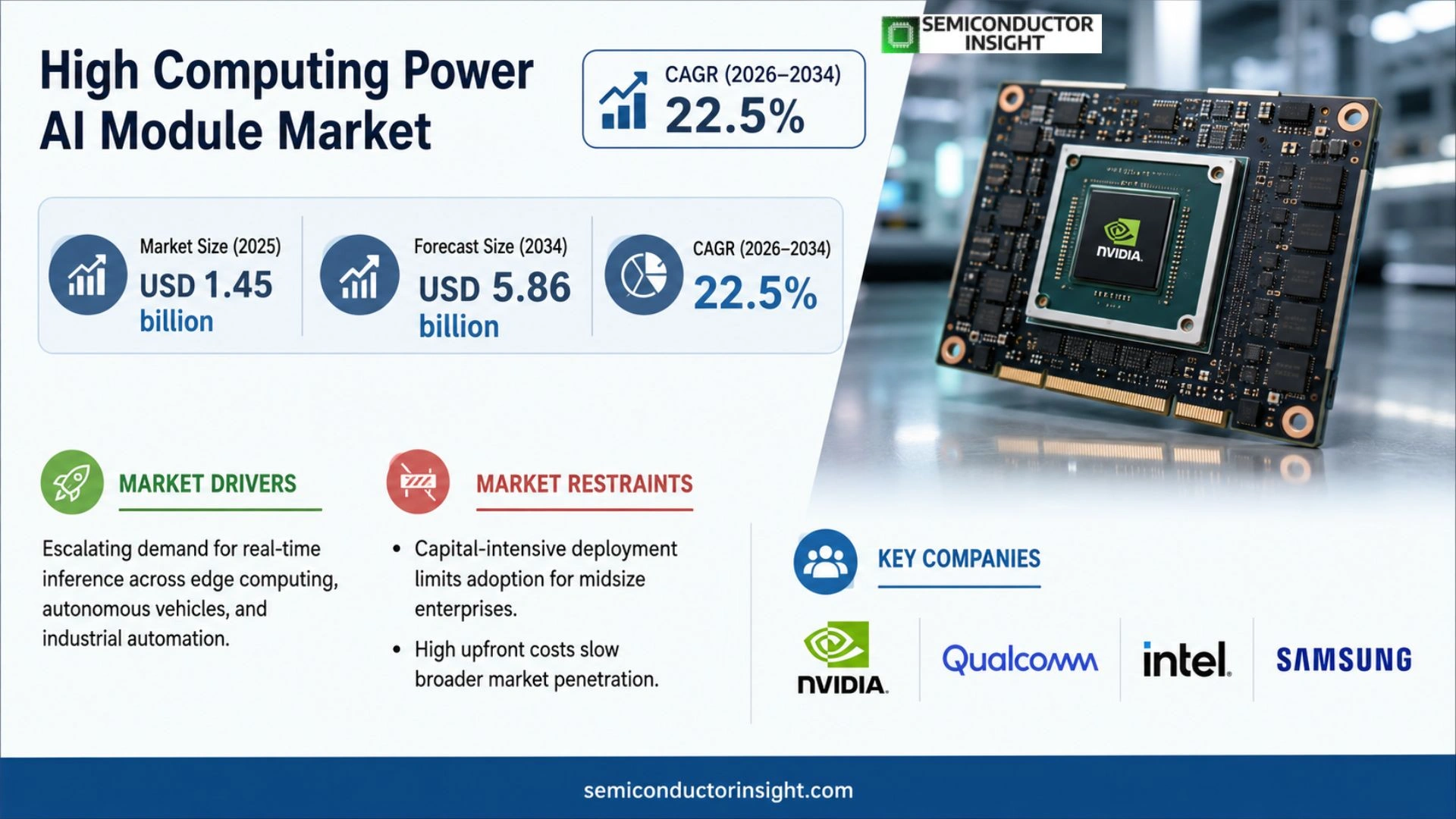
High Computing Power AI Module market was valued at USD 1.45 billion in 2025 and will grow to USD 5.86 billion by 2034, reflecting a CAGR of 22.5% over the forecast period.
High Computing Power AI Modules are integrated computing solutions built for edge and embedded artificial‑intelligence applications that demand performance well beyond conventional IoT or communication modules. They typically combine multi‑core CPUs, GPUs and/or NPUs with on‑board memory, multimedia engines and high‑speed interfaces within compact form factors such as system‑on‑module (SoM) or smart AI modules, enabling deployment in industrial automation, robotics, intelligent transportation and advanced video analytics.
The market expands because enterprises are shifting processing from cloud data centers toward on‑premise edge devices, seeking lower latency and greater data sovereignty. At the same time, semiconductor manufacturers are releasing increasingly capable AI‑centric SoCs on advanced process nodes, which lowers the cost barrier for module integration. However, supply‑chain complexity around high‑end silicon and thermal management presents challenges that vendors must address through robust design practices and long‑term support agreements.
MARKET DRIVERS
Escalating Demand for Real‑Time Inference
The surge in edge‑computing deployments forces enterprises to seek hardware capable of processing petabytes of data within milliseconds. High Computing Power AI Module Market participants that deliver sub‑microsecond latency are securing contracts with autonomous‑vehicle manufacturers and industrial‑automation firms, because downstream revenue hinges on uninterrupted decision loops.
AI‑Accelerated Cloud Services Expansion
Cloud service providers are scaling their AI workloads to accommodate generative‑model offerings. The transition from general‑purpose CPUs to purpose‑built AI modules has cut operational expenses by double‑digit percentages, prompting hyperscalers to allocate up to 30 % of new data‑center budget toward high‑throughput AI processors.
➤ Customers increasingly view computational capacity as a strategic asset rather than a cost center, reshaping procurement cycles and supplier relationships.
Regulatory incentives in several jurisdictions, such as tax credits for AI‑driven productivity gains, further accelerate adoption. Companies that integrate high‑density AI modules into legacy systems report faster time‑to‑market for AI‑enhanced products, reinforcing the market’s upward momentum.
MARKET CHALLENGES
Thermal Management Constraints
As module density climbs, dissipating heat without compromising performance becomes a critical engineering hurdle. Many manufacturers still rely on conventional cooling solutions that add weight and power consumption, limiting deployment in compact edge devices.
Other Challenges
Supply‑Chain Volatility
Component shortages, especially for advanced memory and interconnects, inflate lead times and force OEMs into spot‑buying, eroding margin expectations.
Software‑Hardware Co‑Design Gaps
A mismatch between algorithmic demands and hardware capabilities slows integration cycles. Vendors that fail to provide optimized libraries face resistance from developers seeking plug‑and‑play solutions.
MARKET RESTRAINTS
Capital‑Intensive Deployment
Upfront expenditure for high‑performance AI modules remains steep, particularly for midsize manufacturers that must balance digital transformation budgets against legacy system upgrades. The financial hurdle curtails broader diffusion beyond well‑funded enterprises.
Regulatory Scrutiny on Energy Consumption
Governments are tightening energy‑efficiency standards for data‑center equipment. Designs that prioritize raw compute at the expense of power efficiency encounter certification delays, dampening speed‑to‑market for new offerings.
Talent scarcity compounds these restraints; engineering teams with expertise in heterogeneous AI architectures are in short supply, lengthening development timelines and raising recruitment costs.
MARKET OPPORTUNITIES
Specialized AI Modules for Edge Intelligence
Targeted solutions that marry high compute density with ultra‑low power footprints unlock new verticals such as smart‑city sensors and wearable health monitors. Early entrants capturing this niche can command premium pricing and establish defensible intellectual property.
Strategic Partnerships with Chip Foundries
Collaborations that secure access to next‑generation process nodes enable manufacturers to shrink die size while boosting transistor counts. Such alliances not only reduce unit cost but also enhance performance‑per‑watt, a decisive factor for customers seeking sustainable AI deployments.
Finally, the emergence of modular AI chassis that allow plug‑and‑play upgrades presents a recurring‑revenue model. Vendors that evolve their product lines into scalable ecosystems will benefit from upgrade cycles and long‑term service contracts.
High Computing Power AI Module Market Trends
Edge AI Adoption Expands Module Utilization
The surge in edge‑oriented artificial‑intelligence workloads is reshaping procurement patterns across manufacturing floors, autonomous logistics hubs and city‑scale surveillance networks. Customers now prioritize compute density that can be delivered inside a single module, eliminating the latency penalties of cloud‑relay architectures. This shift is driven by tighter control loops in robotics, the need for on‑site video analytics that respect privacy regulations, and the economic advantage of consolidating multiple processing blocks into one package. As a result, original equipment manufacturers are specifying High Computing Power AI Modules for new product lines at a rate that outpaces traditional communication or low‑power sensor solutions, prompting vendors to accelerate roadmap releases and secure long‑term silicon agreements.
Other Trends
Supply‑Chain Consolidation Around Advanced SoCs
The upstream ecosystem is gravitating toward a narrower set of high‑performance system‑on‑chip families, principally those built on latest‑generation ARM cores and embedded GPU/IPU blocks. Foundries that support sub‑10‑nanometer processes have become indispensable because the performance envelope of these modules hinges on transistor efficiency and memory bandwidth. Concurrently, memory suppliers are scaling LPDDR5 and HBM variants to meet the thermal and power budgets imposed by compact AI workloads. This concentration elevates barriers to entry for new entrants, yet it also creates bargaining power for established chipset vendors who can negotiate volume discounts and guarantee supply continuity for large‑scale OEM programs. The net effect is a more resilient but less diversified supply chain, where strategic partnerships and co‑development agreements are essential for sustaining growth.
Margin Dynamics and Software‑Enabled Differentiation
From a financial perspective, the bill‑of‑materials profile of High Computing Power AI Modules is front‑loaded with the AI‑capable processor, followed by high‑speed memory and power‑management ICs. While this composition inflates unit cost relative to conventional wireless modules, manufacturers offset the gap through value‑added integration services, such as pre‑loaded inference frameworks, OTA update capability and thermal optimization firmware. These software layers command premium pricing and reinforce customer lock‑in, especially when the module vendor supplies end‑to‑end test suites that accelerate time‑to‑market for system integrators. Consequently, gross margins remain attractive, but they are increasingly linked to the robustness of the accompanying software ecosystem rather than purely to hardware specifications. Companies that cultivate developer communities and provide comprehensive SDKs are positioned to capture higher share of the growing edge AI spend.
COMPETITIVE LANDSCAPE
Key Industry Players
High Computing Power AI Module Market – Competitive Overview
The market is currently dominated by a handful of semiconductor powerhouses that couple cutting‑edge AI silicon with mature module‑integration capabilities. NVIDIA’s Jetson family, for instance, leverages the company’s GPU leadership to deliver multi‑teraflop performance in a compact SoM, giving OEMs a turnkey path to edge intelligence. Qualcomm’s Snapdragon Ride platform follows a similar model, marrying an ARM‑based CPU with a dedicated NPU and extensive software tooling, which has made it a popular choice for autonomous‑vehicle suppliers. Intel’s acquisition of Habana Labs and the subsequent launch of the Gaudi‑based AI module line further intensifies competition, as the firm offers x86 flexibility alongside AI‑specific accelerators, appealing to industrial automation players seeking a familiar software stack. These leaders differentiate through silicon performance ceilings, ecosystem breadth, and the ability to guarantee long‑term product availability, factors that directly affect time‑to‑market for downstream system integrators.
Beyond the tier‑one vendors, a diverse set of niche specialists is carving out profitable segments. MediaTek’s Edge AI chipset portfolio targets cost‑sensitive smart‑city deployments, while Samsung Electronics focuses on high‑density memory integration to push throughput in surveillance cameras. Chinese firms such as Horizon Robotics and Cambricon provide AI‑centric SoCs optimized for robotics and intelligent transportation, often coupling their silicon with localized software frameworks. Companies like Ambarella and Bitmain have repurposed video‑processing expertise into AI‑ready modules for edge video analytics, whereas European players including STMicroelectronics and Renesas emphasize safety‑certified designs for industrial control. This layered ecosystem creates a competitive environment where differentiation hinges on performance‑per‑watt, reference‑design support, and the depth of pre‑validated AI libraries.
List of Key High Computing Power AI Module Companies Profiled
- NVIDIA
- Qualcomm
- Intel
- Samsung Electronics
- MediaTek
- Horizon Robotics
- Cambricon
- Ambarella
- STMicroelectronics
- Renesas
- Bitmain
- Graphcore
- Texas Instruments
- Xilinx (AMD)
- Huawei HiSilicon
Segment Analysis:
| Segment Category | Sub-Segments | Key Insights |
| By Type |
|
High Computing Power segment drives adoption across demanding edge workloads. • Provides a balanced performance‑to‑cost ratio that satisfies most industrial AI use‑cases. • Enables sophisticated AI models such as computer vision and predictive analytics without requiring cloud offload. • Benefits from mature ecosystem support, including optimized libraries and reference designs. |
| By Application |
|
Industrial automation emerges as the leading application. • Demands deterministic performance for real‑time process control and fault detection. • Leverages high‑throughput AI inference to enable predictive maintenance and quality inspection. • Benefits from long product lifecycles and stable supply chains, reinforcing module adoption. |
| By End User |
|
OEM manufacturers command the bulk of demand. • Require modules that simplify hardware design and accelerate time‑to‑market. • Value comprehensive software stacks that hide silicon complexity. • Prioritize reliability and long‑term availability to meet stringent industrial standards. |
| By Architecture |
|
Heterogeneous AI SoC stands out as the preferred architecture. • Balances flexibility for diverse AI workloads with power efficiency. • Provides a unified programming model that integrates CPU, GPU and NPU resources. • Aligns with emerging edge‑AI frameworks, enabling rapid feature integration. |
| By Ecosystem |
|
Software‑enabled modules drive market momentum. • Offer out‑of‑the‑box AI frameworks, reducing development effort. • Facilitate rapid prototyping and scaling for OEMs and system integrators. • Strengthen partner ecosystems through certification programs and joint go‑to‑market initiatives. |
Regional Analysis: High Computing Power AI Module Market
North America
Enterprise adoption pulse reveals that mid‑size manufacturers and digital service firms are migrating legacy analytics to real‑time AI inference, a shift that compels integration of denser compute modules into existing PLCs and edge gateways. Vendors that can certify module compatibility with legacy protocols gain a decisive edge, while firms that overlook thermal design risk operational downtime.
Silicon innovation landscape in the region is characterised by a cluster of fabless designers partnering with foundries to push transistor density beyond 5nm. The convergence of GPU, FPGA, and ASIC paradigms yields hybrid modules capable of handling both training bursts and inference streams, allowing customers to defer distinct hardware purchases.
Regulatory and funding climate remains supportive, with federal AI research programmes earmarking resources for high‑throughput compute testbeds. While data privacy statutes impose stringent oversight on model training datasets, they stop short of limiting raw compute capacity, enabling manufacturers to scale module performance without regulatory friction.
Talent ecosystem and ecosystem partnerships flourish as university spin‑outs align with industry consortia to co‑develop optimisation libraries that extract peak throughput from each module. These collaborations nurture a pipeline of engineers skilled in low‑level kernel tuning, ensuring that hardware advances translate quickly into tangible productivity gains for adopters.
Europe
European stakeholders approach High Computing Power AI Module Market with a blend of sustainability ambition and regulatory rigor. Automotive manufacturers are embedding high‑density compute blocks into next‑generation driver‑assistance systems, while pharmaceutical R&D labs seek modules that can accelerate molecule‑simulation workloads within stringent data‑handling rules. Industry bodies promote open standards that ease cross‑border component sourcing, and government‑backed innovation clusters provide test‑beds where module manufacturers can validate energy‑efficient designs against real‑world scenarios. The overall tempo is measured, yet the strategic focus on green compute and interoperable ecosystems positions Europe as a crucible for responsible AI hardware evolution.
Asia‑Pacific
In Asia‑Pacific, High Computing Power AI Module Market is propelled by expansive public‑sector AI roadmaps and a manufacturing base geared for volume. Nations such as China, Japan, and South Korea invest heavily in national AI super‑computing facilities, prompting local chipmakers to deliver modules that can sustain massive parallel workloads. Telecom operators upgrade edge data centres to host AI‑enhanced services, creating demand for compact yet potent compute solutions. Meanwhile, a burgeoning startup scene leverages these modules to build language‑model applications tailored to regional languages, reinforcing a cycle where hardware supply and innovative use cases reinforce each other.
South America
South American economies view High Computing Power AI Module Market through the lens of cost‑effectiveness and sectoral relevance. Agribusiness conglomerates experiment with AI‑driven yield‑prediction tools that require robust compute capacity at field‑edge locations, while mining firms explore real‑time fault‑detection systems powered by dense modules. Regional investment funds allocate capital toward companies that can deliver performance‑per‑dollar advantages, encouraging manufacturers to adapt module designs for lower power envelopes. Though infrastructure constraints temper rapid scaling, the focus on pragmatic applications cultivates a market niche where performance is balanced against operational affordability.
Middle East & Africa
The Middle East & Africa region is in the early phases of integrating High Computing Power AI Modules, driven primarily by oil‑and‑gas optimisation and sovereign‑wealth‑fund‑backed AI pilots. Energy producers deploy compute‑intensive analytics to enhance reservoir modelling, while emerging fintech hubs test AI‑driven risk‑assessment platforms that hinge on powerful inference engines. Infrastructure gaps spur interest in modular, containerised compute units that can be deployed in remote sites. Government‑led innovation labs are beginning to draft frameworks that encourage private‑sector participation, laying groundwork for a gradual expansion of high‑performance AI hardware adoption.
Report Scope
This market research report provides a comprehensive analysis of the High Computing Power AI Module Market , covering the forecast period 2026–2034. It offers detailed insights into market dynamics, technological advancements, competitive landscape, and key trends shaping the industry.
Key focus areas of the report include:
- Market Overview: The report begins with an overview outlining its current market scenario, key growth indicators, and industry transformation drivers. It discusses macroeconomic factors, demand–supply balance, regulatory landscape, and the strategic role of semiconductors in powering advancements across industries such as automotive, telecommunications, consumer electronics, and industrial automation.
- Market Size & Forecast: Historical data and future projections for revenue, unit shipments, and market value across major regions and segments.
- Segmentation Analysis: Detailed breakdown by product type, technology, application, and end-user industry to identify high-growth segments and investment opportunities.
- Regional Insights: Insights into market performance across North America, Europe, Asia-Pacific, Latin America, and the Middle East & Africa, including country-level analysis where relevant.
- Competitive Landscape: Profiles of leading market participants, including their product offerings, R&D focus, manufacturing capacity, pricing strategies, and recent developments such as mergers, acquisitions, and partnerships.
- Technology Trends & Innovation: Assessment of emerging technologies, integration of AI/IoT, semiconductor design trends, fabrication techniques, and evolving industry standards.
- Market Drivers & Restraints: Evaluation of factors driving market growth along with challenges, supply chain constraints, regulatory issues, and market-entry barriers.
- Stakeholder Insights: Insights for component suppliers, OEMs, system integrators, investors, and policymakers regarding the evolving ecosystem and strategic opportunities.
Primary and secondary research methods are employed, including interviews with industry experts, data from verified sources, and real-time market intelligence to ensure the accuracy and reliability of the insights presented.
FREQUENTLY ASKED QUESTIONS:
What is the current market size of High Computing Power AI Module Market?
-> High Computing Power AI Module market will grow to USD 5.86 billion by 2034, reflecting a CAGR of 22.5% over the forecast period.
Which key companies operate in High Computing Power AI Module Market?
-> Key players include Nvidia, Qualcomm, Intel, MediaTek, Samsung Electronics, among others.
What are the key growth drivers?
-> Key growth drivers include rapid adoption of edge AI in industrial automation, robotics, smart cities, and advanced video analytics, which boost demand for high‑performance AI modules.
Which region dominates the market?
-> Asia-Pacific leads the market owing to strong manufacturing ecosystems, extensive investments in smart factories, and early deployment of AI‑enabled edge solutions.
What are the emerging trends?
-> Emerging trends include integration of AI with 5G connectivity, advanced heterogeneous packaging, and the development of AI‑optimized software frameworks for edge deployment.
Get Sample Report PDF for Exclusive Insights
Report Sample Includes
- Table of Contents
- List of Tables & Figures
- Charts, Research Methodology, and more...
 Download Sample Report PDF