
What Is Driving New Demand for Unattended Ground Sensors in 2026? A Technology-Focused Industry Review
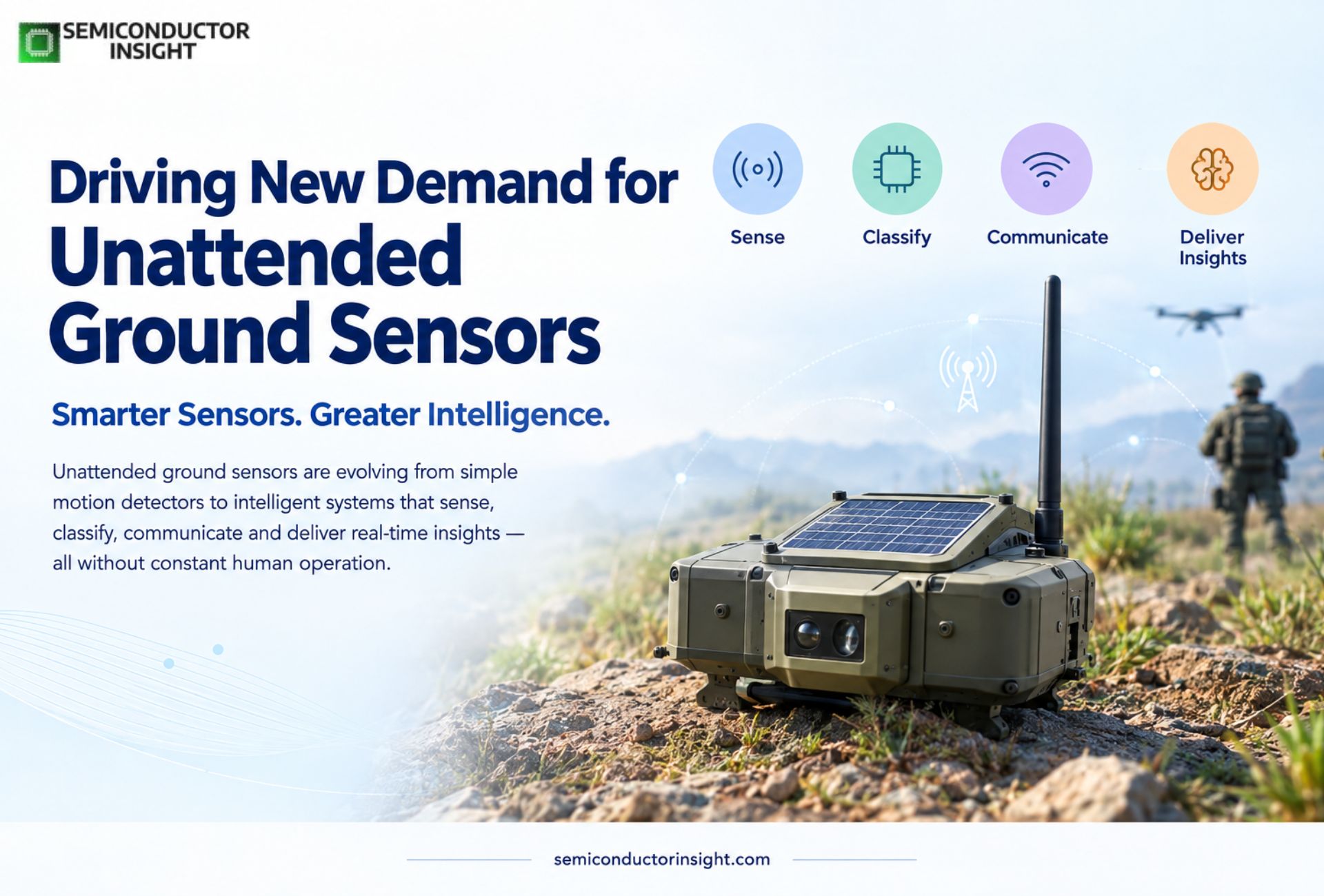
An unattended ground sensor, or UGS, is no longer simply a remotely positioned device waiting for movement. Modern systems are increasingly expected to sense, classify, communicate and contribute usable intelligence without continuous human operation.
- That evolution is closely connected to semiconductor progress.
- Smaller processors, MEMS-based sensing, low-power wireless connectivity and edge-computing hardware allow more functions to be packed into equipment designed for remote deployment.
- The U.S. Army has repeatedly demonstrated the importance of connecting ground sensors with other battlefield assets.
- During Project Convergence, Army teams explored architectures in which sensor information could move through networks and support faster decision-making rather than remaining isolated at the point of collection.
From Detection Device to Distributed Intelligence Node
The biggest change in UGS architecture is the movement from single-purpose detection toward distributed sensing.
A contemporary sensor node may combine seismic, acoustic, magnetic, infrared or imaging capabilities with a processor and communications module. Instead of sending every raw signal back to a command center, local processing can identify relevant events before transmission.
That matters in environments where bandwidth, power and communications reliability are limited. Army experimentation has specifically examined sensor networks operating under constrained-bandwidth conditions, including mobile ad-hoc mesh networking. One Army laboratory effort validated 45 radio systems in a virtual environment while examining network performance.
What Is Actually Inside a Modern UGS?
- The semiconductor content of an unattended ground sensor can be understood as a compact stack.
- At the sensing layer are MEMS accelerometers, microphones, magnetic sensors, image sensors or other detection components. A microcontroller or processor then filters the incoming signals.
- Additional memory handles local data storage, while wireless chips support transmission through appropriate communications networks.
- The trend toward edge processing is particularly important because it can reduce the amount of raw information that has to travel across a tactical network.
- NATO’s 2025 Integrated Air and Missile Defence Policy similarly emphasizes networked sensors, data fusion, advanced algorithms and potential use of artificial intelligence for developing a coherent operational picture.
A 20-Second Battlefield Is Changing Sensor Expectations
Speed has become an important design benchmark.
During early Project Convergence experimentation, the Army discussed reducing the time between identifying a target and engaging it to less than 20 seconds in a demonstration environment. The exercise incorporated information from satellites, airborne platforms and ground sensors into a connected architecture.
That concept changes the role of UGS technology. A sensor is valuable not simply because it detects something, but because its information can reach the right system quickly enough to influence a decision.
This is creating demand for sensors with faster processing, reliable communications and efficient event detection.
Explore the full report details in our recently refreshed edition anytime: https://semiconductorinsight.com/report/unattended-ground-sensor-market/
NATO Is Putting More Attention on Passive Detection
Another important development is the growing role of passive sensing.
In February 2025, NATO announced a multinational initiative involving 16 Allies focused on passive air surveillance, including technologies such as noise detection. NATO noted that passive systems can help identify threats that may not be detected effectively through active surveillance methods such as conventional radar and satellites.
For the UGS ecosystem, this highlights the value of low-signature sensing technologies that can observe activity without continuously broadcasting a detectable signal.
Project Convergence Is Becoming a Real-World Technology Testbed
- The U.S. Army’s Project Convergence Capstone 5 in 2025 brought together U.S. services and multinational partners for realistic experimentation involving next-generation command-and-control capabilities.
- The exercise was organized around integrating forces, equipment and technologies across operationally relevant distances.
- This type of experimentation is important for UGS manufacturers because the sensor itself is only one component of a larger architecture.
- Interoperability, data formatting, communications and command-and-control integration can determine whether a sensor becomes operationally useful.
The Semiconductor Opportunity Is Moving Toward Ultra-Low-Power Intelligence
Battery life is one of the least visible but most important design constraints for unattended systems.
A sensor that consumes too much energy cannot remain deployed for long periods without maintenance. This places greater emphasis on low-power processors, sleep modes, efficient radios and event-triggered operation.
The next generation of UGS hardware is therefore likely to emphasize more computation per watt rather than simply more computation. This creates opportunities for semiconductor suppliers working on microcontrollers, edge AI processors, MEMS devices, power-management ICs, memory and secure communications components.
Why Sensor Fusion Is Becoming the New Battlefield Language?
A single sensor can provide an observation. Multiple sensors can provide context.
Army experiments have progressively focused on connecting sensors, decision-making systems and effectors into a broader sensor-to-shooter architecture.
That makes sensor fusion increasingly valuable. Acoustic information can complement seismic detection; magnetic signatures can strengthen vehicle identification; thermal information can add another layer of confirmation.
For UGS manufacturers, the competitive question is therefore shifting from “Can the sensor detect movement?” to “Can the system produce useful information from several imperfect signals?”
The 2026 UGS Story Is Really About Smarter Nodes
- The strongest transformation in the Unattended Ground Sensor Market is happening beneath the visible hardware.
- Miniaturized semiconductor components are allowing sensing, processing, storage, communications and increasingly sophisticated analytics to occupy a much smaller tactical footprint.
- At the same time, military experimentation is pushing these devices into interconnected architectures rather than treating them as isolated field equipment.
- NATO’s recent emphasis on networked sensors, passive surveillance and data fusion, combined with continuing U.S.
- Army experimentation around sensor-to-shooter connectivity, shows why UGS technology is moving toward persistent, distributed and increasingly intelligent battlefield awareness.
For the semiconductor industry, that makes UGS an especially interesting application area: the future value of the sensor may depend less on its physical size and more on how much intelligence can be embedded inside that small footprint.

Comments (0)