
What Hard Disk Drives Market Tells Us About the AI Boom?
Hard Disk Drives (HDD) Market refers to the global industry involved in the design, manufacturing, distribution, and application of hard disk drives, which are data storage devices used to store and retrieve digital information using magnetic recording technology.
A hard disk drive is a non-volatile storage device that stores data on rotating magnetic disks (platters) and retrieves it using a moving read/write head. HDD market, therefore, includes everything from component manufacturing to large-scale deployment of these drives across different industries.
Take a Quick Glance at Our In-Depth Analysis Report: https://semiconductorinsight.com/report/global-hard-disk-drives-hdds-market/
Growing Demand Creates Long Lead Times for Storage Procurement
Walk into any enterprise data centre right now. You will hear the same phrase: Sold out. This isn’t a normal supply hiccup. This is a structural meltdown.
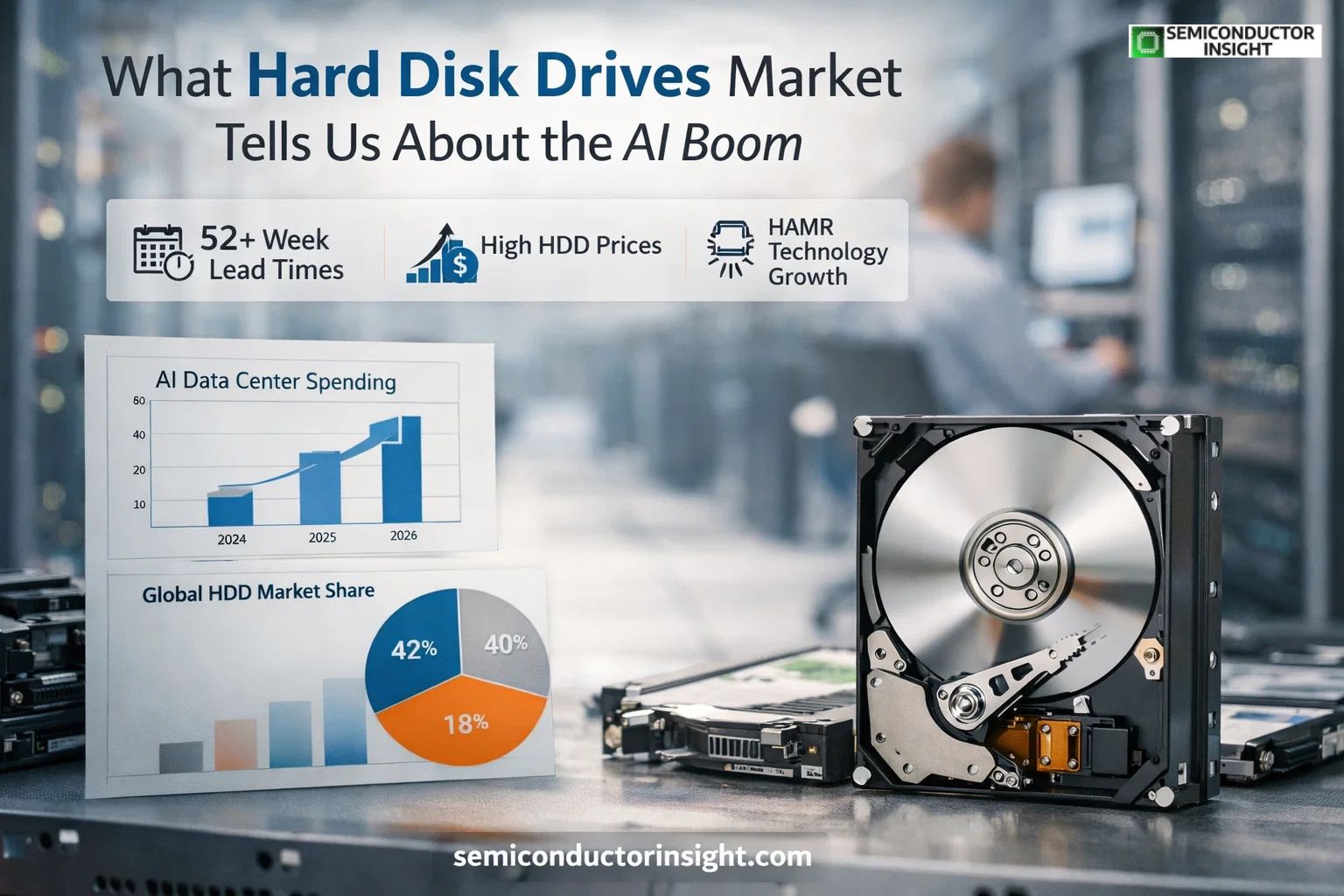
Western Digital, which holds roughly 42% of the market, has publicly stated they are pretty much sold out for the entire calendar year of 2026. Their top seven customers have signed long-term agreements extending all the way to 2028. Seagate, holding about 40% of the market, is in the same boat.
- Lead times for enterprise near line drives have exploded from a few weeks to over 52 weeks.
- Average selling prices for HDDs are at their highest point since 1998.
- Demand in certain segments has surged by 25%, but production of drive heads is stuck at 55-week lead times.
Why the shortage? The AI data centre boom. Hyperscaler allocated roughly 15-20% of their record USD 315 billion capital budgets to storage infrastructure in 2025. They are buying every spinning platter they can find.
Top 3 Major Key Players
- Western Digital Corporation
Based in the US, WD is currently the volume leader. They recently split their business, keeping the HDD division separate from SanDisk (SSDs). They are aggressively pushing HAMR technology and just reported shipping 215 exabytes in a single quarter up 22% year over year.
- Seagate Technology Holdings plc
Seagate is the innovator. They were the first to ship HAMR-based drives commercially. While WD focuses on volume, Seagate often leads in raw areal density (how much data fits on a single platter). They are the go-to for the largest hyperscalers like AWS and Microsoft.
- Toshiba Corporation
The quiet giant. Toshiba is the primary supplier for many Asian markets and specific enterprise niches. While smaller than the US duo, they remain critical for maintaining any semblance of competition in Hard Disk Drives market.
High Performance Storage Evolution in the Era of Data Surge
Here is where the silicon meets the spinning metal. To keep up with demand, HDDs needed a semiconductor-level breakthrough. That breakthrough is called HAMR (Heat-Assisted Magnetic Recording).
The physics is wild. To write data onto a tiny spot of a disk, a laser diode (a semiconductor chip) heats the material to hundreds of degrees for a nanosecond. This allows the magnetic bits to shrink beyond physical limits. Both Seagate and Western Digital are now shipping HAMR drives, targeting capacities of 50TB and beyond, with roadmaps pointing to 100TB per drive.
- 5-inch drives currently dominate, contributing 65.62% of market revenue, growing at nearly 9.29% annually.
- HAMR shipments are expected to grow at a staggering 16.98% CAGR through 2031.
- We went from 2 kbit per square inch on the IBM RAMAC in 1957 to 60 Gbit per square inch today. That is a 30 million-fold increase. Semiconductors made that possible.
How Legacy Information Fuels Next Generation Intelligence
- You might wonder: if AI is so fast, why use a slow hard drive? Because not all data is hot. In the world of AI, 80% of data is cold or warm. It is the training data you only need once, the backups, the surveillance footage from last month, the log files.
- Western Digital recently noted that market research shows 80% of storage inside data centres is still on HDDs. Why? Total Cost of Ownership (TCO).SSDs cost between 5x and 10x more per terabyte. When you are building an exabyte-scale data centre, those dollars add up to billions.
- India is a perfect case study. The country currently has over 1 gigawatt of data centre capacity and is projected to hit 2GW in 2026, requiring over $30 billion in Capex. That is not flash memory. That is massive HDD arrays.
Decoding 2027 Trends Shaping Industry Evolution
Do not expect relief anytime soon. The industry is in a seller’s market that is projected to persist through 2027. Suppliers are receiving less than 50% of their requested wafer allocations for controller chips, and the demand for AI infrastructure shows no sign of slowing down.
What to watch?
The shift toward near-shoring of final assembly in Asia-Pacific and North America.
The battle between SATA, SAS, and NVMe interfaces for the next generation of backplanes.
Hard Disk Drives market used to be boring. Now it is the bottleneck of the digital economy. And that 52-week waitlist? It is the sound of the future being written, one spinning platter at a time.

Comments (0)