
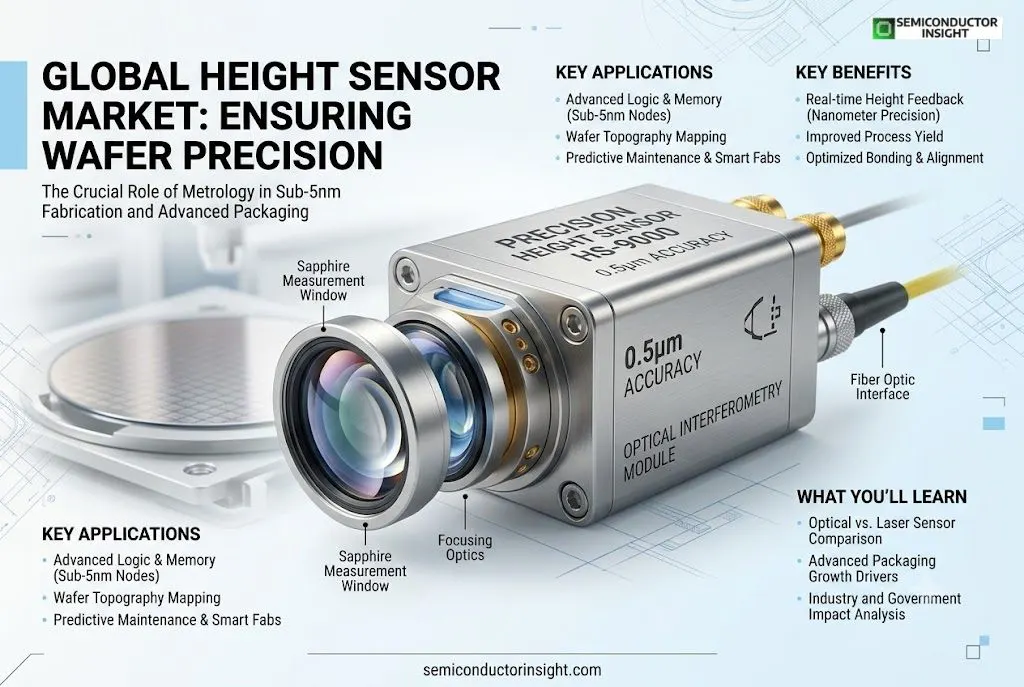
What Did SEMICON West 2026 Reveal About Next-Gen Height Sensors?
The global semiconductor ecosystem relies on a vast network of specialized equipment, and one of its most vital components is the height sensor. As semiconductor fabrication becomes increasingly complex, the global market for precision height sensors is seeing substantial growth.
The overall precision semiconductor measurement systems market, which includes height sensors, is estimated to be valued at approximately $15.9 billion in 2026, reflecting a compound annual growth rate (CAGR) of 7.40%. This growth isn’t just about numbers; it represents the industry’s shift toward sub-5nm nodes and advanced packaging, where even a nanometer-level deviation can determine a chip’s success or failure.
Why is Wafer Height Measurement So Critical?
At its core, the purpose of a height sensor in semiconductor manufacturing is to serve as the eyes of the fabrication process. These sensors are deployed to execute high-precision, non-contact topography mapping of wafers. As wafers are processed through photolithography, etching, and deposition, they can warp, bend, or present uneven surfaces. If these surface irregularities remain undetected, the subsequent layers of circuitry will be misaligned, leading to catastrophic device failure.
Therefore, the primary mission of a height sensor is to provide real-time feedback to ensure that every subsequent manufacturing step occurs on a perfectly level plane. For example, in advanced packaging, technologies like chiplets and Through-Silicon Vias (TSVs) require ‘micron-level accuracy’ to verify bonding and alignment. Without height sensors, the stacking of these 3D ICs would be impossible.
Optical vs. Laser Methods: How Do They Work?
The industry utilizes diverse optical methods, each with specific advantages. In a competitive landscape, 3D Laser Triangulation remains popular due to its rapid speed, capable of processing up to 1,000 measurements per second.
However, photonic sensory cameras are gaining ground for their superior resolution, achieving accuracy up to 0.5 microns and utilizing advanced interferometry to measure minute height changes.
Where Are Height Sensors Used?
1. Advanced Logic and Memory
· The adoption of height sensors is spreading rapidly beyond leading-edge fabs.
· The rise of high-bandwidth memory (HBM) and heterogeneous integration means more sensors are required to measure stacked architectures and edge profiles to ensure reliability.
· The market for wafer edge measurement sensors alone is projected to grow from $189 million in 2025 to $258 million by 2032, underscoring the demand for edge detection in complex architectures.
2. Predictive Maintenance and Smart Manufacturing
· Height sensors are also integral to the smart factory movement.
· The U.S. Department of Energy estimates that predictive maintenance technologies can reduce maintenance costs by 25%-30% while lowering breakdowns by nearly 70%.
· According to NIST, real-time sensor monitoring can improve process efficiency by approximately 15%-20%, enabling fabs to predict equipment drift and adjust processes before yield loss occurs.
You Can Go Through Our Latest Updated Insights Here: https://semiconductorinsight.com/report/height-sensors-market/
Global Tech Developments
Recent trade shows provide a current snapshot of market activity. At SEMICON Japan 2025, major players like Advantest showcased test solutions tailored for AI and HPC. Similarly, at SEMICON West 2025, Onto Innovation debuted AI-enabled inspection technologies, while KLA Corporation rolled out AI-centric process-control for detecting nanoscale defects in GPUs.
These product launches highlight the convergence of artificial intelligence with height-sensing technology. Additionally, recent federal policies, such as the U.S. Infrastructure Investment and Jobs Act (IIJA), are providing billions in annual manufacturing construction investment, stimulating domestic demand for automated process instrumentation like height sensors.

Comments (0)