
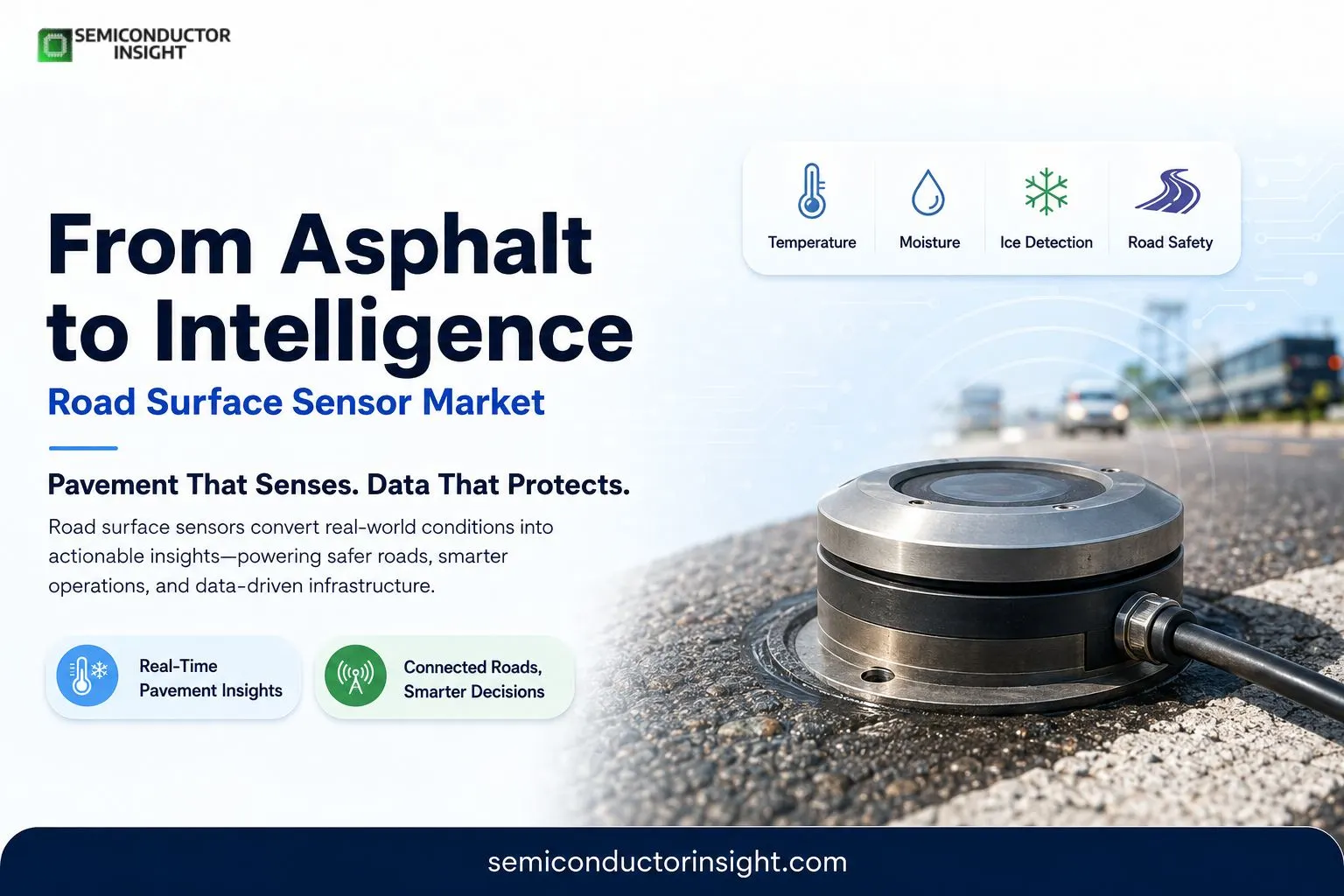
What Can Smart Pavement Detect? A 2026 Look at Road Surface Sensor Market
A conventional road is generally treated as passive infrastructure. A connected road is different. Its pavement can become a source of continuous information, reporting temperature, and moisture, ice, freezing conditions, chemical concentration and other surface characteristics to transportation operators.
- The U.S. Federal Highway Administration describes road-weather Environmental Sensor Stations as systems that can measure atmospheric, pavement and water-level conditions.
- Pavement measurements can include surface temperature, freeze point, wetness, ice, flooding, chemical concentration and subsurface conditions.
That makes road surface sensing an increasingly important intersection between semiconductor devices, embedded electronics, communications and intelligent transportation systems.
What sits underneath the asphalt intelligence?
- Road surface sensors are not a single technology. Depending on the application, sensing can involve thermal elements, optical devices, microwave systems, magnetic sensing, friction measurement and embedded electronic components.
- FHWA identifies both active and passive pavement sensors.
- Active systems transmit a signal and interpret the returned response, while passive systems detect energy naturally emitted or reflected from the environment.
- Some pavement-temperature sensors are buried in the road and designed with thermal characteristics similar to the pavement itself.
- For semiconductor manufacturers, this creates demand for compact sensing, signal-conditioning, processing and communication components capable of operating in harsh outdoor conditions.
A road sensor has a much bigger job than temperature detection
A modern road surface monitoring architecture can be visualized as:
Pavement → Sensor → Signal conditioning → Microprocessor → Wireless/roadside communication → Control centre → Warning or maintenance action
The important shift is that the sensor is no longer the final product. Its value comes from converting a physical road condition into an actionable digital signal.
For example, when pavement temperature approaches freezing, the information can support an anti-icing decision before hazardous ice develops. FHWA notes that road-weather systems combine pavement and atmospheric observations with forecasting to support winter maintenance decisions.
The sensing layer is getting more diverse
- The road surface can now be observed through multiple sensing approaches rather than one fixed detector.
- FHWA lists embedded pavement sensors, friction-measuring devices, cameras and microphones among technologies capable of monitoring pavement conditions.
- Mobile sensing systems can also measure pavement temperature and friction while vehicles move along road sections.
Fixed sensors + mobile sensors + cameras + weather stations + connected vehicles = broader road-condition intelligence
- Instead of asking what is happening at one sensor location, transportation authorities can increasingly build a more detailed picture of an entire route.
The numbers behind a connected sensing point
The physical installation of these systems is surprisingly specific. FHWA siting guidance recommends, for example, that optical precipitation sensors can be installed at approximately 3 metres above the ground, while snow-depth sensors can be positioned around 1 metre above the surface. Pavement sensors can be placed where conditions represent broader road behaviour or where hazards such as black ice and flooding are particularly likely.
These details matter to semiconductor components because sensor accuracy depends not only on the chip but also on installation position, environmental exposure, vibration, thermal behaviour and calibration.
India is moving toward data-rich highway management
India provides another current example of the broader infrastructure transition. The government’s Smart Cities Mission reported that all 100 participating cities had Integrated Command and Control Centres, while 8,067 projects were part of the mission and 94% had been completed by June 2025. These centres use technologies including AI and IoT for city management.
Meanwhile, India’s national highway ecosystem is increasingly incorporating AI-based traffic and incident-management technologies. In December 2025, the government described planned Advanced Traffic Management Systems using AI-based video incident detection, automatic number-plate recognition and surveillance systems.
Although these systems are broader than pavement sensing, they establish the digital infrastructure into which road-surface data can increasingly feed.
You can freely browse our most recent updated report to learn more about it before scrolling further: https://semiconductorinsight.com/report/road-surface-sensor-market/
Why edge processing matters at the roadside?
A sensor installed beside or inside a highway cannot always depend on sending every raw measurement to a distant cloud server. Local processing can identify meaningful events first such as an abnormal temperature drop, wet pavement or suspected icing and transmit only the relevant information.
This makes low-power microcontrollers, analogue-to-digital converters, communication chips and edge processors increasingly relevant to road-surface sensing architectures.
The result is a new hierarchy:
Sense → Interpret → Prioritize → Communicate → Act
That is fundamentally different from simply recording pavement measurements.
The next road sensor is likely to be less visible but more intelligent
- The direction of Road Surface Sensor Market is moving toward smaller electronics, multi-parameter sensing, wireless connectivity, mobile detection and predictive analytics.
- FHWA’s road-weather program already integrates fixed environmental stations, mobile sensing and remote observation into broader transportation decision-making.
- The most significant change is therefore not the number of sensors placed into roads. It is what happens after the measurement is captured.
- A temperature reading becomes a freezing-risk alert. A moisture signal becomes a maintenance trigger. A friction measurement becomes a safety indicator. And a collection of individual readings can become a digital representation of roadway conditions.
For the semiconductor industry, that makes the road surface an emerging distributed sensing environment where tiny electronic components can influence decisions involving winter maintenance, traffic safety, infrastructure monitoring and intelligent mobility.

Comments (0)