
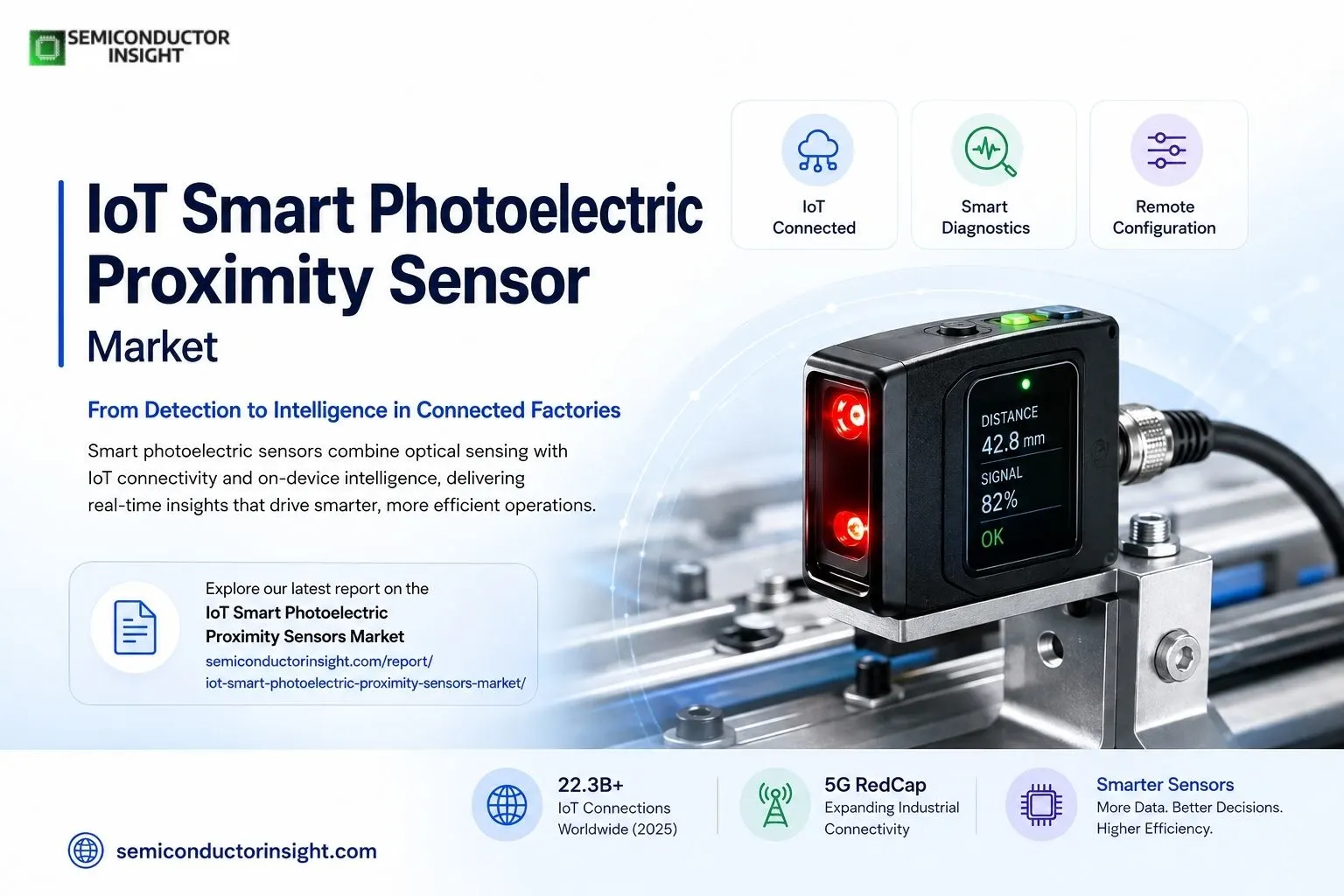
What 22 Billion IoT Connections Mean for the IoT Smart Photoelectric Proximity Sensors Market?
An IoT smart photoelectric proximity sensor combines optical detection with electronics capable of processing, communicating or transmitting information about an object’s presence, position, distance or movement. Traditional photoelectric sensors primarily answer one question: is an object there? The smart version can provide additional information to a PLC, industrial gateway, edge computer or cloud platform.
This difference is becoming increasingly important as factories move from isolated automation components toward connected production systems. A photoelectric sensor can now become one of many small data-generating nodes distributed across a production line.
The Sensor Is Moving Closer to the Decision
The basic sensing chain is changing from a simple detection circuit into a miniature information system.
Light emitter → Object interaction → Photodetector → Signal conditioning → MCU/ASIC → Connectivity → PLC/Edge system → Production decision
This architecture allows semiconductor components such as photodiodes, laser emitters, amplifiers, microcontrollers, ADCs and communication interfaces to work together inside a compact sensing device.
The importance of this architecture becomes clearer when looking at the wider IoT ecosystem. Ericsson reported approximately 22.3 billion IoT connections globally at the end of 2025, including 4.5 billion cellular IoT connections and around 17.5 billion short-range connections.
4.5 Billion Cellular Connections Change the Connectivity Equation
- Industrial sensors historically depended heavily on wired fieldbus networks or local PLC connections. That model is now being complemented by wireless and edge connectivity.
- Ericsson estimates that broadband and critical IoT accounted for approximately 2.6 billion cellular connections in 2025. It also reports that 14 service providers had commercially launched 5G RedCap across multiple markets, while 42 providers in 27 countries were investing in the technology.
- For smart photoelectric sensors, the relevance is not that every sensor will directly use cellular connectivity. Instead, increasingly capable gateways can aggregate data from numerous sensors and send selected information upstream.
What Makes a Photoelectric Sensor Smart?
The next generation is being differentiated by what happens after detection. Industrial users increasingly expect diagnostics, parameterization and communication rather than only an ON/OFF output.
Three capabilities are particularly important:
- Self-monitoring: The sensor can identify contamination, signal degradation or abnormal operating conditions.
- Remote configuration: Parameters can be adjusted through an industrial network rather than manually changing the device.
- Data availability: Detection events and diagnostic information can be supplied to automation software for production monitoring.
IO-Link is particularly relevant here because it allows sensors and actuators to exchange process and diagnostic data with automation systems rather than restricting communication to conventional switching signals.
Automotive Production Is an Important Testing Ground
Automotive factories are among the most demanding environments for photoelectric sensing because production lines contain high-speed conveyors, robotic cells, body assembly stations and battery manufacturing equipment.
Sensors may detect components, verify positioning, count parts or confirm whether an assembly step has occurred. In EV production, the sensing layer becomes even more important as manufacturers introduce new battery and power-electronics processes.
This creates a direct connection between sensor semiconductor technology and the broader EV semiconductor ecosystem.
Our most recent updated related study is available for free at this link: https://semiconductorinsight.com/report/iot-smart-photoelectric-proximity-sensors-market/
Does Tesla Use Silicon Carbide?
Yes, Tesla has used silicon carbide in its electric-vehicle power electronics, most notably in the Model 3 traction inverter. A peer-reviewed review published through Springer Nature identifies the Tesla Model 3 as using a SiC MOSFET inverter containing 24 SiC MOSFET chips, with the devices arranged to support high-current operation.
A separate peer-reviewed analysis in the International Journal of Energy Research identifies the 2018 Tesla Model 3 inverter as using 24 SiC MOSFET devices supplied by STMicroelectronics, contrasting it with earlier Tesla Roadster, Model S and Model X architectures that used silicon IGBTs.
The connection to smart proximity sensing is indirect but important. EV manufacturing requires large numbers of sensors around automated equipment handling batteries, motors, electronic modules and structural components. At the same time, SiC power electronics increases the semiconductor content of the vehicles being produced.
SiC Is Also Moving Into New Automotive Power Designs
- The technology continues to advance. In May 2026, Infineon introduced a 1,300 V SiC power module for EV inverters capable of continuous operation at temperatures up to 205°C, compared with 175°C for its existing designs.
- That development matters for the sensor ecosystem because higher-performance power electronics, battery systems and manufacturing equipment all increase the need for precise thermal, position and process monitoring.
The New Value Is in Data, Not Just Detection
The IoT smart photoelectric proximity sensor is gradually becoming a bridge between the physical production line and industrial software.
A machine no longer needs to wait for a failure before generating information. A connected sensor can provide an early indication that optical performance is deteriorating, a component is arriving incorrectly, or a production sequence is deviating from its expected condition.
With 22.3 billion IoT connections already estimated for 2025, expanding 5G RedCap deployment and increasingly sophisticated semiconductor integration, the photoelectric proximity sensor is moving from being a simple factory component toward becoming a distributed source of machine intelligence.

Comments (0)