
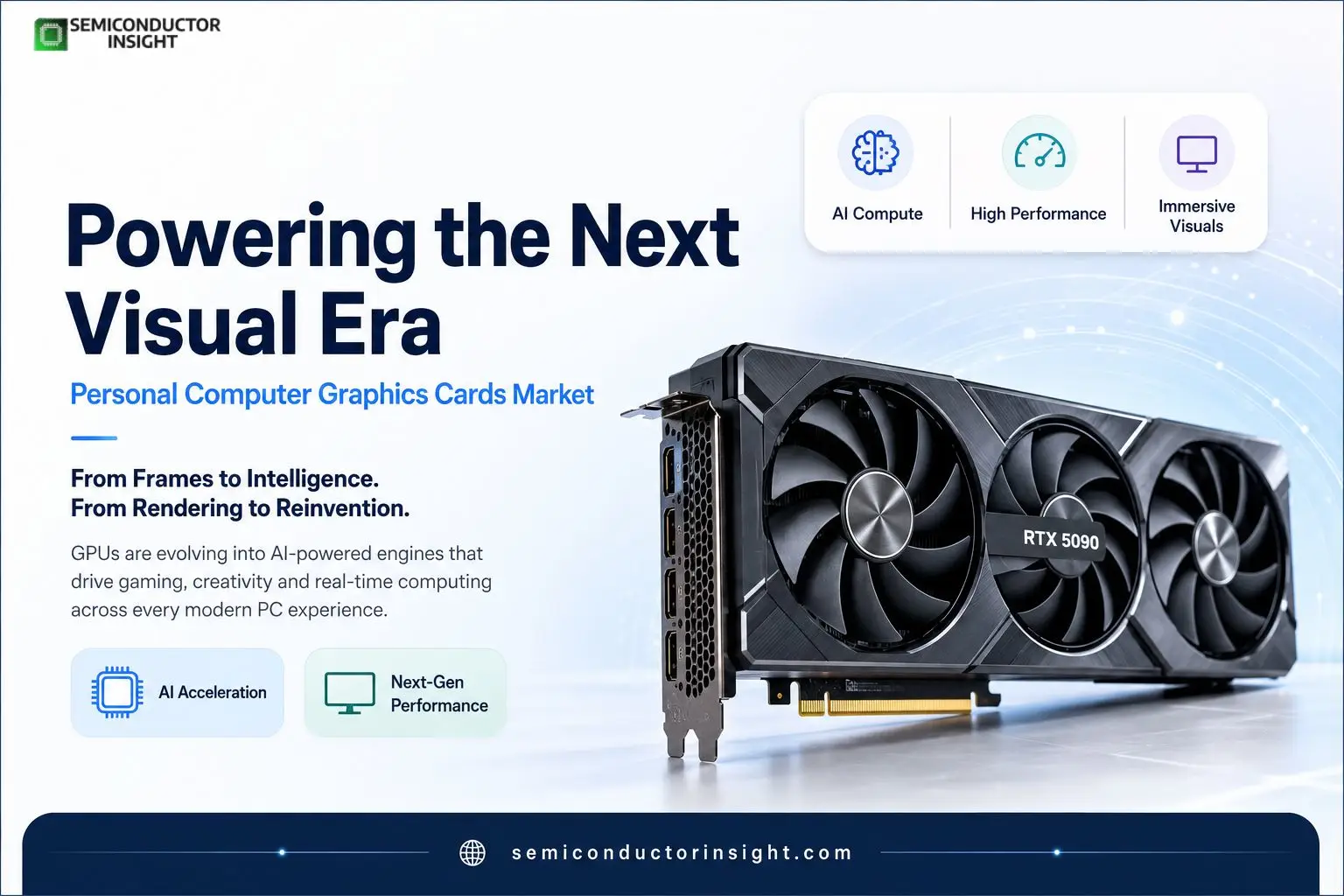
Personal Computer Graphics Cards Market 2026: What 16 GB and 32 GB GPUs Mean for Modern PC Workloads
The personal computer graphics card is no longer simply a component responsible for pushing more frames onto a monitor. Modern GPUs have become parallel computing engines handling ray tracing, AI inference, video encoding, image reconstruction and increasingly demanding creative workloads.
That transition is reshaping Personal Computer Graphics Cards Market in 2026, with new generations competing not only through raw graphics performance but also through memory capacity, neural processing and software-assisted rendering.
- Steam’s June 2026 Hardware Survey provides a useful view of real-world PC adoption.
- DirectX 12-capable GPUs represented 91.74% of surveyed video cards, while several newer GeForce models were already appearing prominently in the installed base.
- The RTX 5070 accounted for 3.29%, RTX 5060 for 2.81%, RTX 5060 Laptop GPU for 2.48%, and RTX 5060 Ti for 2.26% of reported video cards.
The GPU Specification Sheet Is Becoming a Technology Map
The most revealing change is the number of specialized processing blocks being incorporated into one graphics processor. NVIDIA’s RTX 5090, for example, contains 21,760 CUDA cores, 5th-generation Tensor Cores, 4th-generation Ray Tracing Cores, 32 GB of GDDR7 memory and a 512-bit memory interface.
That specification tells a broader story. Graphics cards are increasingly designed around several simultaneous workloads rather than conventional rasterization alone.
GPU workload evolution
Rasterization → Ray Tracing → AI Upscaling → Neural Rendering → Generative AI
Each stage adds another reason for consumers, developers and creators to evaluate GPUs on capabilities beyond conventional frame-rate measurements.
GDDR7 Turns Memory into a Bigger Performance Conversation
Memory has become one of the most closely watched specifications in new graphics cards. The RTX 5090 combines 32 GB GDDR7 with a 512-bit interface, while the RTX 5080 uses 16 GB GDDR7 and a 256-bit interface. NVIDIA’s RTX 5060 carries 8 GB GDDR7 on a 128-bit interface.
AMD is taking a different route with its RDNA 4 generation. The Radeon RX 9070 XT provides 16 GB GDDR6, 64 compute units, 64 ray accelerators, 128 AI accelerators and a 256-bit memory interface.
The practical implication is important: game developers are increasingly designing assets for higher resolutions, complex lighting and larger texture workloads, making VRAM capacity an increasingly visible part of the purchasing decision.
AI Is Moving From the Cloud onto the Gaming PC
One of the most significant developments is the convergence of gaming GPUs and AI processors. NVIDIA’s RTX 50 family uses Tensor Cores for AI workloads and supports DLSS 4 technologies, while AMD’s RDNA 4 architecture adds dedicated AI accelerators and FSR 4.
This changes how performance itself is measured. Instead of rendering every final pixel traditionally, the GPU can combine lower-resolution rendering with AI-generated frames or reconstructed imagery. NVIDIA’s RTX 5090, for instance, is specified at 3,352 AI TOPS, demonstrating how AI throughput has become a headline GPU specification alongside traditional graphics performance.
To Know More about the Report, You Can Freely Browse Our Latest Updated Report: https://semiconductorinsight.com/report/personal-computer-graphics-cards-market/
A New Middle Segment Is Emerging Around 1080p and 1440p
The latest mainstream GPUs show manufacturers are not focusing exclusively on ultra-premium cards. NVIDIA’s RTX 5060 launched with 3,840 CUDA cores and 8 GB GDDR7, while AMD’s RX 9060 XT family includes 32 compute units and configurations with 8 GB or 16 GB of memory.
This segment matters because 1080p and 1440p remain important PC gaming resolutions. New AI-assisted rendering technologies allow these cards to target higher visual quality without requiring every frame to be generated entirely through conventional rendering.
Intel Adds another Layer to the GPU Landscape
Intel’s Arc B580 demonstrates that the desktop graphics card ecosystem is not limited to two major GPU architectures. The B580 uses the Xe2 architecture, 20 Xe-cores, 20 ray-tracing units, 160 XMX engines, 12 GB GDDR6, and 456 GB/s of memory bandwidth. It also supports hardware AV1 encoding and decoding.
The importance goes beyond one model. Additional architectural competition gives PC builders more choices around memory capacity, media engines, AI acceleration and display connectivity.
The Display Pipeline Is Moving With the GPU
Modern graphics cards are also becoming high-bandwidth display platforms. NVIDIA’s current RTX 50 lineup supports configurations reaching 4K at 480 Hz or 8K at 165 Hz with DSC, while Intel’s B580 supports up to 7680 × 4320 output through compatible interfaces.
This reflects a broader hardware relationship:
GPU → Memory → Rendering Engine → Display Interface → High-Refresh Monitor
As high-refresh 1440p and 4K monitors become more capable, graphics cards increasingly have to balance rendering throughput, memory bandwidth and display-output capacity simultaneously.
The Installed Base Shows Why Generational Change Takes Time
The June 2026 Steam data also shows that new GPUs coexist with several older generations. RTX 3060 remained at 3.88%, RTX 4060 at 3.65%, and GTX 1650 at 2.63% of reported video cards.
That creates an unusual market dynamic. Cutting-edge architectures can introduce AI rendering and advanced ray tracing, while millions of existing PCs continue operating on older hardware. Consequently, developers must support a wide performance spectrum, and GPU manufacturers must make each generation useful across both new and established gaming systems.
Where the Graphics Card Is Heading Next?
The most important change in Personal Computer Graphics Cards Market is therefore not simply more cores or higher clock speeds. The graphics card is becoming a hybrid graphics-and-AI processor, combining traditional rendering, ray tracing, neural computation, video processing and high-bandwidth memory within one expansion platform.
The arrival of RTX 50, Radeon RX 9000 and Intel Arc B-series products shows how quickly this architecture is evolving. With 32 GB flagship memory configurations, dedicated AI engines, increasingly sophisticated reconstruction technologies and a large installed base still using previous generations, the PC graphics card is becoming less of a standalone gaming component and more of a general-purpose visual computing engine.

Comments (0)