
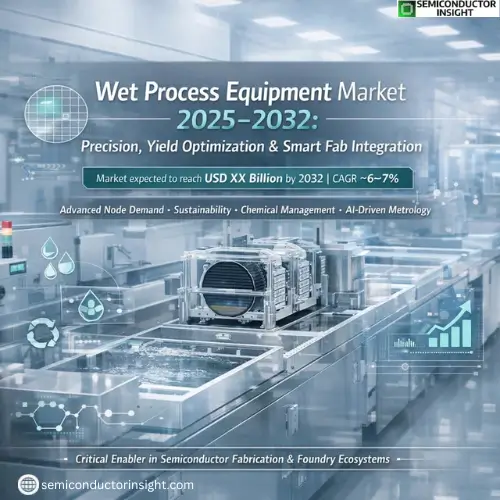
Wet Process Equipment Market Dynamics Enhance Semiconductor Fabrication, Elevate Growth Forecasts
In semiconductor fabrication, precision and cleanliness are everything. Wet process equipment including chemical baths, etching systems, wafer cleaning stations, and plating units forms the backbone of high-quality wafer processing. These systems ensure contamination-free surfaces, uniform etch rates, and reliable deposition of materials. As chip architectures grow denser and fabrication nodes shrink, the demand for highly accurate and efficient wet process tools continues to escalate.
Wet processing, in contrast to dry etch systems, and is highly dependent on chemical interactions, fluid dynamics, and process stability; hence, equipment selection and upkeep are crucial for production yield. Manufacturers increasingly invest in automation, real-time monitoring, and advanced metrology integration to minimize variability.
Wet process equipment market encompasses machinery and integrated systems used for etching, cleaning, plating, and stripping of semiconductor wafers. It spans multiple semiconductor fabrication stages, from front-end processing to back-end packaging, and serves foundries, IDM (Integrated Device Manufacturers), and specialty chipmakers.
Key segments include:
- Wafer cleaning and surface prep systems
- Electrochemical deposition equipment
- Etching and stripping solutions
- Post-process rinse and drying units
Each of these contributes directly to yield optimization, defect reduction, and enhanced device reliability, making wet process equipment indispensable in modern semiconductor fabs.
Current Industry Trends Shaping the Market
Several trends are accelerating wet process equipment adoption globally:
- Advanced Node Requirements: With the rise of 5nm and 3nm nodes, fabs require ultra-precise chemical delivery and surface uniformity. Wet process tools now incorporate AI-assisted flow control and predictive maintenance to meet these demands.
- Sustainability Pressure: Semiconductor manufacturers are under increasing pressure to reduce water consumption, chemical waste, and energy usage. Equipment providers are integrating closed-loop chemical recycling and water-saving technologies.
- High-Mix, Low-Volume Manufacturing: Specialized chips for AI, automotive, and IoT applications are driving fabs to adopt flexible wet process platforms capable of handling different wafer sizes, chemistries, and production volumes.
Import and Export Trends Impacting Equipment Suppliers
The global wet process equipment market is closely tied to semiconductor trade flows. Asia-Pacific remains a dominant importer, with countries like Taiwan, South Korea, and China investing heavily in advanced fabrication lines. Conversely, Europe and North America lead in equipment exports, with major players supplying precision systems worldwide.
Recent data indicates:
- China imported approx. $1.2B worth of wafer processing equipment in 2025, emphasizing rapid capacity expansion.
- Japanese and U.S. manufacturers dominate the high-end etching and plating segment, benefiting from technological expertise and long-standing fab relationships.
To Know More about the Report, You Can Freely Browse Our Latest Updated Report:
https://semiconductorinsight.com/report/wet-process-equipment-market/
Regulatory and Compliance Considerations
Wet process equipment falls under strict environmental, chemical handling, and safety regulations. Manufacturers must ensure compliance with:
- Local chemical discharge limits
- Worker safety standards for handling strong acids and solvents
- International export controls for dual-use or high-tech equipment
Fabs increasingly prefer equipment certified for compliance with ISO and local environmental standards, as regulatory scrutiny continues to tighten.
Advantages and Challenges in Adoption
Advantages:
- High throughput for precision cleaning and etching
- Improved wafer yield and defect reduction
- Scalability for advanced node production
Challenges:
- High initial capital investment
- Ongoing chemical handling and waste management costs
- Need for skilled operators and service engineers
These factors influence fab decision-making and underline the importance of total cost of ownership analysis when selecting wet process systems.
Emerging Innovations
The next generation of wet process equipment focuses on integration with smart fabs. Key developments include:
- Automated chemical delivery with AI-driven process optimization
- Inline defect detection and wafer mapping
- Energy-efficient rinse and drying technologies
- Hybrid platforms combining wet and dry processing for compact fab layouts
With semiconductor demand surging due to AI accelerators, automotive electronics, and IoT devices, the wet process equipment market is poised for steady growth, with compound annual growth rates expected to exceed 6-7% globally through 2030.
Investor Takeaways
- The market is capital-intensive but resilient, offering consistent demand from both leading foundries and specialty chipmakers.
- Long-term relationships with fabs, integration of eco-friendly chemistries, and advanced automation are key differentiators for equipment suppliers.
- Growth opportunities are strongest in regions with expanding semiconductor fabrication capacity, particularly in Asia Pacific and North America.
- High-end wet process equipment integrates AI, IoT, and chemical recirculation systems.
- Market leaders: Tokyo Electron, Lam Research, Applied Materials, SCREEN Semiconductor Solutions.
- Asia Pacific leads in adoption, North America and Europe dominate exports.
Wet process equipment market exemplifies how precision semiconductor tools underpin modern chip production. With innovation, regulatory compliance, and sustainability at the forefront, this sector continues to grow, strengthening the foundation of the global semiconductor ecosystem.

Comments (0)