

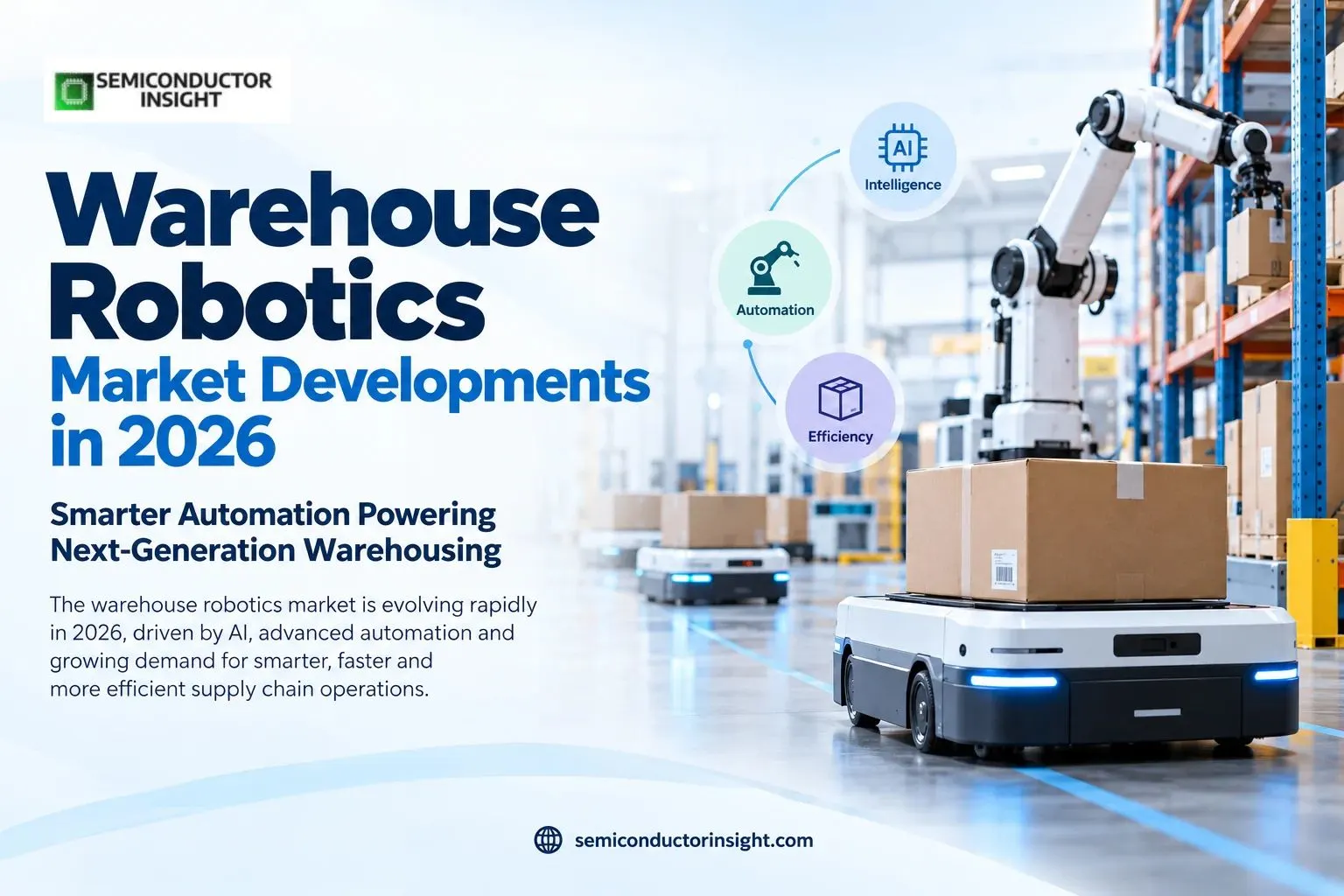
Warehouse Robotics Market Developments in 2026 Reveal a New Phase of Intelligent Fulfilment
Warehouse robotics is moving beyond basic conveyor systems and programmed material handling. E-commerce fulfillment centers, retail distribution networks, manufacturers and third-party logistics providers are adopting autonomous mobile robots (AMRs), robotic picking arms and automated storage systems to manage increasingly complex order flows. These technologies connect physical movement with warehouse management software, allowing operators to coordinate inventory, replenishment, picking and dispatch with greater precision.
The shift is not simply about replacing manual tasks. Businesses are building facilities where people and machines can work together, particularly in operations involving repetitive lifting, long-distance movement and fluctuating order volumes.
The Numbers behind Logistics Automation
- The International Federation of Robotics reported in September 2026 that transportation and logistics accounted for approximately 117,500 professional service robots sold worldwide in 2025, representing 47% of the professional service robot market covered by its report.
- Total professional service robot shipments approached 250,000 units. These figures demonstrate the importance of material movement automation, although the category extends beyond warehouse-only robots.
- For warehouse operators, the practical implications include shorter travel distances for workers, more consistent replenishment and improved coordination between storage and packing.
- The return on investment depends on factors such as facility layout, order profiles, equipment utilization and integration costs rather than robot counts alone.
How AI Is Changing the Way Warehouses Operate?
Artificial intelligence is expanding the capabilities of warehouse robots through machine vision, path planning, object recognition and real-time task allocation. Instead of following only fixed routes, advanced autonomous systems can interpret their surroundings and adapt to changing conditions.
Robotic arms are also becoming more capable of handling products with different shapes, weights and packaging materials. This is especially relevant for e-commerce businesses managing thousands of stock-keeping units (SKUs), where conventional automation can struggle with irregular items. AI-assisted orchestration can help warehouse managers identify bottlenecks, prioritize urgent orders and balance workloads across workstations.
Warehouse Robotics News Today 2026
One of the major developments in 2026 came from Amazon’s June announcement of its next-generation Proteus autonomous robot. The company said the system would support employees by moving heavy carts and responding to conversational instructions.
- Amazon also announced expansion plans for its Vulcan robotic handling technology and STARK tote-handling system, with STARK planned for deployment across 15 European sites by 2027.
- The next-generation Proteus was being piloted, with European deployment planned for the first half of 2027.
DHL Supply Chain has also continued investing in robotics integration. In its March 2026 announcement, DHL described using SVT Robotics’ SOFTBOT platform to accelerate the integration of different automation technologies.
The company said its platform could enable robotics integrations up to 12 times faster than traditional custom-coded approaches. This highlights the growing importance of software compatibility alongside physical equipment.
These developments show why warehouse robotics news increasingly covers software, workforce collaboration and deployment strategies, rather than hardware launches alone.
For a more thorough report, please contact us using our most recent report: https://semiconductorinsight.com/report/ai-robotics-market/
Why Warehouse Layout Is Becoming a Technology Decision?
- Robot deployment increasingly influences how warehouses are designed and upgraded.
- Goods-to-person systems bring inventory to stationary picking employees, while AMRs transport shelves, totes or individual loads between designated work areas.
- Automated storage and retrieval systems use cranes, shuttles or robotic mechanisms to store and retrieve goods in compact spaces.
- Each approach suits a different operational requirement. High-volume facilities with predictable product flows may benefit from fixed automation, while businesses managing seasonal demand or changing product ranges may prefer flexible mobile systems.
- Older warehouses can also adopt selected robotic applications without completely rebuilding their infrastructure.
The Semiconductor Technology behind Smarter Robots
Warehouse robotics depends on semiconductor components that enable reliable sensing, movement and decision-making. Image sensors and processors support machine vision, while microcontrollers and power-management chips coordinate motors, batteries and control systems. Connectivity chips help robots exchange information with warehouse networks, fleet-management platforms and inventory software.
The growth of AI-assisted picking also increases the importance of computing performance at the edge, where robots need to process visual information and respond quickly to nearby obstacles. Reliable electronic components are therefore essential to robot accuracy, energy efficiency and uptime.
For semiconductor suppliers, logistics automation represents an application area spanning processors, sensors, motor-control electronics, memory and industrial connectivity. Component selection depends on environmental conditions, processing requirements, operating temperatures and expected service life.
What Businesses Should Measure Before Expanding Robot Fleets?
Successful automation requires operational evidence rather than relying on the number of robots purchased. Businesses should evaluate several measurable indicators before scaling deployment.
- Orders processed per hour and average picking time per order.
- Robot utilization, battery downtime and maintenance frequency.
- Inventory accuracy, picking errors and damaged-item rates.
- Integration time across warehouse management systems and existing equipment.
- Cost per order, peak-season throughput and return on investment.
These measures help distinguish a successful pilot from a system that can operate reliably across multiple facilities. They also reveal whether a warehouse needs additional robots, better software orchestration or changes to its picking and replenishment processes.
The Next Deployment Wave Will Depend on Flexibility
Warehouse robotics is entering a phase in which adaptability matters as much as speed. AI-enabled mobile robots, more capable robotic manipulators and software platforms that connect equipment from different suppliers are changing how businesses approach fulfillment. Amazon’s announced European expansion and DHL’s focus on faster system integration illustrate two complementary priorities: expanding automation capacity and making new technologies easier to deploy.
For warehouse operators and semiconductor manufacturers, the opportunity lies in understanding which applications deliver measurable operational improvements. Facilities that align robot capabilities with real order patterns, workforce needs and infrastructure requirements will be better positioned to make automation a lasting part of their supply chains.

Comments (0)