

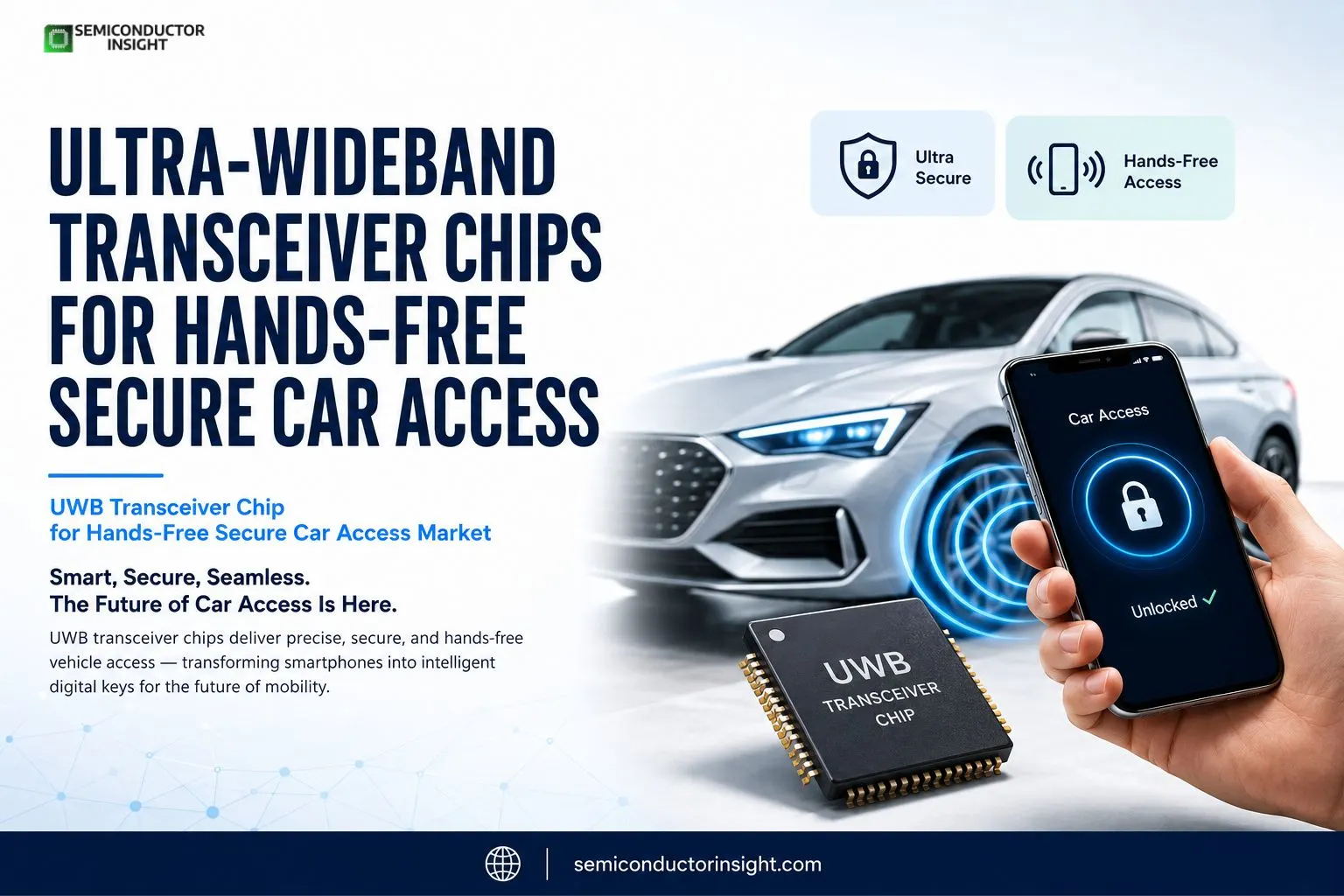
UWB Transceiver Chips Powering Hands-Free Secure Car Access: Semiconductor Innovations Transforming Vehicle Entry in 2026
Ultra-wideband transceiver chips are quietly reshaping how drivers interact with their vehicles, turning smartphones into seamless, ultra-secure keys that work without ever leaving a pocket.
This semiconductor technology delivers centimeter-level accuracy in distance measurement, making traditional key fobs and even basic Bluetooth systems feel outdated.
Intelligent Automotive Security Supported by High Performance Ultra Wideband Technology
At the core of this shift are specialized UWB transceiver chips that emit short radio pulses across a wide frequency spectrum. UWB computes time-of-flight for signals moving at the speed of light, in contrast to Bluetooth or NFC, which rely on signal strength estimates that are susceptible to interference. This results in positioning accuracy down to a few centimeters, enabling features like automatic door unlocking as the driver approaches and engine start only when the authorized device is inside the cabin.
Major automakers have integrated these capabilities. BMW’s Digital Key Plus uses UWB alongside its U1-equivalent implementations for passive entry on models like the iX, allowing users to walk up and drive away effortlessly. NXP’s Trimension family, including the NCJ29D6B single-chip solution, combines ranging with short-range radar for secure access while supporting additional functions such as gesture recognition. STMicroelectronics’ ST64UWB line addresses real-world vulnerabilities by hardening against relay attacks that plagued earlier systems.
Real-World Deployments Bridging Smartphones and Vehicles
- The Car Connectivity Consortium (CCC) has driven standardization through its Digital Key specifications, enabling cross-platform compatibility between phones from Apple, Samsung, and others with vehicles from BMW, Mercedes, and emerging Chinese OEMs like NIO.
- Apple’s implementation, refined since the U1 chip debut, supports hands-free operations where the iPhone stays in a bag or pocket. Continental’s collaboration with NXP demonstrates how UWB integrates with existing vehicle architectures for reliable performance.
- In China, domestic brands are accelerating adoption for next-generation models, pairing UWB with smartphone digital keys for secure, relay-attack-resistant entry.
- Tesla has signaled UWB support for improved phone-key experiences and hands-free trunk access on future vehicles.
- These examples highlight a global movement where semiconductor suppliers equip both premium luxury lines and broadening mid-tier segments.
Semiconductor Design Advances Fuelling UWB Performance Gains
Modern UWB transceiver chips emphasize low power consumption alongside high integration. Single-chip solutions reduce bill-of-materials costs for automakers while maintaining robust security through hardware-anchored encryption and secure elements. IEEE standards and FiRa Consortium efforts continue refining protocols for better interoperability and energy efficiency.
Suppliers like Infineon and Qorvo are expanding portfolios with automotive-grade components optimized for harsh environments, including temperature fluctuations and electromagnetic interference. These chips often support multiple use cases beyond access such as in-cabin sensing or precise item tracking maximizing silicon value in connected vehicles.
Stay connected for additional in-depth information right here: https://semiconductorinsight.com/report/uwb-transceiver-chip-for-hands-free-secure-car-access-market/
Evolving Security Landscape against Sophisticated Threats
Relay attacks, where thieves amplify and relay signals to trick vehicles, exposed weaknesses in older passive entry systems. UWB counters this with time-based verification that is extremely difficult to spoof due to the physics of signal propagation. Secure ranging protocols, including cryptographically protected timestamps, add layers of defense. IEEE Spectrum coverage details how chips like those from STMicroelectronics close these loopholes, providing peace of mind in an era of rising vehicle theft sophistication.
Government and industry bodies emphasize secure connectivity in mobility standards, aligning with broader efforts in vehicle cybersecurity. This focus drives semiconductor innovation toward tamper-resistant designs that protect user privacy and data.
Integration with Broader Vehicle Ecosystems
- UWB transceivers do not operate in isolation. They complement BLE for initial data exchange and NFC as backup, creating hybrid systems that enhance reliability. In electric vehicles, UWB supports advanced features like optimized wireless charging positioning or occupant detection. As software-defined vehicles proliferate, over-the-air updates allow continuous refinement of UWB algorithms post-production.
- OEMs are embedding multiple UWB nodes around vehicle perimeters for full 360-degree coverage, enabling nuanced behaviors such as personalized seat and mirror adjustments based on which door the driver approaches.
Supply Chain and Manufacturing Dynamics in the Semiconductor Space
The push for UWB in automotive has spurred investments in specialized fabrication processes suited for radio-frequency performance and automotive qualification standards.
Foundries and design houses are scaling production to meet demand from both consumer devices (smartphones driving volume) and vehicles (higher reliability requirements). Wikipedia and industry technical resources document a growing ecosystem of chip vendors delivering compliant solutions.
User Experience Transformations on the Road
Imagine approaching your car with groceries in both hands the trunk lid opens automatically via gesture detection powered by UWB sensing. Or sharing a digital key with family members that expires after a set period, all managed securely through the phone. These conveniences, once futuristic, are becoming standard expectations as UWB transceiver chips mature.
Global scenarios vary: European and North American markets prioritize premium security features, while Asian manufacturers leverage UWB for dense urban parking and fleet management efficiencies. Ongoing pilots and production rollouts signal accelerating momentum across continents.
Upcoming Prospects: Semiconductor Roadmap for Widespread UWB Access
Next-generation UWB chips under standards like IEEE 802.15.4ab promise even finer radar-like sensing and lower latency. This will expand applications while keeping power draw minimal for always-on readiness. As more vehicles ship with native support and smartphones proliferate UWB capabilities, the technology moves from differentiator to baseline expectation in secure, connected mobility.
The UWB transceiver chip market for hands-free secure car access exemplifies how targeted semiconductor advancements solve practical problems enhancing security, convenience, and efficiency in daily driving. With real deployments from leading brands and continuous innovation from suppliers, this domain stands poised for broader integration across vehicle segments worldwide.

Comments (0)