UWB transceiver chip for hands-free secure car access Market Insights
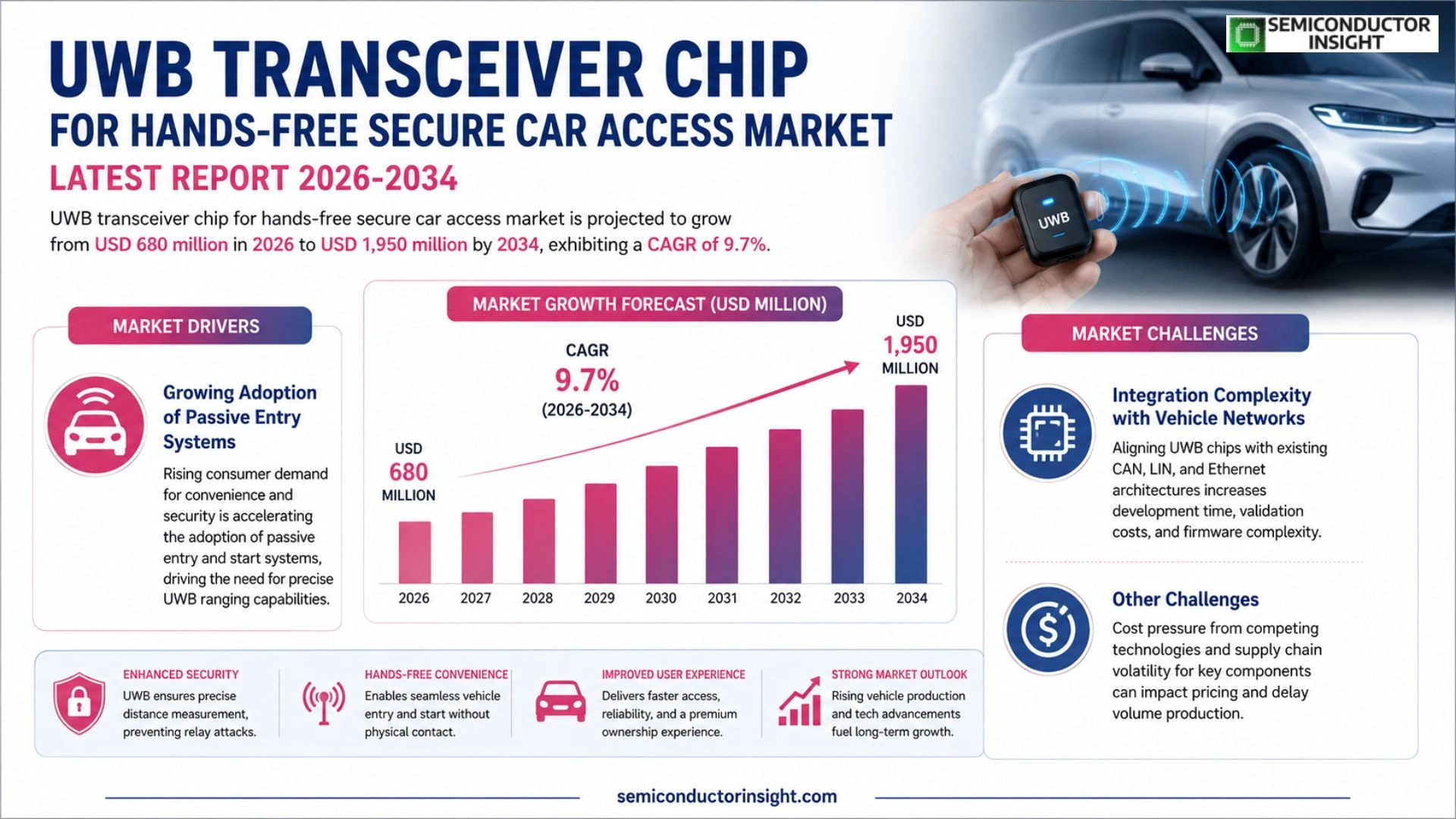
Global UWB transceiver chip for hands‑free secure car access market size was valued at USD 620 million in 2025. The market is projected to grow from USD 680 million in 2026 to USD 1,950 million by 2034, exhibiting a CAGR of 9.7% during the forecast period.
UWB transceiver chips enable precise ranging and secure communication between a vehicle and an authorized device without physical contact. These chips operate on ultra‑wideband frequencies (3.1–10.6 GHz), delivering centimeter‑level accuracy that underpins frictionless key‑less entry, passive entry‑and‑start systems, and vehicle‑to‑infrastructure services.
The market is accelerating because automakers are prioritizing seamless user experiences while tightening security against relay attacks. Furthermore, the rollout of digital keys on smartphones,driven by collaborations such as NXP Semiconductors with BMW,and regulatory encouragement for contact‑less solutions are fueling demand across premium and mass‑market segments.
MARKET DRIVERS
Growing Adoption of Passive Entry Systems
The automotive industry is rapidly shifting towards passive entry and start systems, driven by consumer demand for convenience and enhanced security. UWB transceiver chip for hands-free secure car access Market benefits from this trend as manufacturers seek precise ranging capabilities that traditional RFID cannot provide.
Advancements in Ultra‑Wideband Technology
Recent breakthroughs in semiconductor design have reduced power consumption and cost of UWB modules, making them viable for mass‑market vehicle integration. UWB transceiver chips now deliver centimeter‑level accuracy while maintaining automotive‑grade reliability.
➤ “UWB offers a unique blend of security and user‑experience that is unmatched by Bluetooth or NFC, positioning it as the cornerstone of next‑generation car access solutions.”
Regulatory support in key regions, including the EU’s mandate for secure keyless entry, further accelerates deployment, creating a robust growth platform for UWB transceiver chip for hands-free secure car access Market.
MARKET CHALLENGES
Integration Complexity with Vehicle Networks
Automakers must align UWB transceiver chips with existing CAN, LIN, and Ethernet architectures, which can increase development time and validation costs. The need for seamless firmware updates adds another layer of technical difficulty.
Other Challenges
Cost Sensitivity
While UWB performance is superior, price pressure from competing technologies like Bluetooth Low Energy forces suppliers to balance feature sets with cost targets.
Supply chain volatility for high‑purity silicon and specialized antenna components can also delay volume production, requiring strategic sourcing and inventory planning.
MARKET RESTRAINTS
Stringent Automotive Qualification Standards
Every UWB transceiver chip for hands-free secure car access Market entry must satisfy rigorous automotive qualification protocols, including temperature cycling, vibration, and electromagnetic compatibility tests. The extensive certification timeline can deter smaller vendors from entering the space.
MARKET OPPORTUNITIES
Expansion into Shared Mobility Platforms
Ride‑sharing fleets and autonomous vehicle platforms are exploring UWB for secure, hands‑free access, creating a new revenue stream beyond traditional passenger cars. Early adopters can leverage this niche to establish technology leadership.
UWB transceiver chip for hands-free secure car access Market Trends
Growing Adoption of Contact‑less Vehicle Entry
UWB transceiver chip for hands‑free secure car access Market is witnessing accelerated adoption as automakers prioritize frictionless user experiences. Ultra‑wideband technology delivers centimeter‑level ranging, which enables reliable key‑less entry and passive start functions without a physical key fob. Recent vehicle programs have integrated UWB modules that communicate directly with smartphones, allowing owners to unlock and start a car simply by approaching it. This shift is driven by consumer demand for seamless access, as well as by manufacturers’ strategic roadmaps that embed UWB as a core component of next‑generation digital‑key platforms.
Other Trends
Security Enhancements and Relay‑Attack Mitigation
Security remains a primary catalyst for market expansion. UWB’s precise distance measurement makes it intrinsically resistant to relay attacks, a common vulnerability in traditional radio‑frequency key systems. Automakers are leveraging this capability to meet stricter safety standards and to protect high‑value vehicle assets. Collaborative projects, such as the partnership between NXP Semiconductors and premium automakers, demonstrate how chip manufacturers are delivering hardened firmware and cryptographic protocols that reinforce the trust model between the vehicle and the authorized device.
Integration with Vehicle‑to‑Infrastructure Services
Beyond entry and start functions, the market is expanding into broader vehicle‑to‑infrastructure (V2I) scenarios. The same UWB transceiver that authenticates a driver can also support low‑latency communication with parking guidance systems, toll gateways, and smart‑city sensors. By sharing ranging data, vehicles can negotiate optimal parking spaces, streamline toll collection, and receive real‑time alerts about nearby hazards. This multifunctional use case reinforces the strategic importance of UWB chips as a versatile connectivity layer within the automotive ecosystem.
COMPETITIVE LANDSCAPE
Key Industry Players
UWB Transceiver Chips Driving Hands‑Free Secure Car Access
UWB transceiver market for hands‑free secure car access is currently dominated by a handful of large semiconductor firms that have secured deep automotive alliances. NXP Semiconductors, Qorvo, and STMicroelectronics together account for a significant share of shipments because of their proven integration with OEM digital‑key programs and extensive IP portfolios covering ranging, low‑power operation, and cryptographic security. Their scale enables cost‑effective volume production, while joint development projects with premium car makers (e.g., BMW, Mercedes‑Benz) reinforce a consolidated market structure that favors a few tier‑one suppliers capable of meeting automotive qualification timelines and safety standards.
Beyond the tier‑one leaders, a diverse set of niche players enriches the ecosystem with specialized solutions and emerging technologies. Companies such as Infineon Technologies, Texas Instruments, Renesas Electronics, Skyworks Solutions, Ceva Inc., Broadcom, Analog Devices, Qualcomm Technologies, and MediaTek focus on differentiated UWB IP blocks, ultra‑low‑power designs, or integration with other connectivity stacks (Bluetooth, NFC). Their agility allows rapid adaptation to new use‑cases such as vehicle‑to‑infrastructure services, fleet management, and aftermarket retrofits, thereby expanding the competitive landscape and fostering innovation across both premium and mass‑market segments.
List of Key UWB Transceiver Chip for Hands-Free Secure Car Access Companies Profiled
- NXP Semiconductors
- Qorvo Inc.
- STMicroelectronics
- Infineon Technologies AG
- Texas Instruments Inc.
- Renesas Electronics Corporation
- Skyworks Solutions, Inc.
- Ceva Inc.
- Broadcom Inc.
- Analog Devices, Inc.
- Qualcomm Technologies, Inc.
- MediaTek Inc.
Segment Analysis:
| Segment Category | Sub-Segments | Key Insights |
| By Type |
|
Passive Keyless Entry
|
| By Application |
|
Keyless Entry & Start
|
| By End User |
|
Premium Vehicle Manufacturers
|
| By Security Feature |
|
Secure Ranging
|
| By Vehicle Integration |
|
Embedded Door‑Handle Module
|
Regional Analysis: North America
Ongoing research and development in UWB technology are leading to improved range, data rates, and security features, making it a more attractive solution for car access.
Government regulations focused on vehicle security and data privacy are driving the adoption of advanced technologies like UWB.
Strategic partnerships between automotive manufacturers, technology providers, and semiconductor companies are accelerating the integration of UWB into vehicles.
Growing consumer demand for seamless and secure vehicle access is driving the adoption of UWB-based solutions.
Europe
Europe represents a significant market for UWB transceiver chips for hands-free secure car access, influenced by stringent data protection regulations and a strong focus on automotive innovation. The region’s commitment to connected and autonomous driving initiatives creates a favorable environment for UWB adoption. The high penetration of smartphones and the increasing use of mobile payments further support the demand for secure and convenient access solutions in vehicles. Concerns regarding data security and privacy are prominent in Europe, pushing automakers to explore advanced technologies like UWB to enhance vehicle security and protect user information. The push towards electric vehicles also presents an opportunity for UWB to replace traditional key systems with more efficient and secure alternatives. The relatively complex regulatory environment across different European countries requires manufacturers to adapt their products to meet local requirements, presenting both challenges and opportunities for market players.
Asia-Pacific
Asia-Pacific is expected to witness substantial growth in UWB transceiver chip for hands-free secure car access market. The region’s rapidly expanding automotive market, particularly in China and India, is a key driver. Increasing disposable incomes and a growing middle class are fueling demand for advanced features and enhanced security in vehicles. The proliferation of connected car services and the rise of ride-sharing platforms further contribute to market expansion. Government initiatives promoting electric vehicles and smart mobility solutions are also creating opportunities for UWB technology. The presence of a large and cost-competitive electronics manufacturing base in the region provides a strong foundation for UWB transceiver chip production. However, fragmentation across different countries and varying regulatory standards present challenges for market consolidation.
South America
South America presents a nascent but promising market for UWB transceiver chips in the automotive sector. While the overall automotive market in the region is smaller compared to North America and Asia-Pacific, the increasing adoption of connected car technologies and rising consumer awareness of vehicle security are creating growth opportunities. The demand for cost-effective and reliable security solutions is particularly strong in this region. The growing popularity of used cars and the need for enhanced security features in older vehicles are also driving adoption. Government initiatives focused on promoting automotive manufacturing and infrastructure development are expected to further stimulate market growth. Challenges include limited availability of advanced automotive technologies and the need for greater investment in research and development.
Middle East & Africa
The Middle East & Africa region offers considerable potential for UWB transceiver chip for hands-free secure car access market, driven by rapid urbanization, increasing disposable incomes, and a growing preference for luxury vehicles with advanced features. The region’s focus on smart city initiatives and the development of connected infrastructure create a favorable environment for the adoption of automotive technologies. The rising awareness of vehicle theft and the need for enhanced security solutions are key drivers of market demand. The presence of significant oil wealth in some countries provides substantial investment opportunities for automotive technology development. However, challenges include the relatively low penetration of advanced automotive technologies and the need for greater infrastructure development to support connected car services.
Report Scope
This market research report provides a comprehensive analysis of the UWB transceiver chip for hands-free secure car access Market , covering the forecast period 2026–2034. It offers detailed insights into market dynamics, technological advancements, competitive landscape, and key trends shaping the industry.
Key focus areas of the report include:
- Market Overview: The report begins with an overview outlining its current market scenario, key growth indicators, and industry transformation drivers. It discusses macroeconomic factors, demand–supply balance, regulatory landscape, and the strategic role of semiconductors in powering advancements across industries such as automotive, telecommunications, consumer electronics, and industrial automation.
- Market Size & Forecast: Historical data and future projections for revenue, unit shipments, and market value across major regions and segments.
- Segmentation Analysis: Detailed breakdown by product type, technology, application, and end-user industry to identify high-growth segments and investment opportunities.
- Regional Insights: Insights into market performance across North America, Europe, Asia-Pacific, Latin America, and the Middle East & Africa, including country-level analysis where relevant.
- Competitive Landscape: Profiles of leading market participants, including their product offerings, R&D focus, manufacturing capacity, pricing strategies, and recent developments such as mergers, acquisitions, and partnerships.
- Technology Trends & Innovation: Assessment of emerging technologies, integration of AI/IoT, semiconductor design trends, fabrication techniques, and evolving industry standards.
- Market Drivers & Restraints: Evaluation of factors driving market growth along with challenges, supply chain constraints, regulatory issues, and market-entry barriers.
- Stakeholder Insights: Insights for component suppliers, OEMs, system integrators, investors, and policymakers regarding the evolving ecosystem and strategic opportunities.
Primary and secondary research methods are employed, including interviews with industry experts, data from verified sources, and real-time market intelligence to ensure the accuracy and reliability of the insights presented.
FREQUENTLY ASKED QUESTIONS:
What is the current market size of UWB transceiver chip for hands-free secure car access Market?
-> UWB transceiver chip for hands‑free secure car access market is projected to grow from USD 680 million in 2026 to USD 1,950 million by 2034.
Which key companies operate in UWB transceiver chip for hands-free secure car access Market?
-> Key players include NXP Semiconductors, Qualcomm, STMicroelectronics, Infineon Technologies, and Texas Instruments, among others.
What are the key growth drivers?
-> Key growth drivers include automakers’ focus on seamless user experiences, heightened security against relay attacks, the rollout of digital keys on smartphones, and regulatory encouragement for contact‑less solutions.
Which region dominates the market?
-> Regional data was not disclosed in the provided source.
What are the emerging trends?
-> Emerging trends include integration of digital keys on smartphones, collaborations between semiconductor firms and automotive OEMs, and increasing regulatory support for contact‑less vehicle access technologies.

Get Sample Report PDF for Exclusive Insights
Report Sample Includes
- Table of Contents
- List of Tables & Figures
- Charts, Research Methodology, and more...