
US Vacuum Sensors Market Shaping Smarter Chip Production and High Accuracy Industrial Monitoring
US vacuum sensors market is getting a stronger position inside the semiconductor supply chain because chip manufacturing depends on vacuum control more than most industries do.
Semiconductor tools such as deposition systems, etching chambers, inspection platforms, and wafer processing units all rely on stable vacuum conditions, and even small pressure changes can affect yield, contamination levels, and tool performance. As fabs push toward smaller geometries, tighter process windows, and more advanced packaging, the need for dependable vacuum sensing has become less of a support function and more of a production requirement.
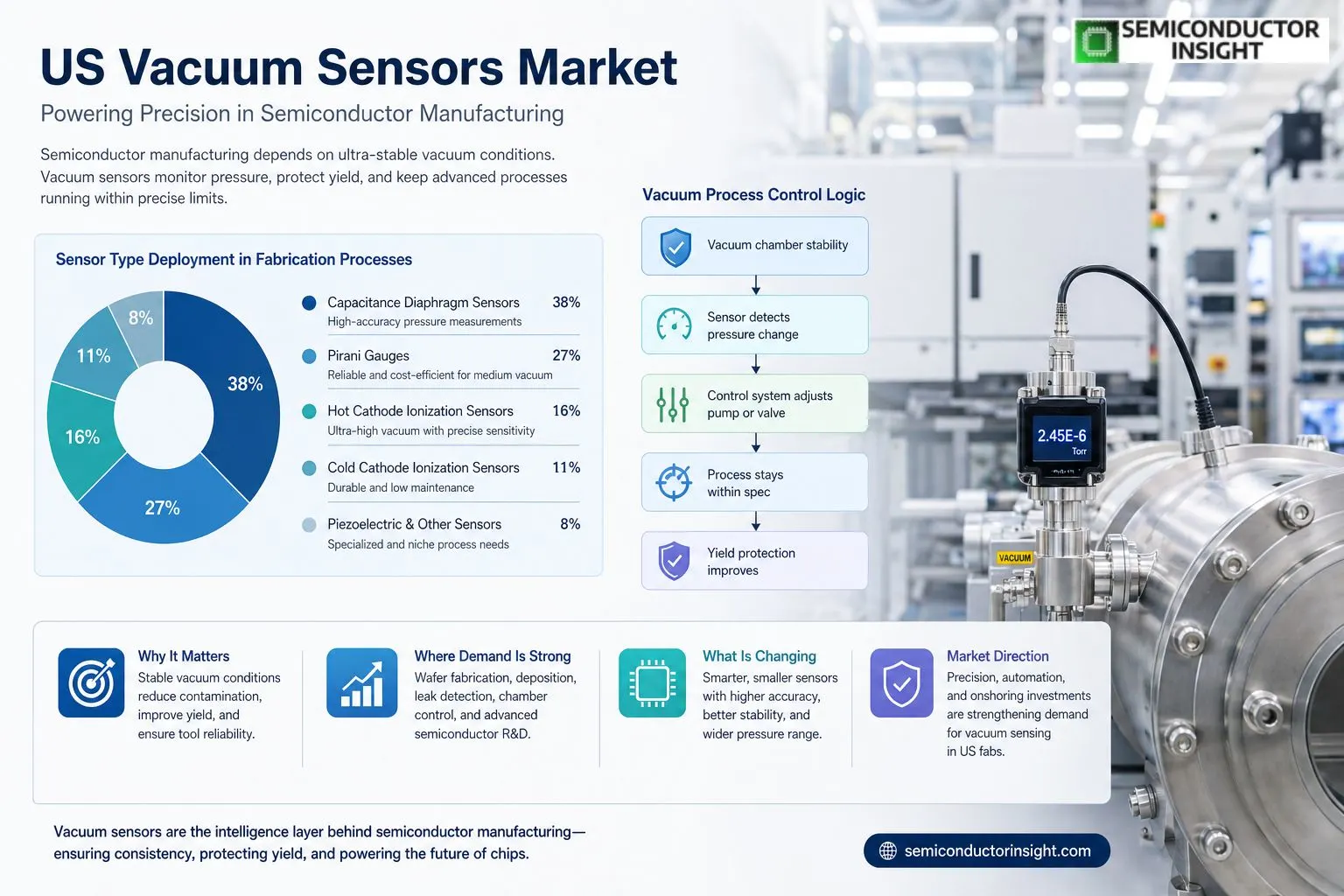
Sensor Type Deployment in Fabrication Processes
- Capacitance diaphragm sensors lead deployment with 38% share, widely preferred for high-accuracy pressure measurements in controlled environments
- Pirani gauges account for 27%, commonly used for medium vacuum ranges due to their reliability and cost efficiency
- Hot cathode ionization sensors hold 16% share, mainly applied in ultra-high vacuum conditions requiring precise sensitivity
- Cold cathode ionization sensors contribute 11%, valued for durability and lower maintenance in vacuum systems
- Piezoelectric and other sensor types make up the remaining 8%, typically used in specialized or niche process requirements
Why vacuum sensing matters inside fabs?
Vacuum sensors do more than measure pressure. They help maintain consistency in chambers where air particles, moisture, and contamination can disrupt processes that must stay extremely controlled, especially in semiconductor work where precision defines the final output.
In a fab environment, these sensors support the invisible work behind chip quality by helping engineers monitor pressure transitions, verify equipment stability, and keep process steps within acceptable operating ranges. That is why vacuum sensing is increasingly seen as part of the intelligence layer inside semiconductor manufacturing rather than just a monitoring accessory.
Explore Our In-Depth Related Market Insights: https://semiconductorinsight.com/report/semiconductor-vacuum-sensors-market/
What is changing in the sensor stack?
One of the biggest changes in US vacuum sensors market is the shift toward smarter and more compact sensing designs. Recent research has introduced a micro-scale vacuum sensor that measures only 27.2 mm³ and uses a dual-mode resonator architecture to cover a wide pressure range from 0.3 to 100,000 Pa, showing how engineering is moving toward high sensitivity without bulky hardware.
This matters for semiconductor systems because fabs often need devices that can fit into tighter equipment layouts while still delivering stable readings across demanding operating conditions. At the same time, sensor makers are being pushed to improve drift resistance, thermal stability, and long-term repeatability because semiconductor tools run continuously and cannot afford frequent recalibration.
Where demand is showing up?
- The strongest demand is coming from wafer fabrication, vacuum deposition, leak detection, chamber control, and advanced semiconductor R&D.
- These are environments where even tiny pressure fluctuations can change film quality, particle behavior, or process repeatability, so vacuum sensors are often built directly into the equipment stack.
- In practical terms, the user is not just buying a sensor; the user is buying process confidence.
- That is especially important in the US, where semiconductor capacity expansion, equipment refresh cycles, and onshore manufacturing investment are all pushing suppliers to deliver better integration, faster diagnostics, and more robust sensing performance.
Small flow chart for process logic
Vacuum chamber stability
-> Sensor detects pressure change
-> Control system adjusts pump or valve
-> Process stays within spec
-> Yield protection improves
This simple chain explains why vacuum sensors are so valuable in semiconductor manufacturing. They sit at the point where physical conditions and digital control meet, which makes them essential in both legacy fabs and newer high automation production lines.
A sharper view of the market direction
US vacuum sensors market is not a standalone story; it is part of the semiconductor industry’s larger move toward precision, automation, and process resilience. As chipmakers continue to invest in equipment upgrades and vacuum-dependent processes, vacuum sensors will remain one of the quiet but essential technologies keeping fabs stable and productive.
The opportunity is strongest for suppliers that understand semiconductor conditions, not just general industrial measurement, because the expectations in chipmaking are far more exacting than in many other sectors.

Comments (0)