
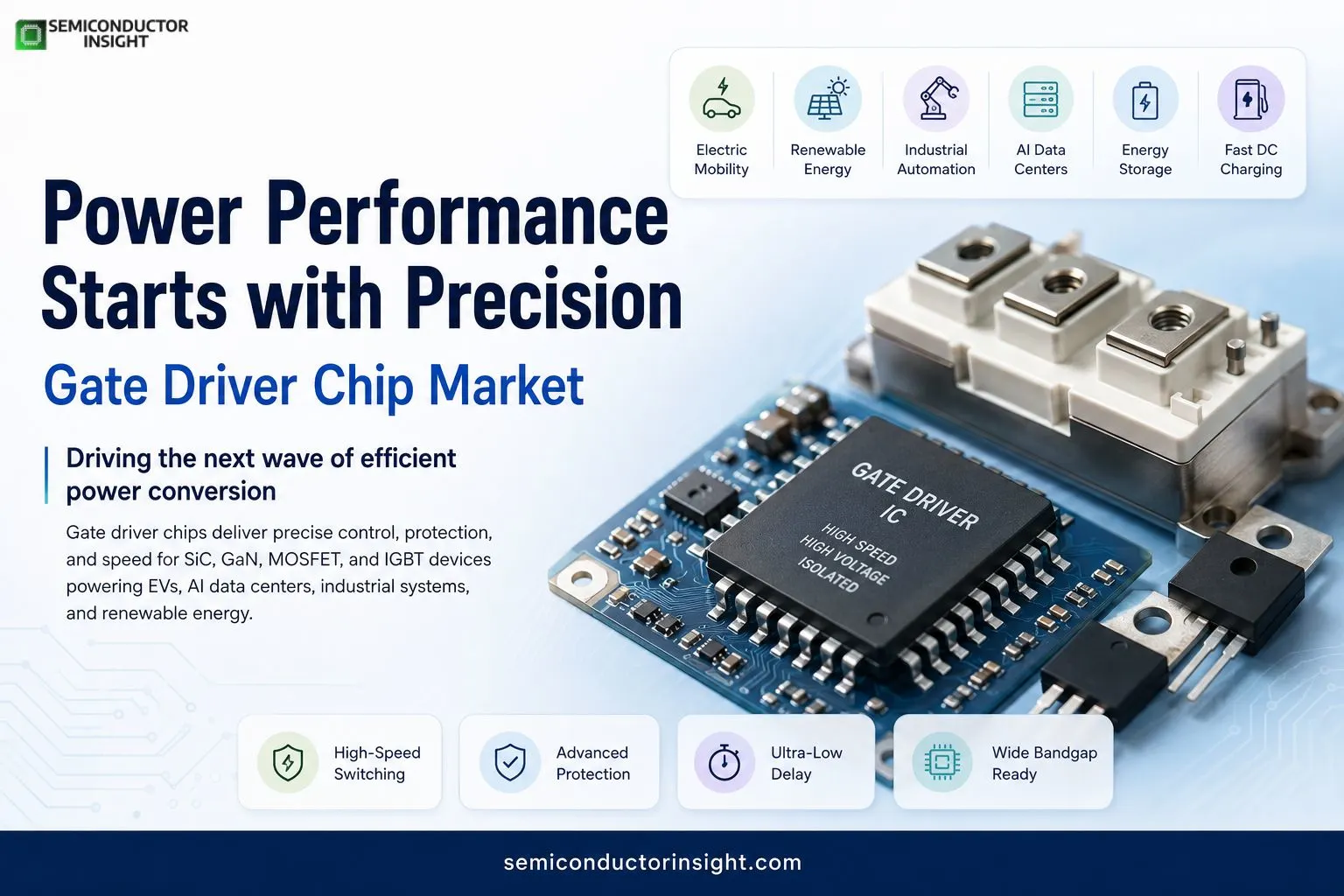
US CHIPS Act Expansion and AI Infrastructure Investments Strengthen the Gate Driver Chip Market in 2026
Power electronics rarely attract the same attention as processors or memory chips, yet they determine how efficiently electricity is converted, controlled, and delivered across modern electronic systems. At the centre of this ecosystem is the gate driver chip, a specialised integrated circuit that controls the switching behaviour of MOSFETs and IGBTs while increasingly supporting silicon carbide (SiC) and gallium nitride (GaN) power devices. As electric vehicles, AI infrastructure, industrial robots, and renewable energy systems demand faster switching speeds and lower energy losses, gate driver chips have become indispensable components in next generation semiconductor architectures.
Modern gate drivers, in contrast to traditional control ICs, incorporate fault prevention, short propagation delay, high voltage isolation, and accurate timing into small packages. This makes it possible for power devices to switch at hundreds of kilohertz while still being dependable and efficient in harsh operating conditions.
The Invisible Intelligence behind Every Power Switch
Every time an electric vehicle accelerates, a solar inverter converts DC into AC, or an AI server powers thousands of processors, a gate driver chip orchestrates the switching sequence. Instead of supplying power directly, it delivers carefully timed gate signals that minimise switching losses and protect expensive semiconductor devices from voltage spikes or shoot through conditions.
The International Energy Agency reports that global renewable electricity capacity has surpassed 3,900 GW, while the International Energy Agency also estimates that the global electric vehicle fleet exceeded 40 million vehicles in previous years. Both sectors rely extensively on advanced power semiconductor modules driven by high performance gate driver ICs.
Power Control Flow
Digital Controller
↓
Gate Driver Chip
↓
MOSFET IGBT SiC or GaN Device
↓
Power Conversion
↓
Motor Battery Grid or Industrial Load
Wide Bandgap Semiconductors Are Changing Driver Chip Design
The rapid commercialisation of SiC and GaN power semiconductors has fundamentally changed gate driver development. These materials switch significantly faster than conventional silicon devices, demanding driver ICs with propagation delays often below 100 nanoseconds, higher common mode transient immunity, and stronger isolation performance.
Many modern automotive gate drivers now support operating voltages exceeding 1,200 volts, making them suitable for traction inverters, high power charging systems, and industrial motor drives. Integrated features such as desaturation detection, Miller clamp protection, programmable dead time, and soft shutdown functions improve both efficiency and operational safety.
Don’t Forget to Surf Our Updated Report for More Detailed Analysis: https://semiconductorinsight.com/report/gate-driver-chip-market/
Key Metrics Driving Industry Evolution
The transformation of power electronics becomes clearer when viewed through engineering and industry data rather than market estimates.
- More than 40 million electric vehicles are operating globally according to the International Energy Agency.
- Global renewable electricity capacity now exceeds 3,900 GW.
- Modern SiC power modules commonly operate at 650 V, 1,200 V, and 1,700 V ratings.
- Advanced gate driver ICs often achieve propagation delays below 100 ns.
- Industrial motor systems account for nearly 45% of global electricity consumption, according to the International Energy Agency.
- High performance gate drivers increasingly support switching frequencies above 500 kHz for GaN applications.
- Automotive qualified driver ICs typically operate across temperatures from -40°C to 150°C.
AI Infrastructure Is Creating a New Demand Centre
While electric mobility remains a major application, AI data centres have become another important growth area. Modern server power supplies require extremely efficient voltage regulation to support GPUs consuming 700 watts or more per processor.
Multi stage power conversion architectures increasingly employ GaN transistors paired with advanced gate driver ICs to reduce switching losses and improve power density.
Recent AI infrastructure expansions announced by leading hyperscale cloud providers continue driving investment in compact, high efficiency power conversion systems where driver performance directly influences energy consumption and thermal management.
Smarter Integration Is Replacing Discrete Designs
- Semiconductor manufacturers are integrating diagnostic intelligence into gate driver chips rather than limiting them to switching functions alone.
- Today’s devices frequently incorporate SPI communication interfaces, digital telemetry, fault logging, programmable gate current control, and real time temperature monitoring.
- This higher level of integration simplifies inverter design while reducing printed circuit board complexity and improving overall system reliability.
- Automotive platforms increasingly use intelligent gate drivers that communicate continuously with vehicle control units to detect abnormal operating conditions before failures occur.
Innovation Pathway
Discrete Driver Circuits
↓
Integrated Protection Features
↓
Digital Diagnostics
↓
Functional Safety Support
↓
Smart Intelligent Gate Driver Platforms
Emerging Applications Continue to Broaden the Technology Landscape
Gate driver chips are no longer confined to industrial motor drives. They now support battery energy storage systems, fast DC charging stations, collaborative robots, railway traction equipment, aerospace power converters, medical imaging systems, and high efficiency telecom infrastructure.
One notable example is the rapid deployment of 800 V electric vehicle platforms, where SiC inverters paired with advanced isolated gate drivers enable faster charging, reduced cable weight, and improved drivetrain efficiency. At the same time, renewable energy developers are installing increasingly powerful solar and battery storage systems that depend on highly reliable gate driver technologies to maximise long term operational performance.
As semiconductor innovation moves towards higher voltages, faster switching speeds, and digitally controlled power architectures, gate driver chips are becoming one of the most strategically important building blocks enabling efficient electrification across transportation, industrial automation, artificial intelligence, and clean energy systems.

Comments (0)