
Printed Circuit Boards Market Insights
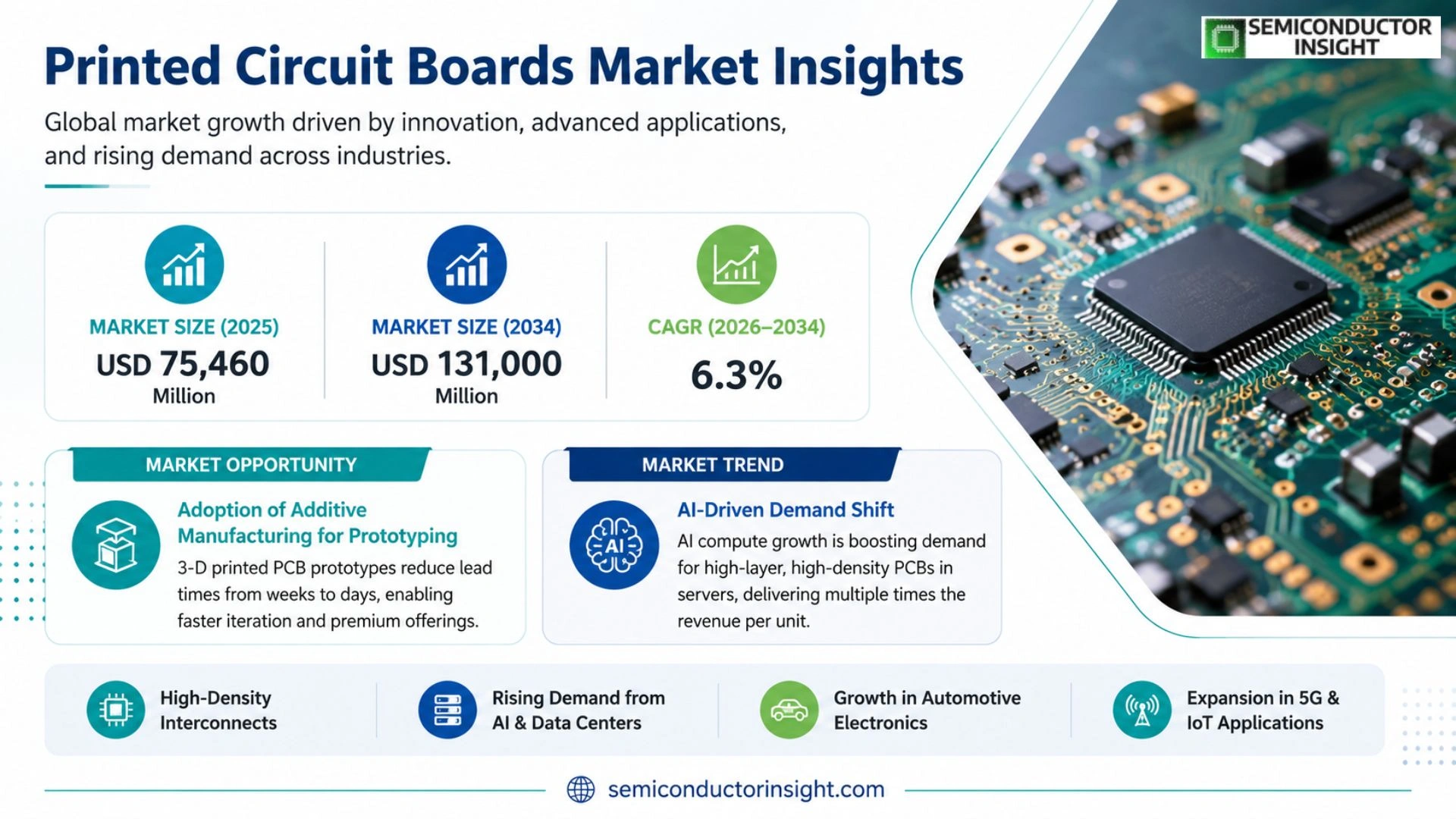
Printed Circuit Boards market size was valued at USD 75,460 million in 2025. The market is projected to grow from USD 75,460 million in 2025 to USD 131,000 million by 2034, exhibiting a CAGR of 6.3 % during the forecast period.
An Electronic Printed Circuit Board is a fundamental component that uses electronic printing technology to form conductive patterns on or within an insulating substrate, providing electrical connections and mechanical support for electronic components. Its core functions include acting as a physical carrier for integrated circuits, enabling signal transmission through precision copper traces, and ensuring reliable signal integrity across the system.
The expansion of artificial‑intelligence data‑center infrastructure and the electrification of vehicles are creating strong demand for high‑layer‑count and high‑density interconnect boards. At the same time, tight supply of advanced low‑loss laminates and long lead times for ultra‑high‑frequency materials pose notable constraints for manufacturers seeking to serve these growth segments.
MARKET DRIVERS
Electrification of Transportation
The surge in electric‑vehicle deployments forces OEMs to source higher‑density multilayer boards capable of handling sophisticated power‑train electronics. Printed Circuit Boards Market suppliers that can deliver miniaturized, heat‑resilient substrates gain a competitive edge as manufacturers chase range‑extension and efficiency gains.
Proliferation of Consumer‑Grade Smart Devices
Wearables, voice assistants, and IoT gateways each embed increasingly complex circuitry, demanding boards with finer trace widths and advanced signal integrity. Companies that invest in high‑frequency material stacks are positioned to capture a larger slice of the expanding end‑user demand.
➤ “Design engineers are now specifying 5 µm trace widths as a baseline, a shift that redefines production line tolerances.”
At the same time, regulatory pushes toward stricter emissions and safety standards compel manufacturers to adopt greener, lead‑free solder alloys, prompting a wave of re‑qualification projects that stimulate ancillary services within Printed Circuit Boards Market.
MARKET CHALLENGES
Escalating Raw‑Material Costs
Copper, epoxy resin, and specialty laminates have witnessed price volatility tied to geopolitical tensions and supply‑chain bottlenecks. Firms that cannot lock in long‑term contracts face margin compression, especially when customers demand low‑cost solutions for high‑volume products.
Other Challenges
Talent Shortage in Advanced PCB Design
The scarcity of engineers versed in HDI and HDI‑compatible simulation tools slows time‑to‑market, forcing some manufacturers to outsource design verification, which adds layers of coordination and potential IP exposure.
MARKET RESTRAINTS
Stringent Environmental Regulations
Regions adopting aggressive RoHS‑like directives require extensive testing and certification for every board batch. The associated compliance costs can deter smaller players from entering niche segments of Printed Circuit Boards Market.
MARKET OPPORTUNITIES
Adoption of Additive Manufacturing for Prototyping
3‑D printed PCB prototypes reduce lead times from weeks to days, allowing design teams to iterate rapidly. Early adopters that integrate additive processes into their service portfolio can command premium pricing while alleviating traditional tooling constraints.
Printed Circuit Boards Market Trends
AI-Driven Demand Shift
The surge in artificial‑intelligence compute platforms has reshaped the demand profile for printed circuitry. High‑layer‑count and high‑density interconnect boards now command a premium on AI servers, delivering multiple times the revenue per unit compared with conventional data‑center boards. This premium stems from tighter signal‑integrity tolerances and the need for faster routing across densely packed copper layers. Manufacturers that have already invested in advanced laminate technologies are capturing disproportionate order volumes, while newcomers face steep entry barriers. The effect on Printed Circuit Boards Market is a migration from consumer‑oriented growth to a supply chain that prioritizes performance metrics, prompting a re‑allocation of engineering resources toward ultra‑high‑frequency materials.
Other Trends
Electrification and Smart Mobility
Vehicle electrification and the integration of autonomous‑driving functions have amplified the value of circuitry inside new‑energy vehicles. Each powertrain module now incorporates multilayer boards that must survive high thermal cycles yet maintain precise timing for motor‑control algorithms. The resulting uplift in board price per vehicle reflects both the increased layer count and the adoption of specialty substrates such as low‑expansion glass fabric. This trend nudges Printed Circuit Boards Market toward a higher‑margin segment, where OEMs demand traceability, reliability, and rapid qualification cycles, thereby incentivising suppliers to co‑develop bespoke solutions rather than relying on generic off‑the‑shelf parts.
Material Supply Tightness and Capacity Expansion
At the material tier, the industry confronts a bottleneck in high‑end copper‑clad laminates and ultra‑low‑loss glass fabrics. Expansion cycles for these inputs span one to two years, a lag that restricts short‑term ability to match the exponential uptick in board orders from AI and automotive customers. Capital intensity and long construction timelines further limit the speed at which existing factories can be repurposed for premium board production. Geographically, mainland China continues to dominate output volume, yet a wave of capacity relocation to Thailand, Vietnam, and Malaysia signals a strategic shift toward diversified supply nodes. For stakeholders in Printed Circuit Boards Market, these dynamics underscore the importance of securing long‑term material contracts and monitoring regional policy incentives that can accelerate high‑value capacity roll‑outs.
COMPETITIVE LANDSCAPE
Key Industry Players
Competitive Dynamics of the Global PCB Market
Unimicron (Taiwan) continues to dominate the multilayer and high‑density interconnect segment, leveraging a vertically integrated supply chain that spans raw material sourcing, advanced laminate processing, and precision etching. Its ability to secure low‑loss copper‑clad laminates ahead of rivals has translated into a steady share of AI‑server and data‑center orders, where board count and stack‑up complexity dictate premium pricing. The market structure exhibits an oligopolistic core,four to six firms capture most of the high‑value volume,while a dense fringe of regional manufacturers competes on cost and niche substrate expertise. Capacity expansion in Mainland China and Southeast Asia is reshaping the geography of production, but conversion timelines for high‑frequency lines remain a bottleneck, reinforcing the strategic importance of firms that already operate dedicated high‑end fabs.
Beyond the flagship players, a cohort of specialists is carving out defensible positions in emerging application areas. Samsung Electro‑Mechanics (South Korea) and AT&S (Austria) have amplified investments in M9‑grade materials to address 5G base‑station and automotive radar needs. Japanese companies such as Nippon Mektron and Ibiden are exploiting their heritage in ceramic and metal‑core technologies to serve aerospace and medical equipment tiers. Taiwanese outfits,including Tripod and HannStar Board,focus on flexible and rigid‑flex formats that align with wearable and IoT device growth. Meanwhile, Chinese firms like Shennan Circuits, Kinwong, and Victory Giant are expanding capacity in Vietnam and Malaysia to capture cost‑sensitive automotive and consumer segments. The cumulative effect is a market where performance‑driven differentiation increasingly outweighs pure price competition.
List of Key Printed Circuit Boards Companies Profiled
- Unimicron
- AT&S
- Samsung Electro‑Mechanics
- Nippon Mektron
- Ibiden
- Tripod
- HannStar Board
- Würth Elektronik
- Sanmina
- Avary Holding
- Shennan Circuits
- Kinwong
- Victory Giant
- CMK
- Shinko Electric
Segment Analysis:
| Segment Category | Sub-Segments | Key Insights |
| By Type |
|
Multilayer PCB
|
| By Application |
|
Electronic Communications
|
| By End User |
|
Automotive Electronics
|
| By Substrate Material |
|
FR‑4 Glass Epoxy
|
| By Electrical Interconnection |
|
Surface‑Mount
|
Regional Analysis: Printed Circuit Boards Market
Asia‑Pacific
Shenzhen, Shanghai and Taipei host clusters where bespoke PCB prototypes are generated within days, fueling rapid iteration for start‑ups in IoT and wearable tech. These ecosystems blend R&D labs with contract manufacturers, reducing time‑to‑market for new form factors.
Recent disruptions have prompted firms to diversify sourcing across Vietnam and Malaysia, creating a multi‑node network that absorbs shocks while preserving lead‑time commitments for high‑mix, low‑volume orders.
The region benefits from a pipeline of engineers trained in surface‑mount technology and high‑frequency materials, allowing manufacturers to upscale capabilities without lengthy recruitment cycles.
Harmonised standards across major economies simplify cross‑border certification, yet emerging environmental directives are nudging producers toward lead‑free processes and waste‑reduction initiatives.
North America
North America maintains a strong foothold in high‑performance board segments, particularly for aerospace and defense applications where reliability thresholds exceed commercial norms. U.S. firms leverage sophisticated surface‑mount and HDI capabilities, often commanding premium pricing for stringent quality certifications. The market is also shaped by an emerging emphasis on sustainable manufacturing practices, driving a modest shift toward recyclable substrates. While labor costs are higher relative to Asia‑Pacific, the region compensates through advanced automation and a mature design‑for‑manufacturing culture that shortens the prototype‑to‑production loop for sophisticated projects.
Europe
European manufacturers excel in niche markets such as medical devices and rail transport, where regulatory compliance and traceability are paramount. Countries like Germany and the United Kingdom have cultivated deep expertise in multilayer and high‑frequency boards, aligning closely with the region’s emphasis on precision engineering. Ongoing environmental legislation is accelerating the adoption of greener processes, prompting firms to invest in water‑based etchants and waste‑recovery systems. Despite a comparatively smaller volume base, the emphasis on value‑added services and collaborative R&D positions Europe as a strategic source for technically demanding board solutions.
South America
South America is gradually expanding its PCB footprint, anchored by Brazil’s growing electronics assembly sector. Local producers are focusing on cost‑effective, standard‑density boards to serve domestic consumer‑electronics demand and automotive imports. Constraints in skilled labor and capital intensity have limited rapid technological adoption, yet governmental incentives aimed at bolstering high‑tech clusters are beginning to attract joint ventures with established Asian manufacturers. This partnership model is expected to elevate design capabilities while keeping price points attractive for regional OEMs.
Middle East & Africa
The Middle East & Africa region is still nascent in Printed Circuit Boards Market, with activity concentrated around the United Arab Emirates and South Africa. These hubs are primarily serving the oil‑and‑gas sector and emerging renewable‑energy projects, where rugged board designs are required. Investment in localized production is modest, but strategic partnerships with global fabricators are facilitating technology transfer and workforce up‑skilling. As infrastructure projects proliferate, the demand for reliable PCB solutions may prompt a modest scaling of local capacities.
Report Scope
This market research report provides a comprehensive analysis of the Printed Circuit Boards Market , covering the forecast period 2026–2034. It offers detailed insights into market dynamics, technological advancements, competitive landscape, and key trends shaping the industry.
Key focus areas of the report include:
- Market Overview: The report begins with an overview outlining its current market scenario, key growth indicators, and industry transformation drivers. It discusses macroeconomic factors, demand–supply balance, regulatory landscape, and the strategic role of semiconductors in powering advancements across industries such as automotive, telecommunications, consumer electronics, and industrial automation.
- Market Size & Forecast: Historical data and future projections for revenue, unit shipments, and market value across major regions and segments.
- Segmentation Analysis: Detailed breakdown by product type, technology, application, and end-user industry to identify high-growth segments and investment opportunities.
- Regional Insights: Insights into market performance across North America, Europe, Asia-Pacific, Latin America, and the Middle East & Africa, including country-level analysis where relevant.
- Competitive Landscape: Profiles of leading market participants, including their product offerings, R&D focus, manufacturing capacity, pricing strategies, and recent developments such as mergers, acquisitions, and partnerships.
- Technology Trends & Innovation: Assessment of emerging technologies, integration of AI/IoT, semiconductor design trends, fabrication techniques, and evolving industry standards.
- Market Drivers & Restraints: Evaluation of factors driving market growth along with challenges, supply chain constraints, regulatory issues, and market-entry barriers.
- Stakeholder Insights: Insights for component suppliers, OEMs, system integrators, investors, and policymakers regarding the evolving ecosystem and strategic opportunities.
Primary and secondary research methods are employed, including interviews with industry experts, data from verified sources, and real-time market intelligence to ensure the accuracy and reliability of the insights presented.
FREQUENTLY ASKED QUESTIONS:
What is the current market size of Printed Circuit Boards Market?
-> Printed Circuit Boards Market was valued at USD 75,460 million in 2025 and is expected to reach USD 113,985 million by 2032, at a CAGR of 6.3% during the forecast period.
Which key companies operate in Printed Circuit Boards Market?
-> Key players include Nippon Mektron, Unimicron, AT&S, TTM, Ibiden, Shinko Electric, CMK, Samsung Electro‑Mechanics, Tripod, HannStar Board, Würth Elektronik, Sanmina, Avary Holding, Shennan Circuits, Kinwong, Victory Giant, among others.
What are the key growth drivers?
-> Key growth drivers include explosive AI computing infrastructure construction, rising demand for high‑layer‑count and high‑density interconnect boards, vehicle electrification and intelligence, advanced high‑frequency materials (M9 grade), and supportive government policies for semiconductor and electronic information industries.
Which region dominates the market?
-> Mainland China remains the largest production base, accounting for over half of global output value, while Taiwan, Japan and South Korea hold critical positions in high‑end substrates and AI supply chains.
What are the emerging trends?
-> Emerging trends include accelerated capacity relocation to Southeast Asia, growth of AI‑driven server and data‑center demand, increasing high‑frequency/high‑speed material adoption, and expanding applications in new‑energy vehicles and 5G communications equipment.

Get Sample Report PDF for Exclusive Insights
Report Sample Includes
- Table of Contents
- List of Tables & Figures
- Charts, Research Methodology, and more...
 Download Sample Report PDF