
Unlocking the Voice of Technology: AI Speech Recognition Chip Market Overview
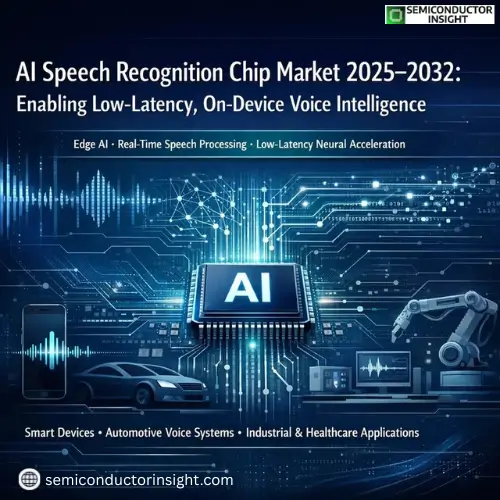
AI speech recognition chip market is rapidly evolving as devices, from smartphones to industrial robots, demand instantaneous voice-based interactions. These chips act as the core enabler, processing complex neural networks locally to deliver real-time, accurate speech recognition while minimizing latency and cloud dependency.
Beyond consumer electronics, sectors like automotive, healthcare, and IoT devices increasingly rely on these chips for voice-driven solutions, making the market highly dynamic and innovation-focused.
Market Insights: Driving Forces behind Growth
The growth of AI speech recognition chips is fuelled by several interconnected factors:
- Explosion of Voice-Enabled Devices: Smartphones, smart speakers, and wearable devices have significantly increased chip demand. Companies like Apple and Amazon continue to embed speech recognition chips in their latest products.
- Edge AI Adoption: Edge-based processing reduces dependence on cloud services, allowing faster recognition and better data privacy. Localized chip processing is critical in autonomous vehicles and industrial robotics.
- Integration with IoT & Smart Homes: Voice-activated home systems and appliances are increasingly dependent on high-performance, low-power AI chips.
Let’s have a look at latest industry highlights:
December 2025: AWS unveiled a wave of innovations at re:Invent 2025, including Graviton5 the company’s most powerful and efficient CPU. Also, Amazon Connect has helped businesses deliver automated voice experiences using neural text-to-speech in more than 30 languages and automated speech recognition in more than 25 languages.
January 2025: MediaTek and Intelligo have announced that they will collaborate to deliver innovative AI voice solutions for the automotive, smart home, and smart retail markets, which will debut at CES 2025. The cooperation will be dedicated to transforming how users interact with vehicles and smart home devices, bringing smarter, safer and more intuitive experiences.
July 2025: Zoho has jumped into the AI race with its first proprietary large language model (LLM) that is designed for enterprise use cases such as structured data extraction, summarisation, code generation, and Retrieval-Augmented Generation (RAG). Zoho also announced it has developed two new Automatic Speech Recognition (ASR) models capable of converting speech to text using AI. It currently only works for English and Hindi, with support for additional languages coming in the future.
Go Through Our Updated Report For More In-Depth Analysis:
https://semiconductorinsight.com/report/ai-speech-recognition-chip-market/
Regional Footprint and Market Share
The AI speech recognition chip market demonstrates varied adoption across regions:
- North America: Leads due to tech giants, IoT adoption, and early-edge AI integration. The U.S. alone accounts for over approx. 40% of market revenue.
- Europe: Strong automotive and industrial robotics industries drive demand for robust, multi-language chips.
- Asia-Pacific: Dominated by consumer electronics, with China, Japan, and South Korea spearheading growth in smartphones and smart home devices.
- Latin America & MEA: Emerging adoption, driven by call centres, telehealth, and voice-enabled banking solutions.
Technological Advancements Shaping the Market
AI speech recognition chip sector sits at the intersection of semiconductor innovation and AI algorithm optimization. Key developments include low-power neural accelerators, where chips with dedicated AI cores enable efficient on-device execution of deep learning models.
Additional advancements feature multi-language support for real-time processing across diverse languages, accents, and dialects, alongside integrated noise-cancellation with adaptive filters that boost recognition accuracy in industrial or noisy environments.
Key Players and Competitive Landscape
The competitive landscape is shaped by innovation and ecosystem partnerships. Leading players include:
- NVIDIA Corporation: Offers AI-focused chips with neural network accelerators, optimized for real-time speech recognition.
- Qualcomm Technologies, Inc.: Mobile chipsets with integrated voice AI accelerators powering smartphones and wearable.
- Intel Corporation: Edge AI chips with specialized neural cores for industrial voice recognition.
- Google (Edge TPU): Low-power, on-device inference chips for speech-driven applications.
- Samsung Electronics: Chips targeting consumer electronics and smart home ecosystems.
Strategies Adopted:
- Collaborative partnerships with cloud AI platforms.
- Investments in low-latency chip R&D.
- Expansion into automotive, healthcare, and industrial automation sectors.
Market Dynamics: Opportunities and Challenges
Opportunities:
- Surge in voice-driven healthcare devices for patient monitoring.
- Integration with AR/VR systems for immersive and voice-controlled experiences.
Challenges:
- Power constraints in mobile and wearable devices.
- Variability in accuracy across languages and noisy environments.
- High manufacturing costs for specialized AI chips.
Flow Chart: AI Speech Recognition Chip Ecosystem
Voice Input → On-Device AI Chip → Neural Network Processing → Noise Filtering & Feature Extraction → Speech-to-Text Conversion → Device/Application Integration
This flow represents how raw audio signals are processed on specialized chips to deliver real-time, accurate speech outputs across devices.
Final Thoughts
AI speech recognition chips are no longer a niche product they are fundamental to the future of voice-driven human-machine interaction. Companies investing in specialized chips that balance accuracy, speed, and power efficiency will dominate the market.
As devices become smarter and users demand seamless voice experiences, the market’s trajectory points toward higher adoption, broader industrial applications, and continuous innovation.

Comments (0)