AI Speech Recognition Chip Market Insights
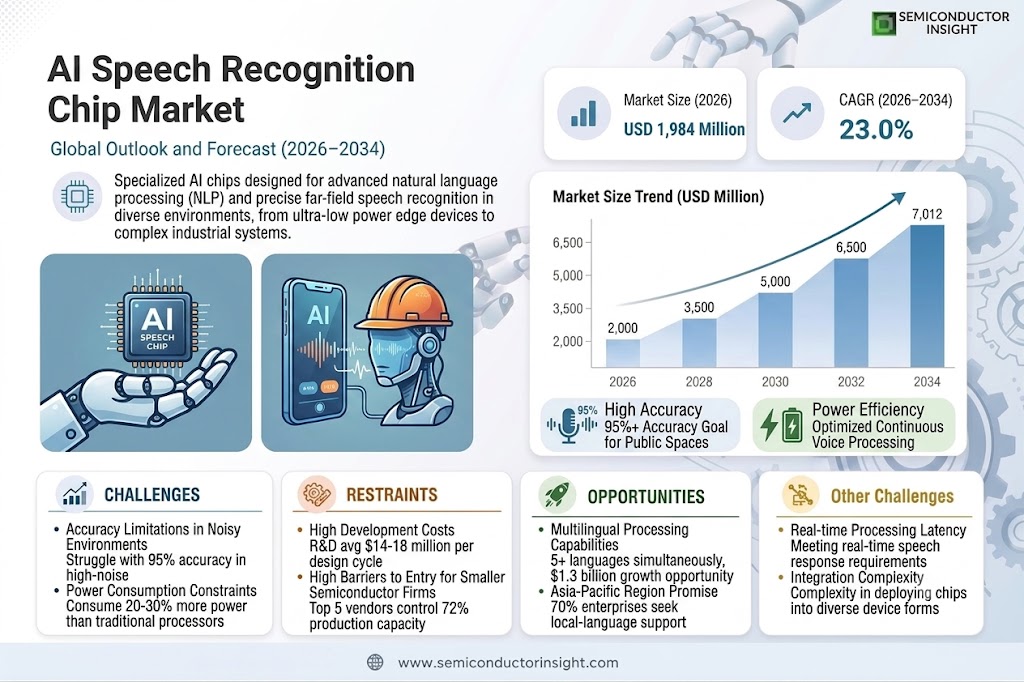
Global AI Speech Recognition Chip market was valued at USD 1,984 million in 2024 and is projected to reach USD 7,012 million by 2032, exhibiting a CAGR of 23.0% during the forecast period.
AI speech recognition chips are specialized semiconductor devices that integrate artificial intelligence (AI) algorithms to process and interpret human speech signals. These chips combine high-performance computing capabilities with advanced neural network architectures to enable real-time voice command processing, noise cancellation, and natural language understanding. Key applications include smart home devices, automotive infotainment systems, healthcare voice assistants, and consumer electronics.
The market growth is driven by increasing adoption of voice-controlled smart devices, advancements in edge computing for faster local processing, and rising demand for hands-free operation across industries. Major players like Qualcomm, Intel, and NXP Semiconductors are investing heavily in low-power AI accelerator designs to improve energy efficiency in battery-operated devices. The Asia-Pacific region shows particularly strong growth potential due to rapid smart home adoption and government initiatives supporting AI development.
MARKET DRIVERS
Rising Demand for Smart Devices
The AI Speech Recognition Chip Market is experiencing significant growth due to increasing adoption across smart home devices and IoT applications. Over 60% of new smart speakers now integrate specialized AI chips for faster voice processing. The shift toward hands-free technology in automotive and healthcare sectors is further accelerating demand.
Advancements in Edge Computing
Deployment of edge AI capabilities has reduced latency in speech recognition systems by 40% compared to cloud-dependent solutions. Major semiconductor companies are investing heavily in neural processing units (NPUs) optimized for real-time voice interactions. This technological leap enables more responsive virtual assistants and speech-to-text applications.
➤ The global AI chip market for voice applications is projected to reach $8.2 billion by 2026, with speech recognition chips accounting for 35% of shipments
The proliferation of voice-enabled customer service solutions and stringent data privacy regulations are creating additional momentum for on-device processing solutions in the AI Speech Recognition Chip Market.
MARKET CHALLENGES
Accuracy Limitations in Noisy Environments
Despite improvements, current AI speech recognition chips still struggle with 95% accuracy in high-noise environments like crowded public spaces or moving vehicles. This performance gap limits adoption in critical applications such as industrial settings and emergency response systems.
Other Challenges
Power Consumption Constraints
While efficient, advanced AI chips still consume 20-30% more power than traditional processors during continuous voice processing, presenting hurdles for battery-operated devices.
MARKET RESTRAINTS
High Development Costs
The R&D expenditure for cutting-edge AI Speech Recognition Chips averages $14-18 million per design cycle, creating significant barriers to entry for smaller semiconductor firms. This has led to market consolidation, with the top 5 vendors controlling 72% of production capacity.
MARKET OPPORTUNITIES
Multilingual Processing Capabilities
Emerging speech recognition chips capable of processing 5+ languages simultaneously present a $1.3 billion growth opportunity. The Asia-Pacific region shows particular promise, with 70% of enterprises seeking local-language support in voice interfaces. New neural network architectures are achieving 98% accuracy across tonal languages like Mandarin.
MAIN TITLE HERE (AI Speech Recognition Chip Market) Trends
Accelerated Growth in Voice-Enabled Applications Driving Market Expansion
The global AI Speech Recognition Chip market has demonstrated robust growth, valued at $1.98 billion in 2024 with projections reaching $7.01 billion by 2032 at a 23% CAGR. This surge is primarily fueled by increasing adoption across consumer electronics, automotive, and healthcare sectors where hands-free operation improves safety and accessibility.
Other Trends
IoT Integration Creating New Opportunities
With the Internet of Things ecosystem expanding, voice recognition chips are becoming critical components in smart home devices, wearables, and industrial applications. Over 65% of new IoT devices now integrate some form of voice control functionality.
Regional Market Development Patterns
North America currently leads in AI Speech Recognition Chip adoption due to advanced technological infrastructure, while Asia-Pacific is emerging as the fastest-growing region. China’s market alone is expected to account for 38% of global demand by 2028, driven by massive smart device production and digital transformation initiatives.
Other Trends
Algorithm Advancements Enhancing Performance
Recent developments in neural network architectures have improved speech recognition accuracy to 98% in controlled environments. Manufacturers are integrating specialized NPUs (Neural Processing Units) to enable real-time processing with lower power consumption – crucial for mobile applications.
Supply Chain Optimization and Cost Reductions
Production scaling and process standardization have reduced chip costs by 27% since 2021, making the technology accessible for mid-range devices. Leading manufacturers are establishing regional production hubs to mitigate geopolitical trade risks and ensure stable component supplies.
COMPETITIVE LANDSCAPE
Key Industry Players
Market Consolidation and Growth Strategies in AI Speech Recognition Chip Sector
The AI Speech Recognition Chip market is dominated by semiconductor giants like Qualcomm, Intel, and NXP Semiconductors, leveraging their established R&D capabilities and global distribution networks. These companies collectively hold over 60% of the 2024 market share. POLYN Technology and AONDevices have emerged as disruptive innovators, specializing in neuromorphic chips for edge-device voice processing. The market exhibits an oligopolistic structure with increasing vertical integration as chipmakers develop proprietary voice algorithms alongside hardware.
Several Asian players like HISILICON and Horizon Robotics are gaining traction through cost-competitive solutions tailored for smart home applications. Niche specialists such as ChipIntelli and Linisound focus on low-power designs for IoT devices, while WayTronic leads in automotive-grade voice chips. The industry is witnessing strategic alliances, with Renesas acquiring voice AI startups to enhance its product portfolio and Advanced Media collaborating with cloud service providers to improve speech-to-text accuracy.
List of Key AI Speech Recognition Chip Companies Profiled
- POLYN Technology
- WayTronic
- NXP Semiconductors
- Qualcomm
- Renesas
- AONDevices
- Intel
- Linisound
- Advanced Media, Inc.
- ChipIntelli
- Shenzhen Jietong Voice
- HISILICON
- Horizon Robotics
Segment Analysis:
| Segment Category | Sub-Segments | Key Insights |
| By Type |
|
Online AI Speech Recognition Chips are experiencing higher adoption due to:
|
| By Application |
|
Consumer Electronics dominates the market because:
|
| By End User |
|
Individual Consumers represent the largest user base due to:
|
| By Technology |
|
Neural Network Processing is becoming the preferred approach because:
|
| By Integration Level |
|
System-on-Chip (SoC) Solutions are gaining significant traction as they:
|
Regional Analysis: Global AI Speech Recognition Chip Market
Silicon Valley’s concentration of tech firms creates a synergistic environment for AI speech chip development, with collaborative R&D efforts yielding cutting-edge solutions for natural language processing and noise cancellation technologies.
High smartphone penetration and smart speaker adoption rates in North American households are driving demand for efficient speech recognition chips that can process multiple voice commands simultaneously with minimal latency.
Major automotive manufacturers in the region are incorporating voice-controlled interfaces into vehicle systems, requiring specialized AI chips that can operate reliably in noisy environments and understand diverse accents.
Voice-enabled medical documentation systems and assistive technologies for patients are creating new opportunities for specialized speech recognition chips in North America’s advanced healthcare sector.
Europe
Europe’s AI speech recognition chip market is expanding due to strict data privacy regulations driving demand for secure, on-device processing solutions. The region shows particular strength in automotive and industrial applications, with German and French manufacturers leading adoption. Multilingual requirements create unique challenges that European chip designers are addressing through innovative architectures capable of handling multiple languages efficiently. The growing emphasis on GDPR-compliant voice technologies is reshaping product development strategies across the market.
Asia-Pacific
Asia-Pacific emerges as the fastest-growing market for AI speech recognition chips, fueled by massive smartphone user bases and government smart city initiatives. China’s technology leaders are making significant investments in proprietary chip designs to reduce foreign dependency. The region’s unique linguistic diversity drives innovation in chips capable of processing tonal languages and local dialects, creating specialized market segments. Manufacturing capabilities in Taiwan and South Korea support cost-effective production of advanced speech processing components.
South America
South America presents developing opportunities in the AI speech recognition chip market, with Brazil leading regional adoption. Growing digital transformation across banking and retail sectors is increasing demand for voice-based interfaces. Portuguese and Spanish language support remains a key focus for chip developers targeting this market. Infrastructure challenges are prompting innovative edge computing solutions that can function reliably with limited connectivity.
Middle East & Africa
The Middle East & Africa region shows nascent but promising growth in AI speech recognition chip adoption, particularly in Gulf countries with smart city projects. Arabic language processing presents technical challenges that local startups are addressing through specialized algorithms. Government initiatives to build local technology capabilities are encouraging partnerships between international chip manufacturers and regional developers, creating a unique ecosystem for voice technology advancement.
Report Scope
This market research report provides a comprehensive analysis of the AI Speech Recognition Chip Market, covering the forecast period 2025–2032. It offers detailed insights into market dynamics, technological advancements, competitive landscape, and key trends shaping the industry.
Key focus areas of the report include:
-
Market Overview: The report begins with an overview outlining its current market scenario, key growth indicators, and industry transformation drivers. It discusses macroeconomic factors, demand–supply balance, regulatory landscape, and the strategic role of semiconductors in powering advancements across industries such as automotive, telecommunications, consumer electronics, and industrial automation.
- Market Size & Forecast: Historical data and future projections for revenue, unit shipments, and market value across major regions and segments.
- Segmentation Analysis: Detailed breakdown by product type, technology, application, and end-user industry to identify high-growth segments and investment opportunities.
- Regional Insights: Insights into market performance across North America, Europe, Asia-Pacific, Latin America, and the Middle East & Africa, including country-level analysis where relevant.
- Competitive Landscape: Profiles of leading market participants, including their product offerings, R&D focus, manufacturing capacity, pricing strategies, and recent developments such as mergers, acquisitions, and partnerships.
- Technology Trends & Innovation: Assessment of emerging technologies, integration of AI/IoT, semiconductor design trends, fabrication techniques, and evolving industry standards.
- Market Drivers & Restraints: Evaluation of factors driving market growth along with challenges, supply chain constraints, regulatory issues, and market-entry barriers.
- Stakeholder Insights: Insights for component suppliers, OEMs, system integrators, investors, and policymakers regarding the evolving ecosystem and strategic opportunities.
Primary and secondary research methods are employed, including interviews with industry experts, data from verified sources, and real-time market intelligence to ensure the accuracy and reliability of the insights presented.
FREQUENTLY ASKED QUESTIONS:
What is the current market size of AI Speech Recognition Chip Market?
-> The AI Speech Recognition Chip Market was valued at USD 1984 million in 2024 and is expected to reach USD 7012 million by 2032.
What is the growth rate of AI Speech Recognition Chip Market?
-> The market is projected to grow at a CAGR of 23.0% during 2024–2032.
Which key companies operate in AI Speech Recognition Chip Market?
-> Key players include POLYN Technology, WayTronic, NXP Semiconductors, Qualcomm, Renesas, AONDevices, Intel, Linisound, Advanced Media, Inc., ChipIntelli, and Shenzhen Jietong Voice, among others.
What are the key growth drivers for AI Speech Recognition Chip Market?
-> Key growth drivers include rising demand for voice-controlled devices, increasing IoT adoption, advancements in AI technology, and enhanced user experience across smart homes, automotive, and consumer electronics sectors.
Which region dominates the AI Speech Recognition Chip Market?
-> North America and Europe currently lead in market demand due to high technological adoption, while Asia-Pacific (especially China and India) is emerging as a high-growth region.
Get Sample Report PDF for Exclusive Insights
Report Sample Includes
- Table of Contents
- List of Tables & Figures
- Charts, Research Methodology, and more...
 Download Sample Report PDF