
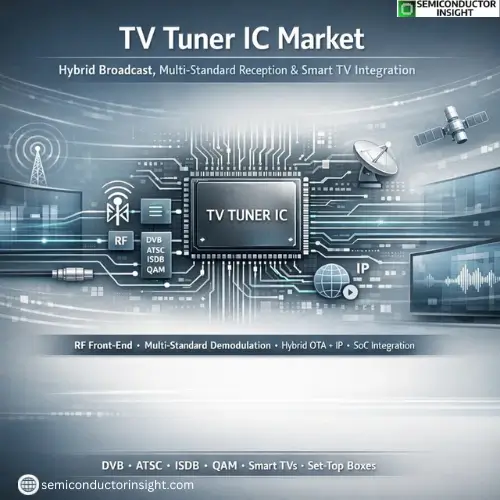
TV Tuner IC Market Position Expands as Hybrid Broadcasting and Connected Entertainment Accelerates Demand
Television tuner integrated circuits (ICs) are unsung yet indispensable components in modern multimedia systems. At their core, TV tuner ICs are specialized semiconductor devices designed to receive, decode, and process broadcast signals from diverse delivery methods terrestrial, satellite, cable, and increasingly, hybrid IP-based streams. In a world where content consumption patterns are evolving rapidly, tuners remain fundamental enablers of reliable signal access, user experience, and broadcast compatibility.
As consumer demand broadens from traditional linear TV to connected entertainment and hybrid reception models, the role of the TV tuner IC has expanded far beyond a standalone module. Today’s semiconductor landscape requires tuners with multi-standard signal handling, integration with digital processing, and seamless interoperability with software platforms.
Technological Foundations: What Makes a TV Tuner IC Work
At its simplest, a TV tuner IC functions as a front-end receiver and demodulator, selecting a specific frequency band from a spectrum of broadcast signals and preparing that signal for digital decoding. Modern TV tuner ICs combine multiple semiconductor functions within a single silicon die:
- RF front-end circuitry that captures broadcast frequencies with minimal noise
- Frequency synthesis and tuning loops to isolate desired channels
- Demodulation engines that handle broadcast standards including DVB-T/T2, ATSC, ISDB, and QAM/Cable formats
- Integration with baseband processors and digital back-end systems
This integration reduces component count, lowers power consumption, and accelerates time to market for OEMs. Because TV reception technologies vary widely across regions and delivery methods, semiconductor designers build tuners that support multi-standard reception within a single hardware platform a necessity for global consumer products.
Market Drivers where Content Consumption Meets Semiconductor Demand
TV tuner IC market is influenced by a convergence of consumer behavior, broadcast evolution, and device proliferation:
- Hybrid Content Models: Modern televisions and set-top boxes increasingly support a blend of over-the-air (OTA), cable, satellite, and internet-based streaming. TV tuner ICs with hybrid support (both RF and IP front-ends) are gaining traction because they allow devices to switch seamlessly between traditional broadcast and internet content.
- Smart TV Penetration: As smart TV deployment continues worldwide, the integration of tuner ICs into systems that also run digital applications, app platforms, and connected interfaces has become standard. This integration challenges semiconductor designers to balance bandwidth, latency, and power profiles while maintaining signal fidelity.
- Regional Standards Diversity: Semiconductor designs must support geographically distinct standards e.g., DVB in Europe, ATSC in North America, ISDB in Japan and parts of Latin America often within the same hardware footprint. This multi-standard requirement places a premium on flexible tuner IC architectures.
Don’t Forget to Surf Our Updated Report for More Detailed Analysis:
https://semiconductorinsight.com/report/tv-tuner-ic-market/
Current Market Situation
The shift toward software-defined reception is a defining trend. Traditional fixed-function tuners are giving way to chipsets that work in tandem with digital signal processors and application software. Software-configurable tuning profiles allow manufacturers to update reception standards, correct signal issues, and introduce new features without hardware changes.
In many modern consumer products, the tuner is part of a system-on-chip (SoC) or closely integrated with the main multimedia processor. This trend reflects a broader industry push toward semiconductor consolidation, reducing overall bill of materials (BOM), improving reliability, and enabling advanced features such as:
- Channel scanning and automated signal optimization
- Over-the-air firmware updates for reception performance
- Application programming interfaces that tie broadcast access into content menus and recommendation systems
Such developments make tuner IC selection not just a hardware decision but a software and systems engineering consideration.
Integration with Connectivity and Signal Management
Another recent development is the convergence of TV tuner ICs with wireless and IP connectivity layers. Tuners now often operate within a broader communication ecosystem, interfacing directly with:
- Wi-Fi and Ethernet stacks for hybrid stream delivery
- Bluetooth peripherals for control and user interaction
- Digital media decoders for adaptive bitrate content
This convergence makes the tuner an integral part of the content access pipeline, not just a receiver of analog or RF signals. Semiconductor vendors that offer integrated RF + digital interfaces simplify overall system design and reduce dependency on disparate modules.
Regional Adoption and Standard Diversity
While global manufacturers pursue integrated solutions, regional variations in broadcast standards continue to shape market demand. In Europe and parts of Asia, digital terrestrial television (DVB-T/T2) remains a dominant mode, whereas in North America, ATSC standards govern much of broadcast reception. Cable operators using QAM modulation also drive demand for tuner ICs with robust cable demodulation support.
Emerging markets show a hybrid trend: as internet connectivity expands, broadcast reception remains important for baseline content access, especially in areas where streaming bandwidth is constrained or inconsistent. This hybrid reality reinforces the need for semiconductor designs that support multiple access modalities.
The TV tuner IC market is solidly positioned at the crossroads of traditional broadcast infrastructure and future content delivery paradigms. As hybrid broadcast + broadband systems proliferate, tuner ICs will remain essential not as isolated components but as integrated elements within advanced multimedia SoCs.
Growth will continue as devices become smarter, content delivery diversifies, and global markets balance legacy broadcast standards with IP-centric consumption. For semiconductor companies and system manufacturers alike, alignment between hardware performance, software adaptability, and regional standardization will define leadership in this evolving market.

Comments (0)