
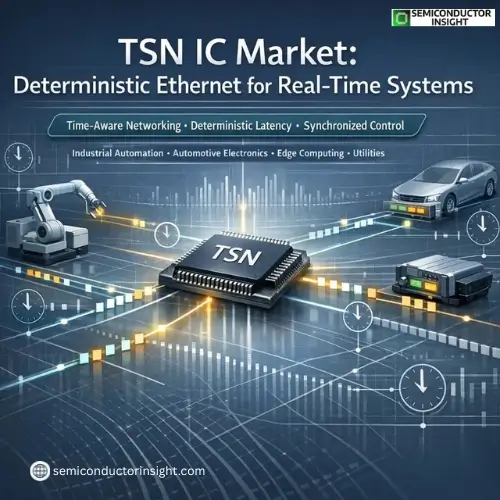
TSN IC Market Growth Drivers and Deployment Shifts in Deterministic Connectivity
Digital systems are no longer judged only by speed they are measured by certainty. As industries transition toward automation, autonomous control, and synchronized machine communication, traditional Ethernet has begun to show its limits. This shift has placed Time-Sensitive Networking (TSN) integrated circuits at the center of next-generation connectivity architectures.
TSN ICs bring determinism to Ethernet by ensuring that data arrives exactly when expected, not merely as fast as possible. This capability is reshaping how factories operate, how vehicles communicate internally, and how edge systems handle mission-critical workloads.
Before Scrolling, Surf Our Latest Report for More Detailed Analysis:
https://semiconductorinsight.com/report/tsn-ic-market/
Where TSN ICs Fit in the Semiconductor Stack?
Unlike general networking chips, TSN ICs sit at the intersection of network timing, traffic scheduling, and hardware-level prioritization. These devices embed IEEE TSN standards directly into silicon, enabling real-time data flow without relying on software workarounds.
At the hardware level, TSN ICs integrate:
- Precision time protocol engines
- Traffic shaping and scheduling blocks
- Hardware queues for time-critical packets
- Synchronization logic across multi-node systems
This makes them essential in environments where latency variation is unacceptable, such as robotics control, in-vehicle networks, and industrial automation lines.
The Demand Shift: Why TSN IC Adoption Is Accelerating?
The rise of TSN ICs is not driven by volume electronics it is driven by system-level reliability requirements. Industries are consolidating multiple communication protocols onto Ethernet, replacing fragmented legacy networks with a single deterministic backbone.
Key demand accelerators include:
- Migration from fieldbus systems to Ethernet-based control
- Growth of machine-to-machine coordination in smart factories
- Increasing software-defined vehicle architectures
- Edge computing workloads requiring guaranteed timing
Rather than adding more cables or protocols, system designers are choosing TSN ICs to simplify architectures while improving predictability.
Application Hotspots Shaping the TSN IC Market
Industrial Automation
- TSN ICs allow motion control, safety signals, and diagnostics data to coexist on the same Ethernet network without interference. This reduces wiring complexity and improves system uptime in manufacturing plants.
Automotive Electronics
- Modern vehicles rely on synchronized data streams from cameras, sensors, and control units. TSN ICs support zonal architectures, enabling deterministic in-vehicle networking for ADAS and future autonomous platforms.
Professional AV & Broadcasting
- Live audio and video systems demand frame-accurate synchronization. TSN ICs ensure lip-sync accuracy and low jitter across distributed media networks.
Energy & Utilities
- Substation automation and grid control systems use TSN ICs to maintain precise timing across geographically distributed assets, supporting faster fault detection and response.
How TSN ICs Change System Design Economics
One of the less discussed impacts of TSN IC adoption is cost rationalization at the system level. While TSN-enabled silicon carries a premium over standard Ethernet chips, it often replaces multiple dedicated networks, leading to fewer protocol gateways, reduced cabling and connectors, lower long-term maintenance costs, and easier scalability across future upgrades. For OEMs, TSN ICs are increasingly viewed as architecture enablers rather than mere component expenses.
Flow View: How TSN ICs Enable Deterministic Networks
Sensor & Control Nodes
↓
TSN-Enabled Endpoints
↓
Time-Aware Switching (TSN ICs)
↓
Synchronized Ethernet Backbone
↓
Real-Time Decision & Control Systems
This flow highlights how determinism is enforced at the silicon level, rather than being managed by software latency compensation.
Competitive Differentiation within the TSN IC Market
Semiconductor vendors are no longer competing solely on raw bandwidth; instead, differentiation is shifting toward how intelligently and efficiently their TSN solutions perform. Key decision factors now include the accuracy of time synchronization, the breadth of TSN standards supported in silicon, power efficiency for edge deployments, and smooth compatibility with existing Ethernet infrastructure.
In many cases, design wins hinge on how seamlessly TSN ICs integrate into mixed-criticality systems, where hard real-time traffic and best-effort data must coexist without compromising determinism or overall network performance.
Deployment Barriers That Shape Buying Decisions
Despite strong momentum, TSN IC adoption requires careful ecosystem alignment. System integrators must ensure that switches, endpoints, and software stacks fully support TSN standards.
Key considerations include:
- Interoperability testing across vendors
- Availability of TSN-aware development tools
- Training for engineering teams transitioning from legacy networks
These factors slow adoption in some regions but also create high switching costs, strengthening long-term supplier relationships.
Business Perspectives: Transitioning from Niche to Network Standard
The TSN IC market is steadily moving from early adoption toward mainstream deployment. As industries standardize on Ethernet for both IT and OT layers, deterministic networking is no longer optional.
Over the coming years, TSN ICs are expected to:
- Expand deeper into edge computing platforms
- Become standard in automotive domain controllers
- Support converged networks across factories and utilities
Rather than replacing Ethernet, TSN ICs are evolving it into a time-aware infrastructure, making real-time communication predictable, scalable, and future-ready.
Final Takeaway
The TSN IC market is not about faster networks it is about reliable time. As digital systems become more autonomous and interconnected, the ability to guarantee when data arrives becomes a competitive necessity. TSN ICs are quietly becoming the silicon backbone of this deterministic future.

Comments (0)