Key Statistics
Key Takeaways
- North America is the largest demand market, supported by financial services, healthcare, technology and other enterprises that continue to operate mission-critical Fibre Channel storage fabrics even as newer storage architectures gain share.
- Fibre Channel remains the core SAN-switch technology for deterministic, lossless storage networking, while 64G and emerging 128G generations defend the category by increasing bandwidth, security and fabric automation for all-flash and AI-era storage.
- Enterprise data centers remain the largest application because regulated and latency-sensitive workloads continue to justify dedicated storage networks, but cloud-native and hyperconverged architectures reduce the addressable volume for traditional standalone SAN switching.
- The market contracts in revenue over 2026–2034 because software-defined storage, hyperconverged infrastructure and Ethernet-based alternatives absorb new workloads faster than Fibre Channel refreshes expand the installed base.
- Refresh economics remain attractive where enterprises already operate large FC fabrics; migrating every host and storage system can be more disruptive than upgrading directors, line cards or top-of-rack switches within an established operating model.
- Security and resilience are becoming product differentiators, illustrated by Broadcom’s Gen 8 128G quantum-safe portfolio and ongoing Cisco MDS development for high-availability enterprise storage fabrics.
SAN Switches Market Overview
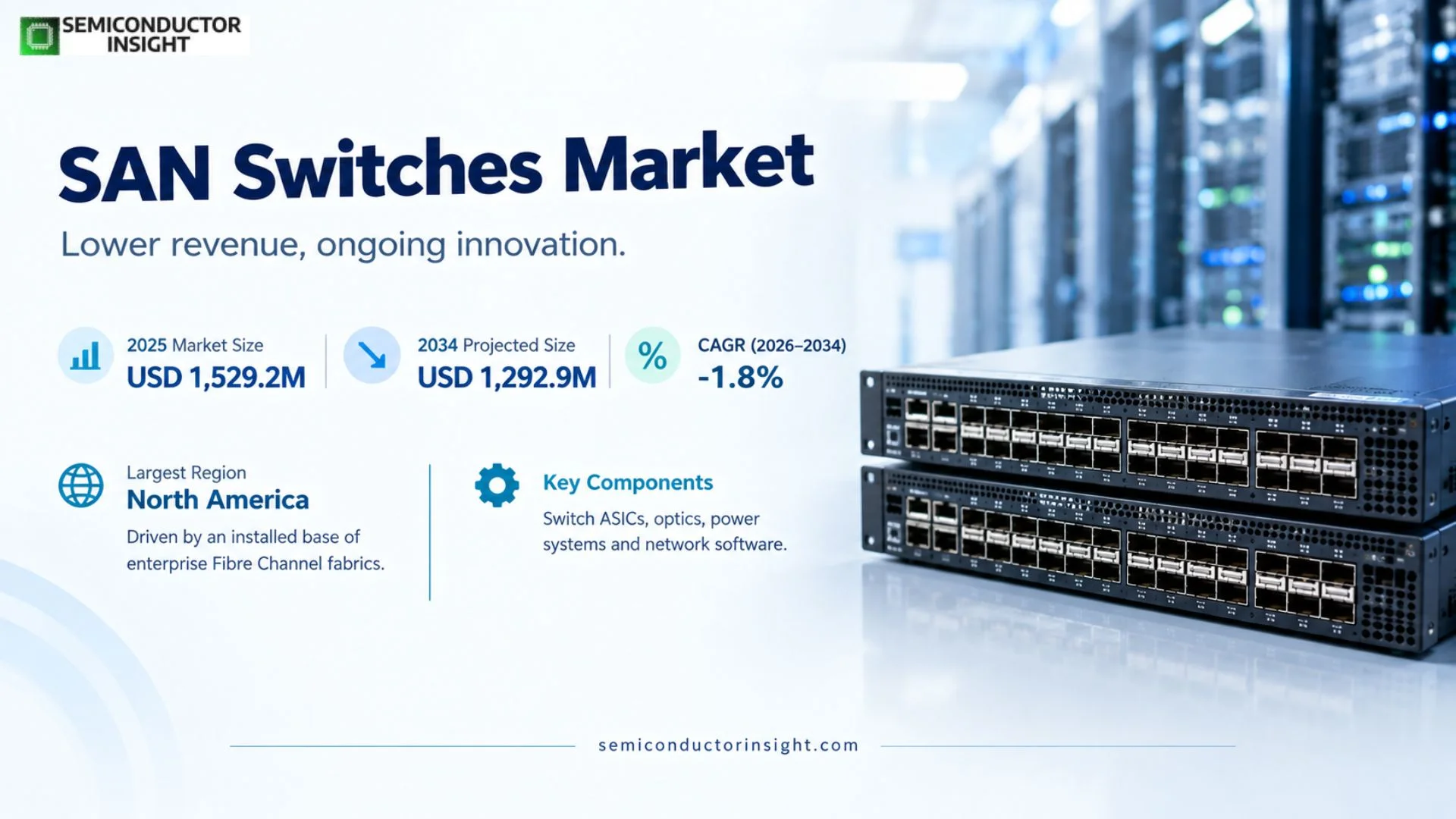
SAN switches market is estimated at US$ 1,529.2 million in 2025 and is projected to decline to US$ 1,292.9 million by 2034, representing an anchor-consistent CAGR of -1.8% during 2026–2034. North America is the largest demand market because a large installed base of enterprise Fibre Channel fabrics continues to support high-value refresh and expansion spending.
A storage area network switch is a purpose-built networking device that connects servers to shared block-storage systems through a dedicated fabric. Fibre Channel remains the defining technology for high-performance enterprise SANs because it provides deterministic, lossless transport, mature zoning and extensive operational tooling. The market also includes iSCSI and Fibre Channel over Ethernet switching configurations where they are positioned as SAN infrastructure, but it excludes general-purpose Ethernet data-center switches unless they are specifically deployed as storage-fabric products.
The category is structurally mature rather than technologically stagnant. Traditional Fibre Channel fabrics face substitution from hyperconverged infrastructure, software-defined storage and Ethernet-based NVMe-oF, which can reduce the number of dedicated SAN switches required in new architectures. At the same time, enterprises with large mission-critical FC estates continue to refresh infrastructure because all-flash arrays, AI-related datasets and higher host throughput increase bandwidth requirements. This tension explains why total market revenue can contract while suppliers continue launching faster and more secure switch generations.
Broadcom’s Brocade portfolio and Cisco’s MDS family illustrate the technical direction. 64G Fibre Channel is already established across directors and fixed switches, and Broadcom announced a Gen 8 128G portfolio in November 2025 with quantum-safe security positioning. Cisco continues to support 64G modules for the MDS 9700 director family. These developments indicate that vendors are defending the installed base by raising throughput, availability, telemetry and security rather than attempting to restore broad unit growth across every enterprise storage workload.
Purchasing decisions are therefore governed by architecture and migration economics. A bank, hospital or large enterprise with thousands of FC ports may prefer an in-family switch refresh because applications, zoning, storage arrays, host bus adapters and operating procedures are already validated. A greenfield cloud-native environment may instead deploy Ethernet-centric or software-defined storage. Suppliers compete not only for new fabrics but for the timing and scope of each installed-base modernization cycle, which makes lifecycle support and backward compatibility central commercial assets.
Segment Analysis: By Type
By type, the market is segmented into FC (Fibre Channel), iSCSI and FCoE. Fibre Channel remains the dominant value segment in mission-critical enterprise storage because it offers purpose-built fabric behavior, predictable latency and a mature operational ecosystem, while iSCSI and Ethernet-based approaches compete where cost, convergence and software-defined architectures are more important than dedicated fabric isolation.
| Type | Commercial role | Market position |
|---|---|---|
| FC (Fibre Channel) | Fibre Channel provides a dedicated lossless storage fabric with zoning, fabric services and mature management tooling. It is widely deployed between enterprise servers and block-storage arrays where predictable performance and fault isolation matter. Modern generations support 32G and 64G broadly, with 128G entering the market, allowing customers to increase bandwidth while preserving existing operational models and storage-network expertise. | FC remains the largest and most defensible SAN-switch segment. Its growth is constrained by architectural substitution, but installed-base refreshes remain valuable because large enterprises can upgrade directors, line cards and edge switches without redesigning the entire storage architecture. Security, automation, congestion analytics and backward compatibility increasingly determine supplier preference as raw port speed becomes only one part of the value proposition. |
| iSCSI | iSCSI carries SCSI storage commands over standard IP networks, allowing organizations to use Ethernet switching and familiar network skills instead of a dedicated Fibre Channel fabric. The architecture can lower acquisition and staffing costs, particularly for smaller environments, virtualized infrastructure and workloads that do not require the deterministic behavior associated with high-end FC deployments. | iSCSI competes more directly with general Ethernet infrastructure, so dedicated SAN-switch revenue is harder to isolate and often lower value per port. It remains important in cost-sensitive and midmarket storage environments, but continued convergence toward software-defined networking means that much of the economic value may be captured by standard data-center Ethernet platforms rather than by a distinct SAN-switch category. |
| FCoE | Fibre Channel over Ethernet encapsulates FC frames across lossless Ethernet infrastructure to converge storage and data traffic on a shared network. The approach can reduce cabling and adapter count where data-center designs support the required Ethernet features. It was positioned as a bridge between FC operational models and converged networking, especially in blade and integrated infrastructure environments. | FCoE is a smaller and more mature segment because the broader market has shifted toward either native Fibre Channel for dedicated SANs or IP/Ethernet storage protocols for converged architectures. Existing deployments still need support and refresh equipment, but the technology is less likely to be the default choice for a completely new storage fabric. Supplier opportunity is therefore tied primarily to installed-base continuity and integrated-system refreshes. |
Why does Fibre Channel remain relevant in a declining market?
Fibre Channel’s advantage is the cost of avoiding disruption in environments where storage fabrics are already deeply embedded. Large enterprises have trained administrators, zoning policies, host bus adapters, multipathing, monitoring and recovery procedures built around FC. Replacing all of that with a different architecture may offer long-term simplification but creates migration risk. A 64G or 128G refresh can deliver higher bandwidth, better security and newer analytics while preserving familiar operations, allowing FC to retain high-value spending even as the overall dedicated SAN-switch market contracts.
Segment Analysis: By Application
By application, SAN switches serve enterprise data centers, cloud service providers, telecommunications and healthcare data centers. Enterprise data centers remain the largest application because financial, government, healthcare and other mission-critical workloads continue to prioritize deterministic storage access and controlled change management, while hyperscale cloud environments are more likely to design around Ethernet-centric storage architectures.
| Application | Demand characteristics |
|---|---|
| Enterprise Data Centers | Large enterprises operate core databases, virtualization platforms, transaction systems and regulated applications that often depend on shared block storage. Existing Fibre Channel fabrics are refreshed as arrays move to all-flash media and host bandwidth rises. Purchasing emphasizes non-disruptive upgrade paths, redundancy, telemetry, security and compatibility with installed storage vendors, making director-class and high-availability switches economically durable despite broader market contraction. |
| Cloud Service Providers | Cloud providers use a mix of storage architectures. Some enterprise-cloud and managed-service offerings retain Fibre Channel where customers require familiar block-storage semantics and isolation, while hyperscale internal platforms often favor software-defined and Ethernet-based designs. Demand therefore concentrates in specialized services and enterprise-facing environments rather than across every cloud workload, limiting the category’s ability to grow with cloud infrastructure as a whole. |
| Telecommunications | Telecom operators support billing, subscriber data, network-management and virtualization workloads that can require highly available storage. SAN switches remain relevant in legacy and regulated systems where deterministic performance and proven recovery procedures matter. New cloud-native network functions, however, increasingly run on standard Ethernet infrastructure, so the application is characterized by selective FC refreshes rather than broad expansion of dedicated storage fabrics. |
| Healthcare Data Centers | Hospitals and healthcare networks manage imaging archives, electronic health records and clinical systems with strict availability and data-protection requirements. Existing FC SANs are often retained because migration risk can affect critical applications and because major storage arrays are already qualified in these environments. Growth is restrained by budget pressure and cloud adoption, but refresh demand remains durable where organizations keep high-value clinical data on-premises. |
Regional Analysis
North America is the largest demand market because it combines a large installed base of enterprise storage fabrics with high spending in financial services, healthcare, technology and government. Asia Pacific is the fastest-growing regional opportunity in selected markets, but manufacturing concentration should not be confused with consumption. Europe remains a mature refresh market shaped by regulated industries and data-sovereignty requirements.
Why do regional SAN-switch demand patterns diverge?
The market is shaped more by installed enterprise architecture than by general data-center construction. North America has many organizations with mature Fibre Channel estates that can justify successive director and edge-switch upgrades. Europe has similar regulated and on-premises workloads but stronger budget and energy scrutiny. Asia Pacific combines advanced enterprise markets such as Japan and Australia with faster-growing data-center markets in India and Southeast Asia. Latin America and Middle East & Africa are smaller, more price-sensitive and often depend on integrated vendor solutions rather than stand-alone storage-network procurement.
| Region | Position | Growth outlook | Demand profile | Supplier-selection logic |
|---|---|---|---|---|
| North America | Largest | Stable to declining | Installed-base refresh led | Backward compatibility, six-nines availability, cyber resilience, vendor interoperability and strong support determine supplier selection. Enterprises often refresh within an established FC operating model rather than redesign mission-critical storage. |
| Europe | Second tier | Moderate decline | Regulated-enterprise led | Data sovereignty, energy efficiency, lifecycle support and compatibility with installed arrays influence purchases. Financial, government and healthcare customers remain important FC users. |
| Asia Pacific | Fastest selected growth | Mixed | New data-center + refresh led | Japan and Australia support high-value enterprise demand, while India and Southeast Asia expand from smaller bases. Cost, local support and integration with multinational storage vendors are important. |
| Latin America | Small | Selective | Integrated-solution led | Budgets and local service access drive purchasing. Buyers often prefer validated bundles from established server and storage vendors rather than bespoke fabric architectures. |
| Middle East & Africa | Smallest | Project dependent | Government + financial led | Gulf states and South Africa create demand for high-availability enterprise infrastructure, but projects are concentrated and require local support, training and long-term maintenance. |
Competitive Landscape
The competitive landscape is highly concentrated around Broadcom’s Brocade Fibre Channel portfolio and Cisco’s MDS family, with additional participation from server, storage and adapter vendors that resell, integrate or support SAN infrastructure. Competition focuses on installed-base control, performance generations, security, management software and OEM channel relationships. This is commercially relevant to the SAN Switches market because vendor selection is typically linked to system-level performance, long service lives and the cost of changing an established architecture after deployment.
Broadcom’s Brocade business has a broad Fibre Channel portfolio spanning entry switches, fixed-port systems and modular directors. Its January 2025 Brocade G710 announcement extended 64G technology into a 24-port entry platform with 460-nanosecond port-to-port latency, a typical 65-watt power draw and scaling from eight to 24 ports. In November 2025, Broadcom announced Gen 8 128G products with quantum-safe positioning, signaling continued R&D investment despite the market’s declining aggregate revenue trajectory.
Cisco competes through the MDS 9000 family, particularly MDS 9700 multilayer directors and associated 64G line cards. Cisco’s advantage comes from enterprise networking relationships, integration with broader data-center infrastructure and a long-lived installed base. Customers with established MDS operations can refresh fabric bandwidth without changing management practices or vendor support models, creating switching costs similar to those that protect Brocade installations.
QLogic and Emulex, now associated with Marvell and Broadcom lineages respectively, are more prominent in host connectivity than in standalone switching, while Dell, HPE, IBM, Fujitsu, NEC and other systems vendors influence the market through OEM bundles and validated storage solutions. These channel relationships matter because many enterprises purchase SAN switches as part of a complete storage architecture rather than as isolated networking equipment.
The strategic battleground is increasingly security and automation. Fibre Channel must defend its role against simpler software-defined and Ethernet architectures, so vendors are adding telemetry, congestion analysis, automated recovery, root-of-trust features and quantum-safe cryptography. The commercial objective is to make an FC refresh deliver enough operational and security value that customers prefer modernization over migration, preserving high-margin installed-base revenue even as total port demand declines.
| Competitive tier | Representative companies | Strategic position |
|---|---|---|
| Fibre Channel platform leaders | Broadcom / Brocade; Cisco | These vendors control the core high-end FC switching and director market through broad portfolios, mature operating systems, management software and extensive qualification with enterprise storage vendors. Installed-base scale creates recurring refresh demand and gives each supplier a strong incentive to preserve backward compatibility while moving customers to 64G and 128G generations. |
| Server & storage system channels | Dell; HPE; IBM; Fujitsu; NEC; Supermicro | Systems vendors influence switch selection through validated architectures, OEM branding and support contracts. Many enterprise customers prefer to buy a complete server, storage and networking stack from a strategic supplier, so channel access can be as important as direct end-user selling for switch manufacturers. |
| Connectivity & networking ecosystem | Marvell / QLogic; Broadcom / Emulex; NVIDIA / Mellanox; Arista; Intel; Microchip | These companies participate through host adapters, Ethernet, converged networking or adjacent connectivity technologies. Their products can either complement Fibre Channel fabrics or enable competing architectures, making them important to the substitution dynamic even when they do not lead the standalone FC switch segment. |
Companies profiled in the report: Brocade (Broadcom), Cisco, QLogic / Marvell, Emulex / Broadcom, IBM, Dell, HPE, Fujitsu, NEC, Arista, Mellanox / NVIDIA, Supermicro, Microchip, Intel. The result for the SAN Switches market is a preference for solutions that can demonstrate repeatable performance, reliable integration and long-term support while fitting the customer’s capital-spending and technology-refresh cycle.
Production Capacity Analysis
SAN-switch production depends on switch ASICs, high-speed SerDes, optics, printed circuit assemblies, power systems and secure network operating software. Physical assembly can be scaled through contract manufacturing, but the strategic bottleneck is access to high-performance silicon, firmware validation and a qualified OEM supply chain capable of supporting multi-year enterprise product lifecycles.
Manufacturing is globally distributed but heavily linked to Asian electronics supply chains for printed circuit boards, components and final assembly. High-end directors also require specialized chassis, backplanes, power supplies and cooling systems designed for redundancy. Suppliers must maintain component availability over long enterprise refresh cycles, which is difficult when semiconductor and optical technologies turn over more quickly than customers retire installed SAN equipment. Lifecycle planning and last-time-buy management therefore affect effective production capacity.
Switch silicon is a major upstream constraint because a new 64G or 128G Fibre Channel generation requires high-speed SerDes, protocol logic, buffering, security and fabric-management features. Broadcom has a structural advantage from owning both silicon capabilities and the Brocade storage-networking platform. Cisco similarly controls the system architecture and software of MDS products. Smaller entrants would need not only hardware but also years of interoperability and reliability validation, making rapid capacity expansion by new competitors unlikely.
OEM distribution creates another form of capacity. Enterprise switches reach customers through Dell, HPE, IBM, Fujitsu and other validated storage ecosystems, and each combination requires compatibility testing and support processes. A supplier may have enough factory output but still be constrained commercially if a new switch is not certified with major arrays, host adapters and operating environments. In this market, qualification slots and software support are therefore as important as assembly-line throughput.
| Capacity factor | Current structure | Commercial implication |
|---|---|---|
| Switch silicon & SerDes | High-speed FC generations require purpose-built switching ASICs, buffering, protocol handling and SerDes that operate reliably at 64G and 128G. The engineering cost and verification burden are high relative to market size. | Silicon ownership creates scale and roadmap advantages. A supplier that controls the ASIC can coordinate feature, power and port-density roadmaps more tightly than a company dependent on merchant switching silicon. |
| System assembly & optics | Fixed switches and directors depend on high-quality PCBs, power supplies, fans, optics and chassis components. Enterprise buyers expect long product lives, making component continuity and second-source planning important. | Manufacturing can be outsourced, but lifecycle management cannot. Component discontinuations can force redesigns that customers do not want during a stable product generation, so suppliers value long-term sourcing agreements and modular architectures. |
| Software & interoperability validation | Fabric operating systems, telemetry, zoning, security and management software must work across large installed bases. New releases require regression testing with storage arrays, host adapters and multipathing environments. | Software validation is a hidden capacity constraint. It limits how quickly vendors can release new hardware or features without increasing field risk, and it is a major reason the market favors long-established platform suppliers. |
Market Dynamics
SAN switches sit in a shrinking but strategically resilient infrastructure category. Dedicated FC fabrics lose share in greenfield cloud-native environments, yet existing enterprise SANs remain difficult to replace and continue to require faster, more secure refreshes. The market outcome is lower aggregate revenue alongside ongoing product innovation. For the SAN Switches market, the commercial implication is shaped by customer qualification, installed-base economics and lifecycle support, so procurement decisions depend on more than a single technical specification or headline price.
The principal growth mechanism is not broad new adoption; it is value preservation within the installed base. All-flash arrays, virtualized workloads and AI-related data movement can make older 16G or 32G fabrics bottlenecks, encouraging upgrades to 64G and eventually 128G. At the same time, software-defined storage and hyperconverged systems remove dedicated SAN layers from some new deployments. Vendors therefore compete to increase revenue per retained fabric through higher speeds, directors, security, analytics and support while accepting that the number of addressable traditional SAN environments will gradually decline.
Market Drivers
Forces supporting demand through 2034
| Driver | Impact | Why it matters |
|---|---|---|
| All-flash and high-throughput storage | Medium-High | Faster arrays and servers can saturate older fabrics, creating refresh demand for 32G, 64G and emerging 128G Fibre Channel in enterprises that retain dedicated SAN architectures. |
| Installed-base migration cost | High for retained FC | Large organizations have operational processes, host adapters, zoning and recovery procedures built around FC. In-family upgrades are often lower risk than complete migration to a new storage-network architecture. |
| Cyber resilience and data protection | Medium-High | Storage networks are part of the data-protection boundary. Hardware root of trust, isolation, analytics and quantum-safe roadmaps provide new reasons to refresh mature switch fleets. |
| AI and data growth in enterprise systems | Medium | AI and analytics increase storage traffic, but the benefit to SAN switches is concentrated in enterprises that use shared FC storage. Hyperscale AI clusters often rely on other network architectures. |
All-flash arrays raise fabric bandwidth requirements
Flash storage can deliver much higher IOPS and throughput than the disk systems that many legacy SANs were designed around. When host and array ports are upgraded, 16G or 32G switching can become the next bottleneck. Enterprises can address the problem by refreshing to 64G switches or director line cards while preserving existing zoning and operational practices. This creates a durable upgrade driver inside the installed base even when new FC fabric creation declines.
Migration cost protects existing Fibre Channel estates
Replacing a storage fabric affects hosts, adapters, multipathing, storage arrays, operational tooling and disaster-recovery procedures. Large enterprises therefore evaluate not just equipment cost but the risk of application disruption and retraining. A staged in-family refresh can be safer than architectural replacement. This switching cost does not guarantee growth, but it slows substitution and supports recurring demand for compatible switches, directors and support contracts.
Security adds a new refresh justification
Storage systems contain critical data and are increasingly targeted by ransomware and destructive attacks. SAN vendors are responding with secure boot, hardware trust, isolation, telemetry and stronger cryptography. Broadcom’s 2025 Gen 8 announcement explicitly positions quantum-safe capabilities as part of the 128G portfolio. Security therefore creates an upgrade rationale that is separate from bandwidth and can accelerate replacement of otherwise adequate older switches.
Data growth sustains high-value enterprise fabrics
Financial, healthcare, government and large industrial organizations continue to generate more transactional, imaging and analytics data. Many of these workloads require deterministic latency, strict access controls and established recovery procedures. Where shared block storage remains the preferred architecture, expanding capacity increases port utilization and can require fabric scaling. The benefit is concentrated in mission-critical environments rather than spread evenly across all data-center growth.
Market Restraints
Factors limiting addressable growth
| Restraint | Impact | Why it matters |
|---|---|---|
| Hyperconverged & software-defined storage | High | HCI and SDS collapse or abstract storage networking into Ethernet-based infrastructure, reducing the number of new environments that require dedicated FC switches. |
| Ethernet-based NVMe-oF alternatives | High | NVMe/TCP and RoCE can run storage traffic across high-speed Ethernet, giving greenfield customers alternatives that share skills and infrastructure with the broader data-center network. |
| Long refresh cycles | Medium-High | Enterprise SAN hardware is engineered for high reliability and can remain deployed for many years. Customers often add ports or line cards rather than replace entire fabrics, limiting unit growth. |
| Concentrated vendor market | Medium | High barriers to entry protect incumbents but reduce category expansion. Innovation is focused on serving existing customers rather than creating a broad set of new suppliers and use cases. |
Hyperconverged infrastructure removes dedicated network layers
HCI platforms combine compute and storage under software control and typically communicate over Ethernet, reducing the need for a separate Fibre Channel fabric in new deployments. The architecture can simplify operations for virtualized and cloud-native workloads. As more applications are deployed on HCI, dedicated SAN switches lose potential greenfield ports. FC remains strong in selected mission-critical environments, but it no longer captures every enterprise storage expansion as it once did.
Ethernet-based storage continues to improve
NVMe/TCP and RoCE allow modern storage protocols to operate across high-speed Ethernet. Customers that already invest in 100G, 200G or 400G Ethernet can consider converging storage traffic onto the same broader networking skill set. This is particularly attractive for cloud-native and scale-out architectures. Fibre Channel counters with deterministic behavior and mature operations, but the availability of credible alternatives limits its total addressable market and pricing power in new designs.
Reliable equipment lengthens replacement cycles
Enterprise directors and fixed switches are designed for continuous operation and often remain in service for many years. A customer may increase capacity by enabling additional ports, adding line cards or upgrading only part of the fabric. High reliability is a product strength but also a volume restraint because installed equipment does not need frequent replacement. Vendors therefore seek software, support, security and higher-speed upgrades to raise lifecycle revenue without relying solely on new chassis shipments.
Market concentration narrows expansion paths
A small number of established platforms dominate Fibre Channel switching because customers require interoperability, long support and proven reliability. The same barriers that protect incumbents also make the market less dynamic: fewer entrants pursue disruptive pricing or new distribution, and vendors focus on extracting value from current enterprise users. This supports margins but does not counter the structural shift toward software-defined and Ethernet-based storage across many new workloads.
Market Opportunities
128G Fibre Channel refresh cycle
Broadcom’s Gen 8 128G portfolio creates a future refresh path for enterprises that want more bandwidth without abandoning Fibre Channel operations. As 128G moves from early adoption into broader qualification, vendors can sell new directors, fixed switches and optics into high-throughput environments. The opportunity is concentrated but attractive because customers often upgrade both core and edge layers over several budget cycles rather than replacing the entire fabric at once.
Cyber-resilient storage fabrics
Ransomware and destructive attacks make the storage network part of enterprise resilience planning. Switch vendors can monetize secure boot, hardware root of trust, traffic analytics, isolation, anomaly detection and stronger cryptography. Security features are especially valuable in financial services, healthcare and government, where data integrity and recovery are business-critical. This provides a qualitative value lever even as aggregate port volumes decline.
SMB access to 64G Fibre Channel
Broadcom’s G710 extends 64G Fibre Channel into a compact 24-port platform with lower power and a smaller entry configuration. Products of this kind can preserve FC relevance among mid-sized enterprises that need deterministic storage performance but cannot justify director-class infrastructure. The opportunity is not enough to reverse total market decline, yet it broadens the refresh pool and can increase attach rates to midrange all-flash arrays.
Lifecycle software and fabric analytics
A mature installed base creates opportunities for management software, health monitoring, congestion analytics and automated remediation. Vendors can use telemetry to help customers optimize ports, identify failing links and plan upgrades before service is affected. This shifts part of the business from hardware replacement toward recurring operational value and strengthens platform stickiness, making customers more likely to remain within the same switching family during future refreshes.
Supply Chain Analysis
The SAN-switch value chain begins with switching silicon, SerDes, optics and other components, moves through secure hardware and operating-system integration, then through OEM validation and enterprise deployment. Value is concentrated in the platform software, interoperability matrix and long support lifecycle because these elements determine whether the switch can be trusted inside a mission-critical storage fabric.
Silicon, Optics & Components
Switch Platform Engineering
OEM Validation & Distribution
Enterprise Deployment & Support
Silicon, Optics & Components
Upstream suppliers provide switch ASICs, processors, memory, power components, optical transceivers, connectors and printed circuit materials. 64G and 128G generations require high-speed signal integrity and lower power per bit. Component changes must be managed carefully because enterprise products remain in the field for years and customers expect replacement parts and compatibility across long lifecycle windows.
Switch Platform Engineering
Brocade, Cisco and other platform vendors integrate hardware with fabric operating systems, zoning, telemetry, congestion controls, security and management software. This stage captures substantial intellectual value because a switch must behave predictably in large redundant fabrics. New hardware generations are useful only when software can interoperate with existing switches and management tools without introducing disruptive migration.
OEM Validation & Distribution
Storage and server vendors validate switches with arrays, host adapters, operating systems and multipathing software. Dell, HPE, IBM, Fujitsu and other channels can package SAN switching into complete enterprise infrastructure. Certification and support agreements create commercial access to customers that prefer one accountable vendor for the whole stack rather than assembling a fabric from separately purchased components.
Enterprise Deployment & Support
End users design redundant fabrics, apply zoning, monitor performance and maintain firmware through long application lifecycles. Support contracts, field replacement, security patches and migration services create recurring revenue. Because operating procedures become deeply embedded, a vendor that provides reliable support can retain the account across several switch generations even as the customer gradually reduces the number of workloads using dedicated SAN infrastructure.
Recent Developments
Report Scope & Segmentation
| Attribute | Coverage |
|---|---|
| Market definition | Purpose-built storage area network switches used to connect servers and shared block-storage systems through Fibre Channel, iSCSI or FCoE fabrics. General data-center Ethernet switches are excluded unless they are specifically deployed and marketed as SAN switching infrastructure. |
| By Type | FC (Fibre Channel); iSCSI; FCoE (Fibre Channel over Ethernet). The report preserves these source-page categories and evaluates them according to installed-base economics, dedicated-fabric behavior and competition from software-defined or Ethernet-centric alternatives. |
| By Application | Enterprise Data Centers; Cloud Service Providers; Telecommunications; Healthcare Data Centers. Enterprise environments represent the largest demand pool because regulated and mission-critical workloads often retain dedicated shared-storage fabrics. |
| By End User | Large Enterprises; Small & Medium Enterprises; Cloud Service Providers. Purchasing behavior differs by availability requirements, IT skill base, installed storage architecture and ability to justify dedicated networking infrastructure. |
| By Port Speed | 16Gbps/32Gbps; 64Gbps/128Gbps; 200Gbps/400Gbps, preserved from the controlling report scope. In practical Fibre Channel roadmaps, current enterprise switching centers on 32G, 64G and the emerging 128G generation, while higher Ethernet speeds are more relevant to competing IP-based storage fabrics. |
| By Functionality | Core Switching; Edge Switching; Director-level. Large fabrics use highly redundant directors at the core and fixed-port switches at the edge, while smaller deployments may operate entirely with compact fixed switches. |
| Regions | North America; Europe; Asia Pacific; Latin America; Middle East & Africa, with regional analysis distinguishing demand from electronics manufacturing concentration. |
| Companies | Brocade (Broadcom); Cisco; QLogic / Marvell; Emulex / Broadcom; IBM; Dell; HPE; Fujitsu; NEC; Arista; Mellanox / NVIDIA; Supermicro; Microchip; Intel. |
Frequently Asked Questions
What is the SAN switches market size in 2025?
The global SAN switches market is estimated at US$ 1,529.2 million in 2025. The market includes purpose-built storage-network switching used for Fibre Channel, iSCSI and FCoE environments, with the largest revenue concentration in enterprise Fibre Channel fabrics. General-purpose Ethernet switches are outside the primary boundary unless they are specifically positioned and deployed as storage-network infrastructure.
What is the projected SAN switches market size by 2034?
The market is projected to decline to US$ 1,292.9 million by 2034. The contraction reflects substitution by hyperconverged infrastructure, software-defined storage and Ethernet-based NVMe-oF in new architectures. Revenue remains supported by high-value refreshes of existing Fibre Channel fabrics, especially where all-flash storage, security and higher host bandwidth justify upgrades to 64G and 128G platforms.
What CAGR is expected during 2026–2034?
The anchor-consistent compound annual growth rate is -1.8% during 2026–2034. The negative rate reflects a gradual reduction in the total dedicated SAN-switch revenue pool rather than disappearance of Fibre Channel. Higher-speed product generations and security upgrades can grow within retained enterprise fabrics even while alternative storage architectures reduce the number of new dedicated SAN deployments.
Which region is the largest SAN switches market?
North America is the largest demand market because it has a large installed base of enterprise storage fabrics across financial services, healthcare, technology, government and other mission-critical sectors. These customers continue to refresh Fibre Channel infrastructure for bandwidth, security and lifecycle reasons. Asia Pacific has important manufacturing and selected growth markets, but manufacturing concentration should not be treated as the same measure as end-user demand.
Which SAN switch type remains dominant?
Fibre Channel remains the dominant SAN-switch technology in high-performance enterprise storage. Its value comes from deterministic lossless transport, mature zoning and management, and a large installed ecosystem of host adapters and storage arrays. iSCSI and Ethernet-based alternatives are important competitors, especially in greenfield and cost-sensitive environments, but they do not eliminate the economic logic of refreshing a large existing FC fabric.
Why is the SAN switch market declining despite new 64G and 128G products?
New product generations improve the value and performance of retained Fibre Channel environments, but they do not reverse the broader architectural shift toward hyperconverged, software-defined and Ethernet-based storage. A smaller number of organizations may spend more per retained fabric while many new workloads avoid dedicated SAN switching altogether. The resulting mix supports continued innovation inside a gradually shrinking total revenue pool.
What is driving SAN switch refresh demand?
All-flash arrays, faster server interfaces, data growth, cyber-resilience requirements and long installed-base lifecycles drive refresh demand. Older 16G or 32G fabrics can become performance bottlenecks as storage improves. Upgrading to 64G or 128G can raise bandwidth and security while preserving zoning, management and operational practices, making in-family modernization less disruptive than a complete architectural migration.
Who are the key companies in the SAN switches market?
The primary platform leaders are Broadcom through Brocade and Cisco through the MDS family. The broader ecosystem includes QLogic/Marvell, Emulex/Broadcom, IBM, Dell, HPE, Fujitsu, NEC, Arista, NVIDIA/Mellanox, Supermicro, Microchip and Intel through adapters, servers, storage systems or competing connectivity technologies. OEM channel relationships are important because switches are frequently purchased as part of validated storage solutions.
What is the main restraint on SAN switch demand?
The largest restraint is architectural substitution. Hyperconverged infrastructure and software-defined storage can remove the need for a dedicated storage fabric, while NVMe/TCP and RoCE let customers use Ethernet-based infrastructure for high-performance storage. Long FC equipment lifecycles also limit replacement frequency. These forces reduce unit growth even though mission-critical installed fabrics continue to generate high-value refresh and support revenue.
How does the SAN-switch supply chain create value?
Upstream suppliers provide switch silicon, SerDes, optics and components; platform vendors integrate hardware with fabric software, security and management; OEMs validate the switches with arrays and servers; and enterprises operate the fabrics through long support lifecycles. The highest defensible value lies in switching silicon, software interoperability, qualification and enterprise support because those capabilities are difficult for a new supplier to replicate quickly.
View research sources used for this overview.
Research Sources & Evidence Base
- Broadcom. Brocade Directors, official Fibre Channel director portfolio and current generation positioning
- Broadcom. World’s First Quantum-Safe Gen 8 128G SAN Switch Portfolio, Gen 8 128G product launch and security roadmap, November 2025
- Broadcom. Brocade G710 24-port 64G Fibre Channel Switch, 64G entry switch specifications and availability, January 2025
- Cisco. MDS 9700 48-Port 64-Gbps Fibre Channel Switching Module, official 64G director switching-module technical documentation
Get Sample Report PDF for Exclusive Insights
Report Sample Includes
- Table of Contents
- List of Tables & Figures
- Charts, Research Methodology, and more...
 Download Sample Report PDF