Market Insights
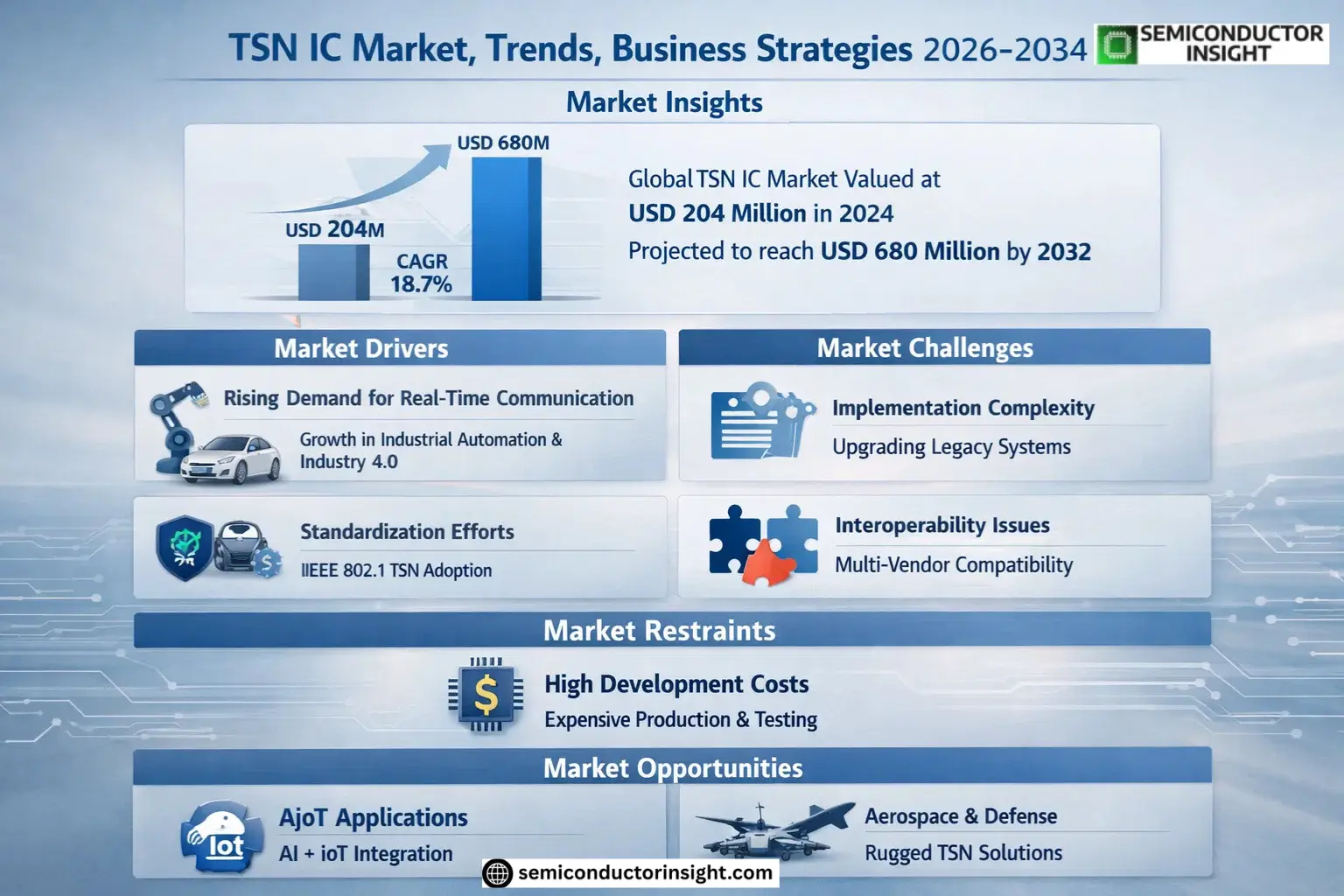
Global TSN IC Market was valued at USD 204 million in 2024 and is projected to reach USD 680 million by 2032, exhibiting a CAGR of 18.7% during the forecast period.
Time-Sensitive Networking (TSN) ICs are specialized hardware components designed to support deterministic, low-latency communication over Ethernet networks. These chips enable precise synchronization and real-time data transmission critical for industrial automation, automotive applications, and smart infrastructure. Key functionalities include time-aware scheduling, traffic shaping, and seamless integration with legacy Ethernet systems.
The market growth is driven by increasing Industry 4.0 adoption, rising demand for autonomous vehicles, and expanding IoT deployments requiring deterministic networking solutions. Major players like Intel, NXP, and Broadcom are accelerating innovation through strategic partnerships – for instance, in Q1 2024, NXP collaborated with Bosch to develop TSN-based automotive Ethernet solutions for next-gen vehicle architectures. Regional analysis shows North America leading with 38% market share in 2024 due to early industrial IoT adoption, while Asia-Pacific emerges as the fastest-growing region with a projected 22% CAGR through 2032.
MARKET DRIVERS
Rising Demand for Real-Time Communication
The increasing adoption of industrial automation and Industry 4.0 applications is driving the TSN IC Market growth, with a projected CAGR of 28% between 2023-2028. Time-Sensitive Networking (TSN) enables deterministic, low-latency communication, making it essential for applications like autonomous vehicles and smart manufacturing.
Standardization Efforts Boost Adoption
The IEEE 802.1 TSN standards have achieved widespread industry acceptance, with over 60% of industrial ethernet implementations now incorporating TSN IC solutions. Major automation vendors are standardizing on TSN for next-generation control systems.
Increasing investments in 5G infrastructure further amplify the need for TSN ICs that can synchronize time-critical data across networks.
MARKET CHALLENGES
Implementation Complexity in Legacy Systems
Modernizing existing industrial networks to support TSN IC technology presents significant technical hurdles, with many enterprises reporting 18-24 month migration timelines. The need for specialized expertise adds to implementation costs.
Other Challenges
Interoperability Issues
Despite standardization, variations in TSN IC implementations among vendors create compatibility concerns, particularly in multi-vendor environments where seamless communication is critical.
MARKET RESTRAINTS
High Development Costs
The specialized nature of TSN IC components results in 30-40% higher production costs compared to conventional networking chips, slowing adoption among price-sensitive applications. Complex testing requirements for time synchronization functionality further contribute to cost pressures.
MARKET OPPORTUNITIES
Emergence of AIoT Applications
The convergence of AI and IoT (AIoT) creates new demand for TSN IC solutions that can support distributed machine learning workloads requiring precise timing. Market analysts project AIoT will drive 25% of TSN IC revenue growth through 2030.
Expansion in Aerospace and Defense
Increasing deployment of networked avionics systems and unmanned platforms presents a USD 1.2 billion opportunity for ruggedized TSN IC solutions meeting MIL-STD specifications through 2027.
Global TSN IC Market Trends ()
Rapid Growth in Industrial Automation Driving TSN IC Demand
Global TSN IC Market was valued at USD 204 million in 2024 and is projected to reach USD 680 million by 2032, growing at a CAGR of 18.7%. This growth is primarily fueled by increasing industrialization 4.0 adoption, requiring reliable time-sensitive networking solutions for synchronized automation.
Other Trends
Automotive Sector Acceleration
Advancements in autonomous vehicle technology have significantly increased demand for high-bandwidth TSN ICs (2-30 Gbps segment), accounting for 42% of 2024 market share. Major automakers are integrating TSN for real-time sensor data processing in ADAS systems.
Regional Market Dynamics
Asia-Pacific dominates with 38% market share due to concentrated electronics manufacturing, while North America shows strongest growth (21% CAGR) from smart factory investments. Europe maintains steady adoption with major industrial automation deployments in Germany and Italy.
Supply Chain and Competitive Landscape
The market remains concentrated, with Broadcom, Intel and NXP collectively holding 58% share. Recent tariff policies have prompted regional supply chain diversification, with Chinese firms like Kyland Technology gaining traction in domestic markets.
Technology Segmentation
High-speed TSN ICs (above 30 Gbps) are witnessing 24% annual growth to support 5G backhaul and edge computing applications. Industrial automation remains the dominant application segment at 46% of total market revenue.
Future Outlook
Market analysts project sustained double-digit growth through 2030, driven by increasing IIoT adoption and standardization of TSN protocols. Emerging applications in smart grid infrastructure and medical robotics present new growth avenues for TSN IC providers.
COMPETITIVE LANDSCAPE
Key Industry Players
TSN IC Market Dominated by Semiconductor Giants and Rising Chinese Challengers
TSN IC Market is currently led by established semiconductor players like Broadcom, Intel, and NXP, who collectively hold over 60% market share. These companies leverage their extensive Ethernet technology portfolios and strong R&D capabilities to dominate high-speed (above 30 Gbps) segments. The market exhibits an oligopolistic structure, with the top 5 players accounting for nearly 75% of global revenues in 2024, though increasing competition from specialized Chinese manufacturers is reshaping the competitive dynamics.
Niche players such as Kyland Technology and Suzhou TSN Technology are gaining traction in industrial automation applications by offering cost-optimized solutions for 2-30 Gbps segments. The Asia-Pacific region, particularly China, is witnessing accelerated growth with domestic players like Beijing Semidrive Technology expanding their TSN portfolios. Recent U.S. tariff policies have prompted some manufacturers to establish localized production facilities, while European suppliers are focusing on automotive-grade TSN solutions to capitalize on autonomous vehicle adoption.
List of Key TSN IC Companies Profiled
- Broadcom
- Intel Corporation
- NXP Semiconductors
- Analog Devices Inc. (ADI)
- Texas Instruments
- Renesas Electronics
- Kyland Technology
- Kungao Micro
- Suzhou TSN Technology
- Motorcomm
- Beijing Guoke Tianxun Technology
- Beijing Semidrive Technology
- Microchip Technology
- Marvell Technology
- Huawei Technologies
Segment Analysis:
| Segment Category | Sub-Segments | Key Insights |
| By Type |
|
2-30 Gbps Segment emerges as the most balanced solution for industrial applications requiring deterministic networking.
|
| By Application |
|
Industrial Automation dominates application demand due to critical need for deterministic networking.
|
| By End User |
|
Manufacturing Enterprises lead adoption as they modernize production facilities.
|
| By Technology Generation |
|
Enhanced TSN shows most promising adoption trajectory in current market.
|
| By Integration Level |
|
Embedded Solutions are becoming the preferred choice for new implementations.
|
Regional Analysis: Asia-Pacific TSN IC Market
China Dominates Asia-Pacific TSN IC Landscape
China’s vertically integrated semiconductor supply chain enables rapid TSN IC prototyping and volume production. Local foundries collaborate closely with industrial automation vendors to customize chipsets for time-critical applications.
National TSN implementation guidelines ensure interoperability between domestic manufacturers’ equipment, creating a unified ecosystem that accelerates TSN IC adoption across Chinese smart infrastructure projects.
Chinese telecom operators are actively deploying hybrid 5G-TSN networks in industrial parks, driving demand for dual-mode ICs that can handle both wireless and wired time-sensitive communications.
Domestic EV manufacturers are incorporating TSN ICs into next-generation vehicle architectures, with local chip designers creating automotive-grade solutions that meet China’s stringent functional safety standards.
South Korea
South Korea’s TSN IC Market benefits from world-leading semiconductor fabrication capabilities and advanced industrial robotics deployment. Samsung and SK Hynix are investing in specialized TSN-enabled memory solutions for real-time industrial applications. The nation’s 5G infrastructure provides ideal testbeds for wireless TSN implementations, with major research projects underway at KAIST to develop ultra-low latency networking chips.
Japan
Japanese industrial automation giants are driving TSN IC adoption through proprietary networking standards that integrate seamlessly with legacy factory equipment. Key players like Mitsubishi Electric and Omron are developing application-specific TSN solutions for precision manufacturing, leveraging the country’s expertise in robotics and motion control systems.
Taiwan
TSMC’s advanced node capabilities position Taiwan as critical supplier of high-performance TSN ICs globally. Local design houses collaborate with international industrial automation vendors to create customized networking solutions, while the island’s machine tool industry serves as early adopters for new TSN-enabled control architectures.
India
India’s emerging TSN IC Market shows strong growth potential with government initiatives promoting domestic semiconductor manufacturing. Implementation focuses on strategic industries like defense and aerospace, where indigenous TSN solutions are being developed for mission-critical timing applications in collaboration with IIT research centers.
Report Scope
This market research report provides a comprehensive analysis of the TSN IC Market, covering the forecast period 2025–2032. It offers detailed insights into market dynamics, technological advancements, competitive landscape, and key trends shaping the industry.
Key focus areas of the report include:
- Market Overview: The report begins with an overview outlining its current market scenario, key growth indicators, and industry transformation drivers. It discusses macroeconomic factors, demand–supply balance, regulatory landscape, and the strategic role of semiconductors in powering advancements across industries such as automotive, telecommunications, consumer electronics, and industrial automation.
- Market Size & Forecast: Historical data and future projections for revenue, unit shipments, and market value across major regions and segments.
- Segmentation Analysis: Detailed breakdown by product type, technology, application, and end-user industry to identify high-growth segments and investment opportunities.
- Regional Insights: Insights into market performance across North America, Europe, Asia-Pacific, Latin America, and the Middle East & Africa, including country-level analysis where relevant.
- Competitive Landscape: Profiles of leading market participants, including their product offerings, R&D focus, manufacturing capacity, pricing strategies, and recent developments such as mergers, acquisitions, and partnerships.
- Technology Trends & Innovation: Assessment of emerging technologies, integration of AI/IoT, semiconductor design trends, fabrication techniques, and evolving industry standards.
- Market Drivers & Restraints: Evaluation of factors driving market growth along with challenges, supply chain constraints, regulatory issues, and market-entry barriers.
- Stakeholder Insights: Insights for component suppliers, OEMs, system integrators, investors, and policymakers regarding the evolving ecosystem and strategic opportunities.
Primary and secondary research methods are employed, including interviews with industry experts, data from verified sources, and real-time market intelligence to ensure the accuracy and reliability of the insights presented.
FREQUENTLY ASKED QUESTIONS:
What is the current market size of TSN IC Market?
-> TSN IC Market was valued at USD 204 million in 2024 and is projected to reach USD 680 million by 2032, exhibiting a CAGR of 18.7% during the forecast period.
What is the projected CAGR for the TSN IC Market?
-> The market is projected to grow at a CAGR of 18.7% during the forecast period (2024-2032).
Which key companies operate in TSN IC Market?
-> Key players include Broadcom, Intel, NXP, ADI, TI, Renesas Electronics, Kyland Technology, Kungao Micro, Suzhou TSN Technology, Motorcomm, Beijing Guoke Tianxun Technology, and Beijing Semidrive Technology.
What are the key growth drivers for the TSN IC Market?
-> Key growth drivers include increasing demand for IoT, smart manufacturing, autonomous vehicles, and the need for reliable, low-latency communication solutions.
What are the primary applications of TSN IC?
-> Primary applications include Industrial Automation, Automobile, Transportation, and others.
Get Sample Report PDF for Exclusive Insights
Report Sample Includes
- Table of Contents
- List of Tables & Figures
- Charts, Research Methodology, and more...
 Download Sample Report PDF