
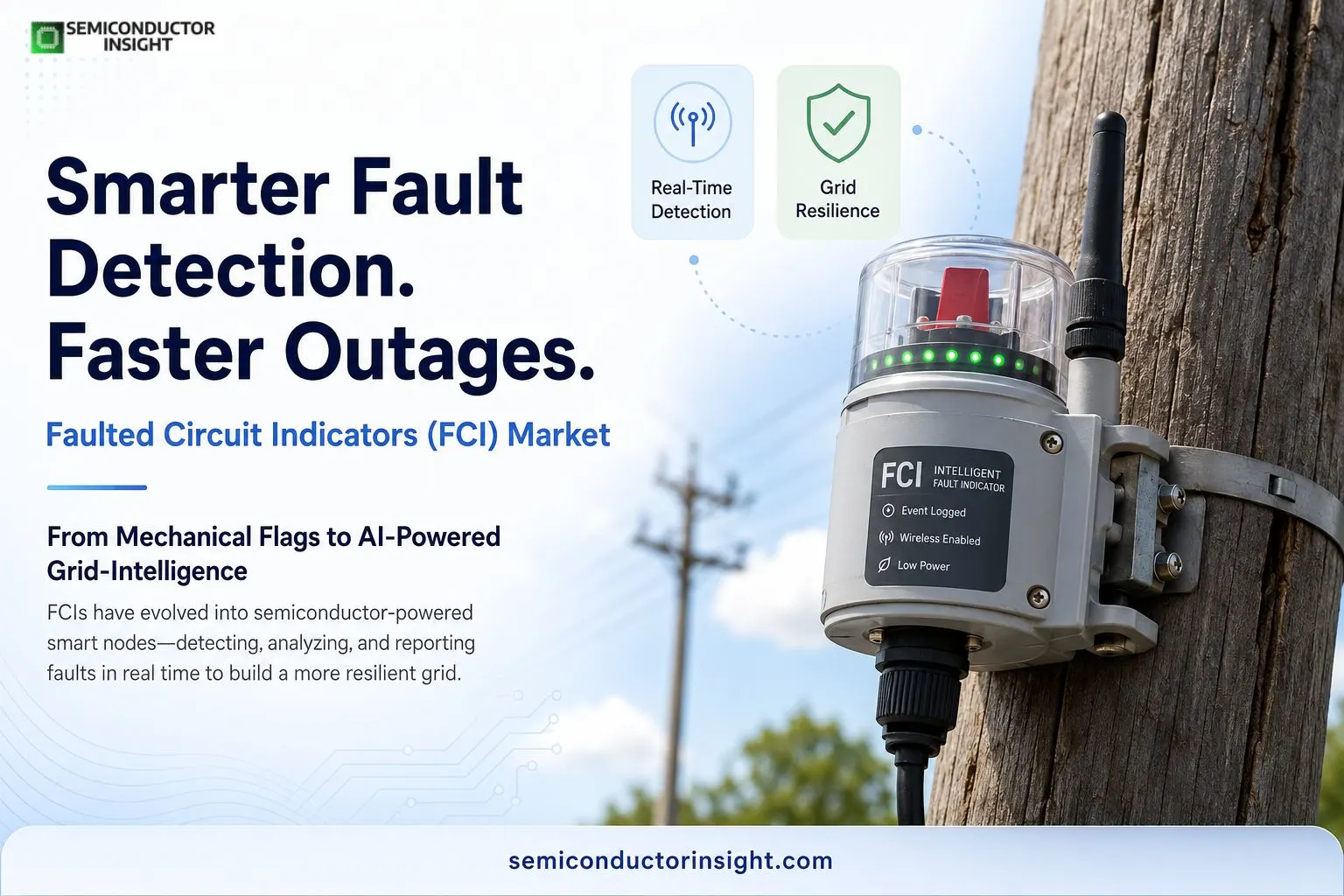
Transformer‑feeder‑centric Faulted Circuit Indicators Market installations tighten reliability metrics.
Faulted circuit indicators (FCIs) have evolved from simple electromechanical flags clamped on overhead lines into mini‑grid‑computers embedded on distribution poles and underground junctions.
In classic configurations, FCIs detect magnetic fields induced by short‑circuit currents and flip a visual target or LED, enabling crews to isolate the faulted section without walking the entire line. Modern FCIs now integrate semiconductor‑based current sensors, microcontrollers, and low‑power wireless radios, turning each unit into a localised fault‑tagging node on the digital grid.
Instead of binary pass/fail flags, modern FCIs log event waveforms, timestamps, and magnitude bands. They then send that information back to distribution operation centres using cellular or mesh radio. This change turns thousands of FCIs into a distributed sensor array, which lets utilities connect outages to specific feeders and line segments in minutes instead of hours.
Semiconductor‑Level Integration in FCI Electronics
- At the core, an intelligent FCI is a semiconductor‑centric package: a ring‑core or Rogowski‑type current sensor feeds into a low‑noise analog‑front‑end, followed by a microcontroller that runs event‑detection algorithms and communication stacks.
- In several EPRI‑documented deployments, these units are built around 32‑bit microcontrollers and low‑power RF‑SoCs that operate on microwatt‑level idle modes, stretching battery life beyond 10 years in field trials.
- In edge‑AI‑enabled pilots, FCIs run lightweight classification models that distinguish between transient faults (such as lightning‑induced surges) and sustained faults (like downed conductors), reducing false alarms and unnecessary truck‑rolls.
- One documented case with a microcontroller‑plus‑AI approach reported fault detection latency under 120 milliseconds and classification accuracy above 96%, with communication delays under 50 milliseconds on Wi‑Fi‑backhaul links, demonstrating how semiconductor logic reshapes outage‑response speed.
For More Detailed Insights, You Can Surf Our Latest Report Here: https://semiconductorinsight.com/report/faulted-circuit-indicators-fci-market/
Grid‑Wide Deployment Volumes and Reliability Gains
In the real‑world grid, FCIs are no longer niche add‑ons; they are mainstream components of modernisation programs. Chinese utilities, for instance, have deployed over 300,000 FCIs between 2023 and 2024 as part of smart‑grid and rural‑electrification initiatives, monitoring faults along more than 1.2 million kilometres of distribution lines.
These deployments are tied to national grid‑modernisation budgets that exceed tens of billions of dollars, explicitly earmarking intelligent fault‑location equipment.
Integration with Smart Grids, Wildfire‑Risk Management, and Distributed Energy
- Beyond pure fault‑tagging, FCIs now sit at the intersection of wildfire‑risk programs, distributed‑energy integration, and self‑healing feeders.
- In western North America and parts of Australia, utilities have linked FCIs to wildfire‑mitigation strategies, using real‑time fault detection to trigger de‑energization in high‑risk corridors when line‑break or tree‑fall events occur.
- Some wildfire‑risk‑sensor mandates now require FCI‑equipped recloser zones to be monitored for rapid response, tightening the link between fault‑indicators and grid‑safety protocols.
- Simultaneously, FCIs that support bidirectional current sensing are finding roles in distributed‑energy‑rich feeders, where solar‑heavy and storage‑augmented circuits can exhibit reverse‑power flows.
- These semiconductor‑enabled FCIs differentiate between upstream and downstream faults, helping operators maintain protection coordination even as the grid topology becomes more dynamic.
From Hardware‑Products to Data‑Driven Reliability Services
What is changing fastest is the FCI role itself: it is shifting from a hardware‑product line into a data‑service enabler. Utilities now mine FCI‑generated event histories to build fault‑probability maps, prioritise recloser‑and feeder‑upgrades, and optimise vegetation‑management cycles. In one documented smart‑grid deployment, FCI‑plus‑SCADA data reduced repeated outage events by around 35% over two years by exposing recurring weak‑link segments and enabling targeted maintenance.
For the semiconductor industry, this means FCIs are no longer just sensor‑and‑LED modules but continuous‑deployment platforms: microcontroller‑based firmware updates, OTA security patches, and evolving analytics models all hinge on the underlying semiconductor architecture. This ecosystem‑driven shift is tightening the dependence of Faulted Circuit Indicators Market on low‑power processors, secure‑wireless stacks, and embedded‑AI tool chains, turning each fault‑indicator into a tiny, field‑deployed node in the wider grid‑digital‑twin vision.

Comments (0)