Smart Grid (AMI) Communication (PLC, RF) Module IC Market Insights
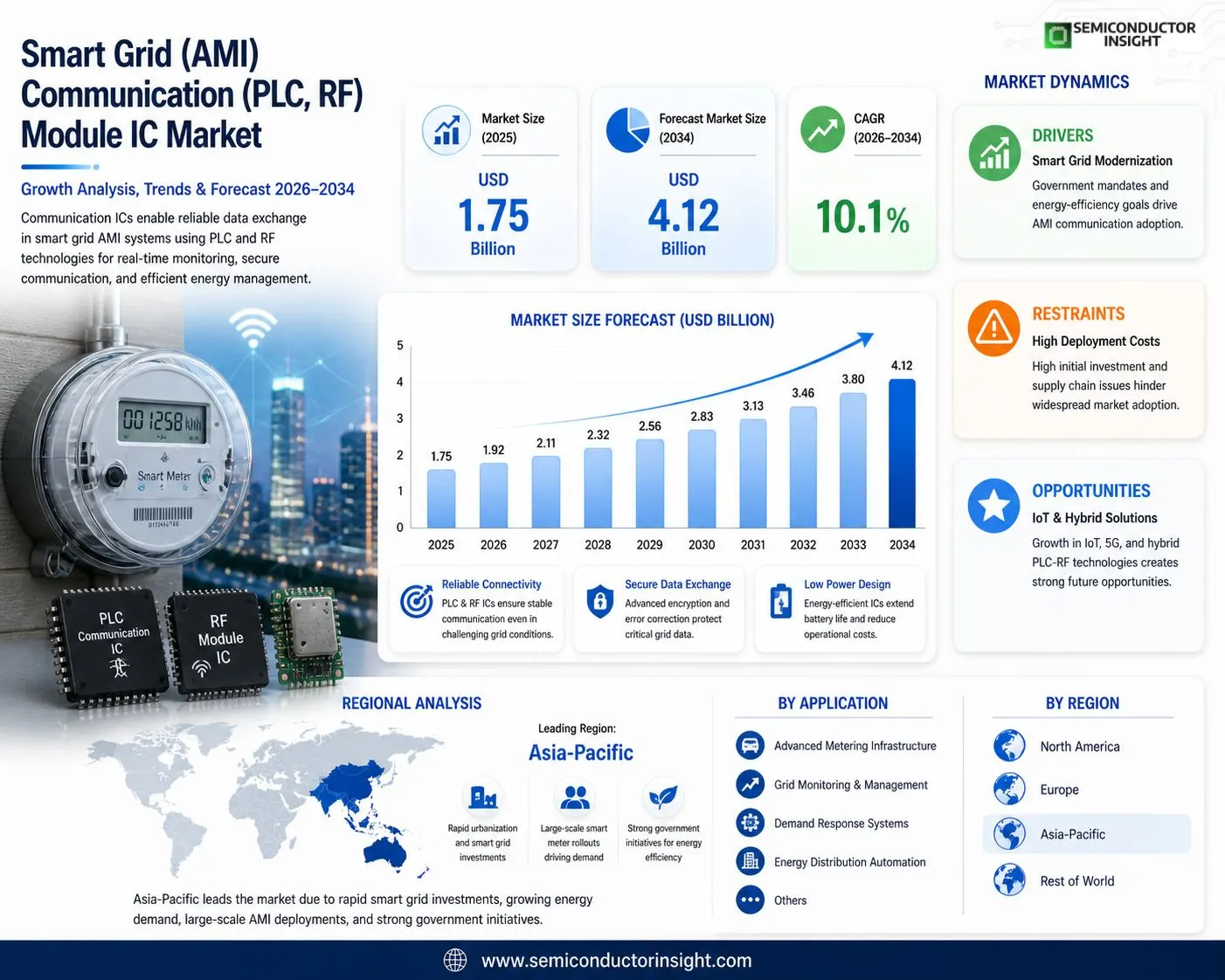
Global Smart Grid (AMI) Communication (PLC, RF) Module IC Market size was valued at USD 1.75 billion in 2025. The market is projected to grow from USD 1.92 billion in 2026 to USD 4.12 billion by 2034, exhibiting a CAGR of 10.1% during the forecast period.
Smart Grid (AMI) Communication (PLC, RF) Module ICs are integrated circuits enabling efficient data exchange in Advanced Metering Infrastructure for smart grids. These ICs support Power Line Communication (PLC), which transmits data over existing power lines, and Radio Frequency (RF) technologies for wireless connectivity. They facilitate real-time monitoring, two-way communication between meters and utilities, demand management, and enhanced grid reliability, encompassing key functions like modulation, demodulation, error correction, and security protocols.
The market sees robust growth fueled by surging smart meter deployments worldwide, government mandates for energy efficiency, and integration of renewables into grids. Furthermore, advancements in IoT and 5G bolster demand for reliable communication ICs. Key players drive innovation; for instance, in April 2024, Texas Instruments introduced the TMPL series PLC modem ICs optimized for AMI applications, enhancing range and power efficiency. Leading companies such as STMicroelectronics, NXP Semiconductors, Renesas Electronics, and Microchip Technology offer diverse portfolios tailored to smart grid needs.
MARKET DRIVERS
Government Mandates and Grid Modernization Initiatives
Global push toward smart grid deployment continues to accelerate demand for Smart Grid (AMI) Communication (PLC, RF) Module IC solutions. Utilities are upgrading aging infrastructure to support two-way communication, real-time monitoring, and improved energy management, with RF mesh and PLC technologies serving as foundational components in advanced metering infrastructure (AMI) deployments.
Rising Adoption of IoT and Hybrid Communication Technologies
Increasing integration of Internet of Things (IoT) devices within energy networks drives the need for reliable, low-cost communication modules. PLC and RF-based ICs enable efficient data transmission in both urban and rural settings, supporting applications such as demand response and distributed energy resource management. Hybrid approaches combining RF mesh with cellular options further enhance network resilience and scalability.
➤ RF mesh networks maintain strong market position due to their self-healing capabilities and cost-effectiveness in high-density deployments, while narrowband PLC offers economical last-mile connectivity leveraging existing power lines.
Advancements in semiconductor design have improved data rates, power efficiency, and interference resistance in communication module ICs, allowing utilities to achieve higher performance in AMI systems without proportional cost increases.
MARKET CHALLENGES
Interoperability and Integration Complexities
Deploying Smart Grid (AMI) Communication (PLC, RF) Module IC solutions across diverse legacy systems presents significant technical hurdles. Varying standards and protocols between different vendors and utility infrastructures can delay large-scale rollouts and increase implementation costs.
Other Challenges
Cybersecurity Vulnerabilities
The expanded attack surface created by connected AMI devices requires robust security measures embedded in communication ICs, yet evolving threats continue to challenge system integrators and utilities.
Signal Interference and Network Reliability
PLC technologies face noise and impedance variations on power lines, while RF solutions encounter spectrum congestion and environmental factors that can degrade performance, particularly in challenging terrains.
MARKET RESTRAINTS
High Initial Investment and Supply Chain Constraints
Substantial upfront capital required for AMI communication infrastructure, including specialized PLC and RF Module ICs, continues to restrain faster adoption in cost-sensitive markets. Global semiconductor supply issues have also impacted timely availability of critical components for meter manufacturers.
Workforce and Technical Skill Shortages
A shortage of skilled RF engineers and technicians capable of designing, deploying, and maintaining advanced communication networks limits the pace of smart grid projects. This gap affects both utilities and system integrators working with PLC and RF technologies.
MARKET OPPORTUNITIES
Emerging Hybrid Networks and Edge Intelligence
Growing interest in hybrid communication architectures that combine PLC, RF mesh, and cellular IoT creates new avenues for innovative module IC designs. Integration of edge computing capabilities within communication ICs can enable localized data processing and faster response times for grid optimization.
Expansion in Renewable Integration and Demand-Side Management
The accelerating transition to renewable energy sources and electric vehicles heightens the need for sophisticated AMI communication to manage bidirectional power flows and dynamic load balancing. This trend opens significant growth potential for advanced Smart Grid (AMI) Communication (PLC, RF) Module IC solutions that support greater grid flexibility and efficiency.
Smart Grid (AMI) Communication (PLC, RF) Module IC Market TrendsHybrid Communication Architectures Gain Momentum
Integrated circuits for Smart Grid (AMI) Communication (PLC, RF) Module continue to evolve toward hybrid solutions that combine power line communication with radio frequency technologies. This trend addresses varying deployment environments where utilities require both the cost-effectiveness of existing power infrastructure and the flexibility of wireless connectivity. PLC-based ICs leverage electrical lines for data transmission in dense urban settings, while RF modules provide reliable coverage in suburban and rural areas with challenging line conditions.Market participants observe increasing demand for communication ICs that support seamless switching between PLC and RF pathways, enabling redundant networks that enhance overall grid reliability. These dual-mode solutions facilitate real-time two-way data exchange essential for advanced metering infrastructure, supporting functions such as demand response and outage detection without single points of failure.
Other Trends
Advancements in Standards and Interoperability
Development of standardized protocols like G3-PLC and PRIME drives innovation in PLC module ICs, allowing better interoperability across multi-vendor smart meter deployments. Semiconductor manufacturers focus on programmable architectures that accommodate multiple standards within a single IC, reducing design complexity for utility equipment makers and supporting global AMI rollouts. RF ICs similarly advance with support for mesh networking topologies that improve scalability in large-scale metering projects.
Enhanced Security and Cybersecurity Features
As two-way communication expands in smart grids, communication module ICs incorporate robust security protocols including encryption, authentication, and secure boot mechanisms. This addresses growing concerns around cyber threats targeting critical energy infrastructure. Leading suppliers integrate hardware-based cryptographic engines directly into PLC and RF chipsets, ensuring data integrity for sensitive metering and grid management information.
Integration with IoT and Next-Generation Networks
Smart Grid (AMI) Communication (PLC, RF) Module IC Market trends reflect deeper integration with broader IoT ecosystems and emerging wireless standards. Manufacturers optimize ICs for lower power consumption and extended range, critical for battery-backed or energy-harvesting devices in remote monitoring applications. RF solutions increasingly align with 5G and LPWAN capabilities, while PLC ICs benefit from broadband variants that deliver higher data throughput for advanced analytics and renewable energy integration.Innovation examples include optimized modem designs that improve signal efficiency and noise resilience in noisy power line environments. Companies such as STMicroelectronics and others expand portfolios with solutions tailored for hybrid PLC-RF setups, supporting utilities in modernizing aging infrastructure while accommodating rising distributed energy resources. These developments position communication ICs as foundational elements for resilient, intelligent grid operations worldwide.
COMPETITIVE LANDSCAPE
Key Industry Players
Smart Grid (AMI) Communication (PLC, RF) Module IC Market Analysis
Smart Grid (AMI) Communication (PLC, RF) Module IC Market is dominated by global semiconductor leaders known for large-scale innovation in PLC and RF communication architectures. Companies such as Texas Instruments, STMicroelectronics, NXP Semiconductors, Renesas Electronics, and Microchip Technology hold substantial market influence due to their extensive AMI‑focused IC portfolios, strong presence in utility metering ecosystems, and continuous investments in communication protocol optimization. These firms leverage advancements in modulation techniques, error correction, and low‑power RF design to support utilities transitioning toward digital, automated grid infrastructures. Many of these players collaborate closely with meter manufacturers and grid solution providers, solidifying their leadership positions.
Beyond the leading tier, several specialized and emerging semiconductor firms contribute meaningful innovation in PLC modem ICs, sub‑GHz RF chipsets, and secure communication processors. Companies such as Silicon Labs, Semtech, MaxLinear, Infineon Technologies, ON Semiconductor, and Analog Devices expand technological diversity through expertise in low‑noise RF transceivers, narrowband PLC solutions, and advanced mixed‑signal ICs. Their developments enhance interoperability, energy efficiency, and communication robustness across smart grid deployments. Collectively, these companies strengthen competitive intensity by advancing feature integration and supporting evolving AMI standards worldwide.
List of Key Smart Grid (AMI) Communication (PLC, RF) Module IC Market Companies Profiled
- Texas Instruments
- STMicroelectronics
- NXP Semiconductors
- Renesas Electronics
- Microchip Technology
- Silicon Labs
- MaxLinear
- Semtech Corporation
- Infineon Technologies
- Analog Devices
- ON Semiconductor (onsemi)
- Qualcomm (RF Connectivity Segment)
- Broadcom
- MediaTek
- Skyworks Solutions
Segment Analysis:
| Segment Category | Sub-Segments | Key Insights |
| By Type |
|
Leading Segment PLC ICs continue to gain dominance due to their ability to leverage existing electrical infrastructure, minimizing deployment complexity and enhancing grid communication reliability.
|
| By Application |
|
Leading Segment Smart meters represent the primary application as utilities intensify modernization efforts to strengthen grid visibility and efficiency.
|
| By End User |
|
Leading Segment Utilities dominate end-user adoption as they drive large-scale AMI communication deployments across transmission and distribution infrastructures.
|
| By Technology Layer |
|
Leading Segment Modem and protocol ICs lead the category as they are essential for core AMI communication functions including modulation, demodulation, and error correction.
|
| By Communication Environment |
|
Leading Segment Urban networks remain the most active deployment environment as utilities strengthen high-density grid infrastructures to handle increasing energy demands.
|
Regional Analysis: Smart Grid (AMI) Communication (PLC, RF) Module IC Market
North America
North America’s accelerated grid modernization programs foster consistent demand for AMI communication ICs, particularly in utilities upgrading legacy metering systems. PLC and RF modules benefit from this infrastructure push as utilities seek solutions offering reliability, compatibility, and low maintenance requirements. These modernization efforts reinforce long-term investments in resilient communication architectures.
A strong network of semiconductor manufacturers and communication technology providers positions North America as a hub for advanced module IC development. Close collaboration between utilities and suppliers accelerates pilot deployments and product refinement, supporting broader adoption of PLC and RF communication solutions tailored to regional performance needs.
Regulatory policies across the United States and Canada emphasize grid reliability, resilience, and integration of distributed resources. These initiatives encourage utilities to deploy robust AMI communication technologies. PLC and RF module IC adoption is further supported by regulatory frameworks that prioritize secure, standardized, and scalable communication systems.
The region is leading experimentation with hybrid PLC–RF communication models, driven by the need to serve diverse geographical and grid conditions. Utilities increasingly adopt module ICs capable of supporting multiple communication modes, ensuring adaptability and long-term value. This trend strengthens regional leadership in communication innovation.
Europe
Europe demonstrates steady momentum Smart Grid (AMI) Communication (PLC, RF) Module IC Market, supported by comprehensive regional energy directives and strong emphasis on sustainability. The region’s commitment to decarbonization encourages widespread deployment of intelligent metering systems, where PLC and RF communication ICs play a pivotal role. Countries with advanced smart grid frameworks continue to expand their AMI footprints, while emerging markets in Eastern Europe show growing interest in flexible and cost-efficient communication modules. Utilities prioritize interoperability and standardization, reinforcing stable demand for high-performance module ICs that support diverse metering environments.
Asia-Pacific
Asia-Pacific experiences rapid expansion driven by large-scale electrification projects, rising urbanization, and extensive government-led grid digitalization programs. The region’s diverse utility landscape creates broad opportunities for PLC and RF module IC adoption, particularly in countries advancing nationwide smart meter deployments. Growing investments in renewable integration and grid automation push utilities toward communication solutions that support scalability and long-distance reliability. Local semiconductor production capabilities further contribute to regional competitiveness and innovation.
South America
South America’s Smart Grid (AMI) Communication (PLC, RF) Module IC Market is shaped by progressive modernization of aging grid infrastructures and increasing efforts to improve power distribution reliability. Utilities in more developed markets within the region are gradually implementing AMI systems, with PLC often favored for its suitability in dense urban environments. Interest in RF communication solutions is rising as utilities aim to enhance network flexibility and manage geographically dispersed service territories. The region’s evolving regulatory environment also encourages broader adoption of advanced communication ICs.
Middle East & Africa
The Middle East & Africa region is witnessing gradual adoption of AMI communication technologies as countries invest in modern grid infrastructure to improve energy efficiency and system visibility. PLC and RF module ICs gain traction in markets prioritizing digital transformation and enhanced grid monitoring. Urban expansion and increasing renewable integration drive utilities to explore reliable communication modules capable of handling diverse climatic and operational conditions. While adoption rates vary significantly across the region, long-term opportunities remain strong as governments expand smart grid initiatives.
Report Scope
This market research report provides a comprehensive analysis of the Smart Grid (AMI) Communication (PLC, RF) Module IC Market , covering the forecast period 2026–2034. It offers detailed insights into market dynamics, technological advancements, competitive landscape, and key trends shaping the industry.
Key focus areas of the report include:
- Market Overview: The report begins with an overview outlining its current market scenario, key growth indicators, and industry transformation drivers. It discusses macroeconomic factors, demand–supply balance, regulatory landscape, and the strategic role of semiconductors in powering advancements across industries such as automotive, telecommunications, consumer electronics, and industrial automation.
- Market Size & Forecast: Historical data and future projections for revenue, unit shipments, and market value across major regions and segments.
- Segmentation Analysis: Detailed breakdown by product type, technology, application, and end-user industry to identify high-growth segments and investment opportunities.
- Regional Insights: Insights into market performance across North America, Europe, Asia-Pacific, Latin America, and the Middle East & Africa, including country-level analysis where relevant.
- Competitive Landscape: Profiles of leading market participants, including their product offerings, R&D focus, manufacturing capacity, pricing strategies, and recent developments such as mergers, acquisitions, and partnerships.
- Technology Trends & Innovation: Assessment of emerging technologies, integration of AI/IoT, semiconductor design trends, fabrication techniques, and evolving industry standards.
- Market Drivers & Restraints: Evaluation of factors driving market growth along with challenges, supply chain constraints, regulatory issues, and market-entry barriers.
- Stakeholder Insights: Insights for component suppliers, OEMs, system integrators, investors, and policymakers regarding the evolving ecosystem and strategic opportunities.
Primary and secondary research methods are employed, including interviews with industry experts, data from verified sources, and real-time market intelligence to ensure the accuracy and reliability of the insights presented.
FREQUENTLY ASKED QUESTIONS:
What is the current market size of Smart Grid (AMI) Communication (PLC, RF) Module IC Market?
-> Global Smart Grid (AMI) Communication (PLC, RF) Module IC Market was valued at USD 1.75 billion in 2025 and is expected to reach USD 4.12 billion by 2034, supported by a CAGR of 10.1%.
Which key companies operate Smart Grid (AMI) Communication (PLC, RF) Module IC Market?
-> Key players include STMicroelectronics, NXP Semiconductors, Renesas Electronics, Microchip Technology, and Texas Instruments, among others.
What are the key growth drivers?
-> Key growth drivers include surging global smart meter deployments, government energy-efficiency mandates, integration of renewable energy sources, and advancements in IoT and 5G technologies.
Which region dominates the market?
-> Regional dominance is not explicitly specified in the available reference data; however, growth is influenced globally by smart grid modernization and AMI infrastructure expansion.
What are the emerging trends?
-> Emerging trends include integration of IoT and 5G in AMI systems, advanced PLC and RF communication technologies, enhanced grid reliability solutions, and increasing innovation in AMI‑optimized IC architectures.

Get Sample Report PDF for Exclusive Insights
Report Sample Includes
- Table of Contents
- List of Tables & Figures
- Charts, Research Methodology, and more...
 Download Sample Report PDF