LED Probe Station Market Insights
Global LED Probe Station market size was valued at USD 392 million in 2025. The market is projected to reach USD 576 million by 2032, exhibiting a CAGR of 5.8% during the forecast period.
LED Probe Station refers to equipment used for LED component detection and testing, which can detect the electrical and optical performance parameters of LED components to ensure their quality and performance. It is widely used in fields such as display screens, backlights, lighting, automobiles, healthcare, smart homes, and more.
The market is experiencing steady growth due to several factors, including surging demand for advanced LED testing in semiconductor fabrication, rapid expansion of microLED and MiniLED technologies, and rising applications in consumer electronics and automotive sectors. Furthermore, innovations in high-precision probing systems and increased investments in photonics R&D are driving further expansion. Key players such as Tokyo Electron, Tokyo Seimitsu, FormFactor, MPI, and Electroglas dominate with diverse portfolios, while companies like Hprobe and Lake Shore Cryotronics, Inc. contribute through specialized solutions.
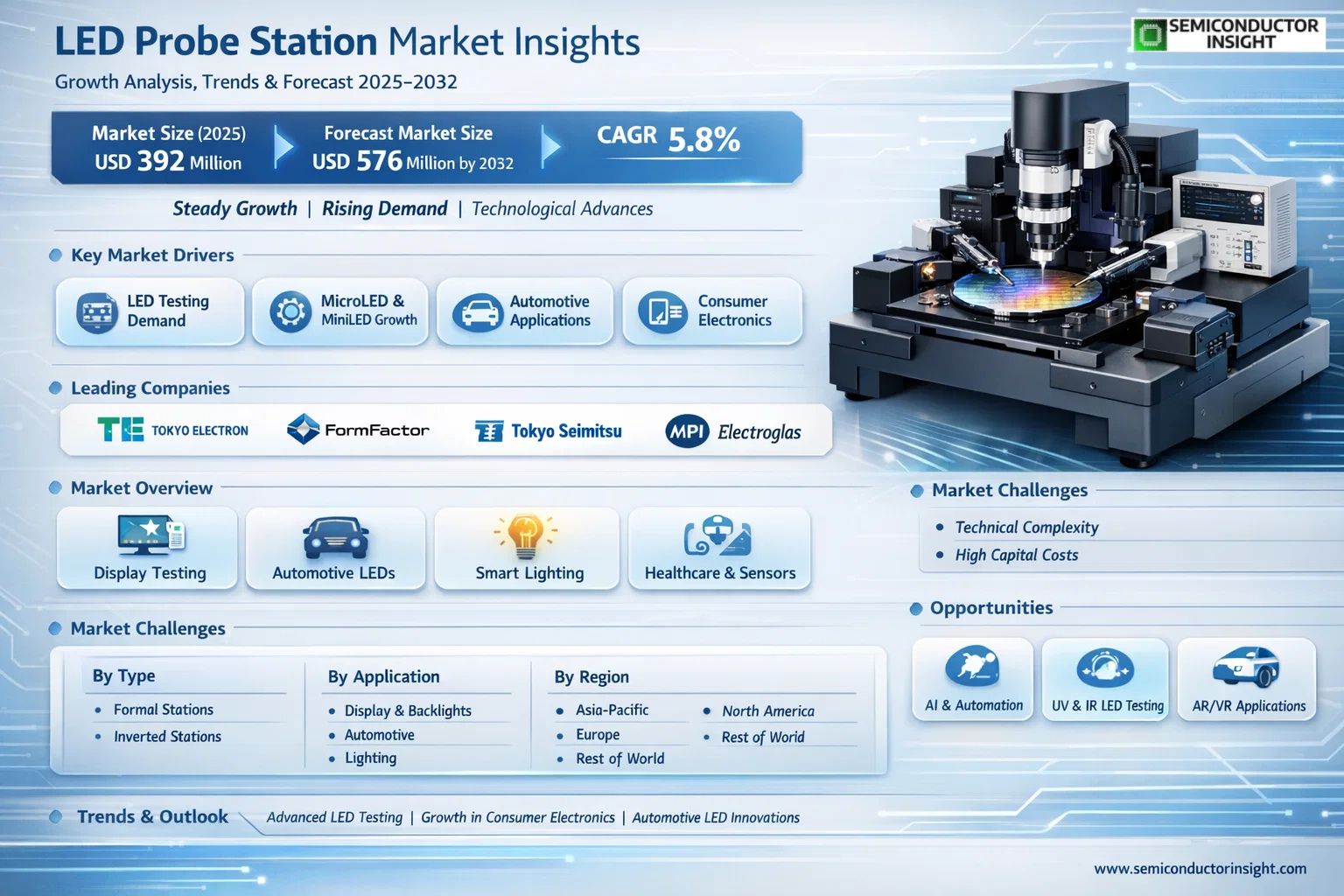
MARKET DRIVERS
Advancements in LED Manufacturing
Rapid evolution of LED Probe Station Market is propelled by the surge in high-brightness and microLED production for displays and lighting applications. Manufacturers are scaling up wafer-level testing to ensure yield rates above 95%, driven by demand from consumer electronics and automotive sectors where precision electrical characterization is critical.
Rising Demand for Automotive and Display LEDs
Integration of LEDs in advanced driver-assistance systems (ADAS) and head-up displays has intensified the need for reliable probe stations capable of handling high-voltage testing up to 100V. The global shift toward energy-efficient lighting further boosts adoption, with probe station deployments increasing by approximately 12% annually in semiconductor fabs.
➤ LED probe station throughput has improved by 20-30% with automated systems, reducing testing time per wafer.
Overall, these factors contribute to market expansion as companies invest in next-generation testing infrastructure to meet stringent quality standards in the competitive LED ecosystem.
MARKET CHALLENGES
Technical Complexity in MicroLED Testing
Probing sub-micron LED dies poses significant hurdles in LED Probe Station Market, requiring ultra-fine needles and vibration-free environments to achieve accurate IV curve measurements. Alignment precision below 1 micron remains a persistent issue, impacting throughput in high-volume production lines.
Other Challenges
High Capital Investment
Initial setup costs for advanced probe stations exceed $500,000 per unit, deterring small to mid-sized LED manufacturers from upgrading, especially amid fluctuating raw material prices for GaN substrates.Supply chain disruptions for specialized RF probes and chucks add delays, with lead times stretching up to 6 months, complicating timely market entry for new LED technologies.
MARKET RESTRAINTS
Regulatory and Standardization Gaps
Stringent safety standards for high-power LED testing in LED Probe Station Market impose compliance burdens, including ESD protection protocols that inflate equipment costs by 15-20%. Lack of unified global standards for probe needle wear leads to inconsistent test data across regions.Intellectual property restrictions limit technology sharing among probe station vendors, slowing innovation in multi-channel testing capabilities essential for next-gen LEDs.Economic slowdowns in key markets like Asia-Pacific reduce capital expenditures on testing equipment, with probe station sales dipping 8% in recent quarters due to overcapacity in LED chip production.
MARKET OPPORTUNITIES
Miniaturization and AI Integration
LED Probe Station Market stands to benefit from the microLED revolution, where probe stations with AI-driven pattern recognition can enhance defect detection rates to over 98%. Emerging applications in AR/VR headsets demand scalable testing solutions for pixel-level validation.Expansion into UV and IR LED segments for medical and sensing devices opens new revenue streams, with market projections indicating 9% CAGR through 2030 driven by healthcare adoption.Strategic partnerships between probe station makers and LED foundries could accelerate deployment of hybrid testing platforms, capitalizing on the growing electric vehicle lighting market valued at billions annually.
LED Probe Station Market Trends
Integration of Advanced Testing for Electrical and Optical Parameters
LED Probe Station Market is experiencing growth driven by the need for precise detection of electrical and optical performance parameters in LED components. These stations ensure quality across applications in display screens, backlights, lighting, automobiles, healthcare, and smart homes. Manufacturers are focusing on equipment that provides comprehensive testing capabilities to meet rising standards in LED production. Key developments include enhanced probing accuracy and compatibility with various LED types, supporting the expansion of high-performance LEDs in diverse sectors.
Other Trends
Expansion in Automotive and Consumer Electronics Applications
Demand for LED probe stations is surging in automotive electronics and consumer electronics segments. Automotive applications require robust testing for LEDs used in lighting and displays, while consumer electronics benefit from precise optical parameter verification. This trend reflects the broader adoption of LEDs in vehicles and devices, prompting suppliers to innovate station designs for higher throughput and reliability. Regional dynamics, particularly in Asia with its manufacturing hubs in China, Japan, and South Korea, are accelerating this shift.
Dominance of Formal Probe Stations and Competitive Landscape
Formal probe stations are gaining prominence over inverted types due to their suitability for standard LED testing workflows. Leading players such as Tokyo Electron, FormFactor, and MPI are consolidating market shares through product enhancements and strategic developments. Surveys indicate that top manufacturers are addressing industry challenges like price fluctuations and supply chain obstacles by focusing on automation and integration. North America and Europe remain key for innovation, while Asia drives volume through cost-effective production. These trends underscore the competitive push towards reliable, versatile LED probe solutions amid evolving market demands.
COMPETITIVE LANDSCAPE
Key Industry Players
Top LED Probe Station Manufacturers and Their Market Positions
LED Probe Station Market is dominated by a few established leaders, with the global top five players collectively holding a significant revenue share in 2025. Companies like Tokyo Electron and FormFactor lead the pack, leveraging advanced technological capabilities in wafer-level testing for LED components. Tokyo Electron, a Japanese giant in semiconductor equipment, excels in high-precision probing solutions tailored for electrical and optical performance evaluation of LEDs used in displays, lighting, and automotive applications. FormFactor follows closely, offering innovative probe cards and systems that support high-volume production testing. The market structure remains moderately concentrated, driven by high barriers to entry such as R&D investments and customization needs for applications in consumer electronics and automotive sectors. Intense competition focuses on precision, throughput, and integration with formal and inverted probe station types.
Beyond the frontrunners, several niche players contribute to innovation and regional dominance, particularly in Asia-Pacific markets like China and Japan. Firms such as MPI, Tokyo Seimitsu, and Micronics Japan provide specialized solutions for LED probe stations, emphasizing cost-effective alternatives and rapid customization for emerging applications in smart homes and healthcare. Hprobe and Wentworth Laboratories cater to high-frequency RF and cryogenic testing niches, while Lake Shore Cryotronics specializes in temperature-controlled environments critical for LED performance validation. Emerging Chinese players like Semishare Electronic, KeithLink Technology, and Shenzhen TEC-PHO are gaining traction through competitive pricing and localized support, challenging incumbents in high-growth segments. This diverse competitive landscape fosters ongoing advancements amid a projected CAGR of 5.8% through 2032.
List of Key LED Probe Station Companies Profiled
- Tokyo Electron
- FormFactor
- Tokyo Seimitsu
- MPI
- Electroglas
- Wentworth Laboratories
- Hprobe
- Micronics Japan
- Psaic
- Lake Shore Cryotronics, Inc
- KeithLink Technology
- ESDEMC Technology LLC
- Semishare Electronic
- KeyFactor Systems
- SEMISHARE
- Pegasus
- SIDEA
- Shenzhen TEC-PHO
- Shenzhen Biaopu Semiconductor Technology
Segment Analysis:
| Segment Category | Sub-Segments | Key Insights |
| By Type |
|
Formal Probe Station
|
| By Application |
|
LED Lighting
|
| By End User |
|
LED Chip Manufacturers
|
| By Automation Level |
|
Semi-Automatic
|
| By Test Environment |
|
Room Temperature
|
Regional Analysis: LED Probe Station Market
Asia-Pacific
China and Taiwan serve as primary hubs, with dense clusters of LED fabs requiring scalable probe stations for parallel testing. This infrastructure supports high-volume output for global displays and lighting, optimizing probe card integration for defect detection at nanoscale.
South Korea and Japan lead in R&D for next-gen probing, incorporating AI-driven alignment and multi-site testing. These innovations enhance precision for power LEDs used in automotive and horticulture, reducing downtime in production lines.
Integrated ecosystems minimize lead times for probe station components, enabling rapid customization. Proximity of suppliers fosters resilience against disruptions, supporting steady expansion in LED Probe Station Market regionally.
Shift toward automation in fabs accelerates uptake of advanced probe stations, particularly for micro-LED qualification. Industry collaborations drive standardization, enhancing interoperability across diverse LED production workflows.
North America
North America exhibits steady growth in LED Probe Station Market, fueled by innovation-centric ecosystems in the United States and Canada. Leading semiconductor firms prioritize probe stations for R&D in advanced packaging and compound semiconductors, emphasizing high-fidelity testing for niche LED applications like AR/VR displays and medical devices. Strong academic-industry partnerships accelerate development of probing technologies compatible with heterogeneous integration. While production volumes trail Asia-Pacific, focus on premium, customizable solutions drives premium pricing and export potential. Regulatory emphasis on energy efficiency spurs adoption in solid-state lighting R&D, with investments in automation enhancing lab-to-fab transitions. Market dynamics reflect a blend of prototyping excellence and strategic outsourcing to Asian manufacturers, positioning the region as a key influencer in global standards for LED probing accuracy.
Europe
Europe’s LED Probe Station Market thrives on stringent quality standards and automotive sector integration across Germany, the Netherlands, and the UK. Probe stations are integral for validating LED performance in adaptive lighting systems and EV headlights, with emphasis on reliability testing under extreme conditions. Collaborative frameworks like Horizon Europe fund innovations in probing for perovskite LEDs and photonics. Mature supply networks support mid-volume production, while sustainability mandates favor efficient, low-contact probing methods. Regional dynamics highlight a balanced approach between indigenous development and partnerships with Asian suppliers, fostering incremental advancements tailored to regulatory compliance and circular economy principles in optoelectronics manufacturing.
South America
South America represents an emerging landscape in LED Probe Station Market, with Brazil and Mexico leading adoption amid growing electronics assembly. Cost-effective probe stations cater to local LED lighting and signage production, addressing infrastructure upgrades in smart cities. Limited domestic R&D shifts focus to imported solutions customized for tropical climates, enhancing durability in high-humidity environments. Market expansion ties to FDI in semiconductors, gradually building testing capabilities for export-oriented displays. Challenges like supply chain fragmentation underscore opportunities for regional hubs, positioning South America as a value-driven player with potential for accelerated integration into global LED Probe Station Market networks.
Middle East & Africa
The Middle East & Africa region shows nascent development in LED Probe Station Market, driven by diversification efforts in the UAE, Saudi Arabia, and South Africa. Probe stations support solar-integrated LEDs and smart infrastructure projects, with focus on ruggedized models for harsh environments. Government visions like Vision 2030 spur investments in local testing facilities for displays and horticultural lighting. Sparse manufacturing bases rely on imports, yet rising tech parks foster skill development. Dynamics emphasize niche applications in oilfield lighting and off-grid solutions, laying groundwork for broader uptake as regional electronics maturity advances within LED Probe Station Market.
Report Scope
This market research report provides a comprehensive analysis of LED Probe Station Market, covering the forecast period 2025–2032. It offers detailed insights into market dynamics, technological advancements, competitive landscape, and key trends shaping the industry.
Key focus areas of the report include:
- Market Overview: The report begins with an overview outlining its current market scenario, key growth indicators, and industry transformation drivers. It discusses macroeconomic factors, demand–supply balance, regulatory landscape, and the strategic role of LED probe stations in testing electrical and optical performance of LED components across industries such as display screens, backlights, lighting, automobiles, healthcare, and smart homes.
- Market Size & Forecast: Historical data and future projections for revenue, unit shipments, and market value across major regions and segments.
- Segmentation Analysis: Detailed breakdown by product type, technology, application, and end-user industry to identify high-growth segments and investment opportunities.
- Regional Insights: Insights into market performance across North America, Europe, Asia, South America, and the Middle East & Africa, including country-level analysis where relevant.
- Competitive Landscape: Profiles of leading market participants, including their product offerings, R&D focus, manufacturing capacity, pricing strategies, and recent developments such as mergers, acquisitions, and partnerships.
- Technology Trends & Innovation: Assessment of emerging technologies, integration of AI/IoT, semiconductor design trends, fabrication techniques, and evolving industry standards.
- Market Drivers & Restraints: Evaluation of factors driving market growth along with challenges, supply chain constraints, regulatory issues, and market-entry barriers.
- Stakeholder Insights: Insights for component suppliers, OEMs, system integrators, investors, and policymakers regarding the evolving ecosystem and strategic opportunities.
Primary and secondary research methods are employed, including interviews with industry experts, data from verified sources, and real-time market intelligence to ensure the accuracy and reliability of the insights presented.
FREQUENTLY ASKED QUESTIONS:
What is the current market size of LED Probe Station Market?
-> Global LED Probe Station market was valued at USD 392 million in 2025 and is projected to reach USD 576 million by 2032, at a CAGR of 5.8% during the forecast period.
Which key companies operate in LED Probe Station Market?
-> Key players include Tokyo Electron, Tokyo Seimitsu, FormFactor, MPI, Electroglas, Wentworth Laboratories, Hprobe, Micronics Japan, Psaic, Lake Shore Cryotronics, Inc, among others.
What are the key growth drivers?
-> Key growth drivers include demand for LED component testing in display screens, backlights, lighting, automobiles, healthcare, and smart homes.
Which region dominates the market?
-> Asia dominates the market, driven by major countries like China and Japan.
What are the emerging trends?
-> Emerging trends include advancements in Formal Probe Station and Inverted Probe Station technologies for precise electrical and optical performance testing.

Get Sample Report PDF for Exclusive Insights
Report Sample Includes
- Table of Contents
- List of Tables & Figures
- Charts, Research Methodology, and more...
 Download Sample Report PDF