
Tracing the Path of Network Interface Cards (NICs) for AI Servers Market in Enterprise AI Infrastructure
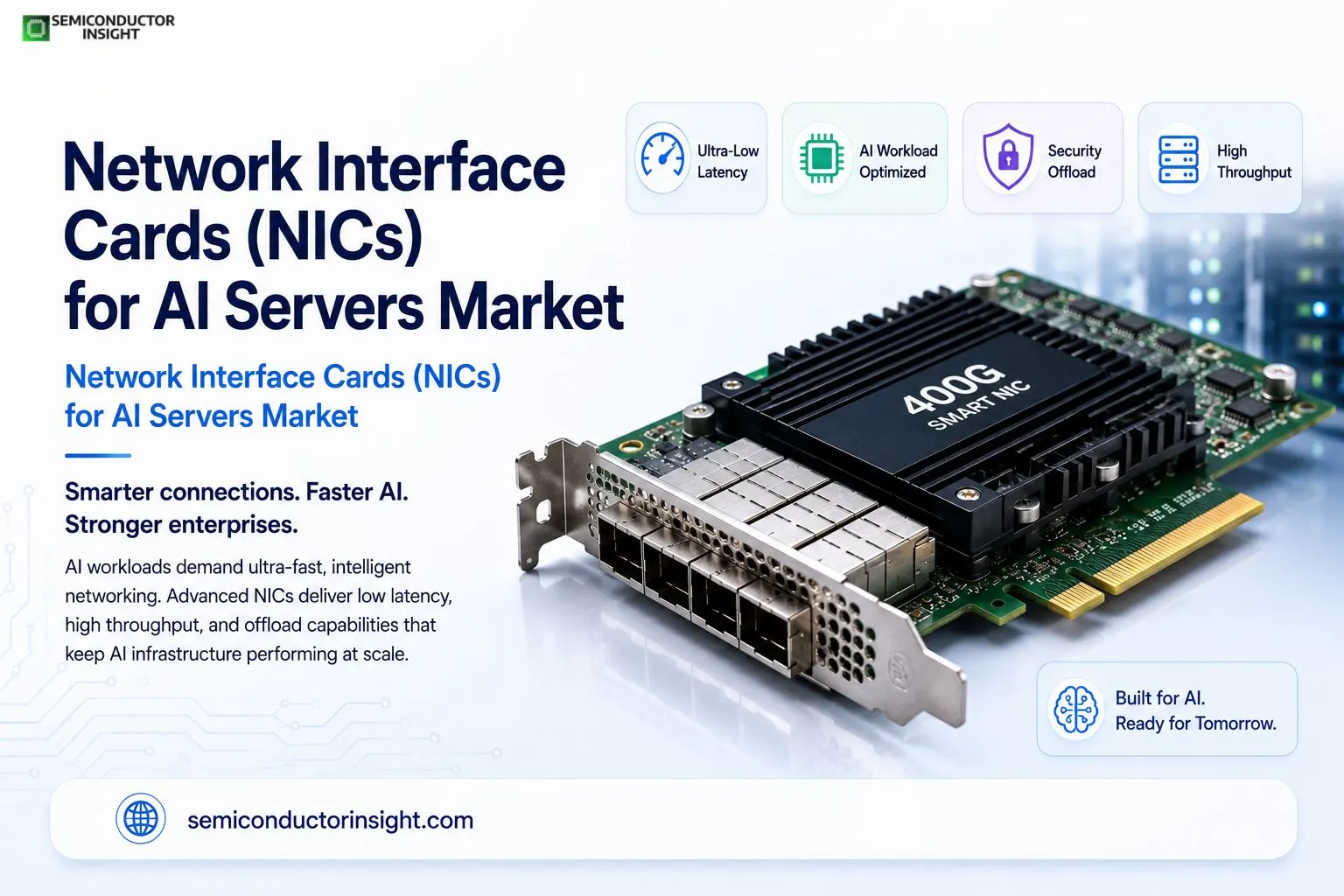
Network interface cards have quietly become the unsung backbone of modern artificial intelligence systems. These specialized components handle the massive data flows that keep thousands of processors working in harmony during complex model training and inference tasks. As AI workloads grow more demanding, the focus has shifted toward NICs optimized specifically for server environments handling parallel computations at enormous scale.
From basic Ethernet controllers described in technical references to advanced smart adapters with offload capabilities, these cards now manage everything from low-latency communications to security functions directly on the hardware. Recent studies outlines how contemporary NICs incorporate features like direct memory access, multiple queues, and even programmable processing elements that reduce strain on central processors.
The Shift toward Smart Connectivity in AI Environments
- Traditional networking hardware struggles when faced with the all-to-all communication patterns common in large language model training. Modern implementations, such as those from NVIDIA’s ConnectX series (formerly Mellanox), integrate data processing units that offload tasks like RDMA operations. This allows GPUs to focus on computations rather than data movement, creating tighter integration across server clusters.
- Intel’s Ethernet adapters, including the E810 series, demonstrate similar progress through features supporting high throughput and precise timing. Case studies from their developer cloud show these adapters delivering performance comparable to specialized alternatives while maintaining compatibility with open standards. In one evaluation involving distributed storage for AI, the adapters handled demanding workloads efficiently, supporting faster deployment cycles in production settings.
Protocol battle: InfiniBand vs. Ethernet in AI clusters
In AI training environments, RoCE over Ethernet accounts for 80-85% of workloads, especially across tier-2 and tier-3 clusters where tuned Ethernet RoCEv2 delivers performance comparable to specialized alternatives. It is typically the default choice for clusters with 256 to 1,024 GPUs, offering around 55% lower total cost of ownership over three years, and large-scale deployments such as Meta’s 24K H100 cluster also run on Ethernet.
- InfiniBand NDR and HDR systems account for 15-20% of the market and are generally reserved for hot-lane, latency-sensitive workloads within hybrid architectures.
- These solutions remain the preferred option for HPC clusters, with NVIDIA’s ConnectX-7 supporting 400G and ConnectX-8 targeting 800G InfiniBand, although they typically carry about a 2x cost premium over Ethernet.
- DPU offload now represents 35% of AI training tasks, reflecting the growing use of hardware acceleration to reduce CPU burden.
- NVIDIA’s BlueField-3, for example, can deliver the equivalent of 300 CPU cores in services offload, while about 50% of cloud service providers are expected to deploy DPUs in 2025-26.
Delivery lead times for 400G and 800G NIC hardware, such as ConnectX-7 and ConnectX-8 class products, currently range from 20 to 30 weeks. NVIDIA’s focus on DGX and HGX builds has extended queues for smaller buyers, while demand for switches above 200G continues to grow at double-digit rates through 2026.
Curious about the report? Dive into our newest updated version at no cost: https://semiconductorinsight.com/report/network-interface-cards-nics-for-ai-servers-market/
In-Network Computing and Offload Innovations
Advanced NICs now perform operations traditionally handled by host CPUs. Features like TCP offload, RDMA over Converged Ethernet, and hardware accelerators for security reduce latency and free computing resources. Arxiv discussions on smart NIC evolution note increasing use in AI/ML contexts, though resource constraints mean they complement rather than replace general-purpose processors.
Broadcom and others have introduced solutions targeting 800G Ethernet specifically for trillion-parameter models. These developments align with open standards efforts like the Ultra Ethernet Consortium, promoting interoperability across different vendor ecosystems.
AI-Led Infrastructure Trends Transforming Enterprise Connectivity
- High-performance Ethernet-based Network Interface Cards (NICs) are increasingly proving their worth in performance efficiency and scalability for next-generation AI infrastructure in large-scale AI server deployments.
- Real world implementations have shown demonstrable benefits in communication in GPU clusters, improved latency handling and more flexible network extension options.
- For example, DriveNets Fabric Scheduled Ethernet deployments for production-scale 512-GPU clusters powered by NVIDIA H200 GPUs demonstrated significant performance gains in a live operational environment, highlighting the increasing role of Ethernet in AI fabrics traditionally dominated by proprietary interconnect technologies.
- And at the same time, enterprises evaluating AI workloads using Intel Tiber Developer Cloud settings underscored how common Ethernet adapters can provide good workload performance while providing benefits in availability, deployment flexibility and infrastructure cost minimization.
- The proof-of-concept implementations showed that the current Ethernet-based NIC designs are increasingly capable of serving demanding AI training and inference workloads without necessitating much more expensive networking alternatives.
- As GPU clusters scale to thousands of accelerators, infrastructure providers are also rethinking network topologies to prevent congestion and preserve ultra-low latency communication.
- High-density switching technologies that support spine-leaf topologies are gaining traction in hyperscale AI deployments because they enable flatter and more efficient network designs.
- Semiconductor and networking firms are investing in 800G networking capabilities, co-packaged optics and silicon photonics technologies to increase bandwidth density and power efficiency for future AI data centres.
- The evolving architectural decisions show that NIC innovation is no longer only about connectivity, but is becoming important to the entire performance, thermal efficiency and scalability of AI server environments.
Sustainability Angles in Networking Hardware
As data centers face scrutiny over resource consumption, NIC advancements targeting lower power per bit become increasingly relevant. Features like dynamic device personalization and application-specific queues help optimize traffic without proportional energy increases. Industry efforts focus on maintaining performance while addressing environmental impacts noted in federal energy reports.
- Deployments span hyperscale operators, research institutions, and enterprise settings.
- National labs and universities adopting platforms with integrated high-speed NICs contribute to diversified use cases.
- Government-supported initiatives in various regions emphasize domestic capabilities in supporting AI infrastructure components, including networking.
The ongoing refinement of these cards reflects the broader push toward AI factories where networking is as critical as compute elements. Continued progress in speeds, offload functions, and integration will determine how effectively organizations can scale intelligent systems in the coming years. With data movement remaining central to AI success, specialized NICs for servers stand positioned as key enablers in this transformation.

Comments (0)