Network Interface Cards (NICs) for AI Servers Market Insights
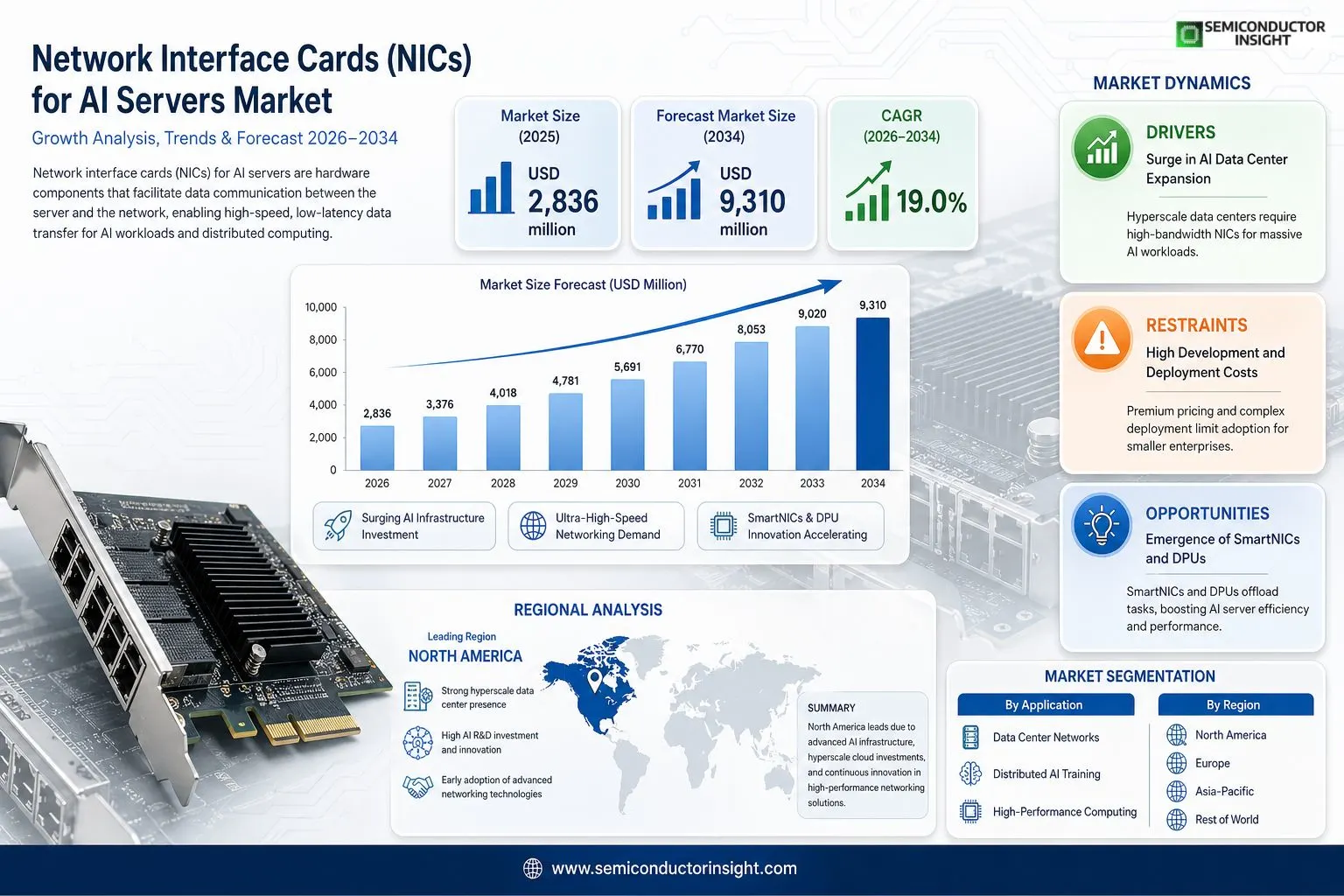
Global Network Interface Cards (NICs) for AI Servers market size was valued at USD 2,836 million in 2025. The market is projected to reach USD 9,310 million by 2034, exhibiting a CAGR of 19.0% during the forecast period.
Network interface cards (NICs) for AI servers are hardware components that facilitate data communication between the server and the network. In AI servers, NICs are mainly used to handle high volumes of data transfer, especially in large-scale distributed computing and training processes.
The market is experiencing rapid growth due to several factors, including surging demand for AI infrastructure, expansion of hyperscale data centers, and the need for ultra-low latency networking in AI workloads. Furthermore, advancements in high-speed Ethernet and InfiniBand technologies, such as 400Gb/s and beyond, are driving further expansion. Initiatives by key players continue to fuel this momentum. For instance, in March 2024, NVIDIA launched the Spectrum-X Ethernet networking platform, optimized for trillion-parameter AI workloads in cloud environments. NVIDIA, Intel, Broadcom, Marvell, HPE, Supermicro, Microchip, Lenovo, Realtek, and Broadex Technologies are some of the key players operating in the market with comprehensive portfolios.
MARKET DRIVERS
Surge in AI Data Center Expansion
The rapid proliferation of AI workloads is a primary driver for Network Interface Cards (NICs) for AI Servers Market. Hyperscale data centers are scaling up to support large-scale training and inference tasks, necessitating high-bandwidth NICs such as 400GbE and 800GbE Ethernet solutions to handle massive data transfers between GPUs.
Advancements in Low-Latency Networking
Innovations in InfiniBand and RoCE technologies enable ultra-low latency communication critical for AI server clusters. These advancements allow seamless scaling of multi-node AI systems, with market growth projected at over 28% CAGR through 2030, fueled by demand from cloud providers.
➤ Key players like NVIDIA and Broadcom dominate with ConnectX series NICs, supporting RDMA for efficient AI data flows.
Additionally, the shift toward distributed AI training across thousands of GPUs underscores the need for reliable, high-throughput NICs, positioning this market for sustained expansion.
MARKET CHALLENGES
Supply Chain Vulnerabilities
Network Interface Cards (NICs) for AI Servers Market faces significant hurdles from global semiconductor shortages, delaying production and increasing lead times for high-end chips essential for 400G+ speeds. This impacts AI infrastructure rollout by major tech firms.
Other Challenges
Interoperability Issues
Diverse AI server architectures from vendors like Dell and HPE require standardized NIC protocols, yet compatibility gaps between Ethernet and InfiniBand persist, complicating deployments in hybrid environments.Power efficiency remains a concern, as advanced NICs consume substantial energy in dense AI racks, challenging data center cooling and sustainability goals amid rising electricity costs.
MARKET RESTRAINTS
High Development and Deployment Costs
Premium pricing of specialized Network Interface Cards (NICs) for AI Servers Market acts as a major restraint, with 400GbE NICs costing up to five times more than standard server NICs, limiting adoption among smaller enterprises.Regulatory compliance for data sovereignty in AI applications adds complexity and expense, particularly in regions enforcing strict data localization rules that affect cross-border AI server networking.Moreover, the rapid evolution of AI hardware standards creates obsolescence risks, deterring long-term investments in NIC infrastructure for AI servers.
MARKET OPPORTUNITIES
Emergence of SmartNICs and DPUs
Network Interface Cards (NICs) for AI Servers Market presents strong opportunities through SmartNICs and Data Processing Units (DPUs), which offload networking, security, and storage tasks from CPUs, enhancing AI server performance by up to 40%.Growth in edge AI deployments drives demand for compact, high-speed NICs tailored for distributed computing, with market segments expected to expand at 35% annually.Partnerships between NIC vendors and AI chipmakers, such as integrations with NVIDIA BlueField DPUs, unlock new revenue streams in customized AI server solutions.
Network Interface Cards (NICs) for AI Servers Market Trends
Surge in High-Speed NIC Adoption
Network Interface Cards (NICs) for AI Servers Market is witnessing a pronounced shift toward higher-speed interfaces, including 200Gb/s and 400Gb/s variants. These advancements address the escalating demands of large-scale distributed computing and AI training processes, where NICs must manage massive data throughput efficiently. Key players such as NVIDIA, Intel, and Broadcom are at the forefront, developing NICs optimized for AI servers to minimize latency and maximize bandwidth in clustered environments. This trend is driven by the need for seamless interconnectivity in hyperscale data centers, enabling faster model training and inference cycles.
Other Trends
Expansion in Data Center and HPC Applications
Data center networks and high-performance computing (HPC) applications dominate the usage of Network Interface Cards (NICs) for AI Servers Market, reflecting the infrastructure buildout for AI workloads. NICs facilitate critical data communication between servers and networks, supporting the growth of AI-driven services. The distributed AI training segment is particularly prominent, as organizations scale clusters for complex machine learning tasks. This application focus underscores the market’s alignment with cloud providers and enterprise AI deployments, where reliable, high-volume data transfer is paramount.
Regional Dynamics and Manufacturer Innovations
In Network Interface Cards (NICs) for AI Servers Market, Asia-Pacific regions like China and Japan are emerging as key growth areas, fueled by rapid data center expansions and AI infrastructure investments. North America maintains leadership through innovation hubs, while Europe advances in HPC integrations. Leading manufacturers including Marvell, HPE, Supermicro, and Microchip are responding with product enhancements, focusing on compatibility with AI accelerators and energy-efficient designs. These innovations address challenges like network congestion and power consumption, fostering competitive differentiation. Overall, the market trends indicate sustained momentum toward more robust, scalable networking solutions tailored for evolving AI server architectures.
COMPETITIVE LANDSCAPE
Key Industry Players
Dominant Manufacturers in Network Interface Cards (NICs) for AI Servers Market
Network Interface Cards (NICs) for AI Servers Market exhibits a concentrated structure dominated by semiconductor leaders and server OEMs, driven by surging demand for high-bandwidth connectivity in data centers and distributed AI training. NVIDIA holds a commanding position with its ConnectX series, particularly the BlueField DPUs and ConnectX-7/8 NICs supporting 400Gb/s and beyond, leveraging its GPU dominance to secure substantial revenue share. Intel follows as a key contender via its Ethernet 800 Series (E810) adapters, optimized for AI workloads with features like Application Device Queues (ADQ) for low-latency inference. Broadcom, another top-tier player, contributes through its BCM957xxx family and Stingray SmartNICs, excelling in scale-out AI clusters. Together, the global top five players accounted for a significant portion of revenues in 2025, underscoring an oligopolistic landscape where innovation in RoCEv2, RDMA, and PCIe Gen5 integration defines competitive edges.
Beyond the frontrunners, niche and specialized players enhance market diversity, addressing varied needs in high-performance computing and cost-optimized deployments. Marvell Technology advances with its Octeon and Teralynx Ethernet solutions, focusing on 200-800Gb/s PAM4 technologies for AI fabrics. Server giants like Hewlett Packard Enterprise (HPE), Supermicro, and Lenovo integrate custom NICs into AI-optimized systems, bundling solutions for end-to-end scalability. Microchip Technology offers value-driven options via its Switchtec and RailFlex NICs, while Realtek Semiconductor targets entry-level segments with Realtek RTL series for edge AI servers. Emerging firms like Broadex Technologies provide high-density, low-power alternatives. Additional contributors include Cisco with its Nexus ecosystem extensions, Dell Technologies’ PowerEdge integrations, AMD’s Pensando Elba NICs, Asus AI server adapters, and GIGABYTE’s enterprise-grade cards, collectively fostering innovation amid rapid market growth at 19.0% CAGR through 2034.
List of Key Network Interface Cards (NICs) for AI Servers Companies Profiled
- NVIDIA
- Intel
- Broadcom
- Marvell Technology
- Hewlett Packard Enterprise (HPE)
- Supermicro
- Microchip Technology
- Lenovo
- Realtek Semiconductor
- Broadex Technologies
- Cisco Systems
- Dell Technologies
- AMD
- Asus
- GIGABYTE
Segment Analysis:
| Segment Category | Sub-Segments | Key Insights |
| By Type |
|
400Gb/s leads the segment due to its ability to handle the immense data throughput demands of modern AI workloads.
|
| By Application |
|
Distributed AI Training dominates as it requires specialized NICs for efficient inter-node communication in complex model development.
|
| By End User |
|
Cloud Service Providers are the frontrunners, leveraging advanced NICs to power vast AI infrastructures.
|
| By Network Protocol |
|
InfiniBand excels in performance-critical AI environments due to its optimized architecture for collective operations.
|
| By Form Factor |
|
PCIe holds the lead for its versatility and widespread compatibility in AI server designs.
|
Regional Analysis: Network Interface Cards (NICs) for AI Servers Market
North America
Silicon Valley and surrounding areas lead in developing cutting-edge NICs for AI servers, focusing on programmable silicon that supports AI acceleration protocols. This fosters rapid prototyping and deployment of solutions optimized for GPU clusters, driving market leadership through continuous R&D advancements.
Cloud providers in the region heavily invest in AI infrastructure, demanding NICs with ultra-low latency and high packet processing rates. This creates a virtuous cycle of demand and innovation, solidifying North America’s role as the primary market for premium AI server networking components.
Collaborations between chipmakers and network vendors accelerate NIC evolution for AI workloads, emphasizing interoperability with AI frameworks. These alliances enhance ecosystem integration, boosting adoption across enterprise and research sectors.
Efforts to reduce power consumption in data centers propel demand for energy-efficient NICs tailored for AI servers, aligning with green computing initiatives and regulatory pressures in the region.
Europe
Europe exhibits strong growth in Network Interface Cards (NICs) for AI Servers Market, propelled by ambitious digital sovereignty goals and expanding AI research consortia. Countries like Germany and France lead with initiatives promoting high-speed networking for sovereign cloud infrastructures, where NICs play a crucial role in enabling secure, low-latency AI deployments. The region’s emphasis on open standards drives adoption of versatile NIC solutions compatible with diverse AI server configurations. Market dynamics are shaped by public-private partnerships funding next-gen data centers, focusing on NICs that support edge AI processing and hybrid cloud environments. Challenges include harmonizing regulations across borders, yet this fosters innovation in privacy-enhanced networking, positioning Europe as a key player in ethical AI hardware advancements.
Asia-Pacific
Asia-Pacific emerges as a dynamic force in Network Interface Cards (NICs) for AI Servers Market, fueled by rapid data center expansion in China, Japan, and India. Sovereign AI ambitions and massive cloud migrations demand scalable NICs optimized for dense AI server racks, emphasizing cost-effective high-bandwidth solutions. Regional dynamics highlight manufacturing prowess, with local vendors customizing NICs for hyperscale operators handling vast AI training datasets. Government incentives for semiconductor self-reliance accelerate development of indigenous technologies, blending Ethernet and RDMA over Converged Ethernet for AI workloads. This region’s cost advantages and volume-driven scaling challenge global incumbents, fostering a competitive environment ripe for NIC innovations tailored to emerging market needs.
South America
South America shows promising traction in Network Interface Cards (NICs) for AI Servers Market, particularly in Brazil and Mexico, where digital transformation initiatives boost AI adoption in enterprises. Limited infrastructure prompts focus on efficient NICs for compact data centers supporting AI analytics and machine learning inference. Market dynamics revolve around affordability and reliability, with imports of advanced NICs adapted for variable power grids and connectivity challenges. Growing tech ecosystems in urban hubs drive demand for plug-and-play solutions integrating with AI servers, while regional collaborations aim to build local expertise. This positions South America for accelerated growth as AI applications penetrate sectors like agriculture and finance.
Middle East & Africa
The Middle East & Africa region advances in Network Interface Cards (NICs) for AI Servers Market, led by Gulf states’ visionary smart city projects and South Africa’s enterprise AI push. Oil-rich nations diversify into AI hubs, investing in robust NIC infrastructures for oil & gas analytics and sovereign data centers. Dynamics emphasize resilient networking amid harsh environments, favoring ruggedized NICs for AI servers in remote deployments. Capacity-building programs and international partnerships enhance adoption of high-performance Ethernet solutions, supporting IoT-AI convergence. This region’s strategic investments signal potential for rapid market maturation, bridging infrastructure gaps with targeted NIC deployments.
Report Scope
This market research report provides a comprehensive analysis of Network Interface Cards (NICs) for AI Servers Market, covering the forecast period 2026–2034. It offers detailed insights into market dynamics, technological advancements, competitive landscape, and key trends shaping the industry.
Key focus areas of the report include:
- Market Overview: The report begins with an overview outlining its current market scenario, key growth indicators, and industry transformation drivers. It discusses macroeconomic factors, demand–supply balance, regulatory landscape, and the strategic role of semiconductors in powering advancements across industries such as data centers, distributed AI training, high-performance computing, and cloud infrastructure.
- Market Size & Forecast: Historical data and future projections for revenue, unit shipments, and market value across major regions and segments.
- Segmentation Analysis: Detailed breakdown by product type, technology, application, and end-user industry to identify high-growth segments and investment opportunities.
- Regional Insights: Insights into market performance across North America, Europe, Asia-Pacific, Latin America, and the Middle East & Africa, including country-level analysis where relevant.
- Competitive Landscape: Profiles of leading market participants, including their product offerings, R&D focus, manufacturing capacity, pricing strategies, and recent developments such as mergers, acquisitions, and partnerships.
- Technology Trends & Innovation: Assessment of emerging technologies, integration of AI/IoT, semiconductor design trends, fabrication techniques, and evolving industry standards.
- Market Drivers & Restraints: Evaluation of factors driving market growth along with challenges, supply chain constraints, regulatory issues, and market-entry barriers.
- Stakeholder Insights: Insights for component suppliers, OEMs, system integrators, investors, and policymakers regarding the evolving ecosystem and strategic opportunities.
Primary and secondary research methods are employed, including interviews with industry experts, data from verified sources, and real-time market intelligence to ensure the accuracy and reliability of the insights presented.
FREQUENTLY ASKED QUESTIONS:
What is the current market size of Network Interface Cards (NICs) for AI Servers Market?
-> Network Interface Cards (NICs) for AI Servers Market was valued at USD 2836 million in 2025 and is expected to reach USD 9310 million by 2034, at a CAGR of 19.0% during the forecast period.
Which key companies operate in Network Interface Cards (NICs) for AI Servers Market?
-> Key players include NVIDIA, Intel, Broadcom, Marvell, HPE, Supermicro, Microchip, Lenovo, Realtek, Broadex Technologies, among others.
What are the key growth drivers?
-> Key growth drivers include high volumes of data transfer in large-scale distributed computing and AI training processes.
Which region dominates the market?
-> Asia is the fastest-growing region, while North America remains a dominant market.
What are the emerging trends?
-> Emerging trends include 50Gb/s, 200Gb/s, 400Gb/s NICs for data center networks, distributed AI training, and high-performance computing.

Get Sample Report PDF for Exclusive Insights
Report Sample Includes
- Table of Contents
- List of Tables & Figures
- Charts, Research Methodology, and more...