

Top Smartphone Battery Companies Shaping the Future of Mobile Power in 2026
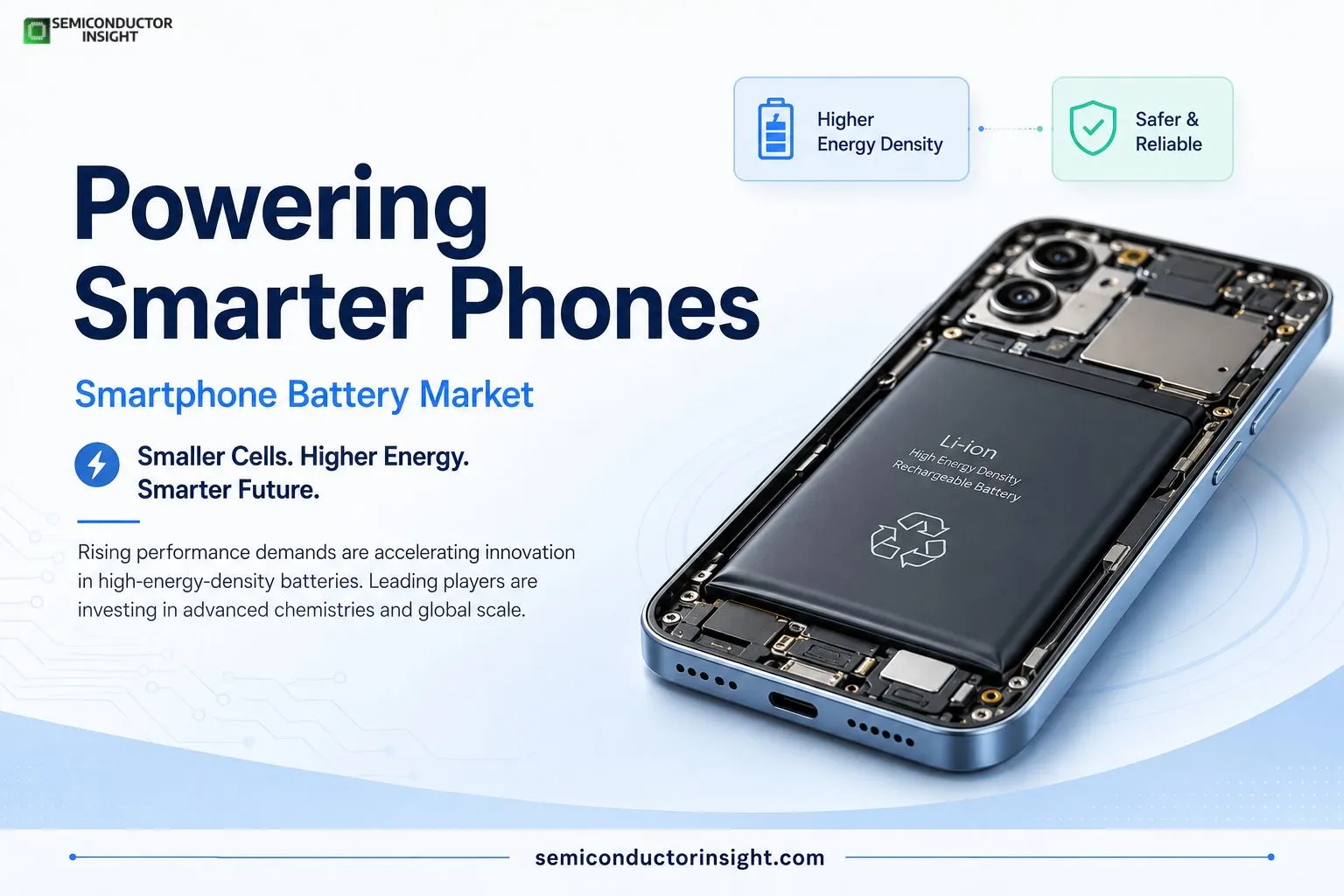
The smartphone battery is quietly becoming one of the most important pieces of semiconductor enabled consumer electronics. Modern phones are expected to handle brighter displays, AI processing, 5G connectivity, high resolution cameras and continuous background applications without making the device noticeably thicker. That equation is pushing manufacturers toward higher energy density rather than simply installing a physically larger cell.
ATL (Amperex Technology Limited)
Founded in 1999 and now a fully owned TDK subsidiary, ATL sits at the heart of the smartphone battery world with production hubs in Dongguan and Ningde, China, plus a fresh cell plant that opened in Haryana, India, in 2025. That Indian facility was built to turn out roughly 200 million battery packs a year once it hits full stride, feeding phones, wearables, and laptops for major global brands.
The company employs tens of thousands across its sites and has long supplied custom lithium-polymer cells that fit the tight internal spaces of flagship handsets. In 2026 it continues refining high-energy-density pouch designs while expanding packaging and system-integration work, keeping its cells inside devices that demand both thin profiles and multi-day endurance.
Samsung SDI
Samsung SDI has been quietly reshaping its small-cell lines while pouring massive resources into next-generation chemistry. By mid-2026 the company was validating prismatic LFP production in the United States for energy-storage boxes, targeting 30 GWh of annual BESS cell capacity by year-end, yet its consumer-electronics battery teams still deliver stacked high-density cells that power Galaxy flagships and other premium phones.
A combined 25-trillion-won investment plan stretching to 2040 is split between Ulsan (mass production of solid-state and sodium-ion) and Cheonan (technology validation). Prototype solid-state cells already shipped to robotics and IT customers, with mass production aimed at the second half of 2027. The firm’s ability to pivot production lines between phone packs and larger-format cells keeps it relevant as smartphone makers chase higher capacities without adding bulk.
LG Energy Solution
- LG Energy Solution’s North American footprint now includes multiple plants converting portions of EV lines to LFP cells for storage, with the goal of more than 50 GWh of ESS capacity on the continent by the end of 2026.
- While that shift dominates headlines, the company’s small-format pouch and cylindrical cells continue to appear in smartphones and other portables.
- In 2026 it restarted production at the Ohio Ultium joint-venture plant after a seven-month pause, bringing roughly 1,400 workers back online, and began commercial LFP output at the Tennessee site after a rapid five-month conversion.
- Parallel work on 46-series cylindrical cells and early sodium-ion samples for both automotive and storage customers shows the same materials science feeding the thinner, higher-density packs required by modern handsets.
Zhuhai CosMX Battery
Zhuhai CosMX has become one of the most aggressive movers in steel-shell and silicon-anode cells for phones. In 2025-2026 it committed roughly 2-2.6 billion yuan to new steel-shell production lines expected to push annual output from about 20 million units toward more than 80 million by the end of 2026. The company already mass-produces cells with 25 percent silicon-rich anodes that reach 900 Wh/L volumetric density and has demonstrated a 100 percent silicon-carbon concept cell inside an ultra-thin 15,000 mAh prototype.
It supplies major Chinese brands plus Apple and operates plants in Zhuhai, Jiaxing, Chongqing, India, Malaysia and Mexico, employing more than 10,000 people across six industry parks. Semi-solid-state cells are already in volume production while all-solid-state development continues.
You can freely browse our most recent updated report to learn more about it before scrolling further: https://semiconductorinsight.com/report/smart-phone-battery-market/
Sunwoda Electronic
Sunwoda’s consumer lithium-battery division remains a core engine even as the company expands into EV and storage. Its India operations in Noida and Greater Noida, plus a Vietnam plant in Bac Giang that is adding capacity to more than 15.5 million units a year, directly serve smartphone brands assembling in those markets. The Vietnam site currently runs with around 250-350 workers and is expanding further.
Globally the firm maintains production bases across Guangdong, Jiangsu, Zhejiang and overseas locations in India, Vietnam, Hungary, Morocco and Thailand, supporting tens of thousands of employees. Automated magnetic-levitation lines for iPhone battery packs have cut changeover times dramatically, and the company continues shipping high-volume smartphone packs while simultaneously building multi-GWh EV cell plants.
Huizhou Desay Battery
Desay Battery operates intelligent parks in Huizhou, Changsha and Vietnam with a total built area exceeding 480,000 square meters and more than 6,500 employees. Its traditional strength is high-volume lithium-ion packs for smartphones, notebooks and wearables, backed by advanced encapsulation and fully automated lines.
In 2026 the company announced plans to invest up to 2.5 billion yuan to expand consumer soft-pack cell capacity to 200 million units annually. Parallel energy-storage work has grown to more than 20-25 GWh of planned system capacity with over 14 automated module and pack lines, yet the consumer side still supplies major phone brands and appears in genuine iPhone replacement and OEM cells verified by independent teardowns.
BYD
- BYD’s battery roots run deep; long before its EV dominance the company produced cells for mobile devices and still maintains a meaningful presence in consumer packs.
- Its vertically integrated model cells, packs and even handset assembly gives it cost and quality control advantages that smartphone brands continue to value.
- While public attention focuses on Blade LFP cells for vehicles, the same chemistry expertise and high-volume manufacturing infrastructure support thinner, safer packs for mid-range and entry-level phones.
- BYD’s scale, measured in tens of GWh across multiple chemistries, and its ability to switch production between consumer and power applications keep it among the reliable high-volume suppliers in 2026.
Panasonic
Panasonic’s cylindrical and prismatic cells have powered countless portable devices for decades. Although much of its recent capacity serves electric vehicles, the company continues to supply high-reliability small cells for smartphones and other electronics through its long-standing materials and manufacturing know-how.
In 2026 Panasonic remains active in refining nickel-based and next-generation chemistries that can be adapted to the compact form factors demanded by flagship handsets. Its global production network and rigorous quality systems make it a preferred partner for brands that prioritize safety and cycle life over pure cost.
VARTA AG
Germany’s VARTA brings European engineering precision to the smartphone and wearable battery segment. The company produces high-performance micro-batteries and custom lithium packs that appear in premium devices requiring extreme reliability and compact size. In recent years VARTA has expanded its lithium-ion capacity while leveraging decades of experience in button cells and rechargeable systems. Its focus on safety certifications and tight tolerance manufacturing continues to win design slots in 2026 phones and accessories that demand consistent performance across temperature ranges and long service lives.
Murata Manufacturing (extra major player)
Japanese component specialist Murata has quietly become a significant supplier of miniature lithium-ion batteries for smartphones, wearables and IoT devices. Drawing on its ceramics and materials expertise, Murata delivers ultra-thin, high-energy cells that fit the shrinking internal volumes of modern handsets. The company’s global manufacturing footprint and reputation for quality have secured it ongoing roles in both flagship and mid-tier devices throughout 2025-2026, complementing the larger Chinese and Korean cell makers with specialized form factors and reliability.
Simplo Technology (extra major player from the broader ecosystem)
Taiwan’s Simplo Technology specializes in battery packs rather than bare cells, integrating cells from leading makers into complete modules for notebooks, tablets and smartphones. Its engineering strength in thermal management, protection circuits and custom shapes has made it a preferred pack partner for multiple global brands. With production facilities across Asia and a steady stream of new high-capacity designs, Simplo continues to convert raw cells into the finished battery assemblies that ultimately power millions of devices each year.

Comments (0)