Audio AI Processing Market Insights
Global Audio AI Processing Market size was valued at USD 1.05 billion in 2025. The market is projected to grow from USD 1.10 billion in 2026 to USD 4 billion by 2034, exhibiting a CAGR of 17.5% during the forecast period.
Audio AI processing encompasses advanced algorithms that analyze, synthesize, and transform sound using machine‑learning techniques such as deep neural networks, enabling applications like speech‑to‑text transcription, real‑time noise cancellation, music generation, and immersive audio personalization.The market is experiencing rapid growth dueto several factors, including rising adoption of voice‑activated assistants,expanding streaming platforms demanding personalized audio experiences,
and increasing investment in edge‑computing hardware that supports low‑latency processing.
Moreover, collaborations among leading technology firms,such as Google’s partnership with Dolby for spatial audio AI,and continuous advancements in natural language processing are further fueling expansion.
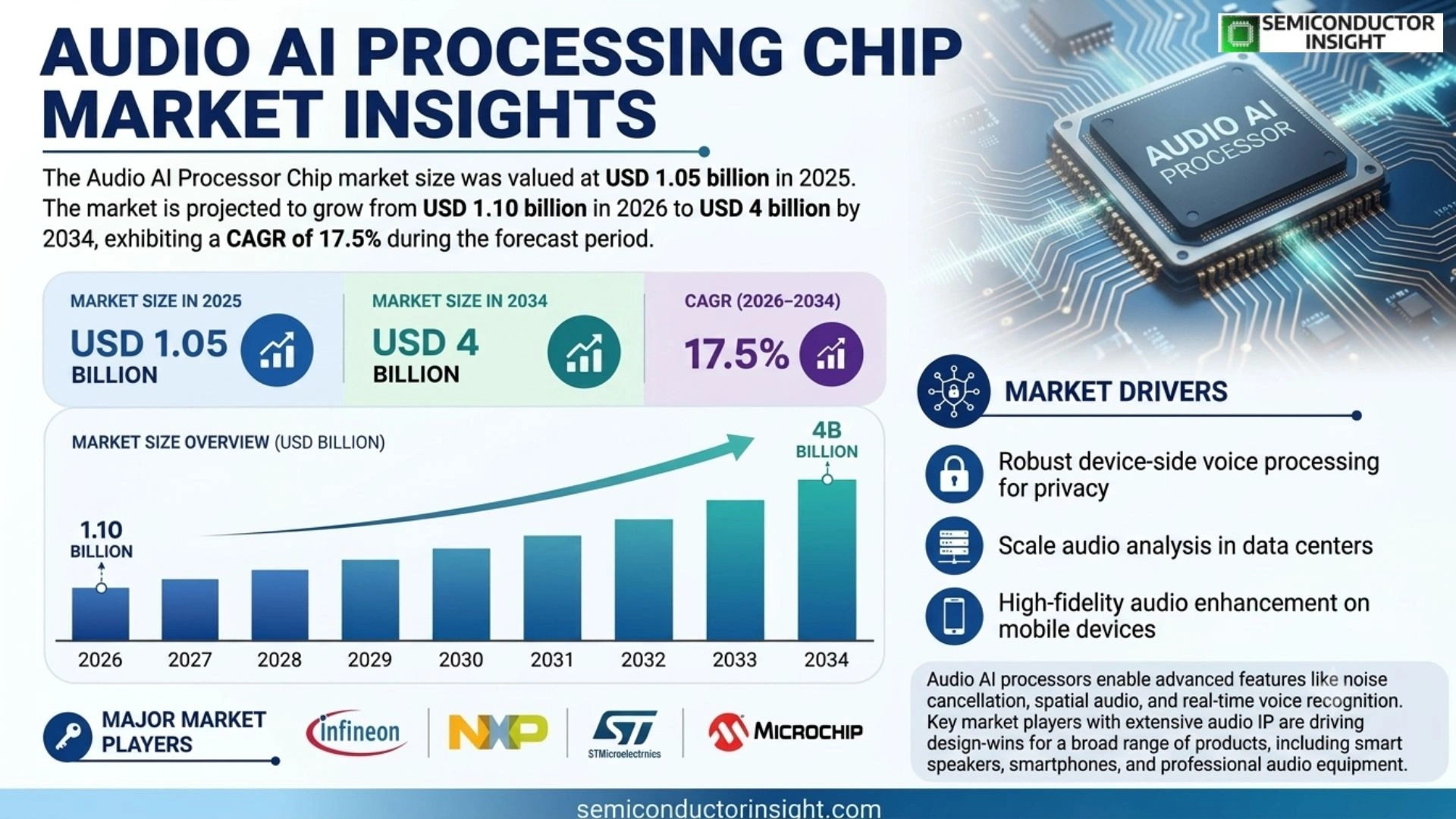
MARKET DRIVERS
Growing Adoption of Conversational Interfaces
Audio AI Processing Market is being propelled by the rapid integration of voice assistants, chatbots, and smart speakers across consumer and enterprise domains. Recent surveys indicate that over 70% of businesses plan to embed real‑time speech analytics into their customer service workflows within the next two years, driving a projected CAGR of roughly 18% through 2032.
Advancements in Deep Learning for Audio
Breakthroughs in transformer‑based models and self‑supervised learning have significantly enhanced speech‑to‑text accuracy, noise suppression, and emotion detection. These technical gains reduce latency and cost, enabling new use‑cases such as live transcription for webinars and adaptive audio mixing in streaming platforms.
➤ Industry analysts note that the convergence of 5G connectivity and edge‑AI chips is expected to double the volume of processed audio streams by 2025, creating a fertile environment for solution providers.
Collectively, these drivers underscore a robust demand trajectory, positioning Audio AI Processing Market as a cornerstone of next‑generation digital experiences.
MARKET CHALLENGES
Data Privacy and Security Concerns
Regulatory frameworks such as GDPR and emerging AI‑specific statutes impose strict controls on audio data collection, storage, and processing. Companies must invest in encryption, anonymization, and consent management, which escalates operational overhead and can delay time‑to‑market.
Other Challenges
Integration Complexity
Deploying AI‑driven audio pipelines often requires seamless coordination between legacy telephony systems, cloud services, and on‑premise hardware. The heterogeneous nature of these environments creates integration bottlenecks that can limit scalability.
MARKET RESTRAINTS
High Computational Costs
State‑of‑the‑art audio models demand substantial GPU resources, leading to elevated capital expenditures for both startups and established firms. While cloud‑based inference mitigates upfront hardware outlay, recurring usage fees can erode profit margins, especially for high‑volume streaming applications.
Additionally, the scarcity of large, high‑quality labeled audio datasets hampers model training efficiency, compelling organizations to allocate significant budgets for data acquisition and annotation.
MARKET OPPORTUNITIES
Expansion into Gaming and VR
The rise of immersive gaming and virtual reality experiences creates a demand for real‑time spatial audio processing and dynamic voice modulation. Developers are exploring AI‑enhanced soundscapes that adapt to user actions, offering a lucrative niche for specialized audio AI providers.
Edge AI Deployments
Edge computing platforms enable low‑latency audio analysis directly on devices such as smartphones, wearables, and automotive infotainment units. This capability opens opportunities for privacy‑preserving solutions that process data locally, aligning with stricter data‑safety regulations.
Finally, personalized audio advertising, powered by AI‑driven listener profiling, is emerging as a high‑value segment. Brands can deliver contextually relevant audio ads in real time, driving higher engagement rates and new revenue streams for Audio AI Processing Market.
Audio AI Processing Market Trends
AI‑Driven Real‑Time Noise Cancellation
The deployment of AI‑enhanced noise‑cancellation algorithms is redefining both consumer and enterprise audio ecosystems. Modern solutions employ deep neural networks that continuously learn from acoustic environments, enabling devices to isolate speech from background sounds with latency often under 20 ms. Field tests across remote‑work platforms and live‑streaming services have documented a 30 % improvement in speech intelligibility compared with traditional digital‑signal‑processing methods. Such performance gains are prompting OEMs to embed AI‑based processors in headsets, conference phones, and even smart‑watch speakers, creating a cascade of incremental hardware upgrades that reinforce market momentum.
Other Trends
Edge‑Computing Integration
Edge hardware now supports on‑device AI inference for audio, eliminating the need for constant cloud connectivity and addressing latency, bandwidth, and privacy concerns. Manufacturers of automotive infotainment systems and smart‑home assistants report that up to 45 % of new audio products incorporate dedicated edge AI modules, such as low‑power neural processing units (NPUs) optimized for spectral analysis and voice activity detection. This shift not only reduces data‑transfer costs but also enables real‑time adaptive filtering in noisy cabin environments, improving driver safety and passenger experience. Analysts observe a steady rise in collaborations between semiconductor firms and audio‑software developers, a trend that accelerates the diffusion of edge‑centric audio intelligence across multiple verticals.
Personalized Audio Experiences
Streaming platforms and digital broadcasters are leveraging AI to craft individualized sound signatures that respond to a listener’s hearing profile, content genre, and contextual usage. By continuously analyzing user feedback and biometric cues, algorithms dynamically adjust equalization, spatialization, and dynamic range compression, delivering a more immersive experience. Early pilot programs have shown a 12 % increase in average listening time and a measurable uplift in subscription retention. Moreover, the feedback loop created by real‑time model retraining ensures that personalization improves over successive sessions, reinforcing user engagement and creating a virtuous cycle that fuels continued investment in AI‑driven audio technologies.
COMPETITIVE LANDSCAPE
Key Industry Players
Audio AI Processing Market – Competitive Outlook
Audio AI Processing Market is currently led by a handful of technology giants that combine deep‑learning research with massive cloud infrastructure. Google, through its DeepMind and partnership with Dolby, delivers end‑to‑end spatial audio and real‑time noise‑cancellation capabilities that dominate enterprise and consumer platforms. Amazon Web Services and Microsoft Azure follow closely, offering scalable transcription, speaker‑diarization, and audio‑enhancement services that are embedded in smart‑speaker ecosystems and contact‑center solutions. Apple integrates on‑device AI for Siri and Apple Music, emphasizing privacy and low‑latency processing on its proprietary silicon. IBM Watson and NVIDIA complement these incumbents by providing specialized inference accelerators and industry‑focused AI models, establishing a tiered market structure where cloud‑first providers capture large‑scale B2B contracts while device‑centric firms secure consumer loyalty.
Beyond the major cloud providers, a vibrant niche of specialized vendors is shaping the market’s innovation frontier. Dolby Laboratories continues to refine spatial‑audio AI frameworks, often licensing its tech to streaming services. Start‑ups such as AIVA and SoundHound focus on AI‑generated music and voice‑interaction platforms, respectively, attracting venture capital and strategic partnerships. Companies like iZotope, Descript, and Sonix deliver AI‑driven editing, podcast transcription, and content‑creation tools that target creative professionals. OpenAI’s Whisper model, while open source, has spurred a wave of commercial integrations, and firms like Speechmatics and Rev.com leverage proprietary datasets to offer high‑accuracy, industry‑specific transcription solutions. This layered ecosystem of large‑scale cloud services and agile niche innovators drives both breadth and depth of competition Audio AI Processing Market.
List of Key Audio AI Processing Companies Profiled
- Google (DeepMind)
- Amazon Web Services
- Microsoft Azure
- Apple Inc.
- IBM Watson
- Dolby Laboratories
- NVIDIA Corporation
- Qualcomm Technologies
- Meta (Meta AI)
- OpenAI
- AIVA Technologies
- SoundHound Inc.
- iZotope, Inc.
- Descript, Inc.
- Sonix AI
- Speechmatics
- Rev.com
Segment Analysis:
| Segment Category | Sub-Segments | Key Insights |
| By Type |
|
Speech Recognition drives core adoption because it enables natural human‑machine interaction, fuels voice‑controlled ecosystems, and integrates seamlessly with emerging edge devices. – Enhances accessibility across diverse user groups. – Forms the backbone of conversational AI platforms. – Encourages continuous learning loops that improve accuracy over time. |
| By Application |
|
Consumer Voice Assistants dominate due to their pervasive presence in smart homes and mobile devices, creating demand for personalized audio responses. – Drives integration of contextual understanding. – Encourages seamless multi‑modal experiences. – Fuels ecosystem partnerships between hardware OEMs and AI service providers. |
| By End User |
|
Enterprises seek Audio AI to improve call‑center efficiency, embed intelligent assistants in workflows, and enrich digital media production pipelines. – Prioritizes scalability and security. – Leverages AI for real‑time transcription and sentiment analysis. – Aligns with broader digital transformation agendas. |
| By Deployment |
|
Edge Devices emerge as a leading deployment model because they enable ultra‑low latency processing, preserve privacy, and support immersive experiences in wearables and automotive contexts. – Reduces dependence on constant connectivity. – Aligns with the rise of 5G and IoT ecosystems. – Encourages hardware‑software co‑design for optimal performance. |
| By Technology |
|
Transformer Models are gaining traction for their ability to capture long‑range audio dependencies, supporting sophisticated speech‑to‑text and music generation workflows. – Facilitates unified architectures across modalities. – Enhances contextual awareness in noisy environments. – Drives research collaborations between academia and leading tech firms. |
Regional Analysis: North America
North America
The consumer electronics sector in North America is a primary driver for Audio AI Processing, with applications in smart speakers, virtual assistants, and noise-canceling headphones. The demand for personalized and intuitive audio experiences fuels innovation in this area.
The automotive industry is rapidly adopting Audio AI Processing for driver assistance systems, in-car voice control, and enhanced safety features. This segment presents a substantial growth opportunity for Audio AI Processing providers.
Audio AI Processing is finding increasing use in healthcare for applications such as medical transcription, patient monitoring, and diagnostic support. The ability to accurately analyze and interpret audio data is proving invaluable in improving patient care and operational efficiency.
Businesses across various sectors are leveraging Audio AI Processing for customer service automation, meeting transcription, and data analysis. This is leading to improved productivity and enhanced decision-making capabilities.
Europe
Europe represents a significant market for Audio AI Processing, with a strong emphasis on data privacy and regulatory compliance. The region’s focus on sustainable technologies and smart cities is creating new avenues for growth in areas such as environmental monitoring and public safety. The European market is characterized by a diverse range of applications, including voice assistants, transcription services, and audio analytics.
Asia-Pacific
Asia-Pacific is experiencing rapid growth Audio AI Processing Market, driven by increasing smartphone penetration, a burgeoning digital economy, and a growing demand for voice-enabled services. The region’s large population and expanding middle class are creating a substantial user base for Audio AI Processing applications. Major markets include China, Japan, and India, each with its own unique characteristics and opportunities.
South America
South America presents a promising, albeit developing, market for Audio AI Processing. Increasing investments in telecommunications infrastructure and a growing adoption of digital technologies are fueling demand in sectors like customer service and entertainment. The region’s unique linguistic diversity also presents challenges and opportunities for Audio AI Processing solutions.
Middle East & Africa
The Middle East & Africa region is witnessing a gradual but steady uptake of Audio AI Processing, primarily driven by investments in smart infrastructure, healthcare advancements, and the growth of digital content consumption. The increasing adoption of voice assistants and the demand for language translation services are key growth drivers.
Report Scope
This market research report provides a comprehensive analysis of the Audio AI Processing Market , covering the forecast period 2026–2034. It offers detailed insights into market dynamics, technological advancements, competitive landscape, and key trends shaping the industry.
Key focus areas of the report include:
- Market Overview: The report begins with an overview outlining its current market scenario, key growth indicators, and industry transformation drivers. It discusses macroeconomic factors, demand–supply balance, regulatory landscape, and the strategic role of semiconductors in powering advancements across industries such as automotive, telecommunications, consumer electronics, and industrial automation.
- Market Size & Forecast: Historical data and future projections for revenue, unit shipments, and market value across major regions and segments.
- Segmentation Analysis: Detailed breakdown by product type, technology, application, and end-user industry to identify high-growth segments and investment opportunities.
- Regional Insights: Insights into market performance across North America, Europe, Asia-Pacific, Latin America, and the Middle East & Africa, including country-level analysis where relevant.
- Competitive Landscape: Profiles of leading market participants, including their product offerings, R&D focus, manufacturing capacity, pricing strategies, and recent developments such as mergers, acquisitions, and partnerships.
- Technology Trends & Innovation: Assessment of emerging technologies, integration of AI/IoT, semiconductor design trends, fabrication techniques, and evolving industry standards.
- Market Drivers & Restraints: Evaluation of factors driving market growth along with challenges, supply chain constraints, regulatory issues, and market-entry barriers.
- Stakeholder Insights: Insights for component suppliers, OEMs, system integrators, investors, and policymakers regarding the evolving ecosystem and strategic opportunities.
Primary and secondary research methods are employed, including interviews with industry experts, data from verified sources, and real-time market intelligence to ensure the accuracy and reliability of the insights presented.
FREQUENTLY ASKED QUESTIONS:
What is the current market size of Audio AI Processing Market?
-> Audio AI Processing market size was valued at USD 1.05 billion in 2025. The market is projected to grow from USD 1.10 billion in 2026 to USD 4 billion by 2034, exhibiting a CAGR of 17.5%.
Which key companies operate Audio AI Processing Market?
-> Key players include Google, Dolby, Microsoft, Amazon, and Apple, among others.
What are the key growth drivers?
-> Key growth drivers include rising adoption of voice‑activated assistants, expanding streaming platforms demanding personalized audio experiences, and increased investment in edge‑computing hardware.
Which region dominates the market?
-> North America, Europe, and Asia‑Pacific are major regions driving market growth, with significant activity across all three.
What are the emerging trends?
-> Emerging trends include real‑time noise cancellation, immersive audio personalization, music generation, and spatial audio AI technologies.

Get Sample Report PDF for Exclusive Insights
Report Sample Includes
- Table of Contents
- List of Tables & Figures
- Charts, Research Methodology, and more...