
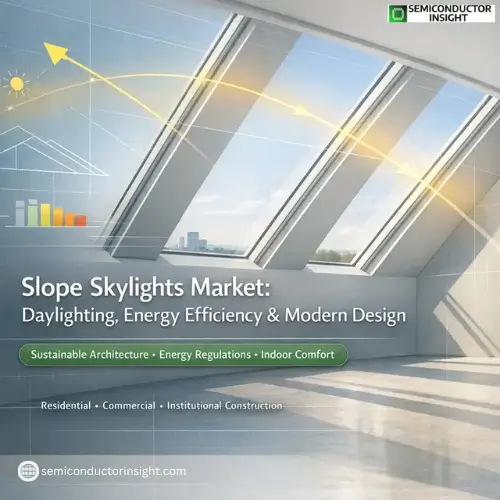
Top Slope Skylights Market Trends: Redefining Daylight Architecture in Modern Buildings
Architecture today is no longer just about structure; it is about experience. As buildings evolve toward openness, sustainability, and occupant well-being, natural daylight has become a design priority rather than an afterthought. This shift has quietly positioned slope skylights as a critical architectural element across residential, commercial, and institutional construction. More than just roof openings, slope skylights are now engineered daylight systems that balance aesthetics, energy efficiency, and indoor comfort.
This blog explores how the Slope Skylights Market is shaping contemporary building practices, what is driving its adoption, and why demand is steadily moving beyond premium architecture into mainstream construction.
Understanding Slope Skylights in a Market Context
Slope skylights are roof-mounted glazing systems installed at an angle, allowing daylight to enter buildings efficiently while managing heat, glare, and weather exposure. Unlike flat skylights, sloped configurations improve water runoff, reduce dust accumulation, and enhance solar capture across changing daylight angles.
From a market standpoint, slope skylights sit at the intersection of construction materials, architectural glazing, and energy-efficient building solutions. They are increasingly specified during early design phases rather than added later, reflecting their growing role in sustainable architecture.
Why Demand Is Expanding Beyond Luxury Projects?
- For many years, slope skylights were associated with high-end villas, museums, and designer homes.
- That perception is changing rapidly due to rising energy costs, stricter day lighting regulations, and growing awareness of indoor environmental quality that are pushing builders to integrate skylights across mid-scale housing, schools, healthcare facilities, and office buildings.
- Developers are discovering that slope skylights reduce reliance on artificial lighting during daytime hours, improve occupant satisfaction, and enhance property value without significantly increasing construction complexity when planned correctly.
Materials and Engineering Are Doing the Heavy Lifting
The modern slope skylight market is no longer driven by glass alone. Advances in laminated safety glass, UV-filtering coatings, and polycarbonate alternatives have expanded application flexibility. Aluminum and thermally broken frames now dominate installations due to their strength, corrosion resistance, and compatibility with insulation systems.
Equally important is engineering precision. Wind load resistance, thermal expansion control, and leak prevention technologies are shaping purchasing decisions, especially in regions exposed to heavy rainfall, snow loads, or high solar radiation.
How Energy Regulations Are Quietly Shaping the Market?
Energy codes across North America, Europe, and parts of Asia-Pacific are indirectly accelerating slope skylight adoption. Day lighting credits in green building certifications and minimum daylight factor requirements in public buildings are influencing architects to specify sloped skylight systems early in the design phase.
Rather than being optional features, skylights are increasingly becoming compliance tools that help projects meet energy performance benchmarks without heavy mechanical system upgrades.
Commercial Buildings Are Becoming Key Demand Centres
While residential construction remains important, commercial and institutional buildings are emerging as strong growth pockets. Educational campuses, airports, retail complexes, and healthcare facilities benefit significantly from uniform daylight distribution, especially in large floor-plate structures.
In these environments, slope skylights are often combined with automated shading systems and smart sensors, allowing facility managers to control light levels dynamically while maintaining visual comfort.
Installation Quality Is Now a Market Differentiator
As adoption grows, buyers are becoming more selective. Poor installation can negate the benefits of even the most advanced skylight systems. This has pushed manufacturers to offer pre-engineered kits, integrated flashing systems, and installer training programs as part of their market strategy.
In many regions, suppliers who provide technical support and design consultation are gaining preference over low-cost product-only vendors.
A Brief Look at Application Segments
Rather than listing traditional segmentation, it is worth noting how usage patterns are evolving:
- Residential buildings prioritize thermal comfort, condensation control, and aesthetics
- Commercial spaces focus on daylight uniformity and energy optimization
- Public infrastructure values durability, safety glazing, and long service life
These differing priorities are encouraging modular product lines rather than one-size-fits-all solutions.
Innovation Is Subtle but Impactful
Innovation in the slope skylights market is not flashy, but it is meaningful. Improvements are happening in glazing coatings, acoustic insulation, self-cleaning surfaces, and integration with building management systems. Manufacturers are also experimenting with recyclable frame materials and lower-carbon glass production processes to align with sustainability goals.
These incremental upgrades are extending product lifecycles and strengthening long-term market demand.
Why This Market Matters More Than It Appears
Slope skylights may seem like a small architectural component, but their influence extends across energy efficiency, occupant wellness, and sustainable design. As cities push for greener buildings and developers seek cost-effective performance upgrades, skylights offer a practical solution with visible benefits.
The aimed market’s steady growth reflects a broader shift in construction philosophy one where daylight is treated as a resource, not just a design feature.
Feel Free to Reach Our Most Recent Updates of the Report:
https://semiconductorinsight.com/report/global-slope-skylights-market/
Major Insights
Slope Skylights Market is evolving from a niche architectural element into a strategic building component. Driven by energy regulations, improved materials, and growing awareness of daylight benefits, slope skylights are becoming standard features in modern construction. Their role in shaping healthier, more efficient buildings ensures that demand will remain resilient across residential, commercial, and institutional sectors.

Comments (0)