MARKET INSIGHTS
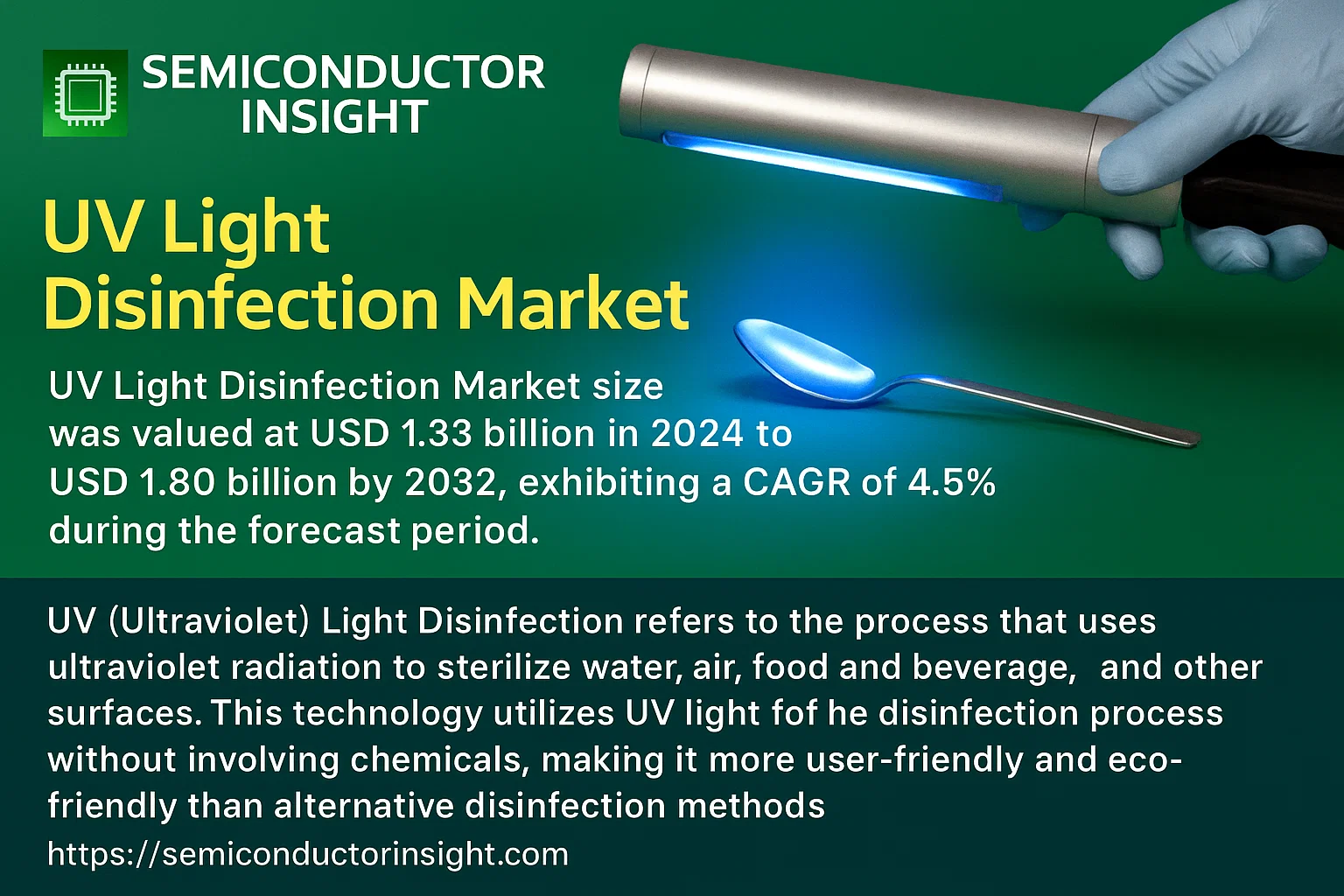
Global UV Light Disinfection Market size was valued at USD 1.33 billion in 2024 to USD 1.80 billion by 2032, exhibiting a CAGR of 4.5% during the forecast period.
UV (Ultraviolet) Light Disinfection refers to the process that uses ultraviolet radiation to sterilize water, air, food and beverage, and other surfaces. This technology utilizes UV light for the disinfection process without involving chemicals, making it more user-friendly and eco-friendly than alternative disinfection methods. UV light has become an established water treatment technology due to its effectiveness in killing or inactivating disease-causing microorganisms including bacteria, protozoan parasites such as Giardia and Cryptosporidium, and most viruses when appropriate dosage rates are applied.
The market is experiencing steady growth driven by several factors, including increasing awareness of infection control in healthcare settings, stringent regulations for water treatment, and growing demand for chemical-free disinfection solutions across various industries. Additionally, the COVID-19 pandemic significantly accelerated adoption of UV disinfection technologies for surface and air purification applications. Key players are actively developing innovative solutions; for instance, many companies have introduced portable UV-C devices for consumer use and advanced automated systems for healthcare facilities. Trojan Technologies, Xylem Inc., SUEZ Water Technologies & Solutions, Halma plc, and Atlantic Ultraviolet Corporation are among the prominent companies operating in this market with diverse product portfolios.
MARKET DRIVERS
Heightened Focus on Infection Control Post-Pandemic
The COVID-19 pandemic fundamentally reshaped hygiene protocols globally, creating a sustained and heightened awareness of airborne and surface-borne pathogens. This has driven strong, persistent demand for UV-C disinfection technologies across various sectors. Hospitals, schools, offices, and public transportation systems are increasingly integrating UV light systems as a non-chemical, supplementary layer of defense to mitigate the risk of outbreaks and ensure occupant safety.
Regulatory Support and Safety Standards
Growing governmental and organizational endorsements are accelerating market adoption. Regulatory bodies are establishing clearer safety and efficacy standards for UV-C devices, lending credibility and encouraging investment. Furthermore, certifications from health authorities provide assurance to end-users, facilitating procurement decisions in sensitive environments like healthcare and food processing.
The advancement of LED-based UV-C technology is a significant driver, offering longer lifespans, lower energy consumption, and greater design flexibility compared to traditional mercury lamps. This enables integration into HVAC systems, consumer appliances, and portable devices, broadening the market’s potential.
MARKET CHALLENGES
High Initial Investment and Cost Sensitivity
The significant upfront cost of high-quality UV disinfection systems, especially automated robots or full-room irradiation units, can be a major barrier to adoption for small and medium-sized enterprises, schools, and budget-constrained healthcare facilities. The need for a clear demonstrable ROI is critical for widespread purchase decisions.
Other Challenges
Safety Concerns and Operational Limitations
UV-C radiation poses potential health risks to skin and eyes, requiring stringent safety protocols, interlocks, and trained personnel. This limits real-time use in occupied spaces and can complicate operational workflows, creating a challenge for seamless integration into daily routines.
Lack of Standardized Efficacy Metrics
The absence of universally accepted, standardized testing protocols for measuring the disinfection efficacy of UV devices against specific pathogens can lead to market confusion. Varying claims from manufacturers make it difficult for buyers to compare products and trust performance outcomes.
MARKET RESTRAINTS
Limitations in Penetration and Shadowing Effects
UV-C light operates on a line-of-sight principle, meaning it cannot disinfect surfaces that are not directly exposed to the light source. Shadows cast by objects, folded fabrics, or complex geometries can create “safe havens” for microbes, limiting the technology’s effectiveness unless multiple exposure angles or manual repositioning are used, which impacts efficiency.
Competition from Alternative Disinfection Methods
The market faces strong competition from well-established chemical disinfectants and emerging technologies like fogging systems and plasma-based purification. For many applications, traditional methods are perceived as more familiar, easier to implement, and cost-effective, restraining the switch to UV technology without a compelling, proven advantage.
MARKET OPPORTUNITIES
Expansion into New Application Areas
There is significant growth potential in applying UV disinfection beyond healthcare. Sectors such as hospitality (hotel rooms), food and beverage retail, residential air purifiers, wastewater treatment, and commercial aviation present vast, untapped markets. The demand for continuous, automated disinfection in high-traffic public areas is a key opportunity.
Integration with IoT and Smart Building Systems
The convergence of UV disinfection with the Internet of Things (IoT) and Building Management Systems (BMS) creates opportunities for “smart disinfection.” Systems can be programmed to operate autonomously in unoccupied rooms, monitor pathogen load via sensors, and provide data on disinfection cycles, offering a value proposition centered on efficiency, data analytics, and peace of mind.
Growing Demand for Sustainable Solutions
As organizations prioritize sustainability, UV disinfection offers a compelling alternative to chemical-based methods. It leaves no toxic residues, reduces the consumption of disposable wipes and chemicals, and aligns with green building initiatives. This eco-friendly profile is becoming a critical factor in procurement decisions across various industries.
UV Light Disinfection Market Trends
Steady Market Expansion Driven by Environmental and Health Concerns
Global UV Light Disinfection Market is demonstrating consistent growth, projected to increase from a valuation of $1328 million in 2024 to approximately $1800 million by 2032, representing a compound annual growth rate (CAGR) of 4.5%. This expansion is primarily fueled by the technology’s non-chemical, eco-friendly disinfection mechanism, which is increasingly preferred across various sectors. The method’s effectiveness against a broad spectrum of pathogens, including bacteria, protozoan parasites like Giardia and Cryptosporidium, and most viruses, makes it a critical solution for ensuring public health and safety without the environmental drawbacks of chemical alternatives.
Other Trends
Technological Diversification and Application Growth
The market is diversifying by technology type, with key segments including Ordinary Cathode Low Pressure Mercury UV Disinfection, High-intensity Ultraviolet Disinfection, and Ozone UV Disinfection. High-intensity systems are gaining traction for their efficiency in applications requiring rapid disinfection. Application-wise, the market is segmented into Drinking Water and Wastewater, Air and Surface, and Food Processing. The water and wastewater segment currently holds a dominant position, driven by stringent regulations and the need for safe potable water. The air and surface disinfection segment is witnessing accelerated growth, particularly in healthcare and public spaces, spurred by heightened hygiene awareness post-pandemic.
Established Market Leaders and Geographic Concentration
The competitive landscape is characterized by the dominance of a few key players, with Trojan Technologies leading the market with a revenue share exceeding 19%. Other major manufacturers include Xylem, SUEZ, Halma, and Chiyoda Kohan. Geographically, North America is the largest market, accounting for over 47% of global revenue, attributable to advanced infrastructure and stringent regulatory standards. Europe follows as the second-largest market. The Asia-Pacific region is anticipated to be a significant growth area in the coming years, driven by rapid industrialization, urbanization, and increasing investments in public health infrastructure. This regional analysis underscores the global nature of the demand for reliable and chemical-free disinfection solutions.
COMPETITIVE LANDSCAPE
Key Industry Players
A Market Dominated by Global Leaders in Water and Environmental Technology
Global UV Light Disinfection Market is characterized by a concentrated competitive landscape with a few large players holding significant market share. Trojan Technologies stands as the undisputed leader, commanding over 19% of the global market revenue. The market structure is primarily dominated by established multinational corporations like Xylem, SUEZ, Halma, and Chiyoda Kohan. These companies possess extensive product portfolios, robust R&D capabilities, and a strong global presence, allowing them to serve major applications such as municipal drinking water, wastewater treatment, and industrial process water. Innovation is a key competitive factor, with a focus on developing high-intensity and energy-efficient UV systems to meet stringent environmental regulations and end-user demands for chemical-free disinfection solutions.
Beyond the market leaders, a range of other significant players operate in specific niches and geographic regions, contributing to a dynamic competitive environment. Companies such as Atlantic Ultraviolet and Onyx (a division of UV Resources) have a strong foothold in the air and surface disinfection segment, particularly for HVAC and healthcare applications. Specialists like Xenex Disinfection Services have gained prominence with their pulsed xenon UV systems for room disinfection in healthcare facilities. Other notable players, including Heraeus, Calgon Carbon (now part of Kurita Water Industries), and Evoqua Water Technologies, offer comprehensive solutions across various UV technologies, from low-pressure mercury lamps to advanced oxidation processes (AOP), catering to diverse needs in food processing and industrial water treatment.
List of Key UV Light Disinfection Companies Profiled
- Trojan Technologies
- Xylem Inc.
- SUEZ Water Technologies & Solutions
- Halma plc (Aquionics)
- Chiyoda Kohan Co., Ltd.
- Heraeus Holding GmbH
- Calgon Carbon Corporation (Kurita Water Industries)
- Evoqua Water Technologies LLC
- Oceanpower
- Lit UV
- Xenex Disinfection Services Inc.
- Atlantic Ultraviolet Corporation
- Onyx (UV Resources)
- Advanced UV, Inc.
- Lumalier Corporation
Segment Analysis:
| Segment Category | Sub-Segments | Key Insights |
| By Type |
|
High-intensity Ultraviolet Disinfection has emerged as the leading technology segment, driven by its superior efficacy and speed in neutralizing a broad spectrum of pathogens. This technology is increasingly favored for applications requiring rapid disinfection cycles and for its ability to handle higher flow rates, making it particularly suitable for industrial and municipal settings. The segment’s growth is underpinned by ongoing technological refinements that enhance energy efficiency and bulb longevity. |
| By Application |
|
Drinking Water and Wastewater remains the dominant application area, as UV disinfection is an established, chemical-free standard for ensuring water safety in municipal and industrial treatment plants. The non-intrusive nature of the technology, which leaves no chemical residues, aligns perfectly with stringent environmental regulations and growing consumer preference for sustainable solutions. This segment benefits from continuous infrastructure upgrades and the global focus on clean water access. |
| By End User |
|
Municipal end users represent the largest segment, primarily due to massive, ongoing investments in public water and wastewater treatment infrastructure. Municipal authorities are major adopters seeking reliable, scalable, and environmentally compliant disinfection systems to serve large populations. The long operational lifespan and relatively low operational costs of UV systems make them a financially viable choice for public sector projects with long-term planning horizons. |
| By Technology Maturity |
|
Established Systems lead this category, as the foundational UV disinfection technologies have been proven over decades in critical applications like water treatment. This maturity translates into high user confidence, standardized regulatory approvals, and a robust supply chain for components and servicing. The predictable performance and reliability of these systems make them the default choice for risk-averse sectors, though innovation in emerging technologies is creating new growth avenues. |
| By System Configuration |
|
Closed Vessel Systems are the leading configuration, particularly for pressurized water applications where safety and contained operation are paramount. Their sealed design prevents UV light exposure and allows for integration into existing piping networks with minimal disruption. The versatility and safety profile of closed vessel systems make them highly suitable for a wide range of industrial processes and municipal water networks, ensuring consistent and controlled disinfection performance. |
Regional Analysis: UV Light Disinfection Market
The market is strongly propelled by environmental protection and public health regulations that mandate high disinfection standards. These regulations create a non-negotiable demand for proven technologies like UV-C disinfection in water treatment plants and healthcare settings, providing a stable and predictable growth trajectory for suppliers.
North America is a global center for UV technology innovation, with leading manufacturers and research institutions continuously improving lamp efficiency, system integration, and smart controls. This constant innovation cycle helps maintain the region’s competitive edge and addresses evolving disinfection challenges more effectively than other markets.
A highly developed and quality-focused healthcare industry is a primary end-user. Hospitals and clinics widely adopt UV robots for room disinfection and upper-air UV systems to control airborne transmission, driven by the need to reduce infection rates and enhance patient safety protocols.
Beyond healthcare, adoption is robust across municipal water treatment, food and beverage processing, commercial buildings, and residential settings. This diversification makes the market resilient to fluctuations in any single sector and exposes a broad customer base to the benefits of UV disinfection technology.
Europe
Europe represents a highly advanced and mature market for UV light disinfection, characterized by strong environmental consciousness and strict EU-wide directives governing water and air quality. Countries like Germany, France, and the UK are at the forefront, driven by a commitment to sustainable and chemical-free disinfection methods. The market benefits from widespread implementation in municipal drinking and wastewater treatment facilities, where UV is favored for its effectiveness against chlorine-resistant microorganisms. The healthcare sector is another major driver, with hospitals increasingly deploying UV-C disinfection systems to complement manual cleaning protocols. A growing emphasis on green building standards is also fostering the integration of UV technology into HVAC systems of commercial and public buildings to improve indoor air quality. While market growth is steady, it is often tempered by lengthy approval processes and varying national regulations within the EU, creating a more fragmented landscape compared to North America.
Asia-Pacific
The Asia-Pacific region is the fastest-growing market for UV light disinfection, fueled by rapid industrialization, urbanization, and increasing investments in public health infrastructure. China, Japan, and India are the key growth engines. Rising concerns over waterborne diseases and severe air pollution in densely populated megacities are prompting governments and industries to seek effective disinfection solutions. The market is witnessing surging demand from the healthcare sector, particularly for portable and room-based UV disinfection units in hospitals. Furthermore, the food and beverage industry is adopting UV technology to ensure product safety and extend shelf life. The region also benefits from a strong manufacturing base for UV components, which helps reduce costs and improve accessibility. However, market maturity varies significantly between developed economies like Japan and emerging ones, with price sensitivity and a lack of standardized regulations presenting challenges to uniform adoption.
South America
The UV light disinfection market in South America is in a developing phase, with growth primarily concentrated in countries like Brazil and Argentina. The driving forces include the need to improve basic sanitation infrastructure and address challenges related to water quality in both urban and rural areas. Municipal water treatment applications represent a significant opportunity, though implementation is often constrained by budgetary limitations. The healthcare sector shows potential, especially in private hospitals seeking to enhance infection control standards. The industrial sector, particularly food processing, is also beginning to explore UV technology as a means to meet export quality standards. Market growth is gradual, heavily influenced by economic stability and government investment in public health projects, with awareness and adoption still lagging behind more developed regions.
Middle East & Africa
The Middle East & Africa region presents a market with high potential but currently characterized by uneven development. In the Middle East, particularly in Gulf Cooperation Council (GCC) countries like the UAE and Saudi Arabia, the market is driven by extensive investments in modern infrastructure, including advanced water desalination and treatment plants where UV disinfection is increasingly incorporated. The healthcare sector in these wealthy nations is also a strong adopter. In contrast, across much of Africa, the market is nascent, with adoption limited by infrastructure challenges and limited investment. However, initiatives aimed at providing clean water and improving healthcare facilities are creating niche opportunities, often supported by international aid and development programs. The region’s extreme water scarcity issues make UV a particularly attractive, chemical-free solution for water reuse applications, pointing toward long-term growth potential.
Report Scope
This market research report provides a comprehensive analysis of the UV Light Disinfection Market, covering the forecast period 2025–2032. It offers detailed insights into market dynamics, technological advancements, competitive landscape, and key trends shaping the industry.
Key focus areas of the report include:
- Market Overview: The report begins with an overview outlining the current market scenario, key growth indicators, and industry transformation drivers. It discusses macroeconomic factors, demand–supply balance, regulatory landscape, and the strategic role of UV disinfection technology in applications such as drinking water and wastewater, air and surface treatment, and food processing.
- Market Size & Forecast: Historical data and future projections for revenue, unit shipments, and market value across major regions and segments.
- Segmentation Analysis: Detailed breakdown by type (Ordinary Cathode Low Pressure Mercury UV Disinfection, High-intensity Ultraviolet Disinfection, Ozone UV Disinfection), application, and end-user industry to identify high-growth segments and investment opportunities.
- Regional Insights: Insights into market performance across North America, Europe, Asia-Pacific, Latin America, and the Middle East & Africa, including country-level analysis where relevant.
- Competitive Landscape: Profiles of leading market participants, including their product offerings, R&D focus, manufacturing capacity, pricing strategies, and recent developments such as mergers, acquisitions, and partnerships.
- Technology Trends & Innovation: Assessment of emerging technologies, efficiency improvements, integration with existing systems, and evolving industry standards.
- Market Drivers & Restraints: Evaluation of factors driving market growth along with challenges, supply chain constraints, regulatory issues, and market-entry barriers.
- Stakeholder Insights: Insights for component suppliers, OEMs, system integrators, investors, and policymakers regarding the evolving ecosystem and strategic opportunities.
Primary and secondary research methods are employed, including interviews with industry experts, data from verified sources, and real-time market intelligence to ensure the accuracy and reliability of the insights presented.
FREQUENTLY ASKED QUESTIONS:
What is the current market size of UV Light Disinfection Market?
-> UV Light Disinfection Market size was valued at USD 1.33 billion in 2024 to USD 1.80 billion by 2032, exhibiting a CAGR of 4.5% during the forecast period.
Which key companies operate in UV Light Disinfection Market?
-> Key players include Trojan Technologies, Xylem, SUEZ, Halma, and Chiyoda Kohan, among others. Trojan Technologies is the largest manufacturer.
What are the key growth drivers?
-> Key growth drivers include the eco-friendly nature of the technology, its effectiveness against a wide range of microorganisms, and increasing applications in water and air treatment.
Which region dominates the market?
-> North America held the largest market share, exceeding 47% of global revenue, followed by Europe.
What are the emerging trends?
-> Emerging trends include advancements in high-intensity UV systems, increased adoption in food processing, and the integration of UV disinfection in HVAC systems for air purification.

Get Sample Report PDF for Exclusive Insights
Report Sample Includes
- Table of Contents
- List of Tables & Figures
- Charts, Research Methodology, and more...
 Download Sample Report PDF