MARKET INSIGHTS
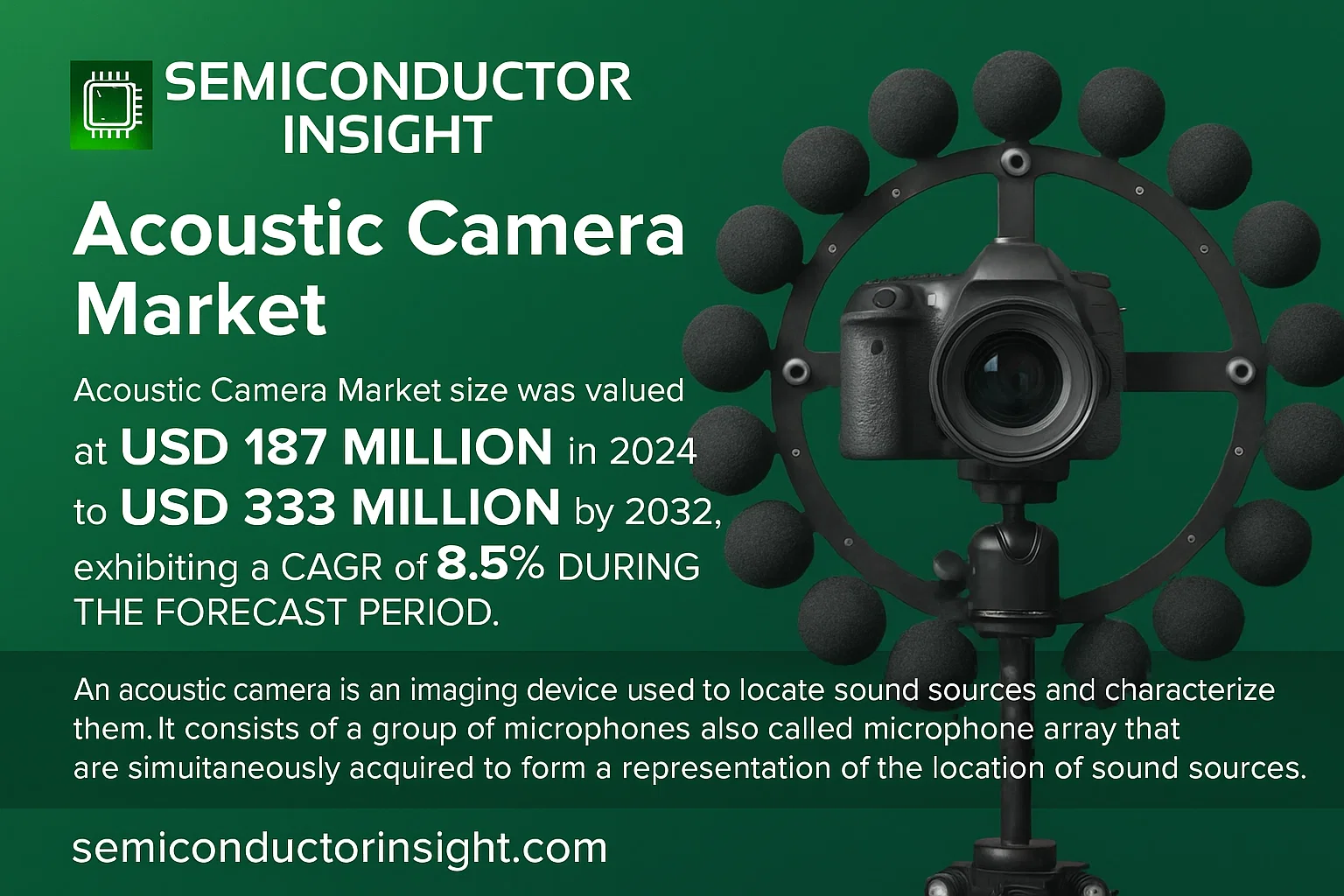
Global Acoustic Camera Market size was valued at USD 187 million in 2024 to USD 333 million by 2032, exhibiting a CAGR of 8.5% during the forecast period.
An acoustic camera is an imaging device used to locate sound sources and characterize them. It consists of a group of microphones also called microphone array that are simultaneously acquired to form a representation of the location of sound sources. With this method, the sound signal is visualized and sequences of acoustic images can be acquired as acoustic videos are generated simultaneously.
The market is experiencing steady growth due to several factors, including increased industrial automation, rising demand for noise pollution monitoring, and stricter government regulations on workplace noise levels. Additionally, growing applications across various industries such as energy and power, manufacturing, automotive, and aerospace are contributing to market expansion. Initiatives by key players in the market are also expected to fuel growth through technological innovations and expanded product portfolios. Fluke Corporation, Siemens AG, Brüel & Kjær, and Sorama are some of the key players that operate in the market with diverse product offerings.
MARKET DRIVERS
Stringent Noise Pollution Regulations
The increasing stringency of government regulations and occupational safety standards regarding noise exposure is a primary driver for the Acoustic Camera Market. Industries such as manufacturing, construction, and aerospace are mandated to comply with noise emission limits, compelling them to adopt advanced noise source identification tools. This regulatory pressure is a significant factor propelling market growth globally.
Advancements in Acoustic Imaging Technology
Continuous innovation in microphone array technology, signal processing algorithms, and software visualization is enhancing the performance and accessibility of acoustic cameras. The development of portable, user-friendly systems with real-time imaging capabilities is expanding their application beyond traditional industrial use to areas like automotive NVH testing and building acoustics.
➤ The integration of artificial intelligence for automated sound source detection and classification is a key technological trend, improving the speed and accuracy of acoustic analysis.
Furthermore, the growing emphasis on predictive maintenance across various industries is driving demand. Acoustic cameras are increasingly used to detect early-stage faults in machinery, such as bearing defects or leaks, by identifying anomalous sound patterns, thereby preventing costly downtime and enhancing operational efficiency.
MARKET CHALLENGES
High Initial Investment and Cost Sensitivity
The significant cost associated with high-end acoustic camera systems, which can include sophisticated microphone arrays and proprietary software, presents a major barrier to adoption, particularly for small and medium-sized enterprises (SMEs). The perception of these systems as a capital-intensive tool limits their penetration in price-sensitive markets.
Other Challenges
Technical Expertise Requirements
Effective operation and interpretation of acoustic camera data require specialized knowledge in acoustics and signal processing. The shortage of skilled personnel can hinder the effective deployment and utilization of these systems, potentially limiting their perceived value.
Performance Limitations in Noisy Environments
While effective in controlled settings, acoustic cameras can face challenges in extremely noisy industrial environments where background noise can mask the target sound sources, affecting the accuracy and reliability of the measurements.
MARKET RESTRAINTS
Economic Volatility and Budget Constraints
Global economic uncertainties and fluctuations in industrial capital expenditure can restrain market growth. During periods of economic downturn, companies often delay or cancel investments in non-essential diagnostic equipment like acoustic cameras, prioritizing core operational expenses instead.
Availability of Alternative Technologies
The presence of alternative noise measurement and source identification methods, such as traditional sound level meters and simpler acoustic intensity probes, acts as a restraint. For applications where pinpoint accuracy is not critical, these lower-cost alternatives may be preferred, limiting the addressable market for advanced acoustic imaging systems.
MARKET OPPORTUNITIES
Expansion into New Application Areas
There is significant potential for growth by applying acoustic camera technology to emerging fields. Applications in renewable energy, such as monitoring the condition of wind turbine blades for defects, and in the development of autonomous vehicles for detecting emergency sirens, represent substantial untapped markets.
Development of Cost-Effective Solutions
Opportunities exist for manufacturers to develop more affordable and compact acoustic camera solutions tailored for SMEs and entry-level users. By leveraging advancements in consumer-grade microphone technology and cloud-based software, companies can create lower-cost offerings that democratize access to acoustic imaging.
Growth in Asian Pacific Industrial Sector
The rapid industrialization and increasing implementation of strict noise control norms in the Asia-Pacific region, particularly in countries like China and India, present a major growth opportunity. The expanding manufacturing and infrastructure sectors in these regions are expected to drive significant demand for noise monitoring and control equipment.
Acoustic Camera Market Trends
Sustained Growth Driven by Industrial Demand
Global Acoustic Camera Market is on a significant growth trajectory, propelled by increasing industrial applications. Starting from a valuation of USD 187 million in 2024, the market is projected to expand to USD 333 million by 2032, representing a Compound Annual Growth Rate (CAGR) of 8.5%. This robust growth is primarily fueled by the demand for advanced diagnostic tools in sectors like energy, manufacturing, and automotive. Companies are increasingly adopting acoustic cameras to localize noise sources accurately, which is critical for predictive maintenance, quality control, and product development.
Other Trends
Product Type Dominance
The market is distinctly segmented by product type, with Handheld/Tablet Type acoustic cameras leading the way. This category accounts for the largest market share at 51%, favored for its portability and ease of use in field applications. The Microphone Array Type, while more complex, is essential for high-precision stationary measurements in laboratory and research settings, catering to a more specialized segment of the market.
Application-Specific Expansion and Regional Dynamics
In terms of application, the Energy and Power sector is the largest end-user, holding approximately 24% of the market share. Acoustic cameras are vital for inspecting wind turbines, power transformers, and high-voltage equipment, helping to prevent failures and ensure operational safety. The market’s geographical footprint is strong in North America and Europe, where industrial and technological adoption is high. However, Asia is emerging as a key growth region, driven by rapid industrialization and infrastructure development in countries like China and India. The competitive landscape is consolidated, with the top two manufacturers, Fluke and Siemens, collectively holding around 53% of Global market share.
COMPETITIVE LANDSCAPE
Key Industry Players
An Overview of Market Concentration and Strategic Positioning
Global Acoustic Camera Market is characterized by a moderately concentrated competitive landscape, with the top two manufacturers, Fluke and Siemens, collectively holding approximately 53% of Global market share. These industry leaders have established dominance through extensive product portfolios, strong brand recognition, and global distribution networks.a subsidiary of Spectris plc, is another pivotal player with a long-standing reputation in sound and vibration measurement, providing high-end solutions primarily for industrial and research applications. Sorama has carved out a significant position with its innovative, real-time acoustic imaging technology, particularly appealing to the automotive and electronics sectors. The market structure is further shaped by ongoing technological advancements in microphone array design and data processing software, driving competition on the basis of accuracy, ease of use, and application-specific solutions.
Beyond the dominant leaders, a number of specialized and regional players contribute to the market’s dynamism. Companies such as Norsonic AS and SINUS Messtechnik bring deep expertise in sound measurement instrumentation for building acoustics and environmental noise monitoring. Specialized firms like Distran and SM Instruments focus on high-frequency applications, including leak detection in pressurized systems, which is critical for the energy and power sector. Gfai tech and CAE Software & Systems offer integrated hardware and software solutions, often tailored for specific industrial workflows. Emerging players like KeyGo Technologies are focusing on cost-effective and portable solutions to capture growth in price-sensitive segments and emerging economies, while established names like Teledyne FLIR leverage their thermal imaging expertise to offer combined acoustic and thermal camera systems for comprehensive diagnostic applications.
List of Key Acoustic Camera Companies Profiled
- Fluke
- Siemens
- Brüel & Kjær
- Sorama
- Norsonic AS
- Distran
- SM Instruments
- Gfai tech
- SDT
- KeyGo Technologies
- Teledyne FLIR
- CAE Software & Systems
- SONOTEC GmbH
- CRYSOUND
- SINUS Messtechnik
Segment Analysis:
| Segment Category | Sub-Segments | Key Insights |
| By Type |
|
Handheld/Tablet Type is the dominant segment due to its superior portability and ease of use for on-site diagnostics across various industries. These devices offer operators the flexibility to conduct noise source identification in real-time without complex setups, making them indispensable for field service engineers and maintenance crews. The user-friendly interface and integrated processing capabilities in handheld units facilitate rapid problem-solving, while microphone array types are critical for high-precision applications requiring detailed spatial resolution and advanced acoustic analysis in controlled environments. |
| By Application |
|
Energy and Power represents the leading application segment, driven by the critical need for predictive maintenance and noise compliance in power generation facilities, wind farms, and electrical substations. The manufacturing sector leverages acoustic imaging for quality control and machinery health monitoring to minimize downtime and improve operational efficiency. The automotive industry utilizes these systems for NVH (Noise, Vibration, and Harshness) testing, while aerospace applications focus on aircraft component testing and noise reduction research, highlighting the technology’s versatility across demanding industrial environments. |
| By End User |
|
Industrial Enterprises constitute the largest end-user segment, deploying acoustic cameras for in-house maintenance, quality assurance, and compliance with stringent noise regulations. Research and academic institutions utilize these systems for advanced acoustics studies, material testing, and development of quieter products, fostering continuous innovation. Service and maintenance providers leverage acoustic cameras as essential diagnostic tools to offer specialized noise assessment services to a diverse clientele, highlighting the growing trend of outsourcing complex technical analyses to expert third-party firms. |
| By Technology |
|
Beamforming is the most widely adopted core technology, favored for its effectiveness in localizing sound sources from a distance in industrial and outdoor settings. This technique provides a robust solution for identifying noise leaks, mechanical faults, and aerodynamic noises with considerable accuracy. Near-field acoustic holography offers superior resolution for close-range analysis in research and product development, while acoustic tomography is an emerging technology for complex volumetric sound field analysis, indicating a market trajectory towards more sophisticated and application-specific imaging solutions. |
| By Sales Channel |
|
Direct Sales is the predominant channel, driven by the high-value, technical nature of acoustic cameras which necessitates direct engagement from manufacturers for customization, demonstration, and after-sales support. Distributors and resellers play a crucial role in expanding geographic reach and providing local inventory and services, particularly for standard product models. Online platforms are gaining traction for marketing and lead generation, but the complex purchase decision process involving technical specifications and budget approvals continues to favor direct relationships between suppliers and industrial customers. |
Regional Analysis: Acoustic Camera Market
North America
Strict Occupational Safety and Health Administration (OSHA) and Environmental Protection Agency (EPA) standards in the U.S. mandate noise control, compelling industries to utilize acoustic cameras for accurate noise mapping and source identification. This regulatory pressure is a primary driver for adoption in sectors like oil & gas, manufacturing, and construction, ensuring a steady market.
The concentration of leading acoustic camera manufacturers and prestigious research universities in North America fosters a hotbed for innovation. Collaborations between industry and academia are accelerating the development of more sophisticated, portable, and user-friendly systems with enhanced software capabilities, keeping the region at the technological forefront.
The large and technologically advanced aerospace and defense industry is a key consumer. Acoustic cameras are critical for testing aircraft components, locating anomalies in complex machinery, and even in certain security and surveillance applications, supported by substantial defense budgets and a focus on maintaining technological superiority.
Well-established automotive, energy, and electronics manufacturing sectors have fully integrated predictive maintenance strategies. The high value of assets and production downtime costs in these industries justifies the investment in acoustic imaging for early fault detection, preventing costly failures and ensuring continuous operation.
Europe
Europe represents a highly significant and technologically advanced market for acoustic cameras. The region’s growth is propelled by the European Union’s stringent environmental directives targeting noise emissions from industrial activities and vehicles. Countries like Germany, France, and the United Kingdom, with their strong automotive and industrial manufacturing bases, are key adopters, using these tools for quality assurance and R&D. The presence of a well-developed renewable energy sector, particularly wind power, utilizes acoustic cameras for blade inspection and optimizing turbine performance. Collaborative research projects funded by entities like the European Commission further stimulate innovation and application development across member states, fostering a cohesive and dynamic market environment.
Asia-Pacific
The Asia-Pacific region is witnessing the most rapid growth in the Acoustic Camera Market, driven by massive industrial expansion and infrastructure development. Nations such as China, Japan, and South Korea are at the forefront, with their booming manufacturing sectors increasingly adopting acoustic imaging for process optimization and maintenance. Government initiatives promoting “Smart Manufacturing” and industrial automation are creating fertile ground for market penetration. While the market is growing from a smaller base compared to North America, the sheer scale of industrial activity and the increasing focus on product quality and operational safety present immense growth potential, making it a key region for future market expansion.
South America
The Acoustic Camera Market in South America is currently in a developing stage, with growth primarily concentrated in countries with larger industrial economies like Brazil and Argentina. Adoption is gradually increasing, driven by the needs of the mining, oil & gas, and power generation sectors for equipment monitoring and environmental compliance. Market growth is somewhat tempered by economic volatility and lower levels of investment in advanced industrial technology compared to more developed regions. However, increasing awareness of the benefits of predictive maintenance and gradual industrialization are expected to fuel steady, long-term market development.
Middle East & Africa
The Middle East & Africa region presents a mixed but promising landscape for acoustic cameras. The affluent Gulf Cooperation Council (GCC) countries, with their extensive oil, gas, and petrochemical industries and major infrastructure projects, represent the core of the market, using these tools for leak detection and facility integrity management. In contrast, adoption in other parts of Africa is minimal, hindered by limited industrial development and budget constraints. The region’s overall potential is tied to economic diversification efforts in the Middle East and the gradual industrialization of key African economies, indicating a market with significant growth opportunities over the coming years.
Report Scope
This market research report provides a comprehensive analysis of the Acoustic Camera Market , covering the forecast period 2025–2032. It offers detailed insights into market dynamics, technological advancements, competitive landscape, and key trends shaping the industry.
Key focus areas of the report include:
- Market Overview: The report begins with an overview outlining its current market scenario, key growth indicators, and industry transformation drivers. It discusses macroeconomic factors, demand–supply balance, regulatory landscape, and the strategic role of semiconductors in powering advancements across industries such as automotive, telecommunications, consumer electronics, and industrial automation.
- Market Size & Forecast: Historical data and future projections for revenue, unit shipments, and market value across major regions and segments.
- Segmentation Analysis: Detailed breakdown by product type, technology, application, and end-user industry to identify high-growth segments and investment opportunities.
- Regional Insights: Insights into market performance across North America, Europe, Asia-Pacific, Latin America, and the Middle East & Africa, including country-level analysis where relevant.
- Competitive Landscape: Profiles of leading market participants, including their product offerings, R&D focus, manufacturing capacity, pricing strategies, and recent developments such as mergers, acquisitions, and partnerships.
- Technology Trends & Innovation: Assessment of emerging technologies, integration of AI/IoT, semiconductor design trends, fabrication techniques, and evolving industry standards.
- Market Drivers & Restraints: Evaluation of factors driving market growth along with challenges, supply chain constraints, regulatory issues, and market-entry barriers.
- Stakeholder Insights: Insights for component suppliers, OEMs, system integrators, investors, and policymakers regarding the evolving ecosystem and strategic opportunities.
Primary and secondary research methods are employed, including interviews with industry experts, data from verified sources, and real-time market intelligence to ensure the accuracy and reliability of the insights presented.
FREQUENTLY ASKED QUESTIONS:
What is the current market size of Acoustic Camera Market?
-> Global Acoustic Camera Market was valued at USD 187 million in 2024 and is projected to reach USD 333 million by 2032, growing at a CAGR of 8.5% during the forecast period.
Which key companies operate in Acoustic Camera Market?
-> Key players include Fluke, Siemens, Brüel & Kjær, Sorama, Norsonic AS, Distran, SM Instruments, Gfai tech, SDT, KeyGo Technologies, Teledyne FLIR, CAE Software & Systems, SONOTEC GmbH, CRYSOUND, and SINUS Messtechnik, among others. The top 2 manufacturers hold approximately 53% of Global market share.
What are the key growth drivers?
-> Key growth drivers include advancements in noise source identification technology, increased industrial automation, stringent noise pollution regulations, and growing applications in sectors like energy & power, manufacturing, and automotive.
Which region dominates the market?
-> The report provides detailed regional breakdowns for North America, Europe, Asia, South America, and Middle East & Africa, with country-level analysis for major economies within these regions.
What are the key market segments?
-> The market is segmented by type, with Handheld/Tablet Type holding the largest share at 51%, and by application, where Energy and Power is the dominant segment with approximately 24% share. Other key application areas include Manufacturing, Automotive, and Electronics and Appliances.

Get Sample Report PDF for Exclusive Insights
Report Sample Includes
- Table of Contents
- List of Tables & Figures
- Charts, Research Methodology, and more...
 Download Sample Report PDF