
Top PSRAM Market Trends: Power, Cost, and Integration in Modern Memory Architectures
Memory Positioned Between Worlds
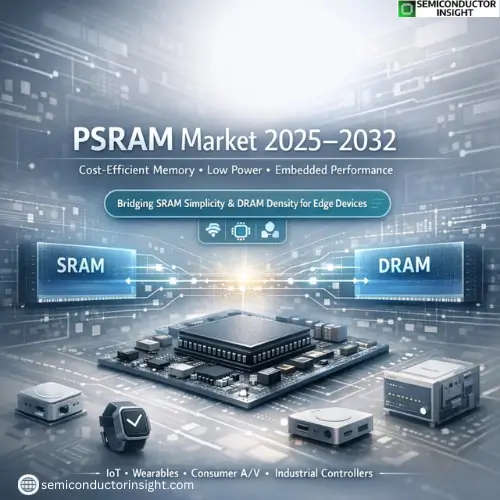
At first glance, memory technologies like SRAM, DRAM, and Flash dominate chip conversations. Yet between these well-known categories sits a versatile alternative: Pseudo Static RAM (PSRAM). Designed to blend the simplicity and fast access of static RAM with the density and cost-efficiency of dynamic RAM, PSRAM has emerged as a strategically relevant option for systems that require moderate memory size, low power, and low cost.
Rather than replacing core memory types, PSRAM fills a niche where embedded applications, cost constraints, and power budgets intersect. It is fast enough to support real-time processing, yet simple enough to implement without demanding complex memory hierarchies.
From Device Needs to Memory Fit
PSRAM’s market significance is rooted in the evolving profile of modern electronic systems. A decade ago, most low-power devices fell comfortably into simple SRAM or tiny Flash footprints. Today, edge computing, AI sensors, connectivity hubs, and wearable devices generate data streams that exceed those modest sizes without justifying full DRAM subsystems.
This is where PSRAM’s sweet spot lies:
- Moderate memory sizes (typically tens to hundreds of megabits)
- Lower cost per bit than SRAM
- Simpler interface than DRAM
- Low-power standby for battery-dependent platforms
In devices like IoT nodes, AR/VR modules, smart meters, and audio/video edge units, PSRAM often balances system cost with usable performance.
Embedded Systems Driving Demand Patterns
Demand for PSRAM tends to track embedded system adoption curves rather than traditional PC- or server-centric cycles. Key verticals include:
- IoT and IoT Edge Gateways, where local buffers and cache help pre-process sensor data
- Wearable and Health Monitors, where power efficiency directly affects battery life
- Consumer Audio/Video Devices, where frame buffering and codec states require flexible memory
- Industrial Controllers, where environmental resilience and simplified memory interface reduce engineering overhead
Trade and Global Supply Considerations
The PSRAM market is tied closely to the global semiconductor supply chain, particularly in East Asia where memory production and packaging ecosystems are concentrated. Key supply chain realities include:
- Core wafer and memory process integration often anchored in Taiwan, China, and South Korea
- Packaging and test capacity influencing lead times and inventory behavior
- Trade flows shaped by demand in connected devices and consumer electronics
- Regional fabrication shifts tied to geopolitical incentives and capacity expansions
Because PSRAM modules often compete indirectly with embedded DRAM and advanced SRAM implementations, trade patterns also depend on customer willingness to invest in on-die or multi-die memory architectures.
Feel Free to Reach Our Most Recent Updates of the Report:
https://semiconductorinsight.com/report/global-psram-pseudo-static-ram-market/
Competitive Landscape and Supplier Strategies
Players in the PSRAM ecosystem include memory specialists and mixed-signal manufacturers who see embedded memory as a growth engine. Notable companies and strategic approaches include:
- Cypress Semiconductor (Infineon) – Longstanding PSRAM portfolio with broad embedded design support
- Winbond Electronics – Competitive mid-range PSRAM options with scalable densities
- Micron/Numonyx (via legacy product lines) – Integration of PSRAM in mixed memory solutions
- Alliance Memory / GSI Technology – Focus on niche embedded memory segments
- Renesas and other microcontroller integrators – Offering PSRAM alongside microcontroller platforms to simplify design
Strategic priorities tend to include:
- Broadening density ranges to fit more design use cases
- Tight collaboration with ecosystem partners on design tools and simulation
- Portfolio bundling (memory + NOR/Flash + controllers) to streamline customer choice
Emerging Direction: Power Efficiency and Intelligent Edge
Longer term, the PSRAM market’s opportunity is tied not just to volume electronics, but to intelligent, autonomous edge platforms that demand memory options optimizing both performance and energy.
As devices become more context-aware from smart appliances to industrial sensors and AR/VR wearable local memory needs will shift away from minimal scratch spaces to richer buffers that enable on-device AI inference, data caching, and real-time pre-processing. PSRAM’s simplicity and density position it well within these use cases.
Closing Insight: Incremental Memory, Exponential Impact
PSRAM Market might not dominate headlines like next-generation DRAM or emerging non-volatile memories, but it plays a strategic role at the intersection of performance, cost, and power. In an industry where every mill watt and every cubic millimetre matters, PSRAM provides an elegant balance for embedded systems that must do “just enough” with fewer constraints.
For engineers, it means simpler design, predictable performance, and manageable cost. For investors, it means exposure to a segment that quietly supports a massive installed base across intelligent devices.

Comments (0)