➣ Global PSRAM (Pseudo Static Ram) Market Overview
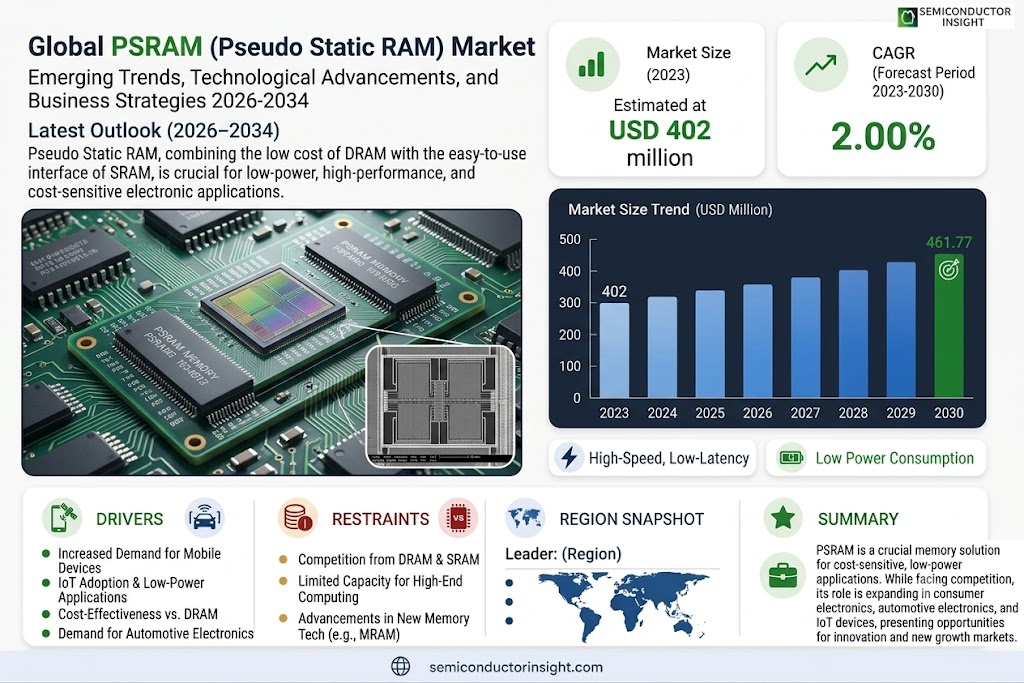
PSRAM consists of a DRAM macro core with a traditional SRAM interface; an on-chip refresh circuit that frees the user from the need to take care of this task. Comparing to traditional CMOS SRAM, PSRAM has advantage in higher density, higher speed, smaller die size, and DRAM compatible process.
Global PSRAM (Pseudo Static Ram) Market: Market Segmentation Analysis
The research report includes specific segments by region (country), manufacturers, Type, and Application. Market segmentation creates subsets of a market based on product type, end-user or application, Geographic, and other factors. By understanding the market segments, the decision-maker can leverage this targeting in the product, sales, and marketing strategies. Market segments can power your product development cycles by informing how you create product offerings for different segments.
Key Company
- Infineon
- Alliance Memory
- Winbond
- ISSI
- AP Memory
- Fidelix
- ESMT
- Micron Technology
- STMicroelectronics
- Fujitsu
- JSC
Market Segmentation (by Type)
- 64Mb
- 128Mb
- 256Mb
- Other
Market Segmentation (by Application)
- Consumer Electronics
- Industrial
- Automotive Electronics
- Other
Geographic Segmentation
- North America (USA, Canada, Mexico)
- Europe (Germany, UK, France, Russia, Italy, Rest of Europe)
- Asia-Pacific (China, Japan, South Korea, India, Southeast Asia, Rest of Asia-Pacific)
- South America (Brazil, Argentina, Columbia, Rest of South America)
- The Middle East and Africa (Saudi Arabia, UAE, Egypt, Nigeria, South Africa, Rest of MEA)
➣ Key Benefits of This Market Research:
- Industry drivers, restraints, and opportunities covered in the study
- Neutral perspective on the market performance
- Recent industry trends and developments
- Competitive landscape & strategies of key players
- Potential & niche segments and regions exhibiting promising growth covered
- Historical, current, and projected market size, in terms of value
- In-depth analysis of the PSRAM (Pseudo Static Ram) Market
- Overview of the regional outlook of the PSRAM (Pseudo Static Ram) Market:
➣ Key Reasons to Buy this Report:
- Access to date statistics compiled by our researchers. These provide you with historical and forecast data, which is analyzed to tell you why your market is set to change
- This enables you to anticipate market changes to remain ahead of your competitors
- You will be able to copy data from the Excel spreadsheet straight into your marketing plans, business presentations, or other strategic documents
- The concise analysis, clear graph, and table format will enable you to pinpoint the information you require quickly
- Provision of market value (USD Billion) data for each segment and sub-segment
- Indicates the region and segment that is expected to witness the fastest growth as well as to dominate the market
- Analysis by geography highlighting the consumption of the product/service in the region as well as indicating the factors that are affecting the market within each region
- Competitive landscape which incorporates the market ranking of the major players, along with new service/product launches, partnerships, business expansions, and acquisitions in the past five years of companies profiled
- Extensive company profiles comprising of company overview, company insights, product benchmarking, and SWOT analysis for the major market players
- The current as well as the future market outlook of the industry concerning recent developments which involve growth opportunities and drivers as well as challenges and restraints of both emerging as well as developed regions
- Includes in-depth analysis of the market from various perspectives through Porters five forces analysis
- Provides insight into the market through Value Chain
- Market dynamics scenario, along with growth opportunities of the market in the years to come
- 6-month post-sales analyst support
Customization of the Report
In case of any queries or customization requirements, please connect with our sales team, who will ensure that your requirements are met.
➣ Drivers:
- Increased Demand for Mobile Devices: PSRAM is widely used in mobile devices such as smartphones, tablets, and wearable electronics due to its high-speed performance, low power consumption, and relatively low cost. With the growing demand for mobile devices worldwide, the need for PSRAM is expected to rise.
- Adoption of IoT Devices: The Internet of Things (IoT) market is expanding rapidly, and PSRAM plays a crucial role in IoT devices. PSRAM’s ability to provide fast access times and its lower power consumption make it a preferred memory solution for IoT applications. As more devices become connected, the demand for efficient memory solutions like PSRAM grows.
- Cost-Effectiveness: PSRAM is cheaper to produce compared to Dynamic RAM (DRAM) while offering similar performance in many applications. This cost advantage makes PSRAM an attractive choice for manufacturers of consumer electronics, contributing to its increased adoption in applications where cost is a critical factor.
- Growing Demand for Automotive Electronics: PSRAM is used in automotive electronics for applications like infotainment systems, advanced driver-assistance systems (ADAS), and navigation systems. As the automotive industry continues to integrate more electronic systems, the demand for PSRAM will increase.
- Rising Data Transfer and Speed Requirements: With the proliferation of data-heavy applications, such as high-definition video streaming, gaming, and augmented reality (AR), PSRAM provides a reliable memory solution that delivers fast data access speeds and low latency, making it ideal for handling large amounts of data quickly.
➣ Restraints:
- Competition from DRAM and SRAM: DRAM and SRAM continue to be dominant in high-performance and high-capacity memory applications. DRAM, although more expensive and power-hungry, offers greater scalability and is preferred for applications requiring high memory density, thus posing a challenge to PSRAM’s growth.
- Limited Capacity: PSRAM, while efficient for low-power applications, is limited in terms of storage capacity compared to other memory types such as DRAM or Flash memory. This limits its usage in high-end computing and memory-intensive applications where larger memory capacities are required.
- Technological Advancements in Other Memory Technologies: The development of newer memory technologies like Magnetoresistive RAM (MRAM) and 3D NAND Flash could pose competition to PSRAM. These newer technologies offer faster speeds, higher endurance, and larger storage capacities, which could limit PSRAM’s market share in certain segments.
- Lack of Awareness in Some Segments: Despite PSRAM’s advantages, there may be a lack of awareness about its benefits in certain industries, particularly in niche sectors. This limits the growth of PSRAM in markets where other memory technologies are more widely adopted.
➣ Opportunities:
- Expansion of Consumer Electronics Market: With the ongoing innovation in consumer electronics, including smart home devices, gaming consoles, wearables, and virtual reality (VR) systems, PSRAM is expected to find new growth opportunities. As these devices demand more efficient and high-speed memory, PSRAM’s role will become even more important.
- Development of 5G Networks: The rollout of 5G networks is expected to drive the demand for high-speed data processing in devices. PSRAM can help meet the higher performance and lower latency requirements in 5G-enabled devices, especially in smartphones, edge computing, and other mobile applications.
- Growth in Automotive Industry (ADAS & Autonomous Vehicles): As the automotive industry moves toward autonomous driving and more advanced in-car infotainment systems, the need for reliable and efficient memory solutions increases. PSRAM’s ability to handle real-time data processing and low power consumption makes it an ideal choice for such applications, offering significant growth opportunities.
- Rise of Edge Computing and AI: The growth of edge computing and artificial intelligence (AI) applications presents a major opportunity for PSRAM. These technologies require fast data processing capabilities, and PSRAM’s combination of high speed and low power consumption makes it well-suited for AI systems, IoT gateways, and edge devices.
- Integration in Wearable and Portable Devices: The wearable electronics market, including smartwatches, fitness trackers, and medical devices, is expanding rapidly. PSRAM’s low power consumption and ability to perform fast data processing are ideal for these battery-dependent devices, providing a promising avenue for market expansion.
➣ Challenges:
- Technological Complexity: While PSRAM offers lower power consumption than DRAM, it still faces challenges in terms of technological complexity. Designing PSRAM that balances speed, power consumption, and cost-effectiveness can be challenging, especially with the need for continuous technological innovation to keep up with competitors.
- Price Volatility: The cost of raw materials, such as semiconductors, can fluctuate, impacting the overall cost of PSRAM production. Price volatility in the global semiconductor market can create pricing pressure, especially in a highly competitive sector.
- Supply Chain Disruptions: The PSRAM market, like the broader semiconductor market, is susceptible to disruptions in the supply chain, which could delay production and impact the ability of companies to meet market demand. Factors such as geopolitical issues, natural disasters, and component shortages could affect supply.
- Environmental Impact of Manufacturing: The environmental impact of semiconductor manufacturing, including the use of chemicals and high energy consumption, presents a challenge to the PSRAM market. Increasing pressure from regulatory bodies and consumers for sustainable and eco-friendly manufacturing practices may require significant adjustments from manufacturers.
- Technological Advancements in Storage Solutions: The rapid advancements in storage technologies such as solid-state drives (SSDs), MRAM, and hybrid memory solutions could hinder the growth of PSRAM in certain markets. As these new technologies offer higher performance, durability, and scalability, PSRAM may struggle to compete in high-capacity storage applications.
Interested in related market reports? Click here to explore more!
➣ About Semiconductor Insight:
Semiconductor Insight was founded in 2016 and focuses on offering thorough research and analysis of the semiconductor industry to help companies make informed decisions in this fast-paced, dynamic field. We have always been dedicated to providing comprehensive semiconductor market research, recognizing the major trends, opportunities, and difficulties influencing the worldwide semiconductor market.
Our clients can stay ahead of the competition thanks to the actionable intelligence provided by our professionally prepared semiconductor market studies, which include competitive analysis, market predictions, in-depth semiconductor industry analysis, and insights into technical breakthroughs. With almost ten years of experience, we continue to lead innovation and provide strategic clarity to semiconductor companies.
Our dedication to provide our clients insights into semiconductor market share and industry trends guarantees that they have the data they require.
Get Sample Report PDF for Exclusive Insights
Report Sample Includes
- Table of Contents
- List of Tables & Figures
- Charts, Research Methodology, and more...
 Download Sample Report PDF