
Top Most 7 Industrial Touch Screen Trends Changing How Operators Interact With Automated Machines
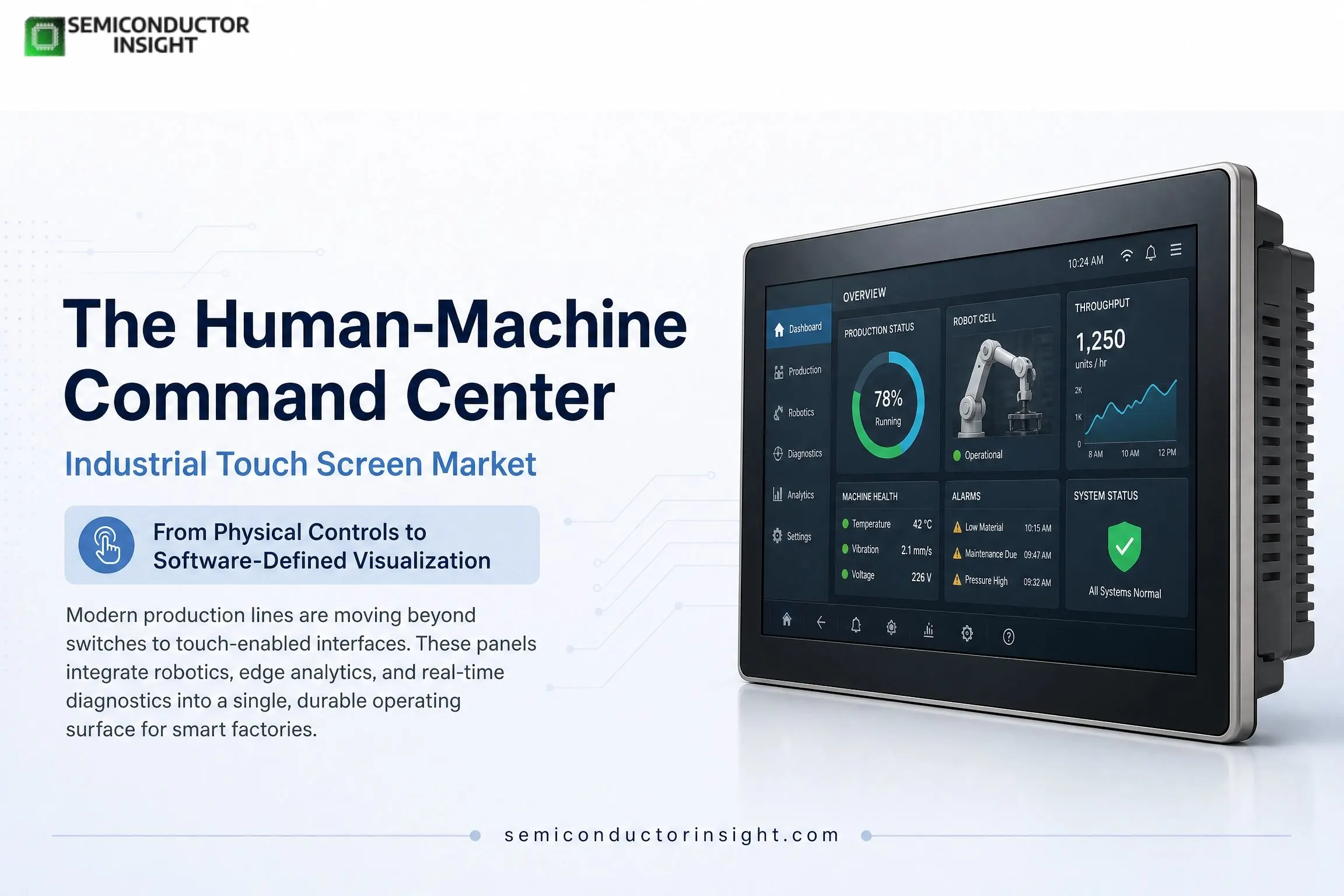
A machine operator no longer interacts with industrial equipment through a simple collection of switches and indicator lights. Modern production lines increasingly rely on touch-enabled interfaces that bring machine status, alarms, process parameters, diagnostics and production data into a single operating surface. This transformation is reshaping Industrial Touch Screen Market, particularly as factories adopt robotics, edge computing, connected sensors and digital manufacturing systems.
The industrial touch screen is becoming more than a display component. It is evolving into the point where people interact with programmable logic controllers, industrial PCs, SCADA platforms, robotic systems and cloud-connected production environments.
The Factory Interface Is Moving From Buttons to Context
The biggest change in industrial touch screens is not simply the replacement of physical controls with glass displays. It is the growing amount of information that operators are expected to interpret from a single interface.
Machine status → Process visualization → Alarm intelligence → Maintenance data → Production analytics → Remote access
This shift is particularly visible in smart factories, where equipment is expected to communicate continuously. The screen must therefore provide more than touch input. It must present information quickly, support multiple communication protocols and remain usable in environments involving vibration, dust, oil, and moisture and temperature variation.
Why Screen Size Is Becoming a Design Decision?
Industrial displays are increasingly being selected according to the complexity of the process rather than a one-size-fits-all approach. Siemens’ current SIMATIC HMI Unified portfolio spans display sizes from 4 inches to 22 inches, while its Unified Comfort Panels extend from 7 to 22 inches. Advantech’s industrial touch-panel portfolio ranges from approximately 3.5 inches to 31.5 inches, covering compact machine controls through larger operator stations.
Small screens remain useful for machine-level commands, while larger displays are increasingly important for dashboards containing multiple production variables, video feeds, alarms and real-time equipment information.
The result is a more segmented market where screen dimensions, viewing distance, installation position and operator workload increasingly determine the product architecture.
Industrial Touch Screen Market Is Being Tested by Harsh Environments
- Consumer touchscreen design cannot simply be transferred to a factory floor. Industrial equipment may be exposed to metal dust, coolant, vibration, cleaning chemicals and accidental contact with tools.
- Advantech, for example, offers industrial touch-panel systems with features including IP66 protection, 7H anti-scratch surfaces, M12 connectivity and resistance to shock and vibration.
- Its product portfolio also includes fanless designs and multiple touch technologies such as projected capacitive and resistive control.
- These specifications show why durability is becoming a central part of the product rather than an optional feature. In food processing, pharmaceutical production and chemical facilities, the interface may also need to support hygienic cleaning requirements and specialized enclosure designs.
A New Generation of HMI Is Becoming Software-Defined
The industrial touch screen is increasingly being treated as a software platform. Siemens’ Unified Comfort Panels combine multi-touch displays with WinCC Unified visualization software and Industrial Edge functionality, allowing the hardware to support more flexible application environments. Siemens also describes its panels as scalable from simple start-stop operations to complex parameter adjustment and data analysis.
This is changing the role of the panel. Instead of displaying a fixed interface created for one machine, newer systems can increasingly support software updates, expanded visualization and connections with broader industrial data environments.
Industrial Touch Screen Market is therefore gradually converging with industrial computing, edge analytics and visualization software.
For More Detailed Insights, You Can Surf Our Latest Report Here: https://semiconductorinsight.com/report/industrial-touch-screen-market/
The Robotics Boom Is Increasing the Need for Better Operator Interfaces
- Industrial automation is creating more complex human-machine interaction requirements. According to the International Federation of Robotics, China reached a robot density of 470 industrial robots per 10,000 manufacturing employees, while South Korea remained the global leader at 1,012 robots per 10,000 employees. Germany recorded 429 robots per 10,000 employees.
- As robot fleets become larger and manufacturing systems become more automated, operators increasingly need interfaces that can show robot status, production sequence, fault conditions and maintenance requirements without navigating through multiple disconnected systems.
- This is where industrial touch screens are gaining importance as the visual command center of automated production.
The Next Interface May Not Be Touch-Only
Touch interaction is still central to industrial HMI design, but research is already exploring what comes next. A 2025 study proposed using large language models with OPC UA to enable natural-language interaction with industrial machines. In a test involving 50 synthetically generated commands across five models, some GPT-5-based systems achieved accuracy between 96% and 98% in the evaluated setup.
The implication is significant. Future industrial interfaces may combine touchscreens with voice, natural-language commands, augmented visualization and AI-assisted troubleshooting.
An operator could eventually move from:
Tap alarm → Search manual → Identify fault
To:
Ask machine → AI interprets condition → Screen displays cause and recommended action
Why Industrial Touch Screen Design Is Becoming More Human-Centered?
Factories are becoming more automated, but the operator remains central to decision-making. This is pushing manufacturers to focus on clearer visual hierarchy, faster access to critical information and interfaces that reduce unnecessary navigation.
The modern industrial touch screen is therefore developing in three directions at once: greater physical durability, greater computing capability and more intuitive interaction.
The market’s evolution is visible in the movement from fixed control panels toward connected industrial interfaces that link machines, people and production data. As automation expands into robotics, smart manufacturing and edge-enabled production systems, the touchscreen is increasingly becoming the place where complex industrial systems become understandable to the human operator.

Comments (0)