AI-Enabled Smart Manufacturing Robotics in Fabs Market Insights
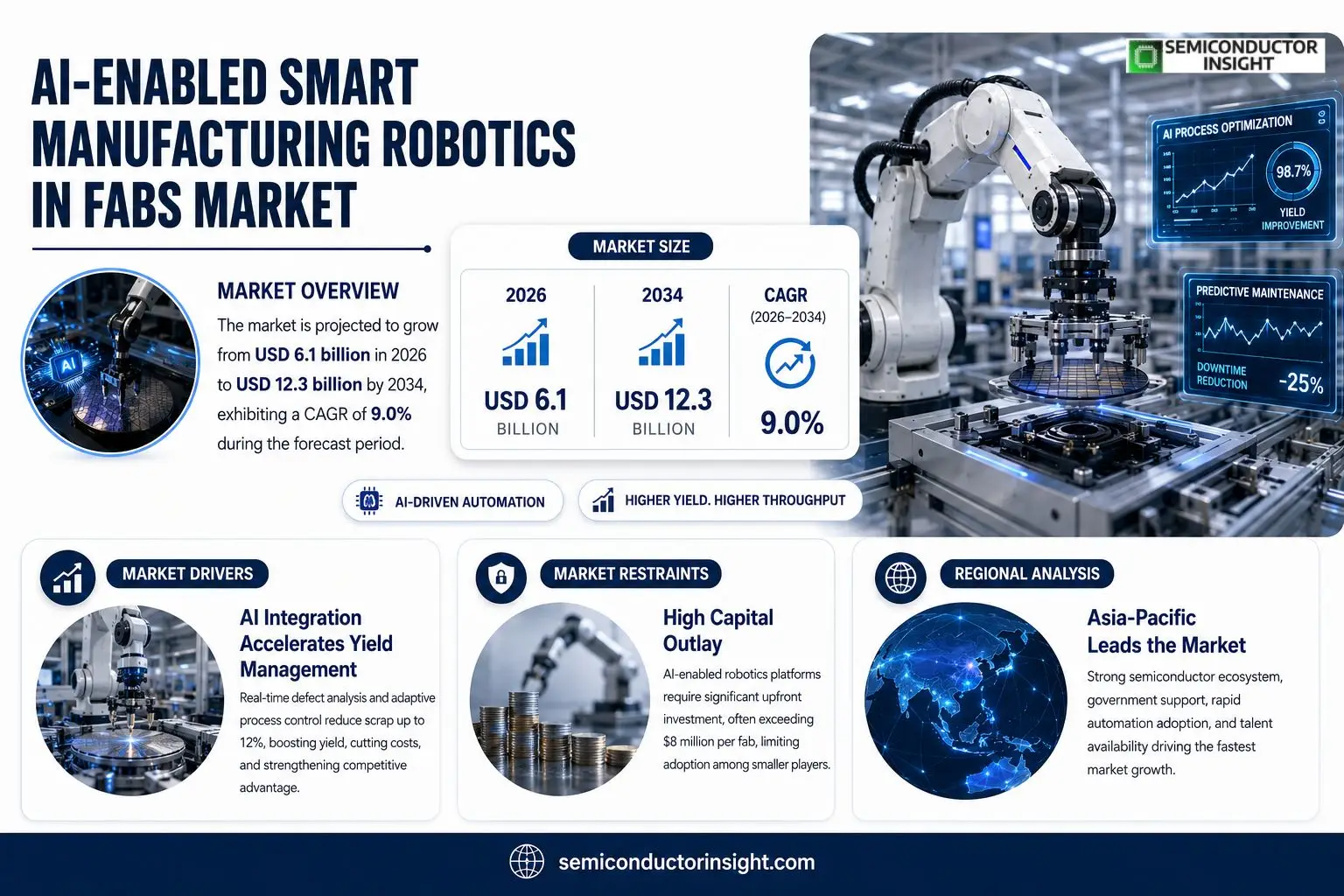
AI-Enabled Smart Manufacturing Robotics in Fabs market size was valued at USD 5.6 billion in 2025. The market will increase from USD 6.1 billion in 2026 to USD 12.3 billion by 2034, exhibiting a CAGR of 9.0% during the forecast period.
AI‑enabled smart manufacturing robotics refer to autonomous robotic systems equipped with machine‑learning algorithms, computer‑vision sensors and edge‑computing units that can adapt production parameters in semiconductor fabs without human intervention. These robots perform wafer handling, lithography alignment, defect inspection and material transport while continuously optimizing cycle time and yield.The market is gaining momentum because semiconductor manufacturers are accelerating their shift toward Industry 4.0 architectures, seeking higher throughput amid rising demand for advanced nodes. Moreover, chronic skilled‑labor shortages push fabs toward automation that can learn from process data. Recent collaborations such as ABB’s joint development platform with Nvidia for AI‑driven robot control and Siemens’ partnership with Intel on edge AI processors illustrate how leading vendors are embedding intelligence directly into fab lines.
MARKET DRIVERS
AI Integration Accelerates Yield Management
Manufacturers are embracing AI‑enabled smart manufacturing robotics to tighten control over wafer‑level yields. By processing defect maps in real time, the systems adjust tool parameters on the fly, shaving off up to 12% of scrap in high‑mix fabs. This efficiency gain translates directly into lower unit costs and a stronger competitive edge for early adopters.
Labor Shortage Mitigation
The semiconductor sector faces a persistent shortfall of skilled technicians. Intelligent robots supplement the workforce by handling repetitive alignment and material‑handling tasks, freeing engineers to focus on process innovation. Companies reporting a 30% reduction in overtime hours attribute the shift to these autonomous assistants.
➤ “Deploying AI‑driven robotics has turned what used to be a bottleneck into a throughput catalyst, especially during peak demand cycles.”
Beyond cost, the strategic benefit lies in agility. Facilities equipped with adaptive robots can reconfigure production lines within a single shift, responding to sudden changes in customer orders without the lengthy retuning traditionally required.
MARKET CHALLENGES
High Capital Outlay
Initial investment for AI‑enabled platforms remains steep, with turnkey solutions often exceeding $8 million per fab. Smaller players struggle to justify the expense against volatile demand, leading to a fragmented adoption curve.
Other Challenges
Integration Complexity
Legacy equipment rarely speaks the same data protocols as modern AI stacks, forcing firms to develop bespoke middleware. The resulting integration timeline can stretch beyond 18 months, eroding the anticipated time‑to‑value.
MARKET RESTRAINTS
Regulatory Uncertainty
Data‑driven control loops are subject to evolving safety standards across regions. Ambiguities in compliance requirements cause some fabs to postpone deployment, fearing retro‑fit costs should regulations tighten after installation.
MARKET OPPORTUNITIES
Edge‑AI Services for Real‑Time Optimization
Vendors that bundle cloud‑based analytics with on‑site edge processing stand to capture a growing slice of the AI‑Enabled Smart Manufacturing Robotics in Fabs Market. Edge solutions deliver sub‑second decision latency, enabling predictive maintenance that can slash unplanned downtime by up to 25%.
AI-Enabled Smart Manufacturing Robotics in Fabs Market Trends
Intelligent Automation Accelerating Fab Throughput
The infusion of AI into fab robotics reshapes production cadence by allowing machines to self‑tune critical steps such as wafer handling, lithography alignment, and defect inspection. Sensors coupled with machine‑learning models generate a continuous feedback loop that trims cycle time while preserving yield. As fabs chase sub‑10 nm nodes, the tolerance window narrows and traditional rule‑based automation struggles to keep pace. Embedding intelligence directly in the robot’s control logic supplies the granularity needed to respond to process drift in real time, reducing re‑work and extending equipment uptime. This shift from static programming to adaptive execution positions AI‑Enabled Smart Manufacturing Robotics in Fabs Market as the cornerstone of next‑generation semiconductor factories.
Other Trends
Collaborative Edge‑AI Platforms
Recent alliances illustrate how ecosystem players are converging on a common architecture. ABB’s joint development platform with Nvidia integrates vision‑centric AI inference engines into robotic controllers, enabling on‑the‑fly adjustments to wafer‑pick trajectories. Parallelly, Siemens and Intel have launched an edge‑AI processor bundle that embeds predictive analytics at the point of material transport, allowing the robot to anticipate bottlenecks before they materialize. These co‑development efforts reduce integration complexity for fab operators and accelerate the rollout of intelligent automation across multiple production lines. By sharing a standardized AI stack, manufacturers gain leverage over software licensing costs while preserving the flexibility to fine‑tune algorithms for proprietary processes.
Labor Scarcity and Process Learning
Persistent shortages of highly skilled technicians have nudged semiconductor producers toward self‑optimizing equipment. When a robot can learn from historical process data, it alleviates the need for manual parameter tweaking that traditionally relied on expert intuition. This capability translates into shorter onboarding cycles for new fabs and a more resilient operational model during periods of workforce turnover. Moreover, the ability to archive and replay learned behaviors creates a knowledge repository that can be transferred across sites, fostering uniform performance standards worldwide. For investors and strategic planners, the convergence of labor constraints and AI‑driven process learning underscores a durable competitive advantage for firms that embed these technologies early in their fab roadmaps.
COMPETITIVE LANDSCAPEKey Industry Players
AI‑Enabled Smart Manufacturing Robotics in Semiconductor Fabs
ABB dominates the fab‑robot segment, leveraging its long‑standing automation footprint and recent joint‑development platform with Nvidia. The partnership threads deep‑learning inference engines into ABB’s articulated units, enabling real‑time adjustment of wafer‑handling trajectories. This capability addresses the fab’s need to compress cycle times while maintaining defect‑free yields, a pressure amplified by the shift toward sub‑5‑nanometer nodes. Siemens follows a similar trajectory, embedding Intel’s edge‑AI processors into its robotic cells to create a closed‑loop control system that learns from sensor streams. Both vendors have cultivated ecosystems of system integrators, which translates into a tiered market where a few large integrators supply the bulk of the hardware, while specialized software firms occupy the value‑adding layer.Beyond the two giants, a constellation of niche players contributes specialized expertise. Fanuc and KUKA supply high‑speed, high‑precision manipulators that excel in lithography alignment, whereas Yaskawa’s collaborative robots cater to material transport in cleanroom environments. Cognex provides vision systems that are often paired with these robots to achieve defect detection rates above 99.9 %. Emerging contributors such as Teradyne and Applied Materials are integrating AI‑driven inspection modules directly into wafer‑testing stations, blurring the line between robotics and metrology. The competitive tableau reflects a blend of traditional automation strength and cutting‑edge AI adoption, forcing all participants to accelerate software development cycles and deepen fab‑specific partnerships.
List of Key Smart Manufacturing Robotics Companies Profiled
- ABB
- Siemens
- Fanuc
- KUKA
- Yaskawa Electric
- Cognex
- Teradyne
- Applied Materials
- Universal Robots
- Rockwell Automation
- Nvidia
- Intel
- Bosch Rexroth
- Mitsubishi Electric
- Tokyo Electron
Segment Analysis:
| Segment Category | Sub-Segments | Key Insights |
| By Type |
|
Collaborative Robots
|
| By Application |
|
Wafer Handling
|
| By End User |
|
Foundry Service Providers
|
| By Integration Strategy |
|
Edge‑AI Integrated Robots
|
| By Value‑Chain Position |
|
Process‑Control Robotics
|
Regional Analysis: AI-Enabled Smart Manufacturing Robotics in Fabs Market
Asia‑Pacific
Taiwan’s wafer fabs have accelerated the deployment of AI‑enabled robotic arms for wafer handling, citing a need to cut human error rates as device geometries shrink. The speed of rollout is amplified by local OEMs that tailor hardware to the specific footprint of 300‑mm equipment.
Recent disruptions have motivated fab owners to source robotic components from regional suppliers, shortening lead times and reducing exposure to cross‑border logistics. This trend reinforces collaborative R&D between fabs and local parts manufacturers.
Universities in South Korea and Singapore now embed AI‑robotics curricula within semiconductor engineering programs, ensuring a pipeline of engineers who can maintain and enhance smart manufacturing systems on site.
Government subsidies in Japan target AI‑enabled automation projects that demonstrate measurable yield improvement, encouraging fab operators to allocate capital toward next‑generation robotics rather than incremental upgrades.
North America
In the United States, fab owners are balancing legacy equipment upgrades with the introduction of AI‑driven robotic inspection stations. The market’s matureness drives a focus on predictive maintenance, where machine‑learning models anticipate robot wear before failure. Canadian fabs, though fewer, are leveraging the same technologies to differentiate themselves in niche specialty‑process segments. The competitive pressure from Asia‑Pacific forces North American players to justify higher labor costs through measurable efficiency gains, prompting a gradual shift toward fully autonomous material‑handling cells.
Europe
European semiconductor manufacturers, concentrated in Germany, the Netherlands, and France, emphasize sustainability alongside automation. AI‑enabled robotics are being evaluated for their ability to reduce energy consumption per wafer processed, a metric increasingly tied to corporate ESG targets. Collaborative research initiatives across the EU are standardizing data protocols, enabling cross‑fab learning that accelerates model refinement. While the regulatory environment is stringent, it also creates a predictable framework for long‑term capital commitments to smart manufacturing solutions.
South America
Brazil’s emerging fab ecosystem is still in a growth phase, yet early adopters are experimenting with AI‑powered robotic pick‑and‑place units to compensate for limited skilled labor. The regional emphasis on cost containment drives vendors to offer modular robotics that can be scaled as production volume rises. Local partnerships with academic institutions are beginning to address the talent gap, fostering a nascent community of engineers versed in both semiconductor processes and AI integration.
Middle East & Africa
In the Middle East, sovereign wealth funds are financing state‑owned fabs that aim to become regional hubs for advanced packaging. These facilities view AI‑enabled robotics as a cornerstone for achieving world‑class yields without relying on imported expertise. In Africa, pilot projects in South Africa focus on robotic inspection for low‑volume, high‑value specialty wafers, highlighting the technology’s adaptability to diverse market scales. Both regions are navigating infrastructural constraints, making the robustness and remote‑monitoring capabilities of AI‑driven robots critical to operational success.
Report Scope
This market research report provides a comprehensive analysis of the AI-Enabled Smart Manufacturing Robotics in Fabs Market , covering the forecast period 2026–2034. It offers detailed insights into market dynamics, technological advancements, competitive landscape, and key trends shaping the industry.
Key focus areas of the report include:
- Market Overview: The report begins with an overview outlining its current market scenario, key growth indicators, and industry transformation drivers. It discusses macroeconomic factors, demand–supply balance, regulatory landscape, and the strategic role of semiconductors in powering advancements across industries such as automotive, telecommunications, consumer electronics, and industrial automation.
- Market Size & Forecast: Historical data and future projections for revenue, unit shipments, and market value across major regions and segments.
- Segmentation Analysis: Detailed breakdown by product type, technology, application, and end-user industry to identify high-growth segments and investment opportunities.
- Regional Insights: Insights into market performance across North America, Europe, Asia-Pacific, Latin America, and the Middle East & Africa, including country-level analysis where relevant.
- Competitive Landscape: Profiles of leading market participants, including their product offerings, R&D focus, manufacturing capacity, pricing strategies, and recent developments such as mergers, acquisitions, and partnerships.
- Technology Trends & Innovation: Assessment of emerging technologies, integration of AI/IoT, semiconductor design trends, fabrication techniques, and evolving industry standards.
- Market Drivers & Restraints: Evaluation of factors driving market growth along with challenges, supply chain constraints, regulatory issues, and market-entry barriers.
- Stakeholder Insights: Insights for component suppliers, OEMs, system integrators, investors, and policymakers regarding the evolving ecosystem and strategic opportunities.
Primary and secondary research methods are employed, including interviews with industry experts, data from verified sources, and real-time market intelligence to ensure the accuracy and reliability of the insights presented.
FREQUENTLY ASKED QUESTIONS:
What is the current market size of AI-Enabled Smart Manufacturing Robotics in Fabs Market?
-> AI-Enabled Smart Manufacturing Robotics in Fabs Market was valued at USD 5.6 billion in 2025 and is expected to reach USD 12.3 billion by 2034.
Which key companies operate in AI-Enabled Smart Manufacturing Robotics in Fabs Market?
-> Key players include Axalta Coating Systems, AkzoNobel, BASF SE, PPG, Sherwin-Williams, and 3M, among others.
What are the key growth drivers?
-> Key growth drivers include railway infrastructure investments, urbanization, and demand for durable coatings.
Which region dominates the market?
-> Asia-Pacific is the fastest-growing region, while Europe remains a dominant market.
What are the emerging trends?
-> Emerging trends include bio-based coatings, smart coatings, and sustainable rail solutions.
Get Sample Report PDF for Exclusive Insights
Report Sample Includes
- Table of Contents
- List of Tables & Figures
- Charts, Research Methodology, and more...
 Download Sample Report PDF