

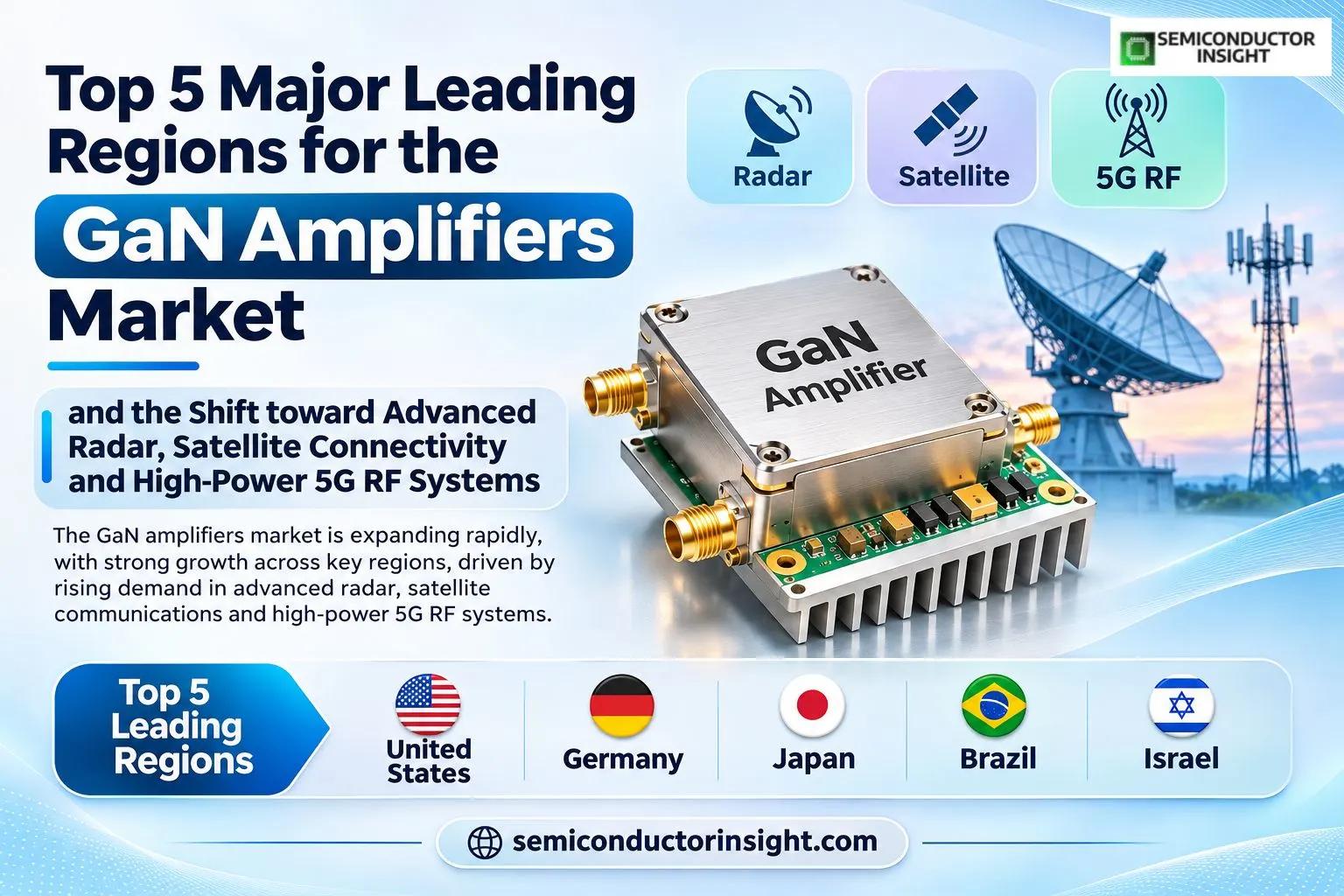
Top 5 Major Leading Regions for the GaN Amplifiers Market and the Shift toward Advanced Radar, Satellite Connectivity and High-Power 5G RF Systems
Gallium nitride (GaN) amplifiers are becoming increasingly important in systems that must transmit high-power radio-frequency signals while operating across demanding frequency ranges. Their high power density, efficiency and thermal performance make them suitable for radar, electronic warfare, satellite communication, telecommunications infrastructure and aerospace applications.
GaN-on-silicon carbide (GaN-on-SiC) is particularly relevant for high-power RF applications because the substrate offers strong thermal conductivity. GaN-on-silicon technologies are also being developed for applications where manufacturing economics and integration requirements are important. The distinction matters because amplifier performance depends not only on the semiconductor material but also on frequency, circuit design, packaging and cooling.
Radar Systems Are Demanding More Power in Smaller Architectures
- Defence radar is one of the most established application areas for GaN amplifiers.
- Active electronically scanned array (AESA) systems use multiple transmit and receive modules to steer radar beams electronically.
- These architectures benefit from compact, efficient power amplifiers capable of operating reliably under demanding conditions.
- In October 2026, Qorvo introduced a C-band radar front-end solution combining frequency-agile BAW filtering with 50-watt and 200-watt GaN power amplifiers.
- Designed for pulsed electronically scanned array radar, the architecture aims to reduce RF component count, DC power consumption and heat generation.
- This development demonstrates how amplifier innovation is increasingly connected with complete RF front-end integration.
Satellite Networks Are Opening New Frequency Requirements
The expansion of low-Earth-orbit satellite constellations is creating additional requirements for high-frequency RF components. Satellite communication systems use power amplifiers in ground terminals, gateways and space-based transmission equipment. Ka-band technology is especially relevant for high-throughput satellite links because it supports wider bandwidths than many traditional satellite frequency bands.
The European Space Agency’s Connectivity and Secure Communications programme completed a project targeting 2-watt and 4-watt GaN Ka-band high-power amplifiers operating between 27 and 31 GHz. The components were designed for very small aperture terminals, supporting mobile and fixed satellite services. This illustrates the growing importance of compact, surface-mountable GaN devices in satellite communication equipment.
North America
North America holds an important position through its defence electronics industry, semiconductor manufacturers, aerospace programmes and telecommunications equipment suppliers. The United States is particularly influential in high-power radar applications, where GaN-on-SiC amplifiers are used in advanced radar transmitters and electronic warfare systems.
- A notable example came from MACOM in June 2025, when it introduced a family of 65-volt GaN-on-SiC S-band radar amplifiers operating across 2.7-3.8 GHz, with output power reaching 800 watts.
- Its portfolio also included a 700-watt C-band amplifier for 5.2-5.9 GHz applications. These specifications demonstrate the importance of high-power discrete and integrated RF solutions for demanding radar architectures.
Europe
Europe’s GaN amplifier ecosystem is supported by aerospace programmes, defence electronics development, satellite communication projects and specialised semiconductor research. Germany, France, the United Kingdom and Italy contribute through RF component development, system integration and advanced manufacturing.
The ESA’s Ka-band amplifier programme demonstrates the region’s focus on developing European technology sources for satellite communication components. Another important development is Qorvo’s October 2026 C-band radar solution, announced during European Microwave Week in London. Its combination of BAW filtering and GaN power amplification reflects Europe’s interest in compact, frequency-agile radar systems.
For More Detailed Insights, You Can Surf Our Latest Report Here: https://semiconductorinsight.com/report/gan-amplifiers-market/
Asia Pacific
Asia Pacific has a substantial opportunity in GaN amplifiers through telecommunications infrastructure, defence modernisation, satellite programmes and semiconductor manufacturing. China, Japan, South Korea and India are important contributors, although their application priorities and supply-chain capabilities differ.
China’s Ministry of Industry and Information Technology reported 4.838 million 5G base stations by the end of 2025, alongside 1.204 billion 5G subscriptions. This enormous network footprint creates a significant ecosystem for RF front-end components, including power amplifiers, although not every 5G base station uses GaN technology. India’s satellite programmes and Japan’s advanced radar and electronics industries provide additional application opportunities.
Latin America
Latin America’s GaN amplifier opportunities are closely connected to telecommunications upgrades, satellite connectivity and defence communication systems. Brazil and Mexico are important markets as operators expand 5G infrastructure and improve network capacity. According to GSMA’s 2026 regional report, mobile technologies and services generated approximately US$600 billion in economic value across Latin America in 2025 and supported nearly 3 million jobs. This reflects the scale of the wider connectivity ecosystem rather than GaN-specific revenue.
Brazil’s expanding 5G infrastructure and satellite communication requirements could support demand for high-performance RF equipment. However, local adoption of GaN amplifiers will depend on procurement programmes, network architecture and the availability of specialised system integrators.
Middle East & Africa
The Middle East is developing demand through defence radar procurement, aerospace investment, satellite connectivity and next-generation telecommunications. Countries including Saudi Arabia, the UAE and Israel have established electronics and defence technology programmes that can support specialised RF component requirements.
- The wider regional 5G deployment landscape is also expanding. Data tracked by TeleGeography and published by 5G Americas in November 2025 identified 26 commercial 5G network deployments in the Middle East and 61 in Africa.
- These are network deployment counts, not individual base-station totals, but they indicate the expanding communications infrastructure relevant to RF component suppliers.
Thermal Design and Packaging Are Becoming Competitive Differentiators
As amplifier power and operating frequencies increase, manufacturers must manage heat dissipation, impedance matching, signal integrity and packaging constraints. Advanced substrates, compact module designs and integrated filtering are therefore becoming important alongside transistor performance.
The GaN amplifiers market is evolving from a component-led business into a broader RF engineering ecosystem, where success depends on delivering efficient, reliable and application-qualified solutions for radar, satellite and wireless infrastructure.

Comments (0)