Key Statistics
Key Takeaways
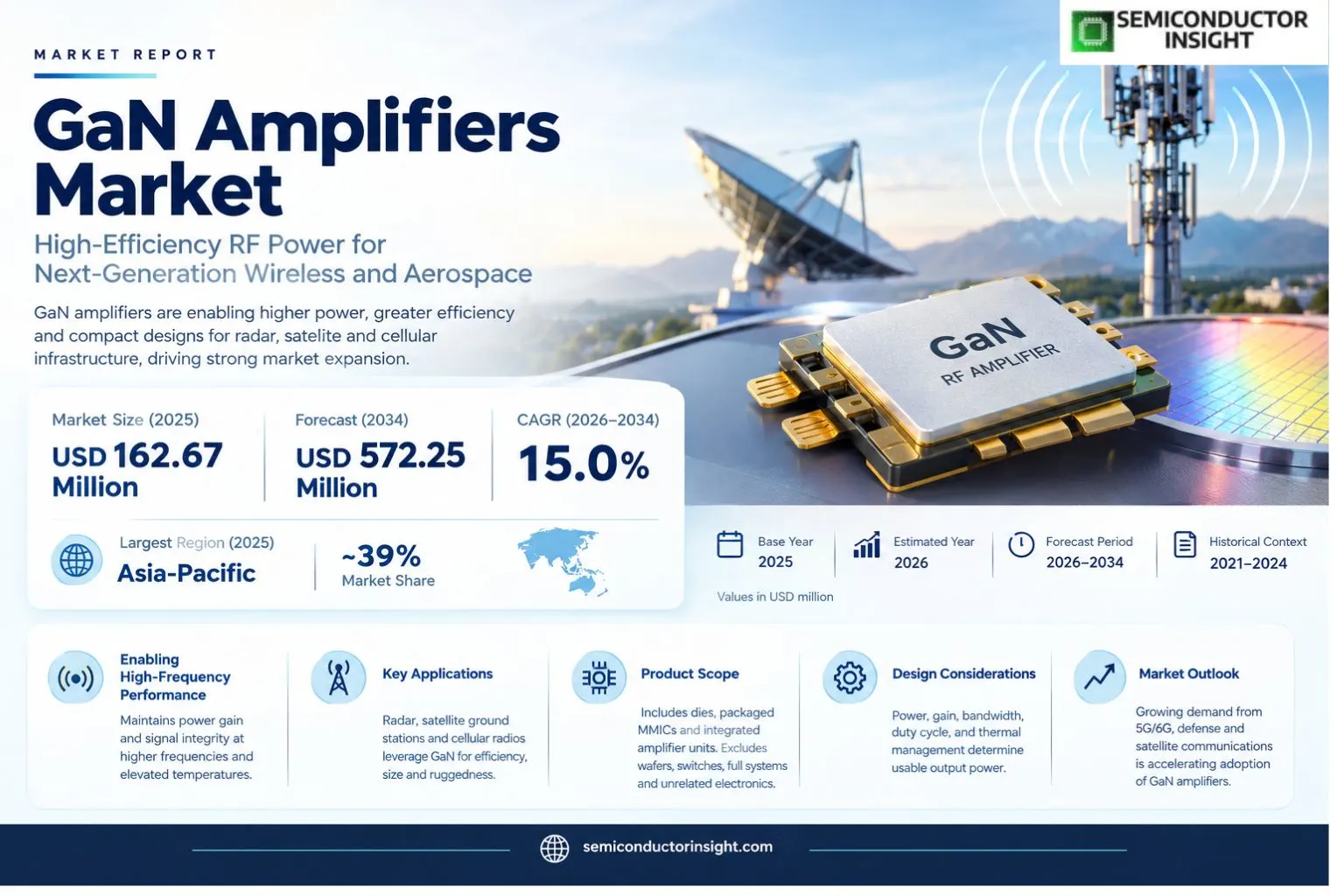
- Global market value: the GaN amplifier industry measured USD 162.67 million in 2025 and is projected to reach USD 572.25 million in 2034, equivalent to a 15.0% CAGR during 2026–2034, with RF power density and system-level thermal management shaping customer adoption.
- Power-class leadership: 25W amplifiers hold an estimated ~28% of 2025 revenue, whereas the 60W category carries an estimated ~21% share and grows faster at ~17.0% CAGR because high-output radar and satellite transmitters reward fewer combined amplifier stages.
- Application demand: wireless infrastructure represents an estimated ~36% of the 2025 market, ahead of aerospace and defense at ~30%; satellite communication advances faster at ~16.2% CAGR as high-frequency ground links require more efficient output stages.
- Regional concentration: Asia-Pacific accounts for an estimated ~39% of 2025 revenue and expands at ~15.7% CAGR, followed by North America at ~33% and Europe at ~19%, reflecting distinct balances of telecom hardware, defense engineering and satellite payload procurement.
- Principal constraints: thermal design, linearity under modulation and the cost of qualified GaN-on-SiC manufacturing restrict substitution even when RF efficiency is compelling; test coverage and long qualification cycles make supplier entry slower than simple device performance comparisons imply.
GaN Amplifiers Market Overview
GaN amplifiers market reached USD 162.67 million in 2025 and is projected to attain USD 572.25 million by 2034, advancing at a CAGR of 15.0% during 2026–2034. Asia-Pacific was the largest regional market with an estimated ~39% share in 2025, supported by wireless equipment production and RF component integration.
Gallium nitride radio-frequency power amplifiers convert a relatively small RF drive signal into the higher output needed by a transmitter while controlling heat and signal distortion. Their commercial value rests on the ability to maintain useful power gain at demanding frequencies and operating temperatures. Radar, satellite ground stations and cellular radios consequently evaluate GaN against gallium arsenide and laterally diffused MOS alternatives on efficiency, size, ruggedness and lifetime rather than on transistor cost alone.
The revenue boundary covers GaN RF power amplifier dies sold as amplifier components, packaged MMICs, and qualifying integrated amplifier units that customers purchase as distinct RF amplification products. It excludes raw epitaxial wafers, generic GaN power switches used in electrical converters, complete radar systems, satellite terminals and the value of unrelated receiver electronics. Device-level and integrated-unit purchases coexist because the supplier mix spans semiconductor makers and specialist RF amplifier manufacturers serving different integration depths.
A transmitter design usually combines a driver stage, an output power stage, matching networks, bias controls and a thermal path that transports waste heat away from the active semiconductor. A nominal 25W amplifier is not directly interchangeable with a 60W part because pulse duty cycle, gain compression, bandwidth and cooling constraints determine usable RF power. Product documentation from MACOM, Qorvo and Analog Devices shows why selection is highly application-specific even within a single nominal output-power class.
Demand depends on how many independently amplified signal paths a radio architecture uses, not simply on the number of networks or satellites in service. Active electronically scanned array radars distribute RF power across numerous transmit/receive elements, while broadband satellite links need efficient stages at higher microwave and millimeter-wave frequencies. Cellular equipment uses different amplifier lineups for macro sites, small cells and private networks, so the mix of carrier bands and output requirements can change market value without a matching change in radio counts.
The industry is moving from discrete performance comparisons toward qualified transmit chains whose amplifier, package and cooling solution are co-designed. Product roadmaps now include compact GaN front-end modules and linearized satellite amplifiers alongside high-power pulsed radar parts. Customers still demand evidence of stable bias behavior, thermal cycling and output linearity across temperature, making design wins durable once awarded but relatively slow to obtain for a newly introduced device family.
Segment Analysis: By Type
Five nominal RF output-power classes describe distinct purchase situations: 6W & 8W, 10W, 11W & 12W, 25W, 60W and Others. The 25W class leads with an estimated ~28% share in 2025, while 60W parts grow at about ~17.0% CAGR on demand for higher peak power and fewer combining stages; the 6W and 8W class retains an estimated ~17% of the market.
| Type | Function | Market position |
|---|---|---|
| 6W & 8W | These modest-output RF stages are useful when a transmit path must fit into a small package or when several distributed elements share an array aperture. Lower absolute heat per device supports constrained electronics, but designers must still balance gain, noise coupling and output back-off. The class is particularly relevant to compact terminals and intermediate driver functions rather than large single-channel radar transmitters. | An estimated ~17% of 2025 revenue sits in this class, with modeled growth of ~12.5% CAGR. It serves designs where compactness and predictable low-power biasing outweigh maximum wattage, making the market more exposed to integration with driver electronics and to competition from mature GaAs solutions at less demanding operating points. |
| 10W, 11W & 12W | Mid-low output classes bridge compact RF electronics and the power levels needed for specialized satellite or instrumentation paths. A Microchip 12W bare-die offering spans 6–18 GHz, illustrating how a single part can serve several microwave bands when matching networks are tailored. Buyers compare usable gain under real modulation with thermal performance, not just the data-sheet saturated output rating. | This category contributes an estimated ~24% of the base-year market and follows ~14.0% CAGR in the allocation. Its relatively broad design space supports steady replacement demand, although high-volume opportunities are limited by frequency-specific package qualification and the choice between buying bare die or an assembled amplifier stage. |
| 25W | Twenty-five-watt devices are a practical center of gravity for many medium-power transmitter channels, combining useful output with manageable packaging options. MACOM offers 25W GaN products across 2.5–6 GHz and 6–18 GHz, showing the importance of frequency coverage and application tuning. Radar designers may use this class as a building block before power combining, while wireless OEMs can use it in selected high-duty transmit paths. | The 25W grouping is the largest at an estimated ~28% of 2025 sales and advances near ~16.5% CAGR. Its lead reflects flexibility across equipment categories rather than a claim that all nominal 25W amplifiers are interchangeable. Frequency response, pulse handling and available cooling infrastructure decide whether an OEM selects this output rating. |
| 60W | High-output amplifier products reduce the number of parallel RF stages needed for a demanding channel, but the thermal path and bias supply become proportionally more consequential. Qorvo specifies a 60W X-band GaN amplifier operating across 8.5–10.55 GHz, and MACOM lists a 60W Ku-band MMIC for satellite uplink uses. Such products often need specialized packaging, heat spreading and extensive acceptance tests. | An estimated ~21% share in 2025 is assigned to 60W products, with ~17.0% CAGR representing the fastest type growth in the model. Higher value per qualified unit offsets narrower socket volumes, particularly where a radar or satellite operator values reduced combiner complexity and compact high-power transmission. |
| Others | The residual class includes outputs below the smallest named range, higher than 60W and specialized amplifier assemblies whose ratings do not map neatly onto a single nominal class. It also captures bespoke frequency-band configurations for pulsed radar and laboratory RF sources. The segment is technically diverse, so average prices and manufacturing yields are less comparable than within the principal wattage groups. | Others represent an estimated ~10% of 2025 revenue and are modeled at ~12.0% CAGR. Bespoke units can command premium pricing but face lower production repeatability, longer acceptance procedures and program-specific documentation; those factors prevent a simple inference that the highest wattage always creates the largest addressable market. |
How do output rating and frequency jointly determine a purchase?
Nominal wattage is only the first screening variable for an RF design. A Ka-band satellite uplink, an X-band radar and a low-frequency communication transmitter can all demand high efficiency but differ in bandwidth, matching-network loss, linearity and temperature tolerance. Designers therefore select devices by the power that can be sustained at the target frequency and duty cycle, and supplier differentiation depends on characterization across operating conditions rather than a single headline power number.
Packaging decisions reinforce this distinction. Bare MMICs give an experienced RF manufacturer control over matching and thermal attachment, whereas flanged packages and integrated assemblies transfer part of the assembly burden to the semiconductor vendor. The commercial consequence is that two products with similar output ratings can address different purchasing departments, qualification budgets and service obligations, limiting direct price comparisons between catalog entries.
Segment Analysis: By Application
Wireless Infrastructure leads applications with an estimated ~36% of 2025 demand, followed by Aerospace and Defense at ~30%, Satellite Communication at ~18%, Civilian Radar at ~12% and Others at ~4%. Satellite Communication shows the fastest modeled expansion at ~16.2% CAGR as high-frequency ground links and space payloads prioritize efficient transmission.
| Application | Demand characteristics |
|---|---|
| Wireless Infrastructure | Radio equipment manufacturers qualify RF power stages against band-specific efficiency, modulation linearity and outdoor operating temperature. The sector has the largest estimated share, ~36% in 2025, because network hardware contains many transmitter channels and maintenance creates a continuing replacement market. Purchasing typically occurs through approved OEM component lists, and a new GaN part must demonstrate stable performance across multi-carrier signals before winning volume sockets. |
| Aerospace and Defense | Military radars and electronic-warfare platforms emphasize pulse power, survivability, traceability and controlled manufacturing changes. The estimated ~30% share in 2025 reflects high component value even when individual program quantities are modest. A qualified supplier can remain in a platform for years, but documentation, screening and export restrictions can make the sales cycle longer than for commercial wireless products. Active arrays also increase the number of independently driven RF paths. |
| Civilian Radar | Weather monitoring, air traffic surveillance and industrial sensing use RF transmitters with defined pulse profiles and demanding uptime expectations. An estimated ~12% of market revenue is associated with this application, which grows at roughly ~14.0% CAGR in the model. Purchasers often value field reliability and repairability over the absolute smallest package, particularly when replacing legacy high-power RF chains within established infrastructure. |
| Satellite Communication | Satellite payloads, gateway terminals and high-throughput ground stations increasingly need efficient microwave or millimeter-wave amplification without excessive cooling mass. This application accounts for an estimated ~18% of 2025 revenue and rises at ~16.2% CAGR. Product selection depends on the exact uplink or downlink band, spectral mask and thermal operating profile, with dedicated engineering support often preceding a long-term supply agreement. |
| Others | Test instrumentation, scientific transmitters and specialized industrial communications make up the residual estimated ~4% application share. Demand is fragmented across short production runs, and engineers may prefer broadband gain, bench-level flexibility or unusual packaging over a standard wireless design. Modeled growth of ~12.0% CAGR reflects recurring technical needs but fewer large-volume programs compared with the named network, radar and satellite categories. |
Sales channels differ materially between defense-qualified RF devices and commercial infrastructure components. A wireless OEM may qualify a family of packages for several radio variants, whereas a space or military integrator often approves a precise die revision, lot-control process and thermal assembly. Specialist amplifier manufacturers add value by delivering tested subsystems when the end customer cannot economically develop its own microwave power chain.
Regional Analysis
Asia-Pacific accounts for an estimated ~39% of 2025 revenue, North America ~33% and Europe ~19%; South America and the Middle East & Africa hold ~5% and ~4%, respectively. Asia-Pacific has the fastest modeled regional expansion at ~15.7% CAGR, while procurement requirements in North America and Europe support higher-value defense and satellite equipment configurations.
Where do GaN amplifier design wins translate into regional demand?
Regional value follows the location of RF device procurement and amplifier integration as well as the destination of finished radio systems. Asian electronics manufacturers benefit from scale and local network supply chains, North American companies concentrate considerable design and defense qualification capacity, and European suppliers participate in space and radar subsystems. Importing regions are smaller but can purchase high-value replacement stages through established equipment vendors, which means installation counts alone are an incomplete proxy for amplifier sales.
| Region | Position | Growth outlook | Demand profile | What decides supplier selection |
|---|---|---|---|---|
| Asia-Pacific | Largest (~39%) | Fastest (~15.7% CAGR) | Wireless hardware, radar and export-oriented RF integration | Supplier selection favors high-volume test capability, stable assembly quality and engineering access near equipment manufacturing clusters. |
| North America | Second (~33%) | Steady (~14.3% CAGR) | Defense radar, satellite payload engineering and specialty RF | Long qualification histories, controlled revisions and trusted domestic supply channels strongly influence awards. |
| Europe | Third (~19%) | Measured (~14.5% CAGR) | Space communications, defense electronics and industrial RF | Procurement combines component traceability with system-level environmental testing and regional program access. |
| South America | Developing (~5%) | Selective (~15.5% CAGR) | Imported telecom radios and surveillance infrastructure | Currency exposure, local integrator support and replacement compatibility can matter more than headline efficiency. |
| Middle East & Africa | Emerging (~4%) | Project-led (~15.8% CAGR) | Gateway links, border radar and critical communications | Tender timing, export compliance and local maintenance partnerships determine the pace of equipment deployment. |
Competitive Landscape of the GaN Amplifiers Market
Competition divides between semiconductor manufacturers supplying GaN RF dies and MMICs, companies offering characterized power-amplifier packages, and integrators selling complete solid-state amplification assemblies. Qualification experience, usable efficiency at the target frequency and thermal design support determine supplier preference more reliably than nominal output power. Buyers also distinguish an RF component supplier from a defense prime that consumes GaN inside a finished radar.
MACOM offers amplifier products covering multiple microwave bands and power ratings, giving system engineers options for selecting a packaged stage or integrating a die into a proprietary RF chain. Its portfolio includes 25W and 60W products as well as higher-output radar devices, but individual frequency ranges and thermal conditions differ. A wide catalog can shorten initial design screening, while formal acceptance still depends on the exact part and its documented production process.
Analog Devices participates through specialized RF amplifier parts with published gain, power-added efficiency and frequency specifications. Its product families illustrate how a nominal 20W or 35W class can address different radar and communications requirements. Qorvo has also supplied high-power GaN RF components and assemblies; the company announced its combination with Skyworks in October 2026, so ownership and product branding should be checked when comparing current supplier portfolios.
Microchip supplies GaN-on-SiC RF products and has described the size, weight, power and cost benefits of these technologies for space and defense applications. Its products span several microwave frequency bands, including smaller power classes used in satellite and radar systems. Filtronic differs by offering integrated solid-state amplifier units and engineering services, positioning the company closer to the subsystem purchase decision than a merchant MMIC-only supplier.
Defense contractors such as Raytheon are important downstream users and integrators of GaN-based radar technology, but a radar program value cannot be equated with the value of its RF amplifiers. The competitive landscape therefore separates semiconductor sellers, specialist amplifier-unit vendors and complete-system manufacturers. Contract wins may signal technology adoption without establishing the addressable component revenue, particularly when a program includes antennas, signal processing, software and support.
Tier structure
| Tier | Companies | Basis of competition |
|---|---|---|
| Tier 1 | MACOM; Analog Devices; Qorvo / Skyworks; Microchip | Broad RF product portfolios, established device characterization and engineering resources make these companies relevant to demanding microwave design selections. Their advantage comes from offering qualified frequency-specific devices and long technical support cycles rather than claiming uniform leadership across every power class or application. |
| Tier 2 | Filtronic; RFHIC; Teledyne Microwave Solutions; CPI Beverly Microwave | Specialist microwave companies compete through packaged amplifiers, application engineering and integrated RF subsystems. They can capture value from customers that need a tested output stage rather than a bare semiconductor. Program access, environmental testing and integration depth differentiate their offerings from those of high-volume catalog device suppliers. |
| Tier 3 | Exodus Advanced Communications; RF-Lambda; other qualified regional specialists | Smaller or more specialized suppliers address custom power, bandwidth and enclosure requirements through tailored amplifier designs and support services. Their products can be commercially important in laboratory, industrial and niche defense settings even when production volume is limited. Customer qualification and delivery reliability determine whether these providers remain preferred sources. |
Key companies profiled
- MACOM Technology Solutions
- RFHIC
- Analog Devices
- Exodus Advanced Communications
- CPI Beverly Microwave
- AMETEK
- Teledyne Microwave Solutions
- Kratos Defense & Security Solutions
- NEC Space Technologies
- Advantech Wireless
- Filtronic
- Wolfspeed
- Mercury Systems
- RF-Lambda
- Skyworks Solutions / Qorvo
- Sumitomo Electric Industries
- United Monolithic Semiconductors
- Microchip Technology
- NXP Semiconductors
- Efficient Power Conversion
Production Capacity and Manufacturing Analysis
GaN amplifier capacity depends on qualified wafer fabrication, microwave assembly and final RF testing rather than only on the number of semiconductor wafers produced. GaN-on-SiC devices require controlled epitaxial structures and repeatable transistor processing, while the finished amplifier must also manage bond parasitics and thermal transfer. These manufacturing stages can be distributed across different companies and countries.
High-frequency RF power devices require tight process control over gate geometry, passivation and contact resistance because small shifts can change gain, breakdown behavior and long-term stability. A semiconductor fab with capacity for general GaN products is not automatically qualified for a demanding aerospace amplifier family. Buyers may insist on part-specific reliability evidence, which means available commercial capacity can lag nominal wafer throughput during the early phase of a new process generation.
Assembly and packaging create a second capacity bottleneck for higher-output RF products. Die attach, wire bonding, heat spreading and impedance matching influence the output that reaches the system connector after package losses. A factory able to assemble conventional RF parts may still need specialized thermal fixtures and calibrated microwave test equipment for a 60W device. Capacity expansion therefore involves engineering training and test time as well as capital equipment.
Manufacturing diversification is valuable when defense and satellite customers require continuity through long procurement cycles. Dual sourcing may be possible at the module level, but changing a GaN MMIC inside a qualified transmitter often triggers fresh testing because matching networks and bias conditions differ. This raises the importance of process-change notices, spare-device inventories and predictable fabrication lead times. Suppliers that coordinate fab and packaging operations can reduce the risk of delayed customer acceptance.
Market Dynamics, Drivers, Restraints and Opportunities
GaN amplifier growth reflects higher RF power density in radar and communications, wider use of active arrays and satellite-link upgrades. The forecast incorporates both positive adoption forces and countervailing effects from expensive fabrication, demanding linearity and qualification delays. Contributions in the following impact tables are analytical allocations to the 2026–2034 growth rate, not observed changes in any single company’s revenue.
MARKET DRIVERS
Drivers Impact Analysis*
| Market Drivers | Impact Rank | CAGR Contribution (%) | 2026–2028 | 2029–2031 | 2032–2034 |
|---|---|---|---|---|---|
| Defense radar arrays and RF modernization | High | +5.50% | High | High | High |
| Satellite gateway and payload power density | Medium-High | +4.00% | Medium | High | High |
| Wireless transmitter efficiency upgrades | Medium | +3.80% | High | Medium | Medium |
| GaN package integration and thermal progress | Low-Medium | +2.60% | Medium | High | High |
| Others (test equipment, industrial microwave and replacement units) | Low | +2.00% | Low | Medium | Medium |
Defense array modernization increases qualified RF paths
Active electronically scanned arrays distribute transmit power across many elements, placing a premium on compact and repeatable amplifier performance. GaN devices can help radar engineers raise power density without proportionally increasing cooling burden, but every component must still meet system reliability standards. New program designs create attractive long-duration supply opportunities because the device may remain specified through years of equipment production and maintenance.
Satellite uplinks reward efficiency at difficult frequencies
Broadband satellite networks require microwave output power where matching losses and thermal dissipation become particularly challenging. GaN amplifier assemblies can improve the useful power available from a constrained ground-station enclosure or payload, while linearization preserves signal quality under modern modulation. The addressable value rises when operators select a complete tested amplifier stage instead of designing a custom high-frequency power chain from separate dies.
Cellular equipment continues to demand better power budgets
Network operators care about electricity consumption and radio-site maintenance costs, encouraging OEMs to improve RF output efficiency across new equipment generations. GaN adoption depends on band, channel power and existing platform architecture rather than a universal migration schedule. Component vendors gain traction when they can demonstrate repeatable linearity and reduced thermal load at the equipment level, especially where site power or enclosure volume is constrained.
Improved packaging turns device capability into deployable hardware
A high-performance die does not deliver its advertised power if the package introduces excessive loss or traps heat at the junction. Advances in thermal attachment, integrated matching and module-level testing help equipment designers capture more of GaN’s intrinsic performance. This creates a second source of differentiation for manufacturers that can supply reliable amplifier assemblies, not merely attractive transistor-level data sheets.
MARKET RESTRAINTS
Restraints Impact Analysis*
| Market Restraints | Impact Rank | CAGR Contribution (%) | 2026–2028 | 2029–2031 | 2032–2034 |
|---|---|---|---|---|---|
| Qualified GaN-on-SiC fabrication and screening cost | High | -1.20% | High | Medium | Medium |
| Linearity, matching and thermal integration complexity | Medium-High | -0.80% | High | High | Medium |
| Long defense and satellite acceptance cycles | Medium | -0.50% | High | Medium | Medium |
| Others (export approvals, supply changes and price pressure) | Low | -0.40% | Medium | Medium | Low |
Wafer and test costs limit low-value applications
High-frequency GaN-on-SiC production requires specialized materials, controlled device processing and extensive RF characterization. Customers may accept the premium for mission-critical radar or satellite transmitters, but less demanding wireless paths can remain on mature alternatives. Yield variation and the cost of screening each device at relevant power and frequency conditions constrain how quickly GaN becomes economical in lower-margin equipment categories.
Electrical performance depends on the complete RF chain
Output compression, adjacent-channel emissions and bias stability can prevent an amplifier from meeting a system specification even when its nominal wattage is sufficient. Matching networks, filters and cooling hardware must be tuned around the semiconductor, which raises redesign effort. A device substitution can therefore require a new printed-circuit layout or acceptance campaign, reducing the speed at which catalog innovations convert into production sales.
Program qualification delays revenue conversion
Aerospace and defense customers frequently evaluate reliability, environmental endurance and traceability before allowing an RF component into an approved bill of materials. These procedures reduce the risk of field failure but can delay commercial shipments after a technically successful demonstration. Suppliers must finance application support and inventory during the approval period, making early design activity a poor substitute for confirmed purchase orders.
Trade and supplier changes complicate continuity
Certain high-performance microwave products face end-use restrictions or export licensing that limit the practical supplier shortlist. Mergers and product-line changes can also alter part availability or support arrangements for existing customers. Equipment manufacturers respond by maintaining controlled alternate designs and carefully monitoring process-change notices, but qualification of replacements increases engineering cost and can postpone production schedules.
MARKET OPPORTUNITIES
Integrated solid-state power units expand supplier value
Some buyers prefer a tested amplifier assembly that includes bias control, protection and thermal design instead of purchasing only a bare RF die. Specialist manufacturers can capture this additional engineering value when they guarantee performance at the system interface. The opportunity is strongest in satellite gateways and high-reliability microwave installations where integration expertise is scarce and the cost of field failure is substantial.
High-frequency satellite links open new design sockets
As operators explore higher-capacity feeder links, amplifier developers can differentiate through bandwidth, linear output power and cooling efficiency at Ka-, Q-, V- and E-band frequencies. These opportunities require considerable engineering effort because performance at one band does not establish suitability at another. Vendors with credible device characterization and integrated RF design support can participate earlier in customer architecture decisions.
Radar modernization creates long aftermarket demand
A qualified radar amplifier can remain in service for many years after the first equipment delivery, supporting replacement units, test fixtures and controlled upgrades. The commercial opportunity extends beyond new system awards to maintaining existing fleets. Manufacturers that preserve component revisions and offer dependable small-lot production can serve this installed base even when new radar procurement fluctuates.
Broader thermal and package partnerships reduce barriers
Collaboration among semiconductor foundries, package specialists and microwave subsystem integrators can shorten the path from a promising GaN die to a production-ready amplifier. Better heat spreading and reproducible RF interfaces lower the burden on equipment designers, potentially allowing more customers to adopt GaN. Such partnerships also create routes for smaller suppliers to compete through specialized performance rather than fabrication scale alone.
Supply Chain Analysis
The GaN amplifier supply chain begins with semiconductor materials and qualified wafer processing, then moves through die fabrication, microwave packaging, RF test and equipment integration. The purchasing interface varies: a defense integrator may buy a screened MMIC, a radio OEM may use a packaged power device, and a satellite operator may specify a complete amplifier unit. Each interface carries different warranty and traceability obligations.
Upstream materials. GaN-on-SiC RF devices depend on substrate quality, epitaxial uniformity and stable device processing. Variation in these inputs can influence breakdown voltage, power density and RF gain, so suppliers qualify material sources carefully. The cost of high-quality wafers and controlled fabrication is a meaningful part of amplifier economics, especially for products that must pass stringent aerospace screening.
Manufacturing handoff. A fabricated die is not yet a finished amplifier ready for every customer. It may require packaging, impedance matching, bias stabilization and thermal assembly before meeting a stated operating envelope. Manufacturers must test gain, output power and efficiency at specified frequencies and temperatures, and some buyers also require environmental or lifetime evidence before approving production supply.
Commercial distribution. RF amplifier sales are frequently tied to engineering support rather than anonymous catalog orders. Design teams need device models, application notes, sample availability and timely notification of process changes. Specialist distributors can help with regional logistics, but they cannot replace the original manufacturer’s technical responsibility for a qualified microwave power stage used in a critical system.
End-market integration. The final purchaser chooses an amplifier as part of a larger transmitter architecture whose performance includes antenna loss, power supply, cooling and signal processing. This is why downstream equipment contract values cannot be treated as semiconductor amplifier revenue. Successful suppliers demonstrate measurable value at the amplifier boundary while maintaining enough integration knowledge to support the customer’s complete RF design.
Recent Developments in the GaN Amplifiers Market
- 1 October 2026 Announced
Filtronic announced a USD 68.1 million follow-on order from SpaceX for Cerus E-band GaN solid-state power amplifier units, with substantial fulfillment expected during its fiscal 2028. The order provides a concrete commercial example of demand for integrated high-frequency RF power, but the contract value should not be mistaken for recognized annual revenue or a measurement of the entire GaN amplifier market. Source - 5 June 2026 Announced
MACOM presented new satellite communications RF technologies for the International Microwave Symposium, including a linearized Q-band GaN MMIC amplifier and transmit-chain demonstrations for direct-to-device connectivity. The announcement underscores the importance of controlling linearity and power consumption at difficult frequency bands. It also shows how suppliers position semiconductor stages within a broader satellite signal chain rather than selling output wattage as a standalone specification. Source - 4 June 2026 Announced
MACOM outlined aerospace and defense RF products for IMS 2026, including a 125W X-band GaN MMIC power amplifier and GaN-based front-end modules for radar applications. These product demonstrations extend beyond the common nominal wattage groups and show the commercial relevance of highly integrated transmit/receive architectures. Performance figures describe specified components, not confirmed market-wide adoption or delivered system revenue. Source - 11 November 2025 Announced
Qorvo introduced four wideband solid-state power amplifier units for radar, satellite communications, electronic warfare and test equipment, positioning them as alternatives to legacy traveling-wave tube amplifiers. The company described potential reductions in equipment footprint and mass. The development illustrates the opportunity for GaN-related solid-state amplification at the subsystem level, although individual amplifier architectures and semiconductor content differ between products. Source - 20 October 2025 Reported
Raytheon reported delivery of its first PhantomStrike GaN-powered radar to Korea Aerospace Industries for the FA-50 aircraft fleet. The system uses an air-cooled architecture designed for constrained aircraft installations. This is downstream evidence that efficient RF amplification can support new radar capabilities; the full radar delivery is not directly comparable to merchant GaN amplifier sales and should not be counted as semiconductor revenue. Source - 23 September 2025 Announced
RTX introduced the APG-82(V)X radar incorporating gallium nitride technology and enhanced processing for airborne surveillance and electronic warfare missions. The announcement demonstrates the continued move toward GaN in active-array architectures, where each transmitter channel must combine power, efficiency and reliability. Component suppliers may benefit from such designs, but the equipment announcement does not disclose the value of the individual amplifier devices. Source - 19 June 2025 Announced
Filtronic unveiled its Prometheus V-band amplifier system at IMS 2025 for satellite uplink applications, combining GaN technology with Cerus solid-state amplifier expertise. The platform emphasizes high-frequency output and scalable integration for demanding ground communications. Its significance is the growing role of packaged amplifier engineering and thermal design in creating saleable products, beyond the performance of an unpackaged GaN transistor. Source - 10 June 2025 Announced
Qorvo launched a K-band power amplifier for low-Earth-orbit satellite applications, describing a broader instantaneous bandwidth and a smaller device footprint than selected competing solutions. The product expands design options for power- and space-constrained payloads. It illustrates why satellite customers evaluate bandwidth and usable efficiency together with package area rather than treating all RF amplifiers of a similar output rating as substitutes. Source
REPORT SCOPE & SEGMENTATION
| Attribute | Details |
|---|---|
| Study Period | 2021–2034 |
| Base Year | 2025 |
| Estimated Year | 2026 |
| Forecast Period | 2026–2034 |
| Historical Period | 2021–2024 |
| Market Size 2025 | USD 162.67 million |
| Market Size 2026 | USD 187.07 million |
| Market Size 2034 | USD 572.25 million |
| Growth Rate | CAGR of 15.0% during 2026–2034 |
| Unit | Value (USD Million), with power class expressed in watts |
| Segmentation | By Type, By Application, and By Region |
| By Type | 6W & 8W · 10W, 11W & 12W · 25W · 60W · Others |
| By Application | Wireless Infrastructure · Aerospace and Defense · Civilian Radar · Satellite Communication · Others |
| By Region | Each region assessed by amplifier power class, end-use application and country North AmericaUnited States, Canada, Mexico EuropeUnited Kingdom, Germany, France, Italy, Nordic countries, Rest of Europe Asia-PacificChina, Japan, South Korea, India, Southeast Asia, Rest of Asia-Pacific South AmericaBrazil, Argentina, Chile, Colombia, Rest of South America Middle East & AfricaSaudi Arabia, UAE, South Africa, Egypt, Rest of Middle East & Africa |
| Key Companies Profiled | MACOM Technology Solutions, RFHIC, Analog Devices, Exodus Advanced Communications, CPI Beverly Microwave, AMETEK, Teledyne Microwave Solutions, Kratos Defense & Security Solutions, NEC Space Technologies, Advantech Wireless, Filtronic, Wolfspeed, Mercury Systems, RF-Lambda, Skyworks Solutions / Qorvo, Sumitomo Electric Industries, United Monolithic Semiconductors, Microchip Technology, NXP Semiconductors, Efficient Power Conversion |
| Customization Scope | Optional scope tailoring may focus on RF frequency band, nominal output class, device versus integrated-unit revenue, end-use program or selected countries, with definitions agreed before a custom study. |
Frequently Asked Questions
How large is the global GaN amplifiers market?
The global GaN amplifiers market stood at USD 162.67 million in 2025 and is projected to reach USD 572.25 million by 2034, implying a 15.0% CAGR during 2026–2034. The market includes GaN RF power amplifier components and qualifying integrated amplifier units, while finished radar, satellite and wireless networks remain downstream equipment rather than part of the amplifier revenue boundary.
What is a GaN RF power amplifier?
A GaN RF power amplifier raises the output of a microwave or radio-frequency signal using gallium nitride semiconductor technology. Engineers value the material for high electric-field tolerance and useful power density, but actual equipment performance depends on frequency, matching, bias control and thermal management. Amplifiers may be sold as bare MMICs, packaged components or characterized assemblies for different customer integration requirements.
Which output-power class leads the market?
The 25W category has the largest estimated 2025 share at ~28%, reflecting its usefulness across medium-power radar, communications and instrumentation designs. The 60W class follows with ~21% and a faster modeled ~17.0% CAGR, while 10W–12W devices hold ~24% and lower-power 6W–8W products ~17%. Power rating is not a universal quality ranking because frequency and duty cycle change usable output.
What are the most important end uses?
Wireless Infrastructure leads with an estimated ~36% of revenue, followed by Aerospace and Defense at ~30%, Satellite Communication at ~18%, Civilian Radar at ~12% and other specialized applications at ~4%. The sectors differ in unit volume, qualification cost and frequency requirements. Satellite links grow particularly quickly when higher-frequency feeder systems need compact and efficient transmit stages.
Which geography is the largest buyer of GaN amplifiers?
Asia-Pacific is modeled as the largest regional market with an estimated ~39% share in 2025 and ~15.7% annual growth. North America contributes ~33%, reflecting defense and space design activity, while Europe accounts for ~19% through satellite, radar and industrial RF programs. South America and the Middle East & Africa are smaller project-led markets whose purchases often arrive through imported equipment.
Why do GaN amplifiers compete with GaAs and older RF technologies?
GaN can deliver useful power density and efficiency under demanding conditions, which helps reduce the number of amplifier stages or the cooling burden in some transmitters. GaAs may remain attractive where output power is modest or established qualification matters more than thermal performance. Engineers compare complete RF-chain results and lifetime cost rather than assuming that one semiconductor material is best at every frequency.
What prevents faster adoption of GaN amplifiers?
Specialized wafer fabrication, microwave testing and packaging increase the cost of qualified GaN parts. Output linearity, gain compression and heat removal also depend on the surrounding circuit, so replacing an existing amplifier can require a board redesign. Defense and satellite customers add environmental screening and process traceability, creating a long interval between initial device sampling and sustained commercial shipments.
Which suppliers are relevant to RF GaN amplification?
MACOM, Analog Devices, Microchip and the combined Qorvo–Skyworks portfolio supply RF semiconductor products, while Filtronic and other microwave specialists offer more integrated amplifier units. Companies such as RFHIC and Teledyne participate through specialized RF capabilities. Defense prime contractors consume GaN within finished systems and should not automatically be classified as independent merchant amplifier suppliers.
How does satellite connectivity influence this market?
High-capacity satellite systems create demand for amplifiers that deliver usable output at Ka-, Q-, V- and E-band frequencies while limiting thermal losses. Ground terminals and spacecraft impose different environmental and service requirements, so vendors compete through band-specific designs and integrated transmit-chain expertise. Satellite program orders can be large, but a multiyear equipment contract should not be treated as a single year of amplifier revenue.
What is included in the market study?
Coverage spans the 2025 base year, a 2026 estimate and forecasts through 2034, with historical context for 2021–2024. Type segmentation comprises five nominal output classes and applications comprise five purchasing categories. Regional analysis covers North America, Europe, Asia-Pacific, South America and the Middle East & Africa, with company positioning, production constraints, commercial drivers and supply-chain considerations.
Research Sources & Evidence Base

Get Sample Report PDF for Exclusive Insights
Report Sample Includes
- Table of Contents
- List of Tables & Figures
- Charts, Research Methodology, and more...
 Download Sample Report PDF