
Top Key Segments Shaping the Electro Absorption Modulators Market through Material Choices and Application Functions
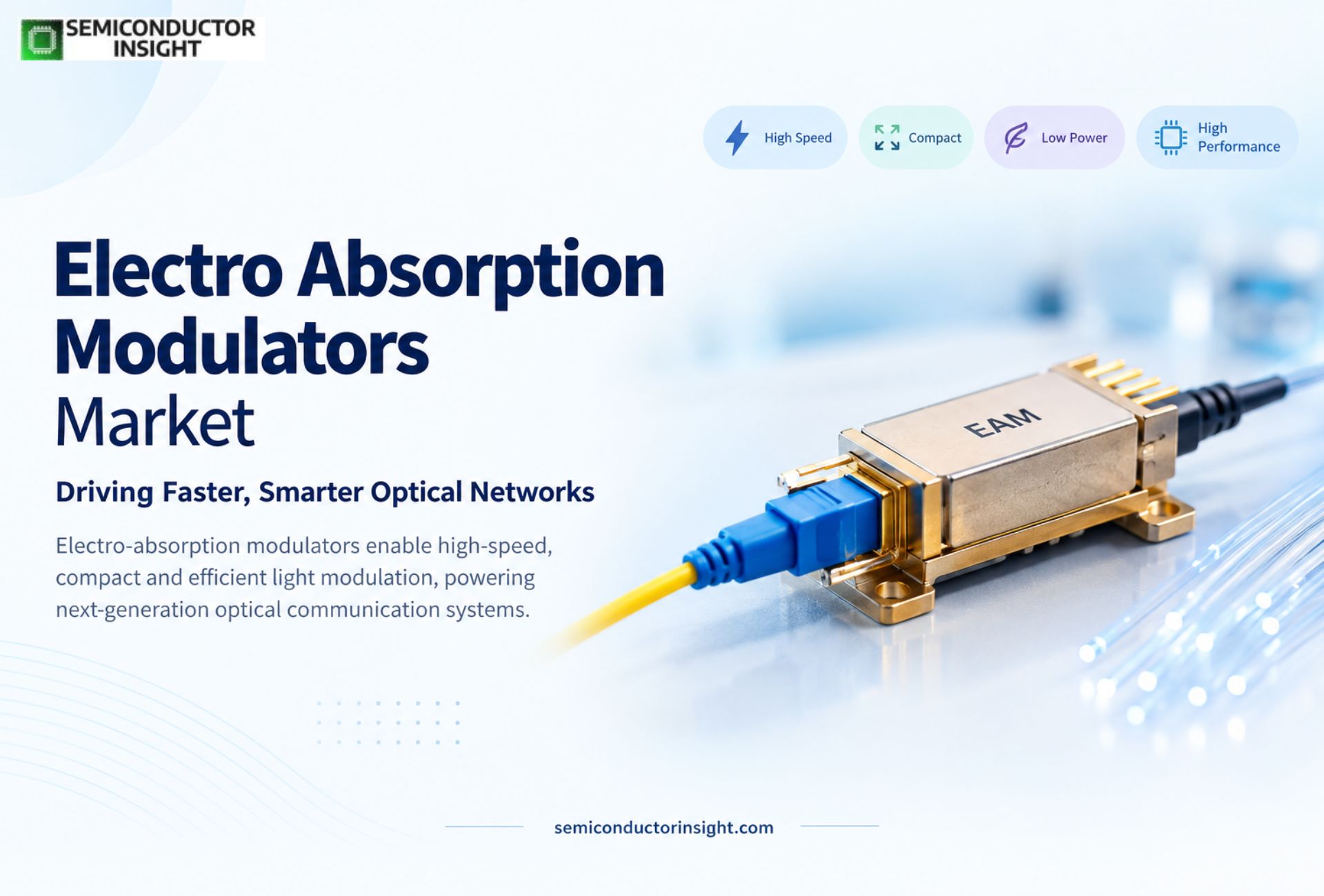
Electro-absorption modulators (EAMs) change the optical absorption of a semiconductor material under an applied electric field, enabling intensity modulation of light at high speeds with compact footprints and relatively low drive voltages. The technology underpins electro-absorption modulated lasers (EMLs) widely used in optical communication links.
- IQ modulators support complex multi-level formats for coherent systems, while NRZ modulators address simpler on-off or pulse-amplitude schemes. Indium-phosphide based devices set the performance benchmark for high-bandwidth operation, especially in metro and data-center environments, and continue to integrate with silicon photonics platforms. Gallium-arsenide based alternatives provide cost-effective options for moderate-speed needs. Optical communication remains the primary application domain, driven by the need for 400 Gbit/s and higher lane rates in cloud and 5G-related infrastructure.
- High-speed data transmission, quantum experiments, and related research create additional demand for precise, high-bandwidth modulation. Telecommunications operators, data-center operators, and research laboratories form the core end-user groups, each prioritising different combinations of speed, energy efficiency, and thermal stability. System-level integration ranges from discrete modulator packages to fully integrated photonic circuits that combine lasers, modulators, and waveguides on a single chip or hybrid assembly.
- Demonstrated electro-optic bandwidths for modern EAMs and EMLs commonly exceed 35 GHz and reach beyond 100 GHz in optimised structures. Laboratory and industrial reports have shown 3 dB bandwidths of approximately 41 GHz for multi-lane O-band EMLs targeting 53 GBaud PAM4 operation, while specialised Ge/Si and membrane InP designs have reported bandwidths above 110 GHz.
Single-lane data rates of 200 Gbit/s and higher have been achieved with PAM4 and higher-order formats, supporting aggregate transceiver capacities of 400 Gbit/s, 800 Gbit/s, and emerging 1.6 Tbit/s configurations. Operating wavelengths frequently centre on the O-band near 1310 nm for short-reach data-centre links, with multi-wavelength arrays spaced across lanes such as 1271 nm, 1291 nm, 1311 nm, and 1331 nm. Extinction ratios of several decibels to more than 8 dB are routinely obtained under practical drive voltages.
Device Architecture and Signal Pathway
A typical EML integrates a distributed-feedback laser section with an electro-absorption section on the same indium-phosphide substrate. Multiple quantum wells in the absorption region respond to reverse bias through the quantum-confined Stark effect, rapidly altering absorption and thereby modulating the optical output. Electrical drive signals, often in the range of 1-2 V peak-to-peak for advanced differential designs, control the absorption while the laser remains continuously biased. The modulated light is coupled into optical fibre either directly or through an integrated spot-size converter. In hybrid platforms the InP EAM is bonded or otherwise coupled to silicon waveguides, combining the high-speed absorption properties of III-V materials with the dense routing capability of silicon photonics.
Material and Bandwidth Realisations
Indium-phosphide platforms dominate high-speed demonstrations because of favourable band-gap engineering and high carrier mobility. Devices with travelling-wave or carefully optimised lumped electrodes have produced bandwidths of 50-106 GHz depending on length, termination, and parasitic control. Gallium-arsenide structures appear in cost-sensitive or moderate-bandwidth contexts.
Heterogeneous integration of InP modulators onto silicon waveguides has enabled transmission experiments at 256 Gbaud on-off keying and multi-level PAM formats exceeding 300 Gbit/s over hundreds of metres to several kilometres of single-mode fibre, meeting forward-error-correction thresholds with modest equalisation. Membrane-style lateral p-i-n designs further reduce capacitance, supporting bandwidths near 50 GHz even at elevated optical power levels.
You can freely browse our most recent updated report to learn more about it before scrolling further: https://semiconductorinsight.com/report/electro-absorption-modulators-market/
Recent High-Speed Demonstrations
At the Optical Fiber Communications Conference and related venues in 2024-2025, multiple groups presented EMLs and EAMs capable of 200 Gbit/s per lane and higher. One commercial development introduced a differential electro-absorption modulated laser aimed at 400 Gbit/s operation, reducing drive-voltage requirements and crosstalk through balanced signalling and on-chip termination.
Multi-channel arrays with channel spacings of a few hundred micrometres have achieved high aggregate bandwidth density while maintaining low crosstalk. Laboratory prototypes continue to push single-lane rates toward 340-450 Gbit/s using PAM4 or PAM6 under advanced equalisation and soft-decision forward-error correction. These results directly support the transition from 400 Gbit/s to 800 Gbit/s and 1.6 Tbit/s pluggable modules inside artificial-intelligence clusters and large-scale data centres.
Integration and Packaging Approaches
Discrete modulator packages remain relevant for flexible system design, while monolithic and hybrid photonic integrated circuits increase functional density and reduce optical interfaces. Co-packaging of electronic drivers with the photonic chip improves signal integrity and can lower overall energy per bit.
Temperature-stable designs that maintain bandwidth and extinction ratio from room temperature to 85 °C simplify thermal management in dense transceiver environments. Research continues into multi-wavelength arrays and co-integration with semiconductor optical amplifiers to boost output power without sacrificing modulation speed.
Electro-absorption modulators continue to advance the practical limits of intensity modulation for optical interconnects. From indium-phosphide EMLs delivering tens of gigahertz of bandwidth for 100 Gbit/s and 200 Gbit/s lanes to heterogeneous silicon-photonic assemblies supporting multi-hundred-gigabit transmission, the technology supplies the compact, high-speed building blocks required by contemporary optical communication systems.

Comments (0)