
Top Emerging Trends in Potentiometer Displacement Sensor Market for Robotics
Potentiometer Displacement Sensor Market reflects this balance between legacy engineering and modern application needs. Rather than being replaced, these sensors are being selectively integrated into systems where durability, linear response, and cost efficiency are critical.
In a world increasingly focused on digital sensors and contactless measurement, potentiometer displacement sensors continue to hold strong relevance. Their value lies not in novelty, but in reliability, simplicity, and predictable behavior under real operating conditions. Across industrial machinery, automotive systems, and motion-controlled equipment, these sensors remain a trusted solution where accurate position feedback is required without complex signal processing.
What Defines the Market Today’s World?
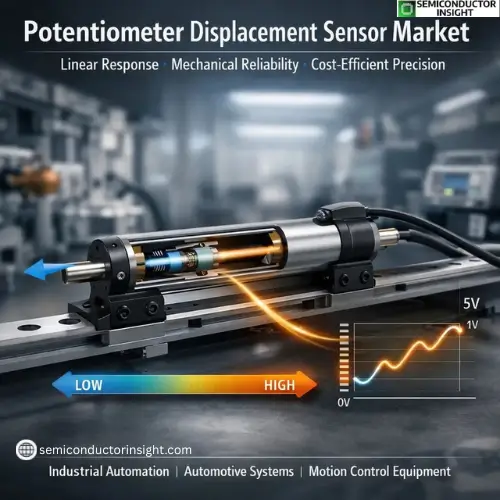
Potentiometer displacement sensors convert mechanical movement into an electrical signal through a resistive track and sliding contact. This straightforward principle delivers immediate, proportional output, making the technology highly transparent for engineers and system designers.
What keeps the market active is not just the sensing method, but how it aligns with practical deployment requirements such as ease of calibration, predictable failure modes, and compatibility with existing control architectures.
Flow of Value Creation in the Market
Mechanical Movement → Sensor Contact Interaction → Analog Signal Output → Controller Interpretation → Motion Adjustment or Monitoring
Recent Situations Reinforcing Market Relevance
Several recent industry developments have quietly reinforced the importance of potentiometer displacement sensors. During supply chain disruptions that affected advanced semiconductor components, manufacturers of industrial equipment turned back to proven analog sensing solutions to avoid production delays. Potentiometer sensors, with simpler manufacturing requirements and broader supplier availability, filled this gap effectively.
In another example, electric vehicle testing rigs and prototype development labs have increasingly used potentiometer displacement sensors for suspension travel measurement and pedal position tracking. Engineers value their immediate response and ease of replacement during rapid iteration cycles.
Industrial Automation: A Stable Demand Anchor
Factory automation remains one of the strongest demand contributors. Conveyor positioning, actuator feedback, and valve stroke measurement continue to rely on potentiometer sensors where environments are controlled and predictable.
Potentiometer displacement sensors continue to be used in heavy machinery and manufacturing equipment because, in contrast to optical or magnetic equivalents, they produce reliable results even in electrically loud situations.
Automotive and Mobility Applications Gaining Focus
The automotive sector has not abandoned potentiometer displacement sensors; instead, it has refined their use. Regulate position sensing, seat adjustment mechanisms, and suspension monitoring systems still deploy these sensors due to their compact size and dependable output characteristics.
By the rise of electric mobility, cost-optimized and easily validated components are preferred for non-critical motion feedback tasks. This trend supports steady market demand rather than rapid substitution.
Design Simplicity as a Competitive Advantage
One of the understated strengths of this market is design clarity. Engineers understand how potentiometer displacement sensors behave over time, how wear manifests, and how output drift can be managed. This transparency reduces risk during system certification and long-term maintenance planning.
For OEMs working under tight development timelines, this predictability often outweighs the appeal of newer sensing technologies.
You Can Go Through Our Latest Updated Insights Here:
https://semiconductorinsight.com/report/potentiometer-displacement-sensor-market/
Market Differentiation beyond Price
While the market is competitive, differentiation increasingly comes from mechanical design quality, material selection, and environmental resistance rather than pricing alone. Suppliers that offer improved wiper durability, sealed housings, and stable resistive tracks gain preference in demanding applications.
Customers are also placing more emphasis on lifecycle support, documentation quality, and customization options, especially for specialized equipment manufacturers.
Geographic Adoption Patterns
Industrialized regions with established automation ecosystems remain the largest consumers of potentiometer displacement sensors. However, emerging manufacturing hubs are steadily increasing adoption as local equipment builders prioritize proven technologies that minimize training and service complexity.
This geographic spread contributes to market resilience and predictable volume growth.
Integration with Modern Control Systems
Despite their analog nature, potentiometer displacement sensors integrate smoothly with digital controllers through standard signal conditioning modules. This compatibility allows them to coexist with advanced control software without requiring extensive redesign.
As a result, the sensors remain relevant even as overall system architectures evolve.
Steady, Practical, and Purpose-Driven
Potentiometer Displacement Sensor Market is characterized by ongoing relevance rather than quick disruption. Growth is anticipated to be steady due to improvements in industrial equipment, automation, and mobility systems.
Future demand will be shaped by:
- Continued emphasis on cost-effective precision
- Preference for easily serviceable components
- Stable demand from mature industrial sectors
Key Takeaway for Stakeholders
The aimed market rewards companies that focus on engineering reliability over novelty. Success lies in delivering sensors that perform consistently, integrate effortlessly, and withstand real-world operating conditions.
In a technology landscape often chasing innovation speed, potentiometer displacement sensors stand out by offering confidence and control.

Comments (0)