Potentiometer Displacement Sensor Market Insights
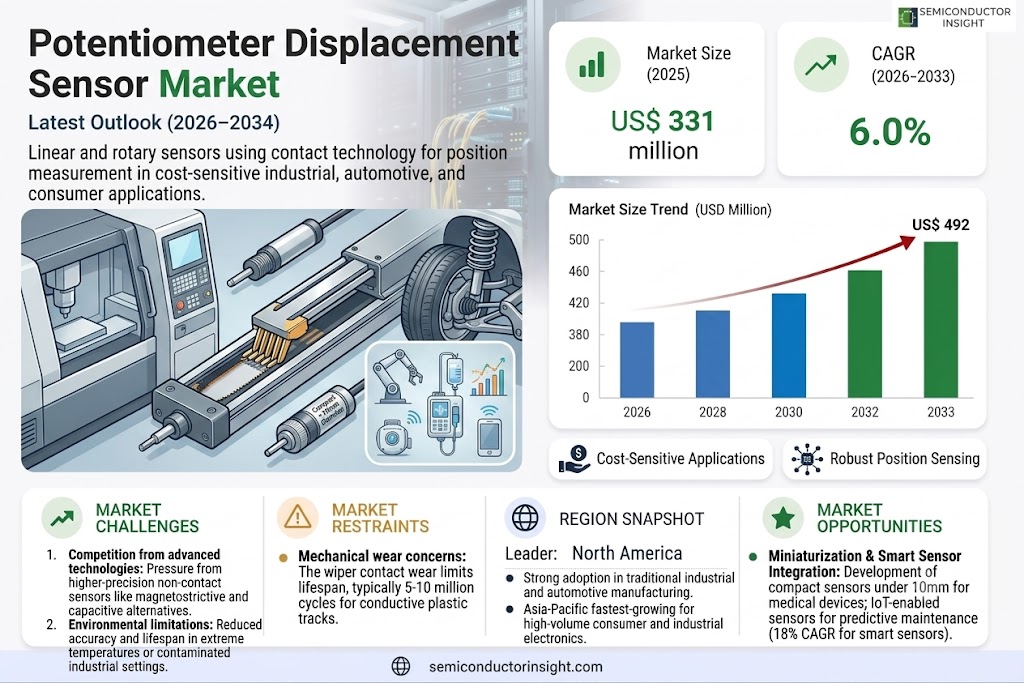
The global potentiometer displacement sensor market size was valued at USD 331 million in 2024. The market is projected to grow from USD 351 million in 2025 to USD 492 million by 2032, exhibiting a CAGR of 6.0% during the forecast period.
Potentiometer displacement sensors are precision measurement devices that detect linear or angular displacement through resistance variation. These sensors consist of a resistive track, sliding contact (wiper), and mechanical linkage that converts movement into electrical signals. Their simple yet robust design enables accurate position feedback in applications requiring cost-effective, reliable solutions with high repeatability.
The market growth is driven by increasing automation across industries, stringent quality control requirements in manufacturing, and rising demand for compact sensing solutions. Key players like TE Connectivity, Honeywell, and Panasonic are expanding their portfolios with miniaturized and IoT-enabled sensors. For instance, in Q1 2024, Bourns introduced a new series of high-temperature potentiometric sensors for automotive and industrial applications, addressing the need for durable components in harsh environments.
 MARKET DRIVERS
Growing Industrial Automation Adoption
The potentiometer displacement sensor market is experiencing growth due to increasing industrial automation across manufacturing sectors. These sensors provide precise linear or angular position measurements, making them essential for robotics, CNC machines, and automotive assembly lines. The global demand for automation solutions has grown by approximately 12% annually over the past five years.
Cost-Effective Measurement Solutions
Potentiometer displacement sensors offer a reliable, economical alternative to more expensive technologies like LVDTs or optical encoders. Their simple design and durability make them preferred for applications where high precision is needed but budgets are constrained. Over 65% of industrial applications requiring displacement measurement under 500mm utilize potentiometer-based solutions.
➤ The automotive sector accounts for nearly 40% of global potentiometer displacement sensor demand, driven by throttle position sensing and suspension monitoring applications.
As electric vehicle production increases, these sensors are being adapted for new applications in battery management systems and motor control, creating additional growth opportunities.
MARKET CHALLENGES
Competition from Advanced Sensor Technologies
The potentiometer displacement sensor market faces pressure from emerging technologies like magnetostrictive and capacitive sensors that offer higher precision and longer lifespans. While potentiometers dominate in cost-sensitive applications, they’re losing market share in high-performance segments where durability requirements exceed 10 million cycles.
Other Challenges
Environmental Limitations
Standard potentiometer displacement sensors show decreased accuracy in extreme temperatures or contaminated environments, limiting their use in aerospace and heavy industrial applications where conditions are harsh.
MARKET RESTRAINTS
Mechanical Wear Concerns
The primary restraint for potentiometer displacement sensors is mechanical wear of the wiper contact, which limits operational lifespan compared to non-contact alternatives. While conductive plastic formulations have improved durability, most models still have a maximum operational life of 5-10 million cycles in typical industrial applications.
MARKET OPPORTUNITIES
Miniaturization and Smart Sensor Integration
Development of compact potentiometer displacement sensors (under 10mm diameter) is creating new opportunities in medical devices and portable equipment. Integration with IoT capabilities allows these traditional sensors to provide predictive maintenance data, increasing their value proposition in Industry 4.0 applications. The smart sensor segment is projected to grow at 18% CAGR through 2030.
Potentiometer Displacement Sensor Market Trends
Steady Growth in Industrial Automation Drives Market Expansion
The global Potentiometer Displacement Sensor market, valued at $331 million in 2024, projects a steady 6.0% CAGR to reach $492 million by 2032. This growth is propelled by increasing automation across manufacturing sectors, where precision displacement measurement remains critical for quality control and process optimization.
Other Trends
Regional Market Dynamics
North America maintains strong adoption with the U.S. holding significant market share, while China emerges as the fastest-growing region. Europe shows stable demand, particularly from Germany’s automotive and aerospace sectors. Asia-Pacific growth is fueled by expanding electronics manufacturing and robotics industries.
Technological Advancements in Measurement Ranges
The <100mm range segment dominates current applications but sees increased competition from emerging non-contact alternatives. Meanwhile, 100-300mm sensors gain traction in industrial machinery, while >300mm variants find specialized uses in construction equipment and aerospace actuators. Leading manufacturers continue to improve linearity and durability across all ranges.
Key Players Maintain Market Concentration
TE Connectivity, Burster, and Nidec collectively hold substantial market share, with ongoing R&D investments focusing on miniaturization and enhanced environmental resistance. The competitive landscape remains consolidated, though regional specialists in Asia are gaining ground through cost-optimized solutions for emerging markets.
Application-Specific Demand Variations
Automotive applications account for 32% of market revenue, driven by throttle position sensing and suspension monitoring. The robotics segment shows the highest growth potential at 8.2% CAGR, while aerospace demand remains stable with stringent reliability requirements. Emerging applications in renewable energy systems present new opportunities for market expansion.
COMPETITIVE LANDSCAPE
Key Industry Players
Global leaders dominate with specialized manufacturers capturing niche segments
The potentiometer displacement sensor market is led by established global players such as TE Connectivity and Honeywell, which collectively hold significant market share through their diversified industrial portfolios. TE Connectivity leads with its robust R&D capabilities and extensive distribution networks across automotive and aerospace sectors. Market consolidation is evident with strategic acquisitions by manufacturers like Burster and Nidec to expand their measurement technology offerings. The top five players accounted for approximately 45% of 2024 global revenue, reflecting moderate concentration despite the presence of numerous regional competitors.
Specialized manufacturers like Teikoku Tsushin Kogyo and Micro-Epsilon thrive in precision applications with customized solutions, particularly in robotics and high-temperature environments. Asian players, including Panasonic and OMRON, are gaining traction through cost-competitive offerings for industrial automation. Emerging technological advancements in conductive plastic potentiometers by CTS Corporation and Bourns are reshaping competition in linear displacement measurement segments below 100mm, which is projected to grow at 6.8% CAGR through 2032.
List of Key Potentiometer Displacement Sensor Companies Profiled
- TE Connectivity
- Burster
- Nidec
- OMEGA
- Teikoku Tsushin Kogyo Co., Ltd.
- Gefran SpA
- Panasonic
- Bourns
- Vishay
- Honeywell
- CTS Corporation
- ZSY
- OMRON
- Micro-Epsilon
Segment Analysis:
| Segment Category | Sub-Segments | Key Insights |
| By Type |
|
Measuring Range Below 100mm
|
| By Application |
|
Automotive Industry
|
| By End User |
|
OEMs
|
| By Measurement Technology |
|
Linear Potentiometers
|
| By Price Segment |
|
Mid-range
|
Regional Analysis: Global Potentiometer Displacement Sensor Market
North America’s advanced manufacturing sector extensively utilizes potentiometer displacement sensors for precise position feedback in robotic systems and CNC machinery, driving continuous market growth.
The region’s aerospace industry employs high-precision displacement sensors extensively in aircraft control systems and landing gear mechanisms, creating steady demand for rugged potentiometer solutions.
Silicon Valley and other tech centers foster continuous innovation in potentiometer sensor technology, particularly in miniaturization and IoT integration for smart manufacturing applications.
Strict industrial measurement standards in North America compel manufacturers to adopt high-quality displacement sensors with potentiometric technology for compliance and precision requirements.
Europe
Europe maintains a strong position in the Potentiometer Displacement Sensor Market, with Germany’s precision engineering sector leading adoption. The region benefits from advanced automotive manufacturing that extensively uses displacement sensors for quality control and assembly automation. Environmental regulations drive innovation in energy-efficient sensor solutions. European manufacturers focus on developing long-lifecycle potentiometer sensors for harsh industrial environments, particularly in offshore energy applications. Collaborative research initiatives between universities and sensor companies foster continuous technological advancements in measurement accuracy.
Asia-Pacific
The Asia-Pacific region shows the fastest growth in potentiometer displacement sensor adoption, fueled by expanding manufacturing capabilities in China, Japan, and South Korea. Increasing automation in electronics production creates significant demand for cost-effective displacement measurement solutions. The region benefits from localized sensor production capabilities and growing investments in industrial IoT infrastructure. Emerging economies are adopting potentiometer sensors for basic automation needs, while mature markets focus on high-precision applications in semiconductor manufacturing and automotive testing.
South America
South America exhibits steady growth in the Potentiometer Displacement Sensor Market, primarily driven by mining and agriculture machinery applications. Brazil leads regional adoption with its growing automotive and aerospace industries. Economic fluctuations impact capital investments in industrial automation, but demand remains stable for essential displacement measurement in process control applications. Local manufacturers are developing rugged potentiometer solutions suitable for challenging environmental conditions prevalent in regional industries.
Middle East & Africa
The Middle East & Africa region shows niche opportunities in the Potentiometer Displacement Sensor Market, with oil & gas applications dominating demand. Precision measurement in drilling equipment and pipeline monitoring systems drives specialized sensor requirements. Infrastructure development projects create additional demand for displacement sensors in construction machinery. The region faces challenges in technical expertise availability but benefits from increasing partnerships with global sensor manufacturers establishing local service networks.
Report Scope
This market research report provides a comprehensive analysis of the Potentiometer Displacement Sensor Market, covering the forecast period 2024–2032. It offers detailed insights into market dynamics, technological advancements, competitive landscape, and key trends shaping the industry.
Key focus areas of the report include:
-
Market Overview: The report begins with an overview outlining its current market scenario, key growth indicators, and industry transformation drivers. It discusses macroeconomic factors, demand–supply balance, regulatory landscape, and the strategic role of displacement sensors in powering advancements across industries such as automotive, aerospace, robotics, and industrial automation.
- Market Size & Forecast: Historical data and future projections for revenue, unit shipments, and market value across major regions and segments.
- Segmentation Analysis: Detailed breakdown by product type (Measuring Range Below 100mm, 100-300mm, Above 300mm), application (Automotive Industry, Aerospace, Robot, Others), and end-user industry to identify high-growth segments and investment opportunities.
- Regional Insights: Insights into market performance across North America, Europe, Asia-Pacific, South America, and Middle East & Africa, including country-level analysis where relevant.
- Competitive Landscape: Profiles of leading market participants, including their product offerings, R&D focus, manufacturing capacity, pricing strategies, and recent developments such as mergers, acquisitions, and partnerships.
- Technology Trends & Innovation: Assessment of emerging technologies, integration of smart sensors, evolving industry standards, and performance requirements.
- Market Drivers & Restraints: Evaluation of factors driving market growth along with challenges, supply chain constraints, regulatory issues, and market-entry barriers.
- Stakeholder Insights: Insights for component suppliers, OEMs, system integrators, investors, and policymakers regarding the evolving ecosystem and strategic opportunities.
Primary and secondary research methods are employed, including interviews with industry experts, data from verified sources, and real-time market intelligence to ensure the accuracy and reliability of the insights presented.
FREQUENTLY ASKED QUESTIONS:
What is the current market size of Potentiometer Displacement Sensor Market?
-> The Global Potentiometer Displacement Sensor Market was valued at USD 331 million in 2024 and is expected to reach USD 492 million by 2032.
What is the expected growth rate (CAGR) of this market?
-> The market is projected to grow at a CAGR of 6.0% during 2024-2032.
Which key companies operate in Potentiometer Displacement Sensor Market?
-> Key players include TE Connectivity, Burster, Nidec, OMEGA, Teikoku Tsushin Kogyo Co., Ltd., Gefran SpA, Panasonic, Bourns, Vishay, Honeywell, CTS Corporation, ZSY, OMRON, and Micro-Epsilon, among others.
What are the major application areas?
-> Major applications include Automotive Industry, Aerospace, Robot technologies, and other industrial automation applications.
What are the key product segments?
-> The market is segmented by measuring range into Below 100mm, 100-300mm, and Above 300mm product categories.

Get Sample Report PDF for Exclusive Insights
Report Sample Includes
- Table of Contents
- List of Tables & Figures
- Charts, Research Methodology, and more...
 Download Sample Report PDF