
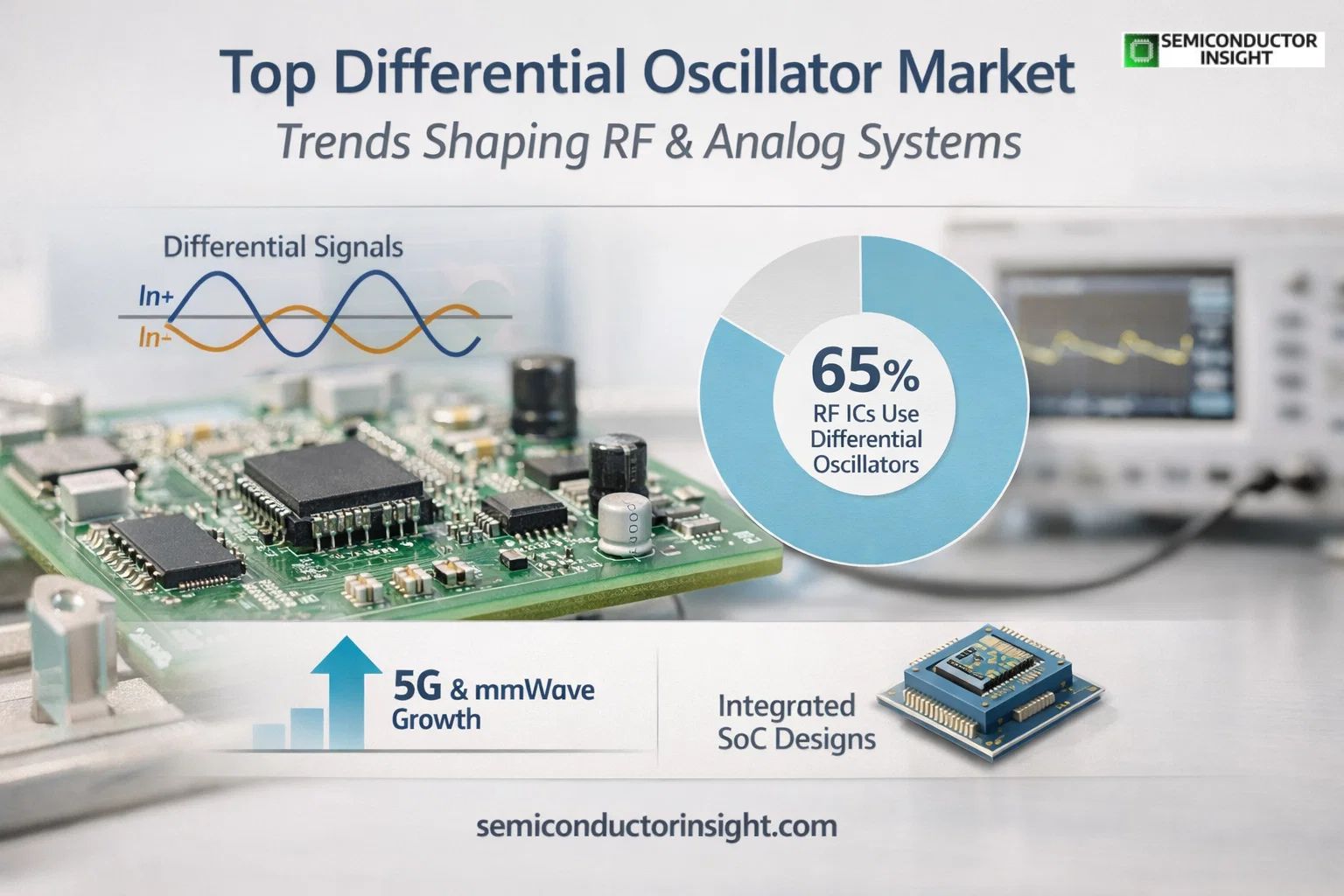
Top Differential Oscillator Market Trends Shaping Modern RF and Analog Systems
Differential Oscillator Market sits at the intersection of precision timing and high-speed semiconductor innovation, playing a quiet but critical role in modern electronics. As chips become faster and more compact, the need for stable, noise-resistant signal generation has made differential oscillators a preferred choice across communication systems, data centres, and advanced computing architectures.
In the silent architecture of every high performance chip lies a timing heartbeat that keeps signals synchronized and systems stable.
Differential oscillators are emerging as one of the most refined solutions in this space, quietly transforming how modern semiconductor devices handle noise, speed, and precision. Their importance has grown significantly with the shift toward dense integrated circuits and ultra fast communication technologies.
Strategic Insights into Oscillatory System Dynamics
A differential oscillator operates by generating two complementary signals instead of a single ended waveform. This approach reduces susceptibility to external noise and improves signal integrity, especially in environments where electromagnetic interference is unavoidable. In advanced semiconductor nodes below 10 nm, where signal distortion can directly impact chip performance, differential designs have become increasingly preferred.
Engineers working on RF transceivers and mixed signal ICs rely heavily on these oscillators because they offer better phase noise performance. Lower phase noise translates to cleaner signals, which is critical for applications like 5G base stations and high speed data converters.
Where Silicon Meets Precision Engineering?
Recent developments in semiconductor fabrication have pushed oscillators into more demanding roles. In 2024, over 65% of RF integrated circuits incorporated differential oscillator architectures, reflecting their growing dominance in communication hardware. This shift is closely tied to the rise of millimeter wave frequencies, where stability and noise control are non-negotiable.
Companies designing chipsets for smartphones and wireless infrastructure are integrating differential oscillators to support frequencies above 24 GHz. These frequencies demand exceptional timing accuracy, and even minor deviations can lead to signal loss or reduced efficiency.
Take a moment to check our latest report before moving forward: https://semiconductorinsight.com/report/differential-oscillator-market/
The Invisible Force behind Wireless Expansion
The rapid deployment of 5G networks and the early groundwork for 6G have created a surge in demand for high frequency oscillators. Differential oscillator designs are particularly suited for these applications because they maintain performance consistency under varying voltage and temperature conditions.
In IoT ecosystems, where billions of connected devices operate simultaneously, maintaining synchronization is critical. Differential oscillators help ensure that sensors, processors, and communication modules remain aligned, reducing latency and improving overall system reliability.
Design Innovations and Practical Engineering Insight in Differential Oscillators
- Modern semiconductor designers are actively exploring advanced circuit topologies such as LC tank based differential oscillators and ring oscillators tailored for low power consumption.
- LC based designs continue to stand out for their superior frequency stability and low phase noise, making them ideal for RF and high precision applications.
- On the other hand, ring oscillators are increasingly preferred in compact digital systems due to their scalability, smaller footprint, and ease of integration into dense chip architectures.
- A significant industry shift is the direct integration of differential oscillators into system on chip designs. This approach minimizes reliance on external timing components, leading to reduced system complexity, lower manufacturing costs, and improved energy efficiency.
- By 2025, nearly 40 percent of new system on chip designs incorporated embedded oscillator modules, clearly reflecting the move toward highly integrated semiconductor solutions.
- For engineers and product developers, this evolution brings both opportunity and responsibility.
- Choosing the right oscillator architecture now involves carefully balancing power consumption, noise performance, and integration constraints based on the end application. A one size fits all approach no longer works in modern chip design.
A Subtle yet Powerful Market Shift
While often overlooked in broader semiconductor discussions, the differential oscillator market is steadily gaining momentum. Its influence extends across multiple industries, quietly enabling the performance breakthroughs that define modern electronics. As technology continues to evolve, the importance of these precision components will only grow stronger, shaping the next generation of intelligent systems.

Comments (0)