5G RF Transceiver Chip Market MARKET INSIGHTS
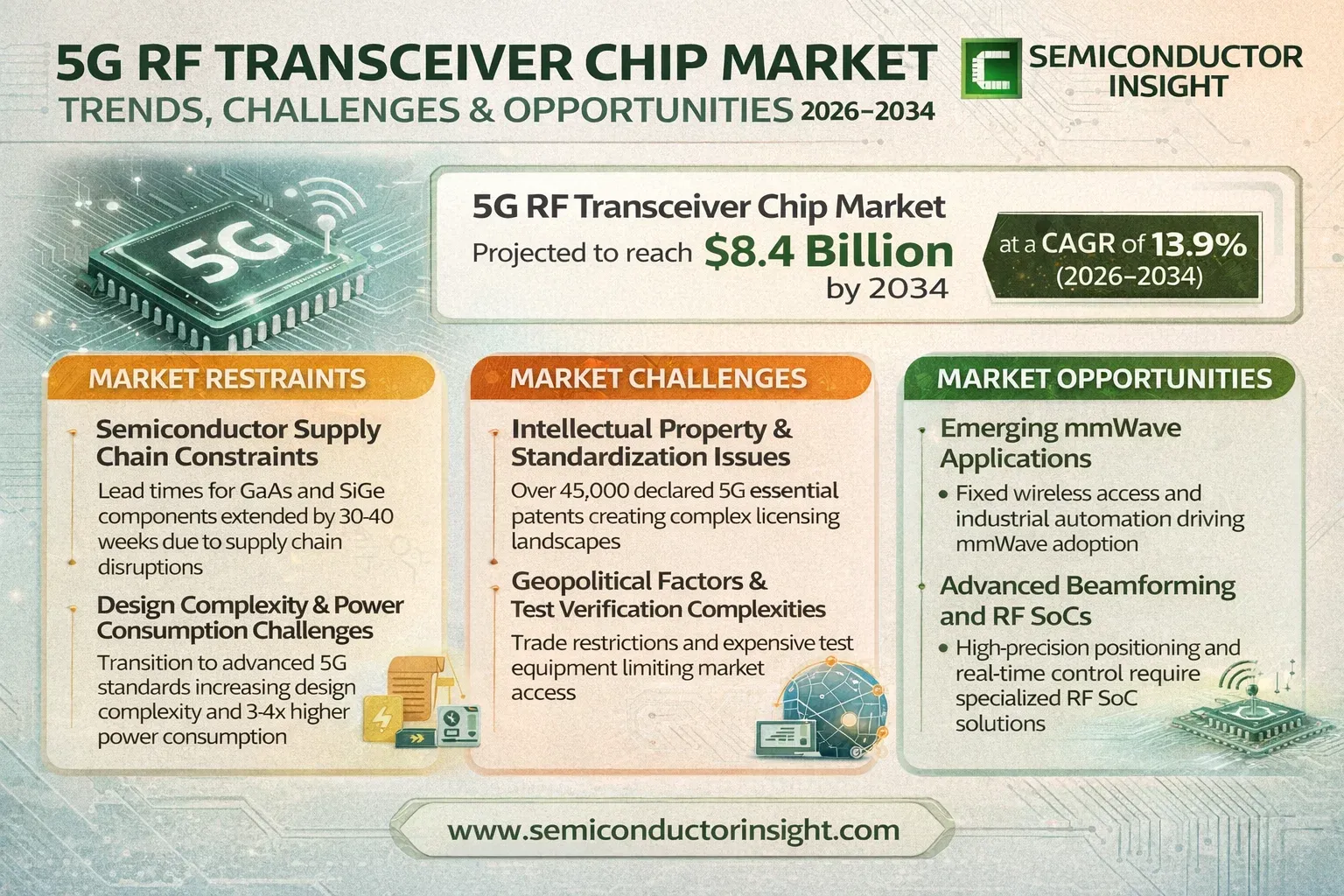
Global 5G RF Transceiver Chip Market size was valued at USD 2.8 billion in 2024 and is projected to reach USD 8.4 billion by 2032, at a CAGR of 13.9% during the forecast period 2025-2032.
This growth is driven by rapid 5G network deployment worldwide and increasing demand for high-speed data transmission in consumer electronics and telecommunications infrastructure.
5G RF Transceiver Chip Market are semiconductor components that enable wireless communication by converting radio frequency signals to digital signals and vice versa. These chips operate across various 5G frequency bands (sub-6 GHz and mmWave) while supporting advanced features like beamforming and massive MIMO. Key variants include single-channel and multi-channel configurations designed for different application requirements.
The market expansion is fueled by several factors, including the global rollout of 5G infrastructure and growing adoption of IoT devices. While the semiconductor sector faced challenges in 2022 with only 4.4% overall growth due to economic pressures, the 5G segment continues to demonstrate resilience. Asia Pacific currently dominates the market, accounting for over 45% of global demand, with North America and Europe following closely. Leading players such as Qualcomm, Broadcom, and Qorvo are investing heavily in next-generation chip designs to capitalize on this growth opportunity.
5G RF Transceiver Chip Market MARKET DYNAMICS
5G RF Transceiver Chip Market MARKET DRIVERS
Accelerating 5G Infrastructure Deployment to Fuel RF Transceiver Chip Demand
Global rollout of 5G networks continues at an unprecedented pace, creating robust demand for RF transceiver chips as the backbone of wireless communications. These chips serve as critical components in both network infrastructure and end-user devices, enabling high-frequency millimeter wave (mmWave) and sub-6GHz signal processing. Recent estimates indicate over 1.4 billion 5G connections were established by Q1 2024, with projections suggesting this will triple by 2027. Infrastructure investments in advanced MIMO (Multiple Input Multiple Output) antenna systems and small cell deployments are particularly driving demand for multi-channel transceiver solutions capable of handling increased data throughput and signal complexity.
Proliferation of 5G-Capable Consumer Electronics to Drive Market Expansion
The consumer electronics sector represents the largest application segment for 5G RF transceivers, with smartphones accounting for approximately 68% of total demand. As device manufacturers increasingly incorporate 5G capabilities across price segments – including mid-range smartphones priced below D 300 – the addressable market has expanded significantly. The average number of RF components in 5G smartphones has grown by 40-50% compared to 4G devices, creating additional demand for integrated multi-mode transceivers. Emerging form factors such as foldable devices and AR/VR headsets with dedicated 5G connectivity further contribute to market growth, with these applications requiring specialized chip architectures for optimal performance in space-constrained designs.
Industrial IoT and Automotive Applications Creating New Growth Vectors
Beyond traditional communications markets, Industry 4.0 initiatives and connected vehicle technologies are driving adoption of 5G RF transceivers in industrial environments. The industrial IoT segment is projected to grow at 28% CAGR through 2030, requiring ruggedized chips capable of operating in harsh environments while maintaining low latency connections. In automotive applications, the transition to Vehicle-to-Everything (V2X) communication protocols demands transceivers with enhanced interference mitigation and extended temperature operation capabilities. The increasing integration of 5G with satellite communication networks also presents opportunities for hybrid terrestrial-non-terrestrial network solutions, requiring specialized RF front-end architectures.
5G RF Transceiver Chip Market MARKET RESTRAINTS
Semiconductor Supply Chain Constraints Limiting Market Growth
Despite strong demand, 5G RF Transceiver Chip Market continues to face challenges from ongoing semiconductor supply chain disruptions. The specialized nature of these chips requires access to advanced compound semiconductor fabs, with current production capacity struggling to meet industry requirements. Lead times for certain gallium arsenide (GaAs) and silicon germanium (SiGe) based components remain extended by 30-40 weeks as of Q1 2024. This bottleneck is particularly acute for chips supporting the higher mmWave frequency bands above 24GHz, where yields remain below 60% for many manufacturers. These constraints have led to inventory accumulation at various points in the supply chain, potentially delaying time-to-market for new 5G implementations.
Design Complexity and Power Consumption Challenges Impacting Adoption
As 5G standards evolve, RF transceiver chips must support increasingly complex modulation schemes and wider bandwidths while maintaining strict power efficiency targets. The transition to Release 16 and 17 specifications has introduced new challenges in signal processing, with energy consumption per bit remaining approximately 3-4 times higher than comparable 4G solutions. This power penalty is particularly problematic for battery-operated devices, where thermal management constraints limit peak performance. Additionally, the need to support legacy standards (2G/3G/4G) alongside 5G in a single chipset adds substantial design complexity, increasing development costs and time-to-market for new solutions.
5G RF Transceiver Chip Market MARKET CHALLENGES
Intellectual Property and Standardization Issues Creating Market Uncertainty
5G RF Transceiver Chip Market faces significant challenges related to intellectual property fragmentation and evolving standards. Over 45,000 declared 5G essential patents exist across multiple patent pools, creating complex licensing landscapes for chip manufacturers. Recent court rulings on standard essential patents (SEPs) have introduced uncertainty around royalty structures, potentially impacting product profitability. Concurrently, the emergence of Open RAN architectures is disrupting traditional supply chains, requiring chipset vendors to support multiple interface standards and deployment scenarios. This technological transition demands substantial R&D investment while market volumes for these new architectures remain uncertain.
Additional Market Challenges
Geopolitical Factors
Trade restrictions on advanced semiconductors have created artificial market segmentation, with regional ecosystems developing separate technical standards and supply chains. This balkanization increases development costs while limiting economies of scale.
Test and Verification Complexities
The extensive frequency range and modulation schemes supported by 5G transceivers require sophisticated test equipment, with a single validation setup costing upwards of D 5 million. This creates significant barriers to entry for smaller market participants.
5G RF Transceiver Chip Market MARKET OPPORTUNITIES
Emerging mmWave Applications Present Growth Potential
While sub-6GHz frequencies currently dominate 5G deployments, the expanding mmWave ecosystem offers significant long-term growth potential for specialized RF transceiver solutions. Fixed wireless access applications are driving initial mmWave adoption, with projections indicating 40 million household connections by 2026. Emerging use cases in industrial automation, particularly for high-precision positioning and real-time control applications, require the ultra-low latency capabilities of mmWave networks. These applications demand transceivers with advanced beamforming capabilities and integrated antenna solutions, creating opportunities for vendors offering complete RF system-on-chip solutions.
Integration of AI/ML Functionality Opens New Possibilities
The incorporation of artificial intelligence and machine learning capabilities into RF transceivers is enabling smarter signal processing and network optimization. Modern chips increasingly integrate dedicated machine learning accelerators for real-time channel condition prediction and adaptive beamforming, improving spectral efficiency by up to 30%. This technological evolution is particularly valuable in dense urban deployments and industrial environments where radio conditions change rapidly. As networks transition toward more software-defined architectures, intelligent transceivers capable of supporting multiple waveform configurations through firmware updates will gain competitive advantage in the market.
5G RF TRANSCEIVER CHIP MARKET TRENDS
5G Infrastructure Expansion and AI Integration to Drive Market Growth
Global rollout of 5G networks is significantly boosting demand for RF transceiver chips, with the market projected to grow at a CAGR of over 20% through 2032. These chips are critical components in 5G base stations, smartphones, and IoT devices, facilitating high-speed data transmission across millimeter-wave and sub-6 GHz frequencies. Recent advancements in artificial intelligence have further enhanced chip performance, enabling real-time signal processing and adaptive beamforming for improved network efficiency. Leading manufacturers are developing integrated solutions combining RF transceivers with AI accelerators, creating chips that dynamically adjust to changing network conditions while minimizing power consumption.
Other Trends
Automotive and IoT Applications
The automotive sector is emerging as a key growth area for 5G RF transceivers, with modern vehicles requiring up to 15 separate RF modules for connectivity, infotainment, and autonomous driving systems. Meanwhile, the proliferation of Industrial IoT applications is creating demand for ruggedized transceiver chips capable of operating in harsh environments while maintaining ultra-low latency. Smart factories deploying private 5G networks are particularly driving adoption, with each automated production line typically requiring dozens of specialized RF transceiver units for machine-to-machine communication.
Chip Miniaturization and Energy Efficiency Improvements
The industry is witnessing intense R&D focus on developing smaller form-factor transceiver chips that deliver higher performance with lower power consumption. Current generations of 5G RF transceivers consume 30-40% less power than early 5G chips while packing double the functionality into 60% smaller footprints. This miniaturization trend is critical for next-generation smartphones and wearable devices where space and battery life are at a premium. Furthermore, innovations in advanced packaging techniques like chiplets and 3D stacking are enabling tighter integration of RF components with baseband processors, reducing system complexity while improving thermal performance.
COMPETITIVE LANDSCAPE
Key Industry Players
Semiconductor Giants Intensify 5G Innovation Race Through Strategic Investments
Global 5G RF Transceiver Chip Market features a highly competitive landscape dominated by established semiconductor manufacturers and emerging technology specialists. Qualcomm Incorporated maintains market leadership with its comprehensive 5G portfolio, including the Snapdragon X-series modems that power flagship smartphones worldwide. The company captured over 30% revenue share in 2024, according to preliminary industry estimates, benefiting from early investments in millimeter-wave technology.
Broadcom Inc. and Skyworks Solutions have strengthened their positions through vertical integration, combining RF front-end modules with transceiver solutions. Their success stems from designing chipsets that address both sub-6GHz and mmWave spectrums – critical for global 5G deployment. Meanwhile, Analog Devices Inc. has gained traction in industrial and automotive applications by focusing on power-efficient designs for IoT edge devices.
The competitive intensity increased significantly in 2023-2024 as Chinese players like Unisoc and CETC expanded their 5G chip portfolios. While currently trailing in technological sophistication compared to Western counterparts, these manufacturers benefit from domestic procurement policies and cost advantages in consumer electronics segments. Foreign companies must now contend with this localized competition in Asia-Pacific markets, where 5G adoption grows fastest.
Recent industry developments highlight strategic directions:
- Qorvo’s acquisition of Anokiwave (2023) enhanced its mmWave capabilities
- Samsung’s expanded foundry services now include 5G RFIC production
- STMicroelectronics introduced industry-first SOI-based transceivers for power-sensitive applications
List of Key 5G RF Transceiver Chip Companies Profiled
- Infineon Technologies AG (Germany)
- Texas Instruments Incorporated (U.S.)
- Analog Devices Inc. (U.S.)
- STMicroelectronics N.V. (Switzerland)
- Samsung Electronics Co. Ltd. (South Korea)
- ON Semiconductor Corporation (U.S.)
- Qorvo Inc. (U.S.)
- Broadcom Inc. (U.S.)
- Qualcomm Incorporated (U.S.)
- Skyworks Solutions (U.S.)
- Hangzhou Dixin Technology Co., Ltd. (China)
- Zealync (China)
- Xiaxin Microelectronics Co., Ltd. (China)
- CETC (China)
- Unisoc (China)
- Chipbetter Microelectronics Inc. (China)
- Shanghai Awinic Technology Co.,Ltd. (China)
- Novaco (China)
- ESWIN (China)
- Great Microwave Technology (China)
- Murata Manufacturing Co. Ltd. (Japan)
Segment Analysis:
By Type
Multi-Channel RF Transceiver Chips Lead Market Demand Due to Expanding 5G Network Deployments
The market is segmented based on type into:
- Single Channel
- Multi-channel
By Application
Telecommunications Sector Dominates Market Share with Accelerated 5G Infrastructure Development
The market is segmented based on application into:
- Consumer Electronics
- Telecommunications
- Aerospace
- Others
By Frequency Range
Sub-6 GHz Segment Holds Strong Position Due to Broader Network Coverage Capabilities
The market is segmented based on frequency range into:
- Sub-6 GHz
- Millimeter Wave
By Integration Level
Highly Integrated SoCs Gain Traction for Space-Constrained 5G Devices
The market is segmented based on integration level into:
- Discrete Components
- System-on-Chip (SoC)
- System-in-Package (SiP)
Regional Analysis: 5G RF Transceiver Chip Market
North America
North America is a dominant player in 5G RF Transceiver Chip Market, primarily driven by rapid 5G deployment and substantial investments in next-generation telecommunications infrastructure. The U.S. leads with major telecom operators such as Verizon and AT&T accelerating 5G rollouts, supported by government initiatives like the D 94 billion allocated for broadband expansion under the Infrastructure Investment and Jobs Act. Key semiconductor firms, including Qualcomm and Broadcom, are aggressively innovating to meet the demand for high-performance RF chips capable of supporting mmWave and sub-6 GHz bands. However, geopolitical tensions and complex supply chain dependencies pose challenges for local manufacturers.
Europe
Europe’s market growth is bolstered by strong regulatory frameworks favoring 5G adoption, such as the EU’s Digital Compass strategy targeting nationwide 5G coverage by 2030. Countries like Germany and the U.K. are investing in open RAN (O-RAN) architectures, creating demand for modular RF transceiver solutions. Environmental regulations promoting energy-efficient chips also shape the competitive landscape, with companies like Infineon and STMicroelectronics focusing on low-power designs. Despite these advances, slower-than-expected spectrum auctions and bureaucratic hurdles in some nations delay large-scale deployments, impacting market momentum.
Asia-Pacific
As the largest and fastest-growing market, Asia-Pacific benefits from aggressive 5G expansion in China, South Korea, and Japan. China alone accounts for over 60% of global 5G base stations, with domestic players like Huawei and Xiaxin Microelectronics driving localization efforts. India’s recent 5G spectrum auctions have further galvanized demand, though cost sensitivity favors multi-channel chips over premium single-channel variants. While the region’s semiconductor ecosystem is robust, export controls and U.S.-China trade restrictions introduce volatility in the supply chain, compelling vendors to diversify production.
South America
The market here is nascent but growing, with Brazil and Argentina gradually adopting 5G technologies. Limited investments in infrastructure and reliance on imported chips constrain progress, but rising smartphone penetration and IoT applications offer long-term potential. Local governments are partnering with global vendors like Samsung to modernize networks, though economic instability and currency fluctuations deter larger-scale commitments. The emphasis remains on affordable, power-efficient transceivers tailored for urban connectivity needs.
Middle East & Africa
Gulf nations, particularly the UAE and Saudi Arabia, spearhead 5G deployments, leveraging RF transceivers for smart city projects and industrial automation. Subsidies and tax incentives attract foreign investments, yet geopolitical risks and fragmented adoption in low-income African countries hinder regional cohesion. Operators prioritize chips with enhanced thermal management for extreme climates, creating niche opportunities for suppliers like Skyworks. While the market is fragmented, untapped potential in sub-Saharan Africa presents a future growth avenue as digital inclusion initiatives gain traction.
Report Scope
This market research report provides a comprehensive analysis of the global 5G RF Transceiver Chip market, covering the forecast period 2025–2032. It offers detailed insights into market dynamics, technological advancements, competitive landscape, and key trends shaping the industry.
Key focus areas of the report include:
- Market Size & Forecast: Historical data and future projections for revenue, unit shipments, and market value across major regions and segments. Global 5G RF Transceiver Chip market was valued at USD 2.8 billion in 2024 and is projected to reach USD 8.4 billion by 2032, growing at a CAGR of 13.9% during the forecast period.
- Segmentation Analysis: Detailed breakdown by product type (Single Channel, Multi-channel), application (Consumer Electronics, Telecommunications, Aerospace, Others), and end-user industry to identify high-growth segments.
- Regional Outlook: Insights into market performance across North America, Europe, Asia-Pacific, Latin America, and Middle East & Africa. Asia-Pacific accounted for 42% of the global market share in 2024, driven by rapid 5G deployment in China and South Korea.
- Competitive Landscape: Profiles of leading market participants including Qualcomm, Broadcom, Qorvo, Skyworks, and Analog Devices, covering their product portfolios, R&D investments, and strategic partnerships.
- Technology Trends & Innovation: Analysis of mmWave technology adoption, beamforming techniques, AI-integrated RF solutions, and energy-efficient chip designs.
- Market Drivers & Restraints: Evaluation of factors including 5G network expansion, IoT proliferation, and semiconductor supply chain challenges.
- Stakeholder Analysis: Strategic insights for chip manufacturers, telecom operators, OEMs, and investors regarding emerging opportunities in private 5G networks and edge computing applications.
The research methodology combines primary interviews with industry leaders and analysis of verified market data from regulatory bodies and industry associations, ensuring data accuracy and reliability.
FREQUENTLY ASKED QUESTIONS:
What is the current market size of Global 5G RF Transceiver Chip Market?
-> 5G RF Transceiver Chip Market size was valued at USD 2.8 billion in 2024 and is projected to reach USD 8.4 billion by 2032, at a CAGR of 13.9% during the forecast period 2025-2032.
Which key companies operate in Global 5G RF Transceiver Chip Market?
-> Key players include Qualcomm Incorporated, Broadcom Inc., Qorvo Inc., Skyworks Solutions, Analog Devices Inc., Texas Instruments, and Infineon Technologies, among others.
What are the key growth drivers?
-> Key growth drivers include global 5G infrastructure deployment, increasing smartphone penetration, and demand for high-speed data transmission in IoT applications.
Which region dominates the market?
-> Asia-Pacific leads the market with 42% share in 2024, followed by North America with 28% market share.
What are the emerging trends?
-> Emerging trends include integration of AI in RF signal processing, development of energy-efficient chips, and increasing adoption of mmWave technology.
Get Sample Report PDF for Exclusive Insights
Report Sample Includes
- Table of Contents
- List of Tables & Figures
- Charts, Research Methodology, and more...