
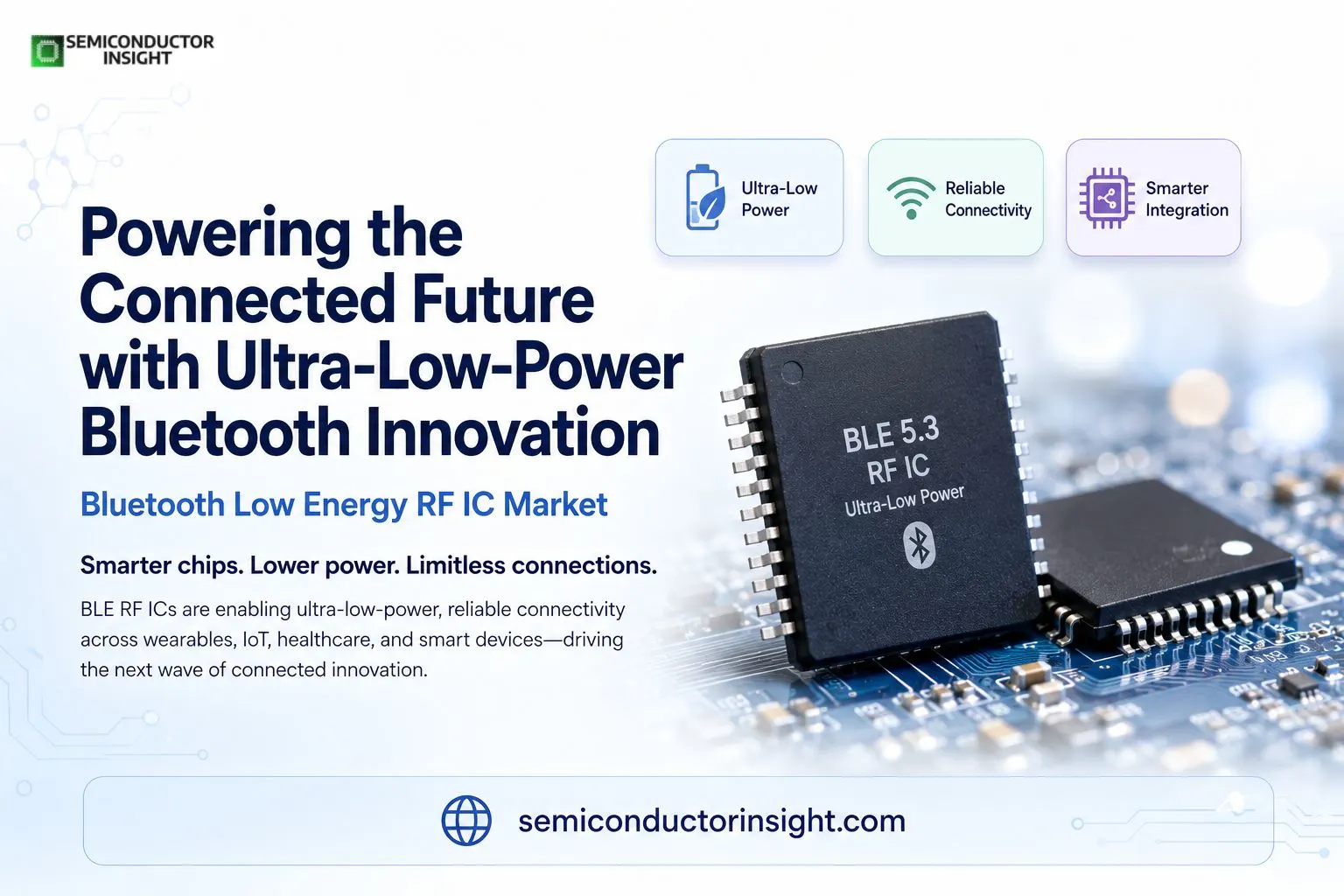
Top Bluetooth Low Energy RF IC Market Developments Influencing Edge AI Semiconductor Designs
Bluetooth Low Energy RF IC market is entering a new phase of semiconductor innovation as ultra-low-power wireless connectivity becomes essential across wearable, industrial sensors, medical electronics, smart retail systems, and edge AI devices. BLE RF ICs are designed to maximise battery life while retaining robust short-range connectivity in tiny electronic devices, in contrast to traditional wireless chips that are primarily intended for high-speed communication. BLE RF integrated circuits are at the core of next-generation semiconductor design methods because of this compromise between energy efficiency and continuous connectivity.
Recent advancements in Bluetooth specifications, including enhanced channel sounding, improved ranging accuracy, and low-latency audio capabilities, are rapidly expanding the functional scope of BLE semiconductor platforms. Semiconductor developers are increasingly integrating RF front-end modules, AI accelerators, power management systems, and multi-protocol support into single-chip architectures to reduce device size and improve energy optimisation.
According to the Bluetooth SIG, global Bluetooth-enabled device shipments are expected to exceed 8 billion units by the end of the decade, reflecting the growing importance of BLE semiconductor ecosystems in connected electronics.
Wearable Electronics: Turning BLE RF ICs into Core Semiconductor Components
- Wearable electronics have become one of the strongest commercial foundations for Bluetooth Low Energy RF IC deployment.
- Smartwatches, fitness bands, smart rings, hearing devices, and wireless earbuds now require highly compact RF chips capable of maintaining stable communication while operating for days or weeks on miniature batteries.
- Manufacturers are aggressively focusing on ultra-low-power semiconductor architectures to support next-generation wearable designs.
In 2026, ROHM Semiconductor introduced compact wireless power chipset solutions for smart rings and wearable products integrating Bluetooth Low Energy communication alongside NFC charging functionality.
- These developments highlight how BLE RF ICs are becoming tightly integrated with sensing, wireless charging, and biometric monitoring technologies within advanced wearable systems.
- The demand for miniaturised connectivity is also encouraging semiconductor companies to move toward multi-functional system-on-chip designs where RF communication, sensing interfaces, and embedded processing units operate within highly compact footprints.
- This integration reduces board space requirements while improving thermal efficiency and extending device battery performance.
Edge AI and BLE Semiconductor Integration Redefining Smart Devices
A major transformation within the Bluetooth Low Energy RF IC market is the growing convergence between wireless communication and edge artificial intelligence. Semiconductor manufacturers are no longer developing BLE chips solely for connectivity purposes; they are increasingly designing platforms capable of supporting local data processing, contextual sensing, and intelligent device interactions.
At major semiconductor events in 2026, companies including Nordic Semiconductor introduced BLE-enabled wireless chips integrating edge AI functionality for industrial IoT systems, wearables, and low-power sensors. These semiconductor solutions are enabling devices to process environmental and behavioural data locally instead of relying entirely on cloud-based infrastructure.
This architectural shift is especially important for healthcare monitoring systems, predictive maintenance sensors, and intelligent retail tracking platforms where power consumption and latency directly affect operational efficiency. BLE RF ICs capable of supporting localised analytics are becoming increasingly valuable for semiconductor manufacturers targeting scalable IoT deployments.
For additional report info, feel free to view our most recent edition: https://semiconductorinsight.com/report/bluetooth-low-energy-rf-ic-market/
Semiconductor Packaging Evolution Supporting Smaller BLE Architectures
- Bluetooth Low Energy RF IC market is also benefiting from rapid improvements in semiconductor packaging technologies. Compact wearable products and sensor nodes require semiconductor packages that deliver high RF performance while minimising energy leakage and physical footprint.
- Wafer-level chip-scale packaging and advanced substrate technologies are increasingly being adopted to improve signal integrity and thermal management in BLE semiconductor platforms. Semiconductor engineers are prioritising package optimisation because even minor reductions in power loss can significantly extend battery performance in ultra-compact connected devices.
- Modern BLE RF ICs are now appearing in electronic shelf labels, industrial beacons, medical patches, and asset-tracking devices where long operational life is commercially critical. According to recent semiconductor and wireless technology observations, billions of IoT endpoints globally are now dependent on low-energy wireless semiconductor architectures for continuous operation across logistics, healthcare, and automation environments.
Medical Electronics Creating New Semiconductor Opportunities
Healthcare electronics are rapidly becoming one of the most technically advanced application areas for Bluetooth Low Energy RF ICs. Remote patient monitoring systems, wearable glucose monitors, biosensors, and portable diagnostic devices increasingly require semiconductor solutions capable of secure, low-power wireless communication.
- Recent academic research evaluating BLE communication for ingestible medical electronics demonstrated that properly configured BLE architectures can achieve lower power consumption and reduced latency compared to certain sub-GHz communication systems in healthcare sensing applications.
- This finding is particularly important as semiconductor companies explore next-generation biomedical devices designed for long-duration internal and wearable monitoring.
Hospitals and healthcare technology developers are increasingly prioritising RF semiconductor solutions that support real-time monitoring while maintaining extended operational efficiency. BLE RF ICs are therefore becoming foundational semiconductor components within connected healthcare ecosystems focused on mobility, patient comfort, and continuous diagnostics.

Comments (0)