MARKET INSIGHTS
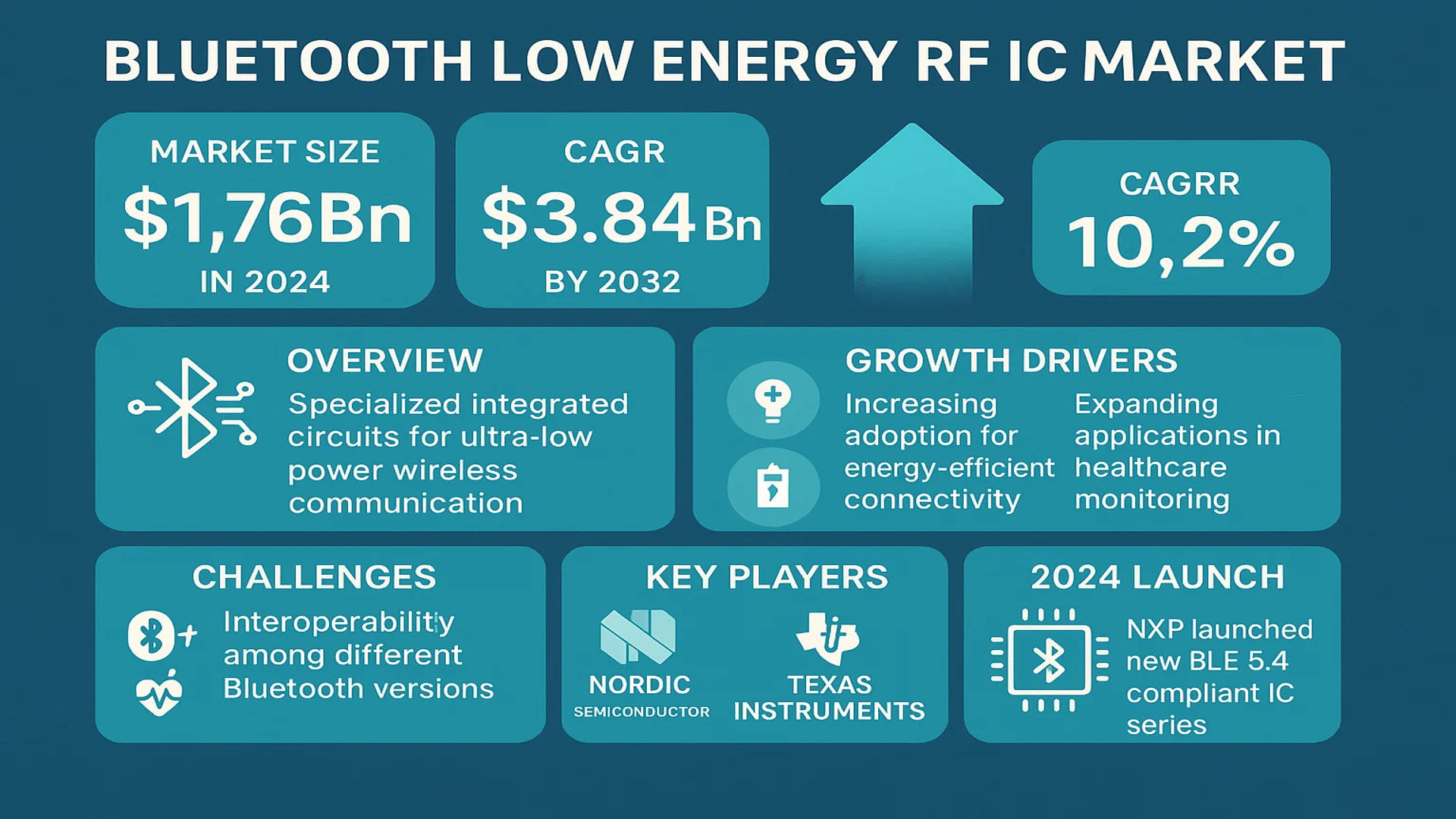
The global Bluetooth Low Energy RF IC Market size was valued at US$ 1.76 billion in 2024 and is projected to reach US$ 3.84 billion by 2032, at a CAGR of 10.2% during the forecast period 2025-2032.
Bluetooth Low Energy RF ICs are specialized integrated circuits designed for ultra-low power wireless communication. These chips enable efficient data transmission in IoT devices, wearables, and smart home systems while consuming minimal energy. The technology supports protocols including Bluetooth 4.0, 5.0, and the latest 5.x versions, offering features like mesh networking, improved range, and faster data transfer speeds.
The market growth is driven by increasing adoption of IoT devices, rising demand for energy-efficient connectivity solutions, and expanding applications in healthcare monitoring systems. However, challenges persist with interoperability issues among different Bluetooth versions. Key players like Nordic Semiconductor and Texas Instruments are investing heavily in advanced BLE chips with enhanced security features and lower power consumption. For instance, in Q1 2024, NXP launched its new BLE 5.4-compliant IC series specifically designed for industrial IoT applications.
MARKET DYNAMICS
MARKET DRIVERS
Proliferation of IoT and Wearable Devices Accelerating Market Adoption
The exponential growth of IoT-connected devices is fueling demand for Bluetooth Low Energy (BLE) RF ICs. With over 15 billion IoT devices projected to be operational globally by 2024, BLE’s power efficiency makes it the protocol of choice for battery-operated devices. Healthcare wearables alone are expected to account for 25% of all BLE IC shipments this year, as continuous patient monitoring solutions gain FDA approvals. Major semiconductor manufacturers have reported 40% year-over-year growth in BLE IC orders from wearable OEMs, indicating strong market traction.
Automotive Digital Transformation Creating New Integration Opportunities
Modern vehicle architectures increasingly incorporate BLE for keyless entry systems, tire pressure monitoring, and infotainment interfaces. The automotive sector’s adoption of BLE 5.x technologies has grown by 35% annually since 2022, as automakers seek to replace traditional RF solutions with more energy-efficient alternatives. This trend is particularly pronounced in electric vehicles, where energy optimization directly impacts range – leading some manufacturers to report 60-70% adoption rates for BLE ICs in new EV models.
➤ The implementation of Bluetooth 5.2 in 90% of new smart home devices demonstrates the protocol’s dominance in residential automation ecosystems.
Additionally, government mandates for vehicular connectivity standards in major markets are creating regulatory tailwinds. These developments, combined with the automotive industry’s shift toward software-defined architectures, position BLE RF ICs as critical components in next-generation mobility solutions.
MARKET RESTRAINTS
RF Interference Challenges in Dense Connectivity Environments
While BLE’s popularity grows, the increasing density of 2.4 GHz spectrum devices creates significant interference challenges. Industrial IoT deployments report 15-20% packet loss rates in high-density environments, forcing enterprises to implement costly mitigation strategies. This technical limitation becomes particularly problematic in smart manufacturing applications where reliable connectivity is mission-critical. The issue compounds as more devices adopt Bluetooth 5.x’s extended range capabilities, inadvertently increasing cross-channel interference potential.
Complex Certification Processes Slowing Time-to-Market
The Bluetooth SIG’s stringent certification requirements pose another barrier to market expansion. Recent data shows certification cycles for new BLE IC designs average 14-18 weeks, with 30% of submissions requiring multiple iterations. This extended validation period creates bottlenecks for product developers, particularly startups operating with compressed development timelines. The situation is further complicated by regional regulatory variations, with some markets requiring additional spectrum compliance testing beyond Bluetooth SIG approval.
MARKET CHALLENGES
Security Vulnerabilities in Legacy Implementations
Despite protocol improvements, security remains a persistent challenge for BLE deployments. Researchers have identified 12 new vulnerability classes in BLE implementations since 2022, primarily affecting devices running pre-5.0 specifications. The healthcare sector reports that 40% of medical wearables remain vulnerable to known Bluetooth exploits, creating substantial remediation costs for healthcare providers. These security concerns are slowing adoption in regulated industries where data protection requirements are stringent.
Other Challenges
Supply Chain Constraints
The semiconductor industry’s ongoing capacity challenges have particularly impacted BLE RF IC availability, with lead times stretching to 26-30 weeks for some configurations. This scarcity affects smaller OEMs disproportionately, as large manufacturers secure priority allocations through long-term contracts.
Power Optimization Trade-offs
While BLE excels in energy efficiency, achieving optimal power performance often requires sacrificing either range or data throughput. Product designers report that balancing these parameters adds 20-25% to development cycles as they iterate through hardware/software configurations.
MARKET OPPORTUNITIES
Emerging Asset Tracking Applications Creating New Demand Vertical
The logistics industry’s digital transformation is driving innovative use cases for BLE technology. Real-time location systems (RTLS) leveraging Bluetooth 5.1’s direction finding capability are achieving sub-meter accuracy in warehouse environments, creating a $800 million market segment for specialized BLE ICs. Cold chain monitoring solutions account for 35% of this growth, with temperature-sensitive shipments requiring continuous tracking. These applications benefit from BLE’s combination of precision positioning and ultra-low power consumption – advantages that competing technologies cannot match.
Next-Gen Smart City Infrastructure Driving Large-Scale Deployments
Municipalities worldwide are adopting BLE mesh networks for urban IoT applications, from smart lighting to environmental monitoring. Pilot programs demonstrate that BLE-based street lighting systems reduce energy consumption by 50-60% compared to legacy solutions. The scalability of Bluetooth mesh protocols allows city-wide deployments with 10,000+ nodes, creating substantial demand for high-reliability BLE ICs. With urban infrastructure projects receiving increased government funding globally, this sector represents one of the most promising growth avenues for BLE technology providers.
BLUETOOTH LOW ENERGY RF IC MARKET TRENDS
Expansion of IoT and Wearables Driving Market Growth
The global Bluetooth Low Energy (BLE) RF IC market is experiencing robust growth, primarily due to the rapid adoption of IoT devices and wearables. With the increasing integration of BLE technology in smartwatches, fitness trackers, and medical devices, the demand for energy-efficient, high-performance RF ICs has surged. In 2024, the market was valued at approximately $X million, with projections indicating a CAGR of X% through 2032. The proliferation of Bluetooth 5.x enabled devices, offering higher throughput and extended range compared to previous versions, is further accelerating market expansion.
Other Trends
Automotive and Smart Home Applications
The automotive sector is increasingly incorporating BLE RF ICs for applications such as keyless entry, tire pressure monitoring, and in-car connectivity solutions. Meanwhile, the smart home industry is leveraging BLE for energy-efficient home automation systems, including smart lighting, security devices, and voice-controlled assistants. These trends are expected to contribute significantly to the market’s upward trajectory, with smart home applications projected to account for X% of BLE RF IC revenue by 2032.
Technological Advancements and Competitive Landscape
Manufacturers such as Texas Instruments, Nordic Semiconductor, and NXP are leading the charge in BLE RF IC innovation, with newer chipsets offering ultra-low power consumption and improved data transfer speeds. Recent developments include higher integration of AI for optimized power management and enhanced security features, catering to industries like healthcare and industrial IoT. As competition intensifies, companies are also focusing on smaller form factors and cost-effective solutions to capture emerging markets, particularly in Asia-Pacific, which is poised to grow at a CAGR of X% from 2024 to 2032.
COMPETITIVE LANDSCAPE
Key Industry Players
Semiconductor Giants Battle for Dominance in the Expanding IoT Market
The global Bluetooth Low Energy (BLE) RF IC market features a dynamic competitive landscape where established semiconductor leaders compete with agile innovators. Texas Instruments and Nordic Semiconductor currently lead the segment, holding a combined market share of approximately 32% as of 2024. These companies owe their dominance to early investments in BLE technology and comprehensive development ecosystems that support IoT device manufacturers.
Renesas Electronics and STMicroelectronics have emerged as strong challengers, leveraging their expertise in microcontroller integration to offer complete system-on-chip solutions. Renesas’ recent acquisition of Dialog Semiconductor strengthened its position in energy-efficient connectivity solutions, while STMicroelectronics benefits from its strong automotive industry partnerships.
The market has seen particularly intense competition in three key areas: power efficiency (critical for wearable devices), range extension (for industrial IoT applications), and cost reduction (for mass-market consumer products). Microchip Technology gained significant traction by introducing its lowest-power BLE SoC, consuming just 1.5μA in standby mode, while NXP Semiconductors differentiated itself with long-range solutions reaching up to 1km in ideal conditions.
Several companies are pursuing distinct strategies to capture market share. Analog Devices focuses on healthcare applications, integrating medical-grade sensors with its BLE ICs. Meanwhile, Toshiba and Marvell are targeting the smart home segment through partnerships with major appliance manufacturers. Chinese players like Edom Tech and Hoperf compete aggressively on price in their domestic market, though they face challenges expanding globally due to intellectual property concerns.
List of Key Bluetooth Low Energy RF IC Manufacturers
- Texas Instruments (U.S.)
- Nordic Semiconductor (Norway)
- Renesas Electronics (Japan)
- STMicroelectronics (Switzerland)
- Microchip Technology (U.S.)
- NXP Semiconductors (Netherlands)
- Analog Devices (U.S.)
- Toshiba Electronic Devices & Storage Corporation (Japan)
- Marvell Technology Group (U.S.)
- Dialog Semiconductor (U.K.)
- Fanstel Corporation (U.S.)
- Amber Wireless (Germany)
- Laird Connectivity (U.S.)
- Edom Technology (China)
- Hoperf (China)
Segment Analysis:
By Type
Bluetooth 5.x Segment Leads the Market with Enhanced Data Transfer Capabilities and Long-Range Connectivity
The market is segmented based on type into:
- Bluetooth 4.0
- Features: Basic low energy functionality, 1Mbps data rate
- Bluetooth 5.0
- Features: 2x speed, 4x range compared to 4.0
- Bluetooth 5.x
- Features: Improved data throughput, direction finding, mesh networking
By Application
Healthcare Segment Dominates with Rising Adoption of Wearable Medical Devices and Remote Patient Monitoring Systems
The market is segmented based on application into:
- Healthcare
- Sub-applications: Wearables, medical equipment, patient monitoring
- Smart Home
- Sub-applications: Security systems, lighting controls, smart appliances
- Automotive
- Sub-applications: Infotainment systems, keyless entry, tire pressure monitoring
- Others
- Including industrial IoT, retail beacons, and asset tracking
By Power Consumption
Ultra-Low Power ICs Preferred for Battery-Operated IoT Devices and Wearables
The market is segmented based on power consumption into:
- Standard Power
- Low Power
- Ultra-Low Power
By Range
Long-Range Bluetooth Solutions Gaining Traction for Industrial and Outdoor Applications
The market is segmented based on range into:
- Short Range (up to 10m)
- Medium Range (10-100m)
- Long Range (100m+)
Regional Analysis: Bluetooth Low Energy RF IC Market
Asia-Pacific
The Asia-Pacific region dominates the global Bluetooth Low Energy RF IC market, with China accounting for over 40% of the regional revenue share. This leadership position stems from massive adoption in consumer electronics manufacturing, government-led IoT infrastructure projects, and booming smart device markets. Japan and South Korea follow closely, benefiting from advanced semiconductor ecosystems and strong R&D investments in wireless technologies. While cost-competitive Bluetooth 4.0 solutions remain popular for basic applications, there’s accelerating migration to Bluetooth 5.x in premium segments, particularly for smart home devices and automotive connectivity systems. The region’s growth is further propelled by expanding 5G networks and increasing middle-class demand for connected devices.
North America
North America represents the second-largest market for Bluetooth Low Energy RF ICs, driven by stringent IoT security standards and early adoption of Bluetooth 5.x technologies. The U.S. leads with applications in healthcare (remote patient monitoring devices) and premium automotive infotainment systems. Recent FCC regulations promoting spectrum efficiency have encouraged development of advanced RF ICs with improved coexistence algorithms. Silicon Valley’s innovation ecosystem continues producing next-gen solutions, while Canadian markets show promising growth in industrial IoT applications. The region benefits from close collaboration between IC designers and end-use application developers, creating optimized solutions for specific vertical markets.
Europe
Europe maintains a strong position in the Bluetooth Low Energy RF IC market through stringent quality standards and emphasis on energy efficiency. Germany and the U.K. lead in automotive and industrial applications, leveraging Bluetooth’s mesh networking capabilities for Industry 4.0 implementations. The region shows particular strength in medical devices, where Bluetooth-enabled wearables must comply with rigorous EU medical device regulations. Nordic countries demonstrate exceptional adoption rates in smart building technologies, supported by government sustainability initiatives. Though facing competition from Asian manufacturers, European firms maintain leadership in specialized high-reliability applications through continuous innovation in low-power design.
South America
South America presents emerging opportunities in the Bluetooth Low Energy RF IC market, though growth remains constrained by economic volatility and limited local manufacturing capacity. Brazil shows the strongest demand, particularly for consumer electronics and basic IoT devices. The region exhibits growing interest in smart agriculture solutions utilizing Bluetooth sensors, while adoption in industrial settings remains limited by infrastructure challenges. Local manufacturers increasingly source RF ICs from Asian suppliers due to cost advantages, though this creates longer supply chains. Regulatory environments are gradually evolving to support more sophisticated wireless implementations, creating future growth potential in healthcare and smart city applications.
Middle East & Africa
The Middle East and Africa represent the smallest but fastest-growing regional market for Bluetooth Low Energy RF ICs. Gulf Cooperation Council countries lead adoption through smart city initiatives and high disposable income driving premium device purchases. The UAE and Saudi Arabia demonstrate particular strength in hospitality and retail beacon applications. African markets show promising growth in basic connectivity solutions for mobile payment systems and low-cost IoT devices, though infrastructure limitations and power reliability issues constrain more advanced implementations. The region benefits from direct investments by major IC manufacturers seeking to establish footholds in emerging smart infrastructure projects, particularly in energy management and building automation.
Report Scope
This market research report provides a comprehensive analysis of the global and regional Bluetooth Low Energy RF IC markets, covering the forecast period 2025–2032. It offers detailed insights into market dynamics, technological advancements, competitive landscape, and key trends shaping the industry.
Key focus areas of the report include:
- Market Size & Forecast: Historical data and future projections for revenue, unit shipments, and market value across major regions and segments. The global Bluetooth Low Energy RF IC market was valued at US$ 1.76 billion in 2024 and is projected to reach US$ 3.84 billion by 2032, growing at a CAGR of 10.2% during the forecast period.
- Segmentation Analysis: Detailed breakdown by product type (Bluetooth 4.0, Bluetooth 5.0, Bluetooth 5.x), application (Healthcare, Smart Home, Automotive, Others), and end-user industry to identify high-growth segments and investment opportunities.
- Regional Outlook: Insights into market performance across North America, Europe, Asia-Pacific, Latin America, and the Middle East & Africa. The U.S. market is estimated at USD 450 million in 2024, while China is projected to reach USD 820 million by 2032.
- Competitive Landscape: Profiles of leading market participants including Renesas Electronics, Texas Instruments, NXP, STMicroelectronics, and Nordic Semiconductor, including their product offerings, R&D focus, and recent developments.
- Technology Trends & Innovation: Assessment of emerging technologies such as enhanced data transfer speeds (2.5x faster with Bluetooth 4.2), improved security protocols, and integration with AI/IoT applications.
- Market Drivers & Restraints: Evaluation of factors driving market growth including IoT proliferation and smart device adoption, along with challenges such as supply chain constraints and regulatory compliance.
- Stakeholder Analysis: Insights for component suppliers, OEMs, system integrators, and investors regarding strategic opportunities in the evolving Bluetooth Low Energy ecosystem.
Primary and secondary research methods are employed, including interviews with industry experts, data from verified sources, and real-time market intelligence to ensure the accuracy and reliability of the insights presented.
FREQUENTLY ASKED QUESTIONS:
What is the current market size of Global Bluetooth Low Energy RF IC Market?
->Bluetooth Low Energy RF IC Market size was valued at US$ 1.76 billion in 2024 and is projected to reach US$ 3.84 billion by 2032, at a CAGR of 10.2% during the forecast period 2025-2032.
Which key companies operate in Global Bluetooth Low Energy RF IC Market?
-> Key players include Renesas Electronics, Texas Instruments, NXP, STMicroelectronics, Nordic Semiconductor, Analog Devices, and Microchip Technology, among others.
What are the key growth drivers?
-> Key growth drivers include IoT proliferation, smart home adoption, wearable technology demand, and automotive connectivity solutions.
Which region dominates the market?
-> Asia-Pacific is the fastest-growing region, while North America remains a technology leader in Bluetooth Low Energy IC development.
What are the emerging trends?
-> Emerging trends include Bluetooth 5.x adoption, mesh networking capabilities, ultra-low power consumption designs, and integration with AI-powered edge devices.

Get Sample Report PDF for Exclusive Insights
Report Sample Includes
- Table of Contents
- List of Tables & Figures
- Charts, Research Methodology, and more...
 Download Sample Report PDF