

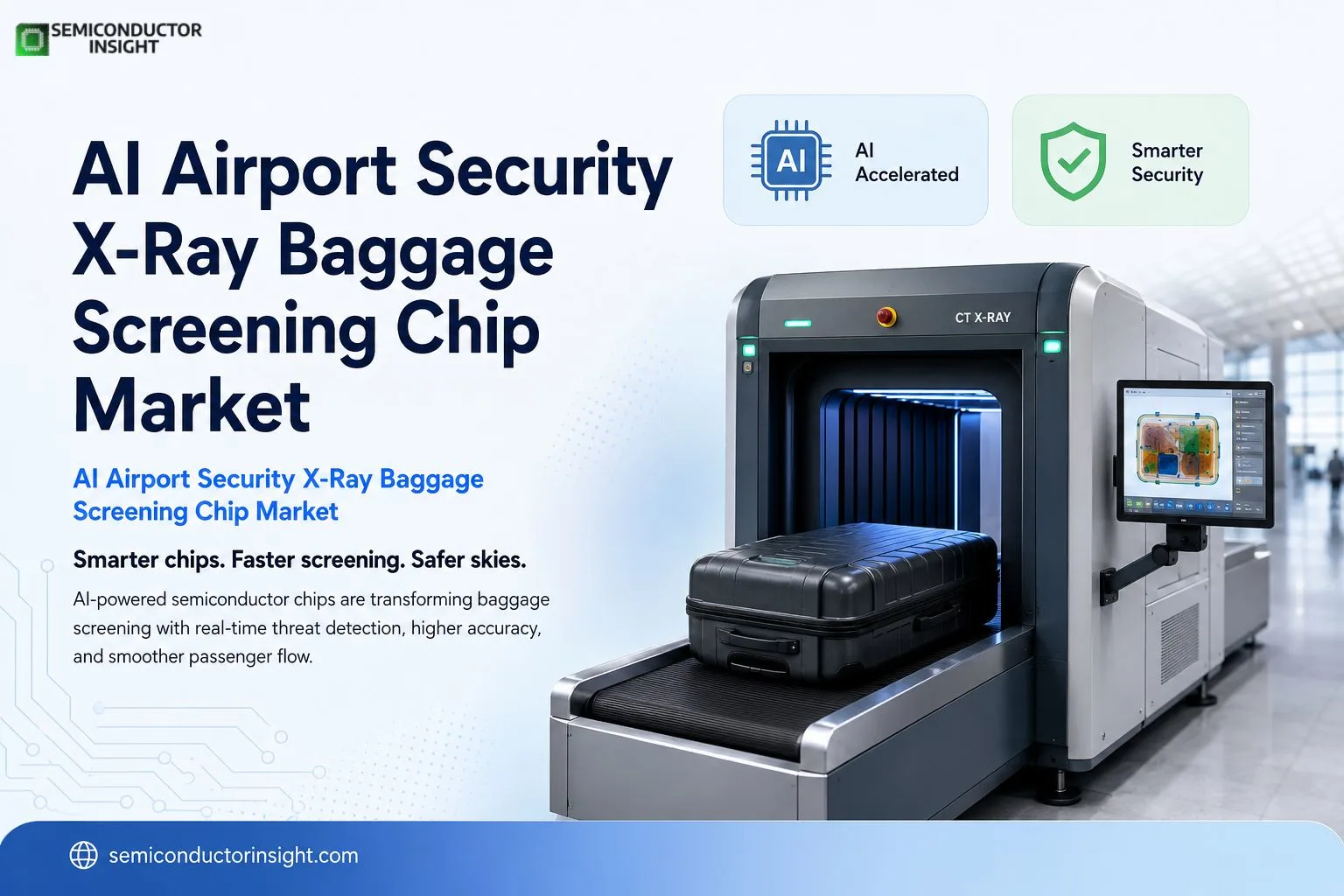
Top AI Chip Innovations Transforming AI Airport Security X-Ray Baggage Screening Chip Market
Airport security has quietly become one of the fastest adopters of artificial intelligence hardware. Behind every modern baggage scanner sits a sophisticated semiconductor platform capable of processing enormous volumes of X-ray image data within fractions of a second. AI Airport Security X-Ray Baggage Screening Chip Market is evolving beyond conventional image processing toward intelligent edge computing, where dedicated AI accelerators classify prohibited items, identify hidden threats, and assist human operators without slowing passenger movement.
The shift is being driven by growing passenger traffic, increasingly complex baggage contents, and the need for faster screening without compromising safety. Semiconductor manufacturers are now developing specialized AI inference chips that combine low latency, high computing efficiency, and energy optimization specifically for security imaging equipment.
Aviation Growth Is Increasing the Need for Faster Intelligent Screening
Global airports are preparing for unprecedented passenger volumes over the coming decade. According to the International Air Transport Association (IATA), worldwide passenger traffic is expected to exceed 5.2 billion travelers during 2025, creating enormous pressure on airport screening infrastructure.
Every year airports process billions of checked and cabin baggage items, requiring inspection systems capable of continuous operation around the clock. Conventional image analysis often depends heavily on operator interpretation, whereas AI-enabled semiconductor chips perform object recognition almost instantly before forwarding suspicious cases for human review.
This combination significantly improves inspection throughput while reducing repetitive workloads for security personnel.
Why Semiconductor Architecture Has Become the Hidden Hero?
Unlike general-purpose processors, AI baggage screening chips are designed specifically for high-speed inference. They integrate multiple computing engines capable of simultaneously processing dual-view or computed tomography (CT) scan images.
Modern screening chipsets typically include
- Neural Processing Units optimized for object detection
- High-bandwidth memory controllers for rapid image movement
- Integrated image signal processors
- Hardware encryption for secure airport networks
- Low-power architectures enabling continuous operation
These semiconductor innovations allow scanners to detect weapons, explosives, lithium batteries, and other prohibited objects with significantly greater consistency than earlier generations of equipment.
AI Models Are Learning From Millions of Security Images
ü One of the biggest transformations is the quality of training data now available for AI screening systems.
ü Large security datasets containing millions of annotated X-ray images enable deep learning models to distinguish overlapping objects that previously required manual inspection. Instead of recognizing only object shapes, AI chips evaluate density distribution, material characteristics, and contextual placement inside luggage.
ü Recent research published through aviation security organizations demonstrates that deep neural networks continue improving detection accuracy as additional operational image libraries become available.
ü This continuous learning capability is creating smarter screening platforms without requiring complete hardware replacement.
Real Airports Are Already Expanding AI Powered Screening
The transition from laboratory demonstrations to commercial deployment is accelerating worldwide.
The Transportation Security Administration in the United States continues deploying advanced CT baggage scanners equipped with AI-assisted threat detection across major airports. By early 2025, the agency had installed more than 900 CT checkpoint scanners, enhancing carry-on baggage inspection capabilities across its network.
Meanwhile, airports including London Heathrow, Amsterdam Schiphol, Singapore Changi, and several large Asian aviation hubs are expanding automated screening programs that combine computed tomography, AI software, and high-performance semiconductor processors to reduce passenger waiting times while improving threat identification.
These deployments illustrate how specialized chips have become central components of airport modernization strategies.
You Can Go Through Our Latest Updated Insights Here: https://semiconductorinsight.com/report/ai-airport-security-x-ray-baggage-screening-chip-market/
Tiny Chips Processing Massive Amounts of Data
A single modern CT baggage scanner can generate hundreds of image slices for one suitcase. Processing this information requires enormous computational capability.
Instead of sending every image to cloud servers, edge AI chips analyze data directly inside the scanner. This reduces latency to milliseconds while maintaining passenger privacy and minimizing network dependence.
High-performance inference processors can execute trillions of mathematical operations every second, allowing security equipment to maintain continuous inspection even during peak airport traffic periods.
As semiconductor fabrication nodes continue shrinking, future screening chips are expected to deliver higher performance without increasing power consumption.
Security Regulations Are Encouraging Smarter Semiconductor Designs
· Airport screening technology must comply with strict certification requirements before deployment.
· Organizations including the International Civil Aviation Organization (ICAO), the European Civil Aviation Conference (ECAC), and national aviation authorities continuously update security performance standards to address evolving threats.
· These regulations encourage semiconductor developers to build processors that support explainable AI, encrypted data handling, secure firmware updates, and long operational reliability.
· Hardware-level cybersecurity has become nearly as important as processing performance because airport screening equipment is increasingly connected to digital security ecosystems.
The Next Innovation Wave Goes Beyond Object Detection
Emerging semiconductor roadmaps are moving beyond identifying prohibited objects. Future AI chips are expected to combine multimodal sensor fusion, anomaly detection, and predictive diagnostics within a single processor.
Researchers are exploring chips capable of integrating X-ray imaging with spectroscopy, millimeter-wave sensing, and advanced material classification. Such platforms could identify suspicious substances more accurately while automatically monitoring scanner health, reducing maintenance downtime for airport operators.
As airports continue investing in intelligent infrastructure, semiconductor innovation will remain the computing backbone that enables safer, faster, and more automated baggage inspection across the global aviation ecosystem.

Comments (0)