
MARKET INSIGHTS
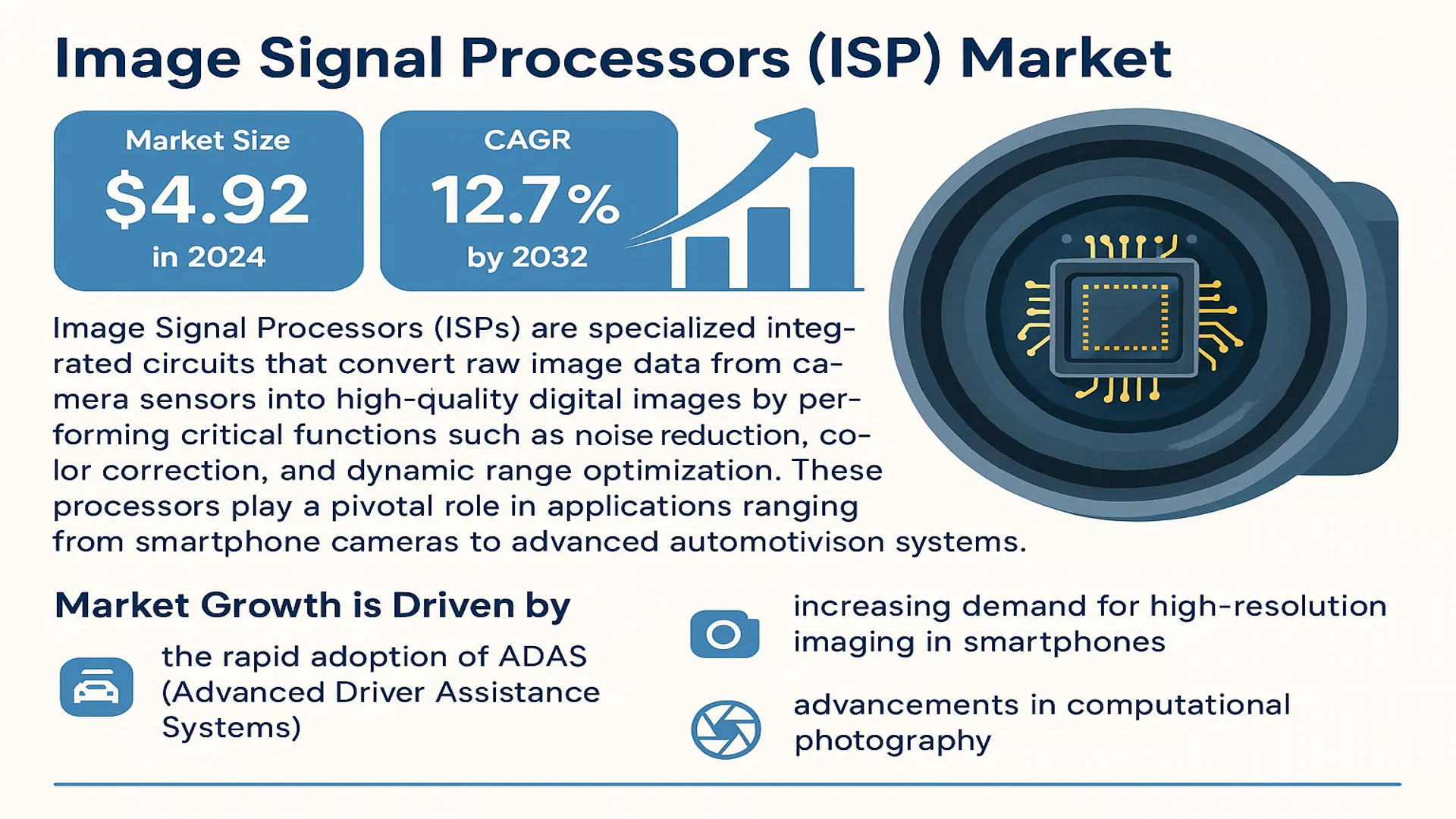
The global Image Signal Processors (ISP) Market size was valued at US$ 4.92 billion in 2024 and is projected to reach US$ 11.38 billion by 2032, at a CAGR of 12.7% during the forecast period 2025-2032.
Image Signal Processors (ISPs) are specialized integrated circuits that convert raw image data from camera sensors into high-quality digital images by performing critical functions such as noise reduction, color correction, and dynamic range optimization. These processors play a pivotal role in applications ranging from smartphone cameras to advanced automotive vision systems.
The market growth is driven by increasing demand for high-resolution imaging in smartphones, the rapid adoption of ADAS (Advanced Driver Assistance Systems), and advancements in computational photography. While North America currently dominates the market, Asia-Pacific is expected to witness the fastest growth due to expanding electronics manufacturing and rising consumer demand. Key players like Sony, Samsung, and Qualcomm continue to invest in next-generation ISP technologies to enhance AI-driven imaging capabilities.
MARKET DYNAMICS
MARKET DRIVERS
Rising Demand for High-Resolution Imaging in Consumer Electronics to Fuel ISP Market Growth
The global proliferation of smartphones with advanced camera systems continues to be a dominant driver for Image Signal Processors. With over 1.5 billion smartphones shipped annually, manufacturers are incorporating increasingly sophisticated multi-camera setups, requiring powerful ISPs for image enhancement. The flagship smartphones now commonly feature 50MP+ primary sensors, computational photography capabilities, and AI-powered image processing – all of which depend heavily on advanced ISPs. This technological arms race among smartphone OEMs has created sustained demand for increasingly capable image processing solutions.
Automotive Sector Adoption of ADAS Systems Creating New Growth Avenues
The automotive industry’s rapid adoption of Advanced Driver Assistance Systems (ADAS) represents a significant growth opportunity for ISP manufacturers. Modern vehicles now incorporate between 6-12 cameras for applications ranging from surround-view systems to driver monitoring. These systems require specialized ISPs capable of performing in challenging lighting conditions while meeting stringent automotive reliability standards. With autonomous vehicle development accelerating, the demand for high-performance, low-latency image processing solutions is expected to maintain steady growth through the decade.
Expansion of AI-Powered Surveillance Infrastructure Driving Market Growth
Global investments in smart city infrastructure and intelligent surveillance systems are creating robust demand for specialized ISPs optimized for security applications. These processors must enable real-time video analytics, facial recognition, and object detection while operating in diverse environmental conditions. The transition to 4K and higher resolution surveillance cameras, coupled with edge-based AI processing requirements, has necessitated the development of more sophisticated ISP solutions tailored specifically for security applications.
MARKET RESTRAINTS
Increasing Design Complexity and Power Consumption Challenges Market Growth
As imaging requirements become more demanding across applications, ISPs must accommodate higher resolution sensors, more advanced algorithms, and real-time processing needs. This escalating complexity leads to significant power consumption increases – a critical constraint for battery-powered devices. Processor designs must balance performance with thermal management considerations, often requiring trade-offs that limit functionality. These technical constraints represent ongoing challenges for ISP manufacturers seeking to push the boundaries of image processing capabilities.
Stringent Certification Requirements in Automotive and Industrial Sectors
The automotive and industrial sectors impose rigorous certification standards that can significantly extend development timelines and increase costs for ISP manufacturers. These markets require components that meet exacting reliability, temperature tolerance, and longevity specifications. The qualification process for new ISP designs can take 12-18 months, creating a substantial barrier to entry and slowing the pace of innovation. Additionally, the need for specialized manufacturing processes to meet these standards contributes to higher production costs that may be prohibitive for some suppliers.
MARKET OPPORTUNITIES
Emerging Applications in AR/VR and Metaverse Ecosystems Present New Growth Potential
The rapid development of augmented reality and virtual reality technologies creates significant opportunities for advanced ISP solutions. These applications demand ultra-low latency image processing with exceptional power efficiency to enable seamless mixed reality experiences. As the metaverse concept evolves, the need for real-time 3D reconstruction and photorealistic rendering will drive innovation in specialized image processing architectures. Early movers in developing ISP solutions optimized for these emerging use cases stand to gain substantial market share as these technologies mature.
Medical Imaging and Diagnostic Applications Offer Untapped Potential
The healthcare sector presents growing opportunities for specialized ISPs in medical imaging equipment and portable diagnostic devices. Advancements in endoscopic imaging, digital pathology, and point-of-care diagnostics require increasingly sophisticated image processing capabilities. These medical applications necessitate high-fidelity color reproduction, noise reduction, and enhanced contrast capabilities – all areas where custom ISP solutions can provide significant value. The trend toward AI-assisted diagnostics further amplifies the need for processors capable of running complex algorithms while meeting stringent medical device regulations.
MARKET CHALLENGES
Intense Competition and Pricing Pressure from Established Players
The ISP market features intense competition among established semiconductor companies and emerging challengers, creating significant pricing pressure. Market leaders leverage their economies of scale and vertically integrated manufacturing to maintain cost advantages, making it difficult for smaller players to compete on price. This competitive landscape forces manufacturers to continually invest in R&D to differentiate their offerings, creating a high barrier for new entrants. Additionally, the prevalence of integrated solutions (combining ISP functionality with other processors) in many applications poses challenges for standalone ISP vendors.
Shortage of Specialized Engineering Talent Constrains Innovation
The development of advanced ISP solutions requires highly specialized engineering expertise in fields including semiconductor design, image processing algorithms, and machine learning. There is currently a global shortage of engineers with the required cross-disciplinary skills, making it challenging for companies to scale their development efforts. This talent gap is exacerbated by the concentrated nature of the industry, with many qualified professionals working for entrenched market leaders. The inability to attract and retain top talent presents a significant challenge for companies seeking to innovate and expand their market presence.
IMAGE SIGNAL PROCESSORS (ISP) MARKET TRENDS
AI Integration Revolutionizes Image Signal Processing
The integration of Artificial Intelligence (AI) and Machine Learning (ML) into Image Signal Processors (ISPs) has emerged as a transformative trend, enhancing real-time image processing capabilities in applications such as smartphones, automotive cameras, and surveillance systems. AI-powered ISPs enable adaptive noise reduction, advanced dynamic range enhancement, and superior low-light performance—features that are increasingly critical for consumer and industrial applications. The demand for computational photography in smartphones, driven by brands integrating multi-camera setups with AI-driven image fusion techniques, accounts for over 40% of the global ISP revenue in the consumer electronics segment. Furthermore, automakers are leveraging AI-enhanced ISPs for autonomous vehicles, where real-time object detection and scene analysis are paramount.
Other Trends
Automotive Sector Fuels Demand for High-Performance ISPs
The rapid expansion of Advanced Driver-Assistance Systems (ADAS) and autonomous driving technologies has significantly increased the adoption of high-resolution, low-latency ISPs. Modern vehicles integrate multiple cameras for 360-degree views, pedestrian detection, and lane-keeping assistance—all requiring efficient image processing. The automotive ISP market is projected to grow at a CAGR of over 15% through 2032, driven by regulatory mandates for vehicle safety and increasing consumer demand for smart features. Meanwhile, innovations such as HDR (High Dynamic Range) processing and multi-exposure fusion further enhance visibility in challenging lighting conditions, making ISPs indispensable in next-gen vehicular systems.
Edge Computing Redefines ISP Applications
The shift toward edge computing is reshaping the ISP market, as real-time processing directly on devices reduces latency and bandwidth constraints. ISPs now incorporate dedicated neural processing units (NPUs) to enable on-device AI tasks, such as facial recognition in security cameras and augmented reality (AR) filters in mobile devices. This trend is particularly prominent in the security and surveillance sector, where 4K and 8K camera systems rely on edge-based ISPs for instantaneous analytics. Additionally, the rise of IoT-enabled smart devices demands power-efficient ISPs with miniaturized footprints, pushing manufacturers to develop system-on-chip (SoC) solutions integrating ISP and AI acceleration cores.
COMPETITIVE LANDSCAPE
Key Industry Players
Innovation and Strategic Alliances Define Market Competition
The global Image Signal Processor (ISP) market features a dynamic competitive ecosystem with leading semiconductor companies and specialized chip designers vying for dominance. STMicroelectronics and ON Semiconductor currently lead the market, collectively holding nearly 25% of the global revenue share in 2024. Their success stems from comprehensive ISP solutions that cater to both high-performance and cost-sensitive applications across automotive and consumer electronics sectors.
While established players maintain strong positions, emerging competitors like VeriSilicon and THine Electronics are gaining traction through specialized offerings. These companies focus on AI-powered image processing and low-power designs that appeal to smartphone manufacturers and IoT device makers. Their growth reflects the increasing demand for energy-efficient processing in battery-operated devices.
Market leaders have responded to these challenges through strategic acquisitions and R&D investments. Samsung Electronics recently expanded its ISP capabilities through partnerships with camera module manufacturers, while Qualcomm integrated advanced ISP functionality directly into its mobile processors. Such moves demonstrate how companies are adapting to the industry’s shift toward more integrated solutions.
List of Key Image Signal Processor Manufacturers
- STMicroelectronics (Switzerland)
- ON Semiconductor (U.S.)
- Arm Limited (U.K.)
- Socionext (Japan)
- Renesas Electronics (Japan)
- OmniVision Technologies (U.S.)
- Fujitsu (Japan)
- Samsung Electronics (South Korea)
- VeriSilicon (China)
- THine Electronics (Japan)
- NXP Semiconductors (Netherlands)
- Qualcomm (U.S.)
Segment Analysis:
By Type
Up to 10 MP Segment Holds Significant Market Share Due to Widespread Adoption in Mobile and Compact Devices
The market is segmented based on type into:
- Up to 10 MP
- Subtypes: Entry-level mobile processors, Embedded camera processors
- Greater than 10 MP
- Subtypes: High-resolution camera processors, Premium smartphone ISPs
By Application
Consumer Electronics Segment Leads the Market Owing to High Demand in Smartphones and Cameras
The market is segmented based on application into:
- Automotive
- Consumer Electronics
- Subtypes: Smartphones, Digital cameras, Tablets
- Security and Monitoring
- Subtypes: CCTV systems, Industrial inspection
- Other
By Architecture
Integrated ISPs Gain Traction Due to Space and Power Efficiency
The market is segmented based on architecture into:
- Discrete ISPs
- Integrated ISPs
- Subtypes: System-on-Chip (SoC) integrated, Application processor integrated
By Processing Level
Advanced Processing Segment Expands with Growing Demand for AI-based Image Enhancement
The market is segmented based on processing level into:
- Basic image processing
- Advanced image processing
- Subtypes: AI-based processing, Computational photography
Regional Analysis: Image Signal Processors (ISP) Market
Asia-Pacific
The Asia-Pacific region dominates the global ISP market, driven by the thriving semiconductor industry and rapid advancements in smartphone camera technologies. China, South Korea, and Japan collectively account for over 60% of the regional market share, with Chinese manufacturers like OmniVision Technologies and Huawei accelerating demand for high-resolution ISPs. The widespread adoption of AI-powered computational photography in consumer electronics and the aggressive expansion of smart city initiatives with extensive surveillance requirements further propel market growth. However, geopolitical tensions and semiconductor supply chain vulnerabilities present notable challenges despite the region’s technological momentum.
North America
North America remains a critical hub for ISP innovation, led by the U.S., where major players such as Qualcomm and ON Semiconductor develop cutting-edge solutions for autonomous vehicles, AR/VR, and advanced surveillance systems. The region benefits from strong R&D investments and collaborations between tech giants and academic institutions. The automotive sector, in particular, is fueling demand for high-performance ISPs, supported by increasing regulatory mandates for ADAS (Advanced Driver-Assistance Systems). However, high manufacturing costs and intellectual property disputes occasionally slow down the pace of commercialization.
Europe
Europe’s ISP market thrives on stringent quality standards and a robust automotive industry, where German and French manufacturers integrate ISPs for enhanced vehicle safety and automation. STMicroelectronics and NXP Semiconductors lead in providing energy-efficient processors compliant with EU regulations. The region also sees growing applications in industrial imaging and medical devices, though slower smartphone market growth compared to Asia tempers overall expansion. Emphasis on data privacy (e.g., GDPR) influences the development of secure ISP architectures for edge computing applications.
South America
In South America, escalating demand for affordable smartphones and security cameras drives gradual ISP market growth, particularly in Brazil and Argentina. Limited local semiconductor fabrication capabilities lead to heavy reliance on imports, which inflates costs and delays adoption of advanced technologies. Localized partnerships with global suppliers and government incentives for tech startups aim to bridge this gap, though economic instability remains a persistent barrier to large-scale investments in ISP-related infrastructure.
Middle East & Africa
This emerging market shows potential, with the UAE and Saudi Arabia investing in smart city projects that rely on high-quality imaging for security and traffic management. Mobile device penetration is rising, but budget constraints limit the uptake of premium ISP-equipped gadgets. The lack of domestic manufacturing compels reliance on imported components, though regional collaborations with Asian and European suppliers are fostering gradual market development. Long-term growth hinges on improved digital infrastructure and localized tech ecosystems.
Report Scope
This market research report provides a comprehensive analysis of the global and regional Image Signal Processors (ISP) markets, covering the forecast period 2024–2032. It offers detailed insights into market dynamics, technological advancements, competitive landscape, and key trends shaping the industry.
Key focus areas of the report include:
- Market Size & Forecast: Historical data and future projections for revenue, unit shipments, and market value across major regions and segments. The Global ISP market was valued at US$ 4.92 billion in 2024 and is projected to reach US$ 11.38 billion by 2032.
- Segmentation Analysis: Detailed breakdown by product type (Up to 10 MP and Greater than 10 MP), application (Automotive, Consumer Electronics, Security & Monitoring, and Others), and end-user industry to identify high-growth segments and investment opportunities.
- Regional Outlook: Insights into market performance across North America, Europe, Asia-Pacific, Latin America, and the Middle East & Africa, including country-level analysis where relevant. The U.S. market is estimated at USD million in 2024, while China is projected to reach USD million.
- Competitive Landscape: Profiles of leading market participants, including STMicroelectronics, ON Semiconductor, Arm, Socionext, Renesas Electronics, OmniVision Technologies, and others, covering their product offerings, R&D focus, and recent developments.
- Technology Trends & Innovation: Assessment of emerging technologies, including AI integration, advanced image processing algorithms, and semiconductor design trends.
- Market Drivers & Restraints: Evaluation of factors driving market growth along with challenges, supply chain constraints, and regulatory issues.
- Stakeholder Analysis: Insights for component suppliers, OEMs, system integrators, investors, and policymakers regarding the evolving ecosystem and strategic opportunities.
Primary and secondary research methods are employed, including interviews with industry experts, data from verified sources, and real-time market intelligence to ensure the accuracy and reliability of the insights presented.
FREQUENTLY ASKED QUESTIONS:
What is the current market size of Global Image Signal Processors (ISP) Market?
->Image Signal Processors (ISP) Market size was valued at US$ 4.92 billion in 2024 and is projected to reach US$ 11.38 billion by 2032, at a CAGR of 12.7% during the forecast period 2025-2032.
Which key companies operate in Global Image Signal Processors (ISP) Market?
-> Key players include STMicroelectronics, ON Semiconductor, Arm, Socionext, Renesas Electronics, OmniVision Technologies, Fujitsu, Samsung Electronics, VeriSilicon, THine Electronics, NXP Semiconductors, and Qualcomm.
What are the key growth drivers?
-> Key growth drivers include rising demand for high-quality imaging in smartphones, automotive cameras, and security systems, along with advancements in AI-based image processing.
Which region dominates the market?
-> Asia-Pacific is the fastest-growing region, driven by strong semiconductor manufacturing in China, Japan, and South Korea, while North America remains a technological leader.
What are the emerging trends?
-> Emerging trends include integration of AI/ML in ISPs, demand for high-resolution imaging, and increasing applications in autonomous vehicles and AR/VR devices.

Get Sample Report PDF for Exclusive Insights
Report Sample Includes
- Table of Contents
- List of Tables & Figures
- Charts, Research Methodology, and more...
 Download Sample Report PDF


